

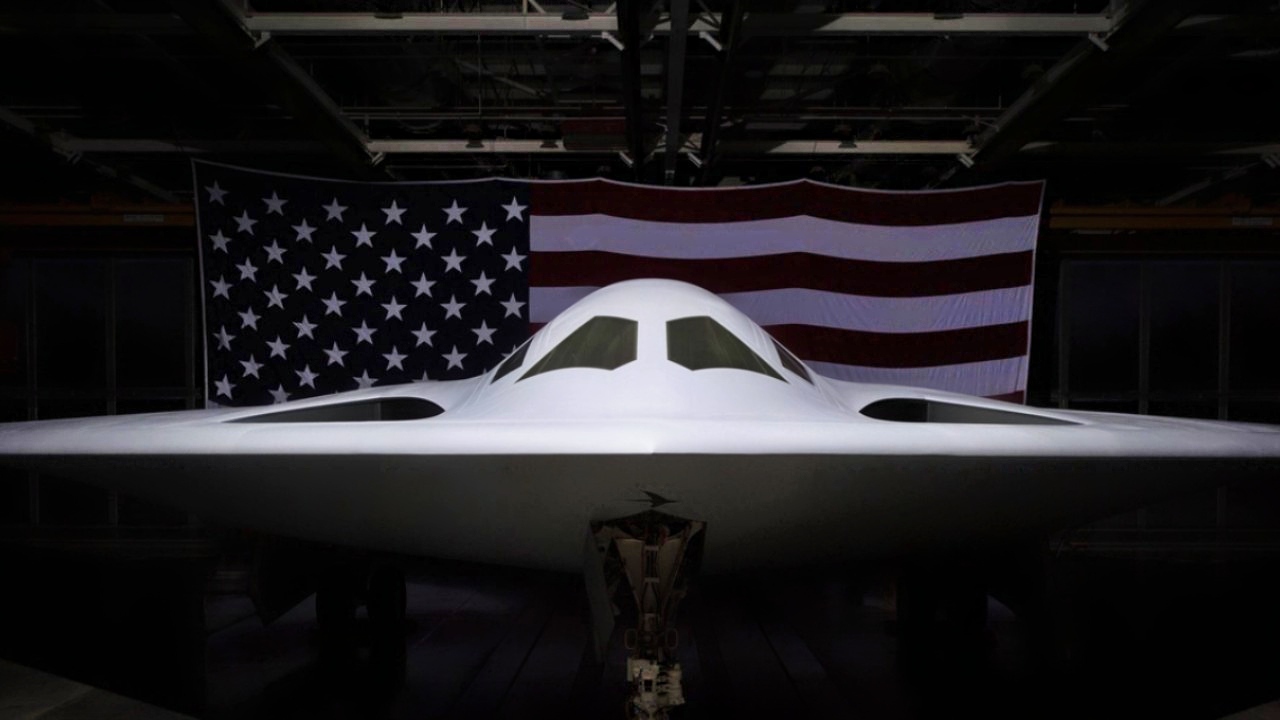
Key Points and Summary on the B-21 Raider – The US Air Force is accelerating its B-21 Raider program, with at least two test aircraft expected to be flying by 2026 and capable of being rapidly configured for combat missions if required.
-This potential for early deployment comes as the US weighs the possibility of future strikes on Iran’s nuclear facilities.
-While the B-21 is designed as a more advanced and stealthy successor to the B-2 Spirit, questions remain about its payload capacity, specifically whether it can carry the 30,000-pound “bunker buster” bombs used in the recent “Operation Midnight Hammer.”
B-21 Raider Could Be in Combat Soon (Maybe Attacking) Iran?
When the Northrop (now Northrop Grumman) B-2 “Spirit”—the original “Stealth Bomber”—first arrived on-scene on January 17, 1989, it was pooh-poohed by critics in Congress and the mainstream media alike as an overpriced boondoggle.
To be sure, the B-2 certainly is expensive, commanding a price of $2.1 billion in 2025 dollars.
But the plane has repeatedly proven, via the litmus test of real-world combat, that it’s more than worth the price tag, delivering plenty of proverbial “bang for the buck” in terms of its ability to strike targets and bring its pilots back home safely and accurately.
This value was first demonstrated during Operation Allied Force in the skies over Kosovo in 1999, followed by the Global War On Terror (GWOT) in Iraq and Afghanistan, the 2024 bombing campaign against the Houthi terrorist group in Yemen, and most recently and dramatically, Operation Midnight Hammer (the devastating US air strikes against three Iranian nuclear facilities).
Now, Northrop Grumman has built the 6th Generation direct successor to (and near-spitting image of, in terms of physical appearance) the Spirit, that being the B-21 Raider.
This similarity raises the question: will the B-21 soon follow in its immediate ancestor’s footsteps into combat, and perhaps against Iran for good measure?
Bottom Line Up Front (BLUF)
Aviation journalist John A. Tirpak of Air and Space Forces Magazine (the official publication of the Air & Space Forces Association [AFA]) is at least hinting at the possibility of the Raider entering into combat sooner rather than later.
As he states in the opening paragraph of his July 14 2025 article titled “Air Force: Test B-21s Could Fly Combat Missions, Northrop Can Expand Production at Plant 42”: “A production expansion of the Air Force’s next-generation bomber, the B-21 Raider, which is planned in the service’s fiscal 2026 budget, could be accommodated largely within aircraft manufacturer Northrop Grumman’s existing Palmdale, Calif., plant, according to the Air Force. The service also stated that at least two of the bombers will be operational by 2026. While used for testing, **they can be quickly configured for combat operations if necessary**.” [emphasis added]
If those Raiders are indeed ready for combat next year, that would be a remarkable turnaround, considering that the B-21 barely made its maiden flight on November 10, 2023.
B-21 and Iran: Geopolitical Necessities?
This conceivable 2026 timeframe for the B-21s being ready for combat would undoubtedly be quite convenient if International Atomic Energy Agency (IAEA) chief Rafael Grossi turns out to be correct in his assessment that the B-2 strikes on Fordow, Isfahan, and Natanz merely set back Iran’s uranium enrichment program by only “a matter of months.”
This is a decidedly pessimistic contrast to US President Donald Trump’s assertion that “completely and totally obliterated” Tehran’s nuclear program.
But then, when asked by a reporter (during the NATO summit in the Netherlands on June 25) whether he would strike Iran again if it were to rebuild its nuclear facilities, Mr. Trump bluntly replied, “Sure.” Meanwhile, Iran’s ambassador to the United Nations, Amir-Saeid Iravani, said that his country’s uranium enrichment will “never stop” because Iran has an “inalienable right” to do so for “peaceful nuclear activity.”
So then, if a renewed round of US airstrikes against Iran’s nuke facilities does become necessary down the road, that leads us to a question…
Is the B-21 Physically Up to the Task?
Granted, this is primarily speculative educated guesswork in light of the still-secretive nature of the B-21 program, but for what it’s worth, in an October 11 2023 article, Bill Sweetman of Aviation Week Network estimated that the weapons payload capacity of the B-21 at 20,000 lbs. (9,071 kg), which is less than half of the 40,000-pound bomb load (18,143 kilograms) of the B-2.
If Mr. Sweetman’s estimates are accurate, that would cast serious doubt upon the newer warbird’s ability to carry the 30,000-lb. (14,000 kg) GBU-57 Massive Ordnance Penetrator (MOP) bomb immortalized by its usage in the Midnight Hammer strikes.
Other reports have the B-21 Raider being able to carry one GBU-57, however, nothing is specific at this point.
That said, even a 20,000-pound capacity would still give the B-21 the ability to strike targets—nuclear and non-nuclear alike—that aren’t buried as deeply underground as the Fordow facility is.
And, in a hypothetical worst-case scenario, if the US were to “fight fire with fire” by using its nuclear capabilities to ensure the destruction of Iran’s nuke program, then the B-21 would indeed be up to that grim task, as it’s reportedly able to carry the B61 thermonuclear gravity bomb.
Let’s pray to god that never happens.
About the Author: Christian D. Orr, Defense Expert
Christian D. Orr is a Senior Defense Editor. He is a former Air Force Security Forces officer, Federal law enforcement officer, and private military contractor (with assignments worked in Iraq, the United Arab Emirates, Kosovo, Japan, Germany, and the Pentagon). Chris holds a B.A. in International Relations from the University of Southern California (USC) and an M.A. in Intelligence Studies (concentration in Terrorism Studies) from American Military University (AMU).
Military Matters


