


Key Points and Summary – Britain’s Queen Elizabeth-class carriers are suddenly busy again, leading NATO drills and sailing from the Arctic to the Indo-Pacific.
-Their revival masks a deeper problem: the UK’s real security priorities lie in the North Atlantic, Arctic and GIUK Gap, where submarines, P-8 patrol aircraft and undersea surveillance matter more than big decks.

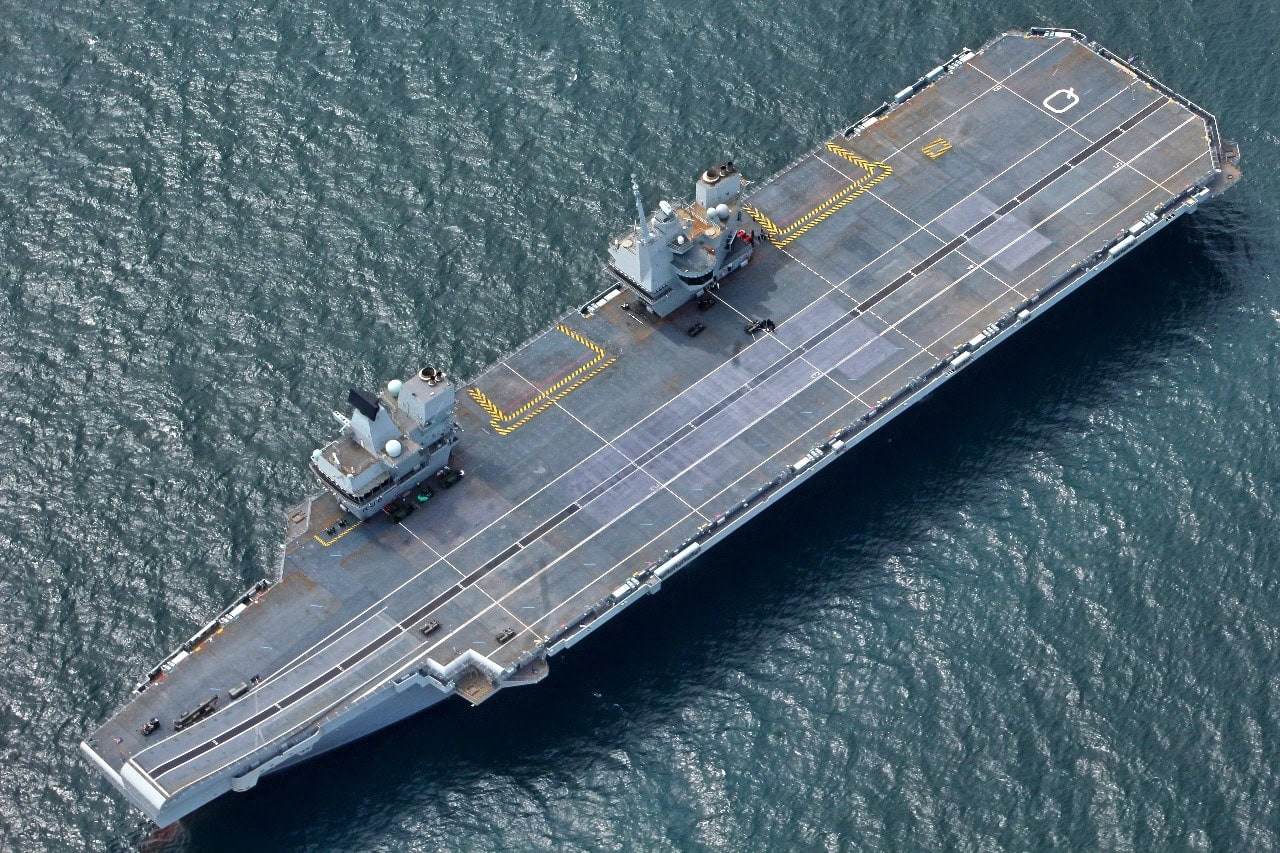
HMS Prince of Wales Royal Navy (Queen Elizabeth-Class Aircraft Carrier). Image Credit: Royal Navy.
-With limited budgets, escorts and munitions, a carrier strike group risks becoming a prestige project that crowds out critical investments—useful for coalition signalling, but increasingly misaligned with Britain’s geography, resources, identity and long-term defence needs.
Queen Elizabeth-Class vs Reality: Why Britain’s Threats Aren’t on Her Flight Deck
The Royal Navy’s Queen Elizabeth-class carriers were written off not long ago as symbols of strategic confusion: too large for a modest middle power, too dependent on American F-35Bs to generate sorties at scale, and too vulnerable in an age of hypersonics, drones, and precision strike.
Yet something curious has happened over the past year.
HMS Queen Elizabeth and HMS Prince of Wales are suddenly busy again—leading NATO exercises, spearheading air-maritime integration drills, operating more consistently with U.S. and European partners, and even signalling across the Arctic-North Atlantic seam where Russia’s bastion strategy continues to evolve. Their growing visibility invites a more fundamental question: revived or not, are Britain’s supercarriers actually essential to British strategy in 2025?
Well, what looks like a comeback deserves closer scrutiny.
Carrier Power in a Harsh New Strategic Environment
The carriers’ return to relevance is happening at a moment when the maritime battlespace has tilted against expensive surface assets. The combination of long-range fires, stealthy submarines, maritime drones, and AI-enabled targeting shrinks the oceans faster than budget committees.
For all the Royal Navy’s professionalism, its carrier strike group is not immune to these pressures.
Yet Britain operates in a geopolitical reality shaped by geography, alliance politics, and declining national capacity. The North Atlantic—Britain’s primary strategic theater—does not demand a carrier presence the way the Indo-Pacific does. The job of deterring Russia in the GIUK Gap is about submarines, ASW aircraft, seabed protection, and securing the Arctic approaches, not about launching F-35Bs against Murmansk.
Much of Britain’s core security work rests not on carrier decks but on undersea vigilance and integrated air-maritime defence. This is why the carriers have always sat uneasily in British strategy.
They point east of Suez while Britain’s interests point north.
Prestige and Power Projection: The Lure That Never Dies
Still, the impulse to retain a global carrier capability runs deep. The ships provide a kind of strategic theatre, allowing Britain to act as a convening power in coalitions, a leader in NATO task groups, and an ally capable of showing up where Washington wants a European flag present.
The Royal Navy has used the QE-class to anchor deployments to the Mediterranean, the High North, and even the Indo-Pacific. In each case, the carriers served as diplomatic platforms as much as military ones. They signal commitment, resolve, and reach.
They give London a seat at the table in a way a frigate never could. But prestige is not strategy. The question is whether these deployments meaningfully advance the national interest or simply sustain a post-imperial image of Britain as a global player. In an era of hard choices, a state cannot afford to confuse symbolism with necessity.
Britain’s True Strategic Priorities Lie Closer to Home
The map is not ambiguous. Britain’s security is anchored in the North Atlantic, the Arctic, and the northern flank of NATO. These are the spaces that matter for maintaining nuclear deterrence, protecting critical infrastructure, managing grey-zone competition, and supporting U.S. and Canadian forces across the Northern Approaches. The QE-class carriers contribute little to this continental-maritime architecture.
A single P-8A patrol aircraft, a Type 26 frigate, or a well-placed undersea sensor array does more work for actual defence than a carrier strike group sailing out of Portsmouth. Britain’s relevance in the alliance rests on capabilities that are persistent, survivable, and tailored to the threat—not on platforms designed for expeditionary wars that Britain will never fight alone. This is the hard reality of a constrained-resource power confronting a resurgent Russia and a rapidly changing maritime domain.
The carriers absorb resources, personnel, and political focus that could be applied to frigate production, undersea warfare, missile stockpiles, and Arctic-ready patrol forces.
Where the Carriers Do Add Value—But At What Cost?
None of this means the carriers are useless. They provide airpower at sea when land basing is contested. They allow NATO to disperse air assets and complicate an adversary’s targeting picture. They strengthen interoperability with the United States, especially the Marine Corps, which continues to experiment with F-35B distributed operations.
Queen Elizabeth-Class. Image Credit: Creative Commons.

HMS Prince of Wales and HMS Queen Elizabeth pictured at sea for the first time. Image Credit: Royal Navy.
In the grey space of coalition deterrence, the carriers can punch above their weight—if they are properly protected, consistently available, and integrated into broader NATO planning.
But that “if” is doing a great deal of work. Britain has chronically under-resourced escort ships, munitions stockpiles, and replenishment capacity.
A carrier strike group without adequate escorts is not a strategy; it is a liability. A carrier without a robust air wing is not a deterrent; it is a target. The QE-class only makes sense if the rest of the force is scaled to match it, and that is where British politics has repeatedly failed.
Queen-Elizabeth-Class In 1 Word: Mistake?
The debate over the QE-class comes down to a collision between identity and strategy. Does Britain cling to the idea of being a global maritime power with worldwide reach, or does it accept the geographic reality that its primary role is as a Northern Approaches power—an anchor of North Atlantic defence, an Arctic stakeholder, and a key state in the defence of the Euro-Atlantic homeland? The carriers are most compelling for a Britain that still imagines itself in the Indo-Pacific.

ATLANTIC OCEAN (Aug. 8, 2017) The Royal Navy aircraft carrier HMS Queen Elizabeth II sails in formation alongside the Nimitz-class aircraft carrier USS George H.W. Bush (CVN 77) during exercise Saxon Warrior 2017, Aug. 8. Saxon Warrior is a United States and United Kingdom co-hosted carrier strike group exercise that demonstrates interoperability and capability to respond to crises and deter potential threats. (U.S. Navy photo by Mass Communication Specialist 3rd Class Tristan B. Lotz/Released)
They make far less sense for a Britain that takes its own geography seriously. If Britain intends to double down on its North Atlantic role—a role that will only grow more important as Russia adapts and the Arctic opens—then the QE-class begins to look like a beautifully engineered distraction.
But if Britain still sees value in occasional global demonstrations of power and commitment, then the carriers remain useful, so long as the cost is understood and the limitations acknowledged. The path Britain chooses will reveal whether the carriers are an asset or an anchor.
For a nation wrestling with its post-Brexit identity and its shrinking military bandwidth, the answer to whether the carriers are “needed” will depend on whether Britain chooses to act like the global power it once was—or the northern-hemisphere power it actually is.
About the Author: Dr. Andrew Latham
Andrew Latham is a non-resident fellow at Defense Priorities and a professor of international relations and political theory at Macalester College in Saint Paul, MN. You can follow him on X: @aakatham. He writes a daily column for the National Security Journal.
More Military
The Mach 15 X-43D ‘Hypersonic Scramjet’ Has a Message for the U.S. Air Force
Europe’s Future Combat Air System (FCAS) Stealth Fighter Is ‘Circling the Drain’
The Mach 2 B-58 Hustler Bomber Has a Message for the U.S. Air Force


Rad
November 20, 2025 at 1:58 am
Not an accurate description. Only very few countries have aircraft careers and uk is one of them. All careers suffer from the same issues, not just the uk.
Mark UK
November 21, 2025 at 6:15 am
Well said indeed. I am increasingly concerned about constant pops by The National Interest against the UK . I cannot but think this is all linked to the current political debacle that besets the US. Anyone reading Trumps so called peace plan for Ukraine would realise the current US regime ( and not the very many fine US service men and women with whom I have had the privelige to serve) has nothing but total contempt for it’s allies. Against this background European members of NATO ( and yes last time I looked the US was a member of NATO too) must be able to deploy the full spectrum of military capability without dependence on the US , and yes this includes Carrier Strike
Mr Tony A Rosier
November 21, 2025 at 8:16 am
I feel that Britain has a duty to help any of our old commonwealth countries if they are threatened ! After all the contributed people and money towards the defence of the UK. Therefore it’s imperative that the UK retains a workable amphibious force capable of defending itself in the Pacific and away from major bases. With that in mind I feel we should be joining with France in the development of a new carrier with cats and traps that can operate future aircraft.
MR JAMES F HASLAM
November 24, 2025 at 8:24 am
Mistake, no. Rude, yes.