

The Royal Navy’s Aircraft Carriers Can’t Take on America But They are Powerful
In early March 2026, as U.S. and Israeli strike operations against Iran intensified, the British government moved to increase the readiness of its most powerful naval asset: the aircraft carrier HMS Prince of Wales. The Royal Navy reduced the ship’s notice-to-sail window to just five days, positioning it for a potential rapid deployment to the Middle East if required.
At the same time, Britain was already reinforcing its regional posture with destroyers, air defense systems, and RAF aircraft operating in Cyprus and Qatar. And as those moves were being made, U.S. President Donald Trump dismissed British aircraft carriers as “toys,” arguing that the United States did not need them and suggesting they were insignificant compared to American naval power.
The comment was obviously politically charged, and debates are ongoing over whether the president deliberately intended to dismiss the long-standing transatlantic special relationship, or whether he was effectively playing hardball as part of his years-long campaign to encourage the United Kingdom and Europe to bolster their own military capabilities.

HMS Prince of Wales and HMS Queen Elizabeth pictured at sea for the first time. Image Credit: Royal Navy.
What the UK Actually Operates At Sea
The Royal Navy currently operates two large fleet carriers: HMS Queen Elizabeth and HMS Prince of Wales. The ships form the core of Britain’s modern carrier strike capability and are the largest warships ever built for the UK. Each vessel displaces around 65,000–80,000 tonnes and is designed to operate the short take-off and vertical landing (STOVL) variant of the F-35B Lightning II.
That means British carriers use a ski-jump ramp instead of catapults, limiting them to aircraft capable of vertical or short takeoff. A typical deployed air wing consists of around 12-24 F-35Bs in peacetime, with capacity rising to roughly 36 in a high-intensity conflict.
Crucially, though, the carrier itself offers only one part of the capability. A British carrier strike group typically includes multiple escort vessels, including Type 45 destroyers for air defense, frigates for anti-submarine warfare, support ships, and a nuclear-powered attack submarine. In one sense, the absence of catapult launches limits the carrier’s air wing, but when equipped with the right aircraft, they are perfectly capable.

ATLANTIC OCEAN (Aug. 8, 2017) The Royal Navy aircraft carrier HMS Queen Elizabeth II sails in formation alongside the Nimitz-class aircraft carrier USS George H.W. Bush (CVN 77) during exercise Saxon Warrior 2017, Aug. 8. Saxon Warrior is a United States and United Kingdom co-hosted carrier strike group exercise that demonstrates interoperability and capability to respond to crises and deter potential threats. (U.S. Navy photo by Mass Communication Specialist 3rd Class Tristan B. Lotz/Released)
A Navy in Decline?
At its peak after the Second World War, the Royal Navy was one of the largest fleets in the world, operating multiple large fleet carriers and maintaining a global presence. That status eroded steadily during the Cold War and accelerated after it. The most significant break came in 2010, when the UK retired its last operational carrier capability following the withdrawal of the Harrier fleet and the decommissioning of the Invincible-class ships.
For nearly a decade, Britain had no fixed-wing carrier strike capability at all – the first such gap in almost a century.
The Queen Elizabeth-class program, approved in the late 2000s and entering service from 2017 onward, was therefore not an expansion of British naval power but an effort to restore lost capability. That distinction is important because the UK is no longer a naval superpower like the United States, but it still remains one of a very small number of countries capable of building and operating large aircraft carriers.
Availability and Readiness
The UK has two carriers, but neither is available at all times. Carrier operations are universally governed by maintenance cycles and training requirements. As a result, the Royal Navy’s model is built around maintaining availability for at least one carrier at any time. From a U.S. perspective, it looks like a weakness – but neighboring France, with just one carrier, is in a far worse position, even if it is nuclear-powered.
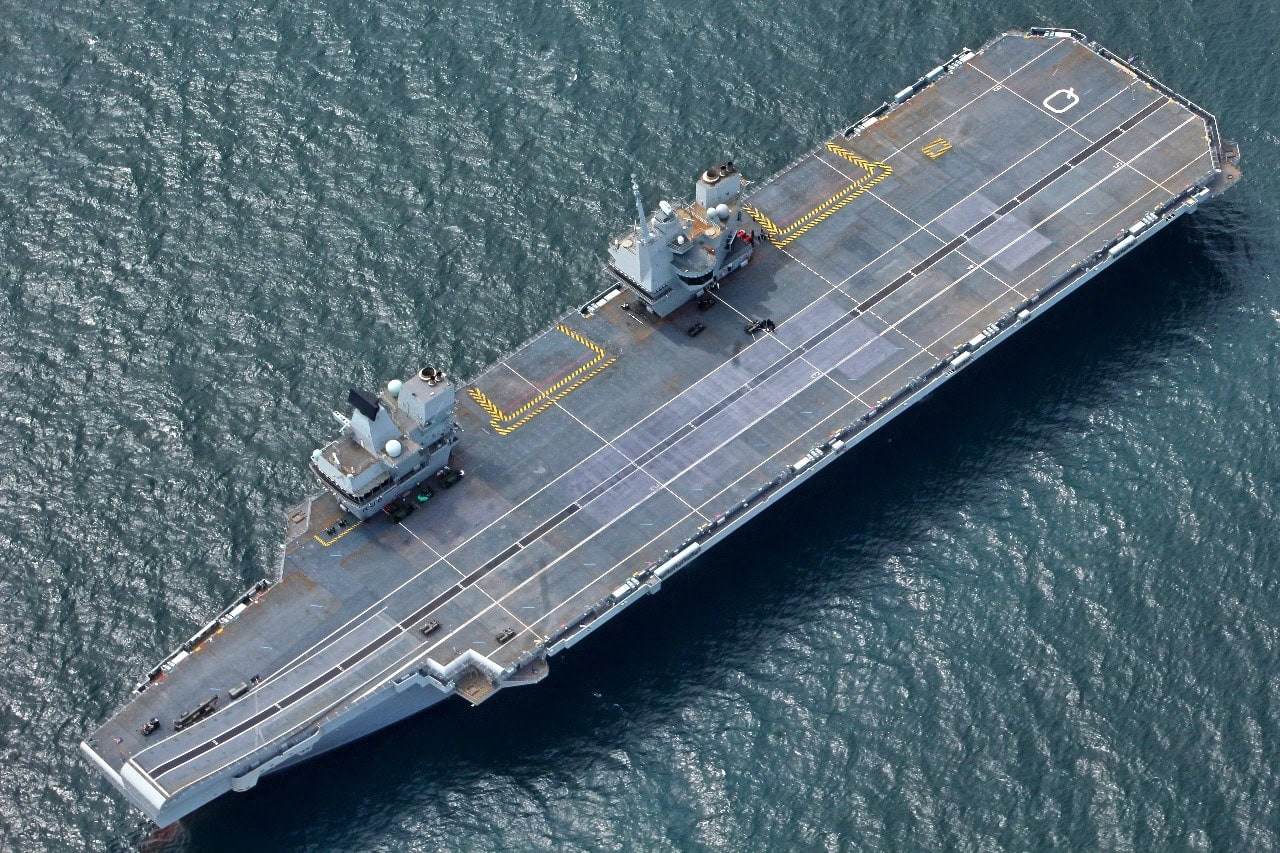
Queen Elizabeth-Class. Image Credit: Creative Commons.
Nonetheless, a fleet of just two aircraft carriers does present its own challenges, and recent events illustrate that quite clearly. While HMS Prince of Wales was placed on high readiness in March 2026, its sister ship, HMS Queen Elizabeth, was still experiencing maintenance delays and certification work.
Even when a carrier is available, generating a full strike group can be difficult. In recent weeks, reports have described a series of challenges the Royal Navy has faced in assembling sufficient escort ships. That is a problem that is not unique to the United Kingdom, however.
Even the United States, which operates 11 aircraft carriers, typically deploys only a fraction at any given time due to similar maintenance and training cycles. The real difference is simply scale; the U.S. can absorb gaps, but the U.K. cannot.
How Capable Are British Carriers?
The Queen Elizabeth-class carriers are by no means toys. They are designed around a modern, fifth-generation air wing centered on the American F-35B, meaning Britain can deploy modern, stealthy fighter jets with advanced sensors and networking capabilities worldwide.
They are, in effect, an extension of American/NATO capability, as the carriers’ air wings are designed to be fully interoperable and to share targeting data across networked forces. In exercises and deployments, British carriers have long operated alongside U.S. Marine Corps F-35Bs, easily integrating into American-led air operations.
The United Kingdom’s 2021 Carrier Strike Group deployment (CSG21) demonstrated this, marking Britain’s return to global carrier operations and involving thousands of personnel. The deployment also included one of the largest fifth-generation carrier air wings assembled at the time. There are, however, some limitations.
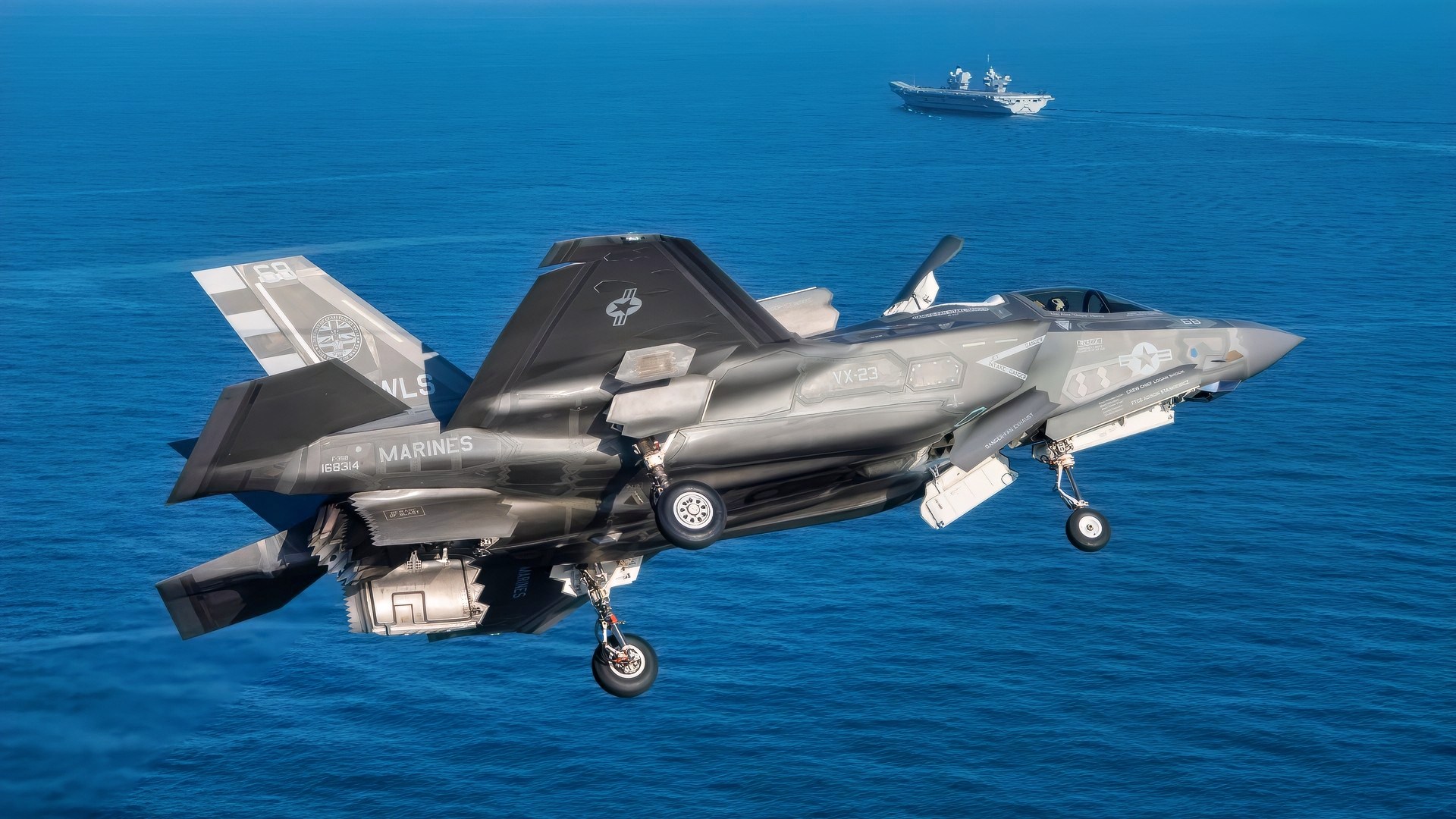
F-35 test pilot Marine Maj. Paul Gucwa from Air Test and Evaluation Squadron Two Three (VX-23), Naval Air Warfare Center Aircraft Division (NAWCAD), flies an F-35B Lightning II fighter aircraft to the U.K. HMS Prince of Wales aircraft carrier in the Western Atlantic Oct. 11, 2023.
As mentioned, British carriers lack catapult systems, meaning they cannot operate heavier fixed-wing aircraft such as the E-2 Hawkeye airborne early warning platform. Instead, they rely on helicopter-based systems like the Merlin Crowsnest, which provide less range.
Sortie generation rates are also lower than those of U.S. supercarriers, and the overall air wing is smaller.
British carriers are, therefore, highly capable in limited-intensity operations and deterrence missions. They are also valuable during coalition warfare. They are not, however, designed to sustain large-scale, high-tempo combat operations independently against a peer adversary.
U.S. Carriers Are Built for Scale
Compared to the U.S. Navy’s newest carrier class, the Gerald R. Ford-class, the Queen Elizabeth-class carriers are certainly less capable. The American carriers are significantly larger, with a full-load displacement of around 100,000 tonnes, and electromagnetic catapult systems that can launch a wider range of aircraft.
They typically carry 70-80 aircraft and are designed for sustained and high-intensity combat operations.
British carriers are smaller, carry fewer aircraft, and use an older launch system. Plans from around 2010-2012 briefly considered converting the carriers to EMALS, but were abandoned due to technical risks and spiraling costs.
The carriers were specifically designed to have no catapults at all, thereby reducing cost and complexity – meaning there’s one less thing to maintain. But this does not mean that British ships are simply inferior versions of U.S. ships. They are built for a different purpose.

ATLANTIC OCEAN (Sept. 21, 2024) The world’s largest aircraft carrier, USS Gerald R. Ford (CVN 78), sails in formation with the Japan Maritime Self Defense Force (JMSDF) Kashima-class training ship, JS Kashima (TV-3508), middle, and Hatakaze-class guided missile destroyer JS Shimakaze (TV-3521) while conducting routine operations in the Atlantic Ocean, September 23, 2024. The U.S. Navy and JMSDF continue to train together to improve interoperability and strengthen joint capabilities. For more than 60 years, the U.S.-Japan Alliance has been the corner stone of stability and security and is crucial to the mutual capability of responding to contingencies at a moment’s notice. (U.S. Navy photo by Mass Communication Specialist 2nd Class Jacob Mattingly)
Whereas U.S. carriers are designed to act as the backbone of global naval warfare, capable of operating independently at scale, British carriers were designed from the beginning to operate within alliances, augment larger forces, and provide additional capacity where necessary.
Why They Still Matter
Despite their limitations, British aircraft carriers are strategically significant. Only a handful of countries – including the United States, China, India, and the United Kingdom – operate large, fixed-wing aircraft carriers. That alone places Britain in a relatively small group of naval powers capable of projecting air power at sea.
Carriers provide a unique capability: the ability to launch sustained air operations without relying on foreign bases, making them particularly valuable in regions where access is politically difficult. They also serve as visible instruments of deterrence.
But are they toys? Well, if “toys” means technically less capable, then sure. But many major global players wish they had toys this powerful.
About the Author: Jack Buckby
Jack Buckby is a British researcher and analyst specialising in defence and national security, based in New York. His work focuses on military capability, procurement, and strategic competition, producing and editing analysis for policy and defence audiences. He brings extensive editorial experience, with a career output spanning over 1,000 articles at 19FortyFive and National Security Journal, and has previously authored books and papers on extremism and deradicalisation.


