


Summary and Key Points: Defense technology analyst Reuben F. Johnson evaluates the “most dangerous job on earth”: the Iranian Transporter Erector Launcher (TEL) crews.
-Amidst Operation Epic Fury, allied reconnaissance drones and satellites have reduced Iranian ballistic missile launches by 90%, according to CENTCOM Admiral Brad Cooper.

Iran Missiles. Image Credit: Creative Commons.
-The IRGC operates from hardened “missile cities,” yet the transition from tunnel cover to firing sites has become a lethal bottleneck.
-With an estimated 150 launchers remaining, experts from RUSI and the Washington Institute predict the total neutralization of Iran’s mobile ballistic capability as crew life expectancy drops from days to hours.
The Iranian TEL Bottleneck: Why Mobile Launcher Losses Are Halting Tehran’s Missile Offensive
As of today, there is a mad, dangerous, and life-threatening race going on in Iran—one like the world has never seen. This is a race against the clock. Those who can beat the clock will live to fight another day. Those who do not end up as the “honored dead” due to being lost on the battlefield.
The job is that of an Iranian missile mobile launch crew. Today, that occupation is being described as the most dangerous job on earth.
For one of these Iranian mobile launch crews to be able to fire their missile, they have to break out from under whatever cover they are hiding under and quickly reach a firing site. This is where the race against the clock takes place. That launch crew has to be able to fire their missile and return to some safe and concealed location before the United States and other allied nations’ satellites or drones spot them.

Iran’s missile capabilities. Image Credit: Creative Commons.
Before coming out of their bases, soldiers work through a pre-launch checklist that can be completed in as little as an hour. The crew, supposedly between five and 10 soldiers, loads a missile weighing hundreds of kilos onto the rails and inputs encyclopedic amounts of data to ensure the projectile can accurately reach its target. That can include everything from meteorological and navigation data to information about the Earth’s shape and rotation.
The vehicle that these Iranian crews would be firing their missile from is usually referred to as a transporter erector launcher, or TEL. It is a large truck with the launching platform apparatus mounted on the back. It is the standard piece of machinery used to send a mobile ballistic against a target in the theatre.
It is also the most hunted target in all of Iran these days. The United States and its partner nations know that there are a finite number of these launchers in the Iranian arsenal—and those numbers are getting smaller all the time as the launchers are picked off one by one.
Mauro Gilli, professor at the Hertie School in Berlin, explained the strategy of the United States, Israel, and others in targeting these TELs: “If you destroy the launchers, the ballistic missiles become useless.”
Very Short Life Expectancy
Prior to the beginning of the Iran war, Tehran possessed one of the largest ballistic missile arsenals in the Middle East. These missiles can hit targets at up to 1,250 miles away, which would allow them to reach Israel, the Gulf states, and U.S. bases across the region.
But the missiles themselves are only useful if Iran can launch them. That requires these specialised mobile launchers, usually mounted on large truck-like vehicles. Destroy those launchers, and the missiles become effectively useless.

Iran’s Drones That Russia Is Using. Image Credit: Creative Commons.
Matthew Savill, director of military sciences at RUSI, has revealed that Iranian losses are increasing rapidly and after only 10 days into Operation Epic Fury. If the launcher crews are not able to hide from the reconnaissance drones, satellites, and other remote sensors, they are quickly taken out.
“What you now have is a campaign that is doing a combination of hunting for the remaining ballistic missiles and critically, their launchers, as that is a bottleneck,” he said during a briefing on Monday.
“If the Israeli figures are to be believed then [Iran] only has an estimated 150 launchers left,” Savill explained. He then added that at the current rates of their losses, Iran will not be able to launch ballistic missiles from mobile launchers by the end of this week.
U.S. Central Command (CENTCOM) Commander Admiral Brad Cooper stated that ballistic missile attacks from Iran have dropped by roughly 90 percent since the strikes began.
Psychological Factors
Other reports are that stress on the missile crews is causing them to succumb to psychological pressure. “The entire war effort of the Iranian regime depends on them.”
Iranian ballistic missile crews are also among the most ideologically committed of the personnel within the Islamic Revolutionary Guard Corps (IRGC). Typically, they operate from mountain hideouts that are known in Iran as “missile cities” and feature elaborate networks of tunnels that are buried deep underground.
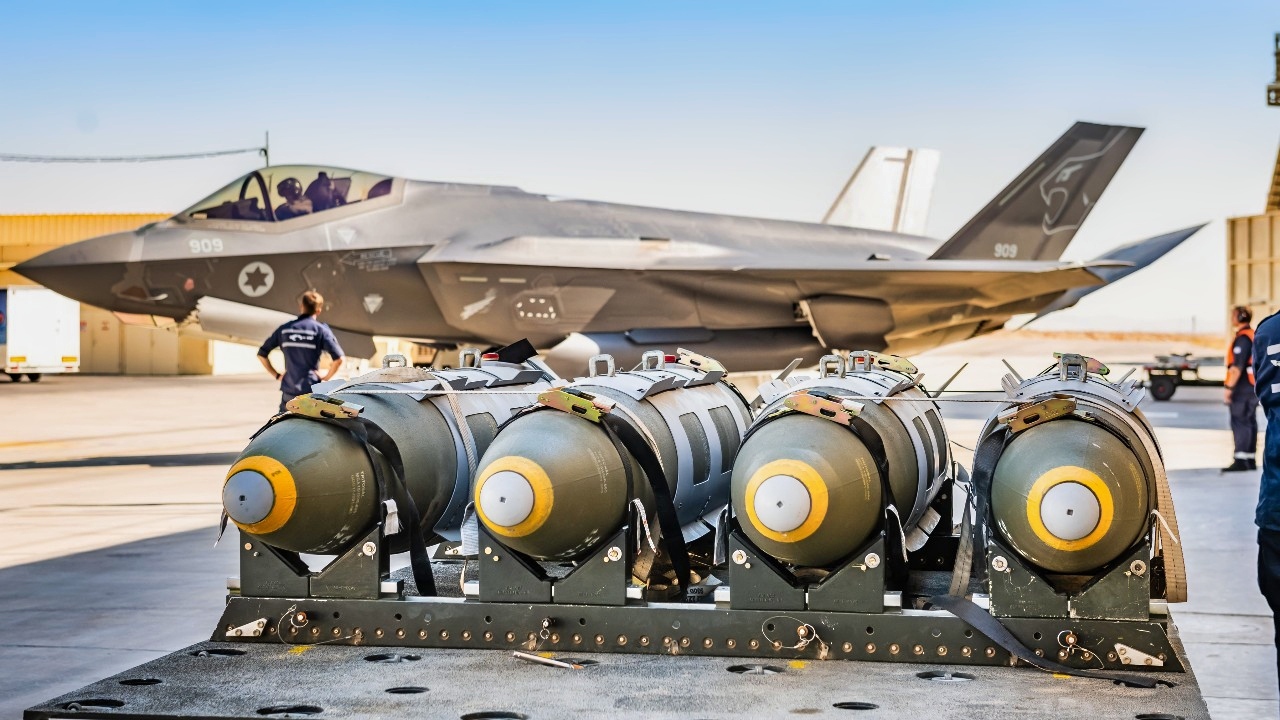
Israel F-35I Adir Stealth Fighter. Image Credit: IAF.

An Israeli Air Force pilot walks to an F-35I Adir prior to a Red Flag-Nellis 23-2 mission at Nellis Air Force Base, Nevada, March 15, 2023. Red Flag is an opportunity to build on the success of JUNIPER OAK 23-2, JUNIPER FALCON, and additional combined exercises to enhance interoperability with Israel, strengthen bilateral cooperation, and improve capabilities in ways that enhance and promote regional stability and reinforce the United States’ enduring commitment to Israel’s security. (U.S. Air Force photo by Airman 1st Class Trevor Bell)

An Israeli Air Force pilot climbs into an F-35I Adir prior to a Red Flag-Nellis 23-2 mission at Nellis Air Force Base, Nevada, March 16, 2023. Red Flag is an opportunity to build on the success of JUNIPER OAK 23-2, JUNIPER FALCON, and additional combined exercises to enhance interoperability with Israel, strengthen bilateral cooperation, and improve capabilities in ways that enhance and promote regional stability and reinforce the United States’ enduring commitment to Israel’s security. (U.S. Air Force photo by Airman 1st Class Trevor Bell)
“They are very safe inside [these tunnels.] They are under tens of feet of hard rock,” said Uzi Rubin, who is a former director of Israel’s missile defense programme.
Sam Lair, who is a researcher at the James Martin Center for Nonproliferation Studies, said: “You have moments of long stretches of profound boredom where you are sitting in a cave … then you have moments of profound stress where you were asked to leave the cave and set up your missile.”
Farzin Nadimi, an expert on the Iranian missile programme at The Washington Institute, said: “This is the most dangerous job on earth right now. We are probably talking about a life expectancy of days, and soon it will be hours.”
About the Author: Reuben F. Johnson
Reuben F. Johnson has thirty-six years of experience analyzing and reporting on foreign weapons systems, defense technologies, and international arms export policy. Johnson is the Director of Research at the Casimir Pulaski Foundation. He is also a survivor of the Russian invasion of Ukraine in February 2022. He worked for years in the American defense industry as a foreign technology analyst and later as a consultant for the U.S. Department of Defense, the Departments of the Navy and Air Force, and the governments of the United Kingdom and Australia. In 2022-2023, he won two awards in a row for his defense reporting. He holds a bachelor’s degree from DePauw University and a master’s degree from Miami University in Ohio, specializing in Soviet and Russian studies. He lives in Warsaw.


