


Britain’s four Vanguard-class ballistic-missile submarines carry the entire United Kingdom nuclear deterrent. Each 15,900-ton boat is powered by a Rolls-Royce PWR2 nuclear reactor, runs at more than 25 knots submerged, and carries up to 16 American-made Trident II D5 submarine-launched ballistic missiles. The class — HMS Vanguard, HMS Victorious, HMS Vigilant, and HMS Vengeance — entered service between 1993 and 1999. The Royal Navy has kept at least one of them on patrol every single day since 1969. The Dreadnought-class replacement is delayed and over budget, forcing London to extend the Vanguards’ service lives well beyond their design.
The Vanguard-Class Is the UK’s Nuclear Weapons Program, Totally At Sea
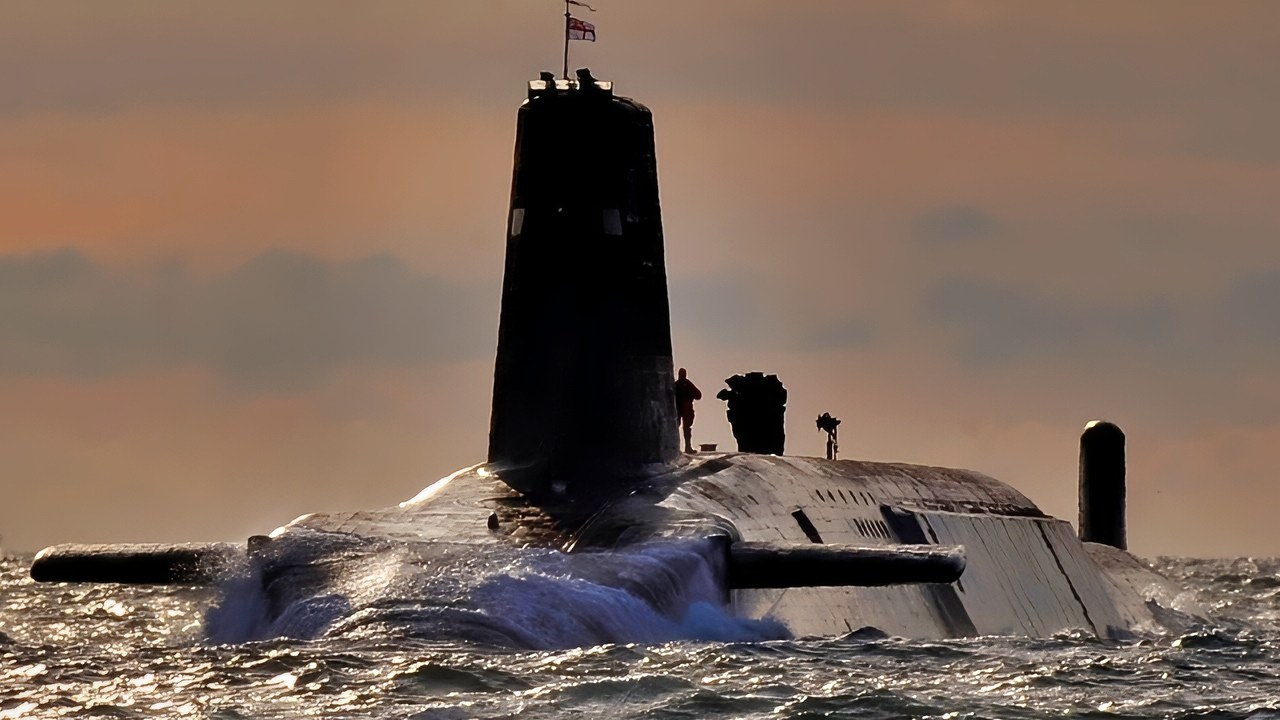
Vanguard-Class Submarine Royal Navy Photo. Image Credit: Creative Commons.
The British Royal Navy is at its weakest point in history. It has too few ships to deploy to global hotspots. The legendary maritime service is experiencing a long-running recruitment and retention crisis, too.
Still, the Royal Navy has some impressive capabilities that, if only London could scale such capabilities, the Royal Navy would not be in such dire straits as it is.
Built during the late Cold War to replace the older Resolution-class submarines, the Vanguard-class submersible is the key player in the United Kingdom’s nuclear deterrent.
Four Resolution-class boats were designed around a single mission: maintain Britain’s continuous at-sea nuclear deterrent (CASD). At least one of these submarines is always on patrol somewhere in the world’s oceans, hidden and ready to launch nuclear retaliation if the United Kingdom were ever attacked with nuclear weapons.
Why the Vanguard-Class Was Built
This system emerged from the Cold War, when Britain (and the United States) faced threats from the mighty Soviet Union. Britain originally relied upon the Polaris missile system. By the late 1970s, though, London rightly concluded Polaris would become obsolete against improving Soviet missile defenses.
So, Prime Minister Margaret Thatcher’s government determined that a newer system was needed. At that point, Britain purchased the Trident system from the United States and designed a new submarine around it.
The result was the Vanguard-class. She was bigger, quieter, and more capable than the older Resolution-class submarines.

Vanguard-Class Submarine From Royal Navy. Image Credit: Royal Navy.
Stealth Is Life
Everything about the Vanguard-class is contingent upon stealth beneath the waves.
A nuclear deterrent only works if the submarines survive an enemy’s first strike. Vanguard-class submarines employ pump-jet propulsion, acoustic dampening, advanced sonar systems, quiet reactor technology, and deep-ocean patrol patterns.
Because of the capabilities built into the Vanguard-class, enemy forces have extreme difficulty tracking and detecting these technological marvels.
The Vanguard-Class Has Only One Real Mission
Britain’s Vanguard-class submarine carries almost entirely the US-made Trident II D5 nuclear missile. It is not meant to hunt enemy ships or to launch cruise missiles. These are essentially undersea, permanent second-strike platforms that can survive a first strike and retaliate thereafter. This is why British nuclear submarine strategy emphasizes stealth, survivability, and continuous patrol.
The “continuous at-sea deterrent” concept means one submarine is always hidden undersea while the others rotate through maintenance, training, or refit cycles. Britain has maintained this uninterrupted nuclear patrol posture since 1969, the height of the Cold War.
Why the Vanguard-Class Matters
These British submarines are often compared to the American Ohio-class submarine because both rely on the same Trident II D5 missile system. Britain’s force is much smaller, with only four submarines versus the much larger US SSBN fleet.

SOUDA BAY, Greece (Sept. 7, 2019) The Ohio-class cruise missile submarine USS Florida (SSGN 728) arrives in Souda Bay, Greece, for a scheduled port visit, Sept. 7, 2019. NSA Souda Bay is an operational ashore base that enables U.S., allied, and partner nation forces to be where they are needed and when they are needed to ensure security and stability in Europe, Africa, and Southwest Asia. (Photo by Joel Diller/Released)

Puget Sound Naval Shipyard, Wash. (Aug. 14, 2003) — Illustration of USS Ohio (SSGN 726) which is undergoing a conversion from a Ballistic Missile Submarine (SSBN) to a Guided Missile Submarine (SSGN) designation. Ohio has been out of service since Oct. 29, 2002 for conversion to SSGN at Puget Sound Naval Shipyard. Four Ohio-class strategic missile submarines, USS Ohio (SSBN 726), USS Michigan (SSBN 727) USS Florida (SSBN 728), and USS Georgia (SSBN 729) have been selected for transformation into a new platform, designated SSGN. The SSGNs will have the capability to support and launch up to 154 Tomahawk missiles, a significant increase in capacity compared to other platforms. The 22 missile tubes also will provide the capability to carry other payloads, such as unmanned underwater vehicles (UUVs), unmanned aerial vehicles (UAVs) and Special Forces equipment. This new platform will also have the capability to carry and support more than 66 Navy SEALs (Sea, Air and Land) and insert them clandestinely into potential conflict areas. U.S. Navy illustration. (RELEASED)

Ohio-Class Submarine U.S. Navy.
The UK’s strategic deterrent is therefore concentrated into a tiny but highly survivable fleet. That makes the stealth and reliability of these submarines absolutely critical to British national security.
Vanguard-Class Specifications
Here are the key specifications drawn primarily from the online defense publication, SeaForces, detailing that the Vanguard-class was built by Vickers Shipbuilding/BAE Systems. After the HMS Vanguard, there are the HMS Victorious, HMS Vigilant, and HMS Vengeance. Vanguard-class submarines displace around 15,900 tons when submerged.
Rolls-Royce PWR2 nuclear reactors power this sub. The power provided by the PWR2 nuclear reactors allows the submarine to reach more than 25 knots submerged.
A crew of around 132-135 serves on this submarine.
Here’s the key aspect of the Vanguard, though. She carries up to 16 Trident II D5 Submarine-Launched Ballistic Missiles (SLBMs). To protect these vital submarines from potential enemy counterattacks, there are four 533mm torpedo tubes onboard. The torpedo of choice for the Vanguard-class is the Spearfish heavyweight torpedo.
The British government has classified its official operating depth, although it is generally assumed to be around 300 meters.
The Trident II D5 Missile
The Trident II D5 missile system is American-designed but is used jointly by the Royal Navy and the United States Navy. This SLBM carries about 130,000 pounds and has a range of 4,000 to 6,200 nautical miles.
As noted above, the missile carries a MIRV-capable warhead.
Once fired, the weapon is steered by inertial and stellar guidance to reach its target. This system can travel an astonishing 20,000 feet per second. A three-stage solid-fuel rocket propels the weapon upon launch.
Problems Face the Vanguard Fleet
Despite its great reputation, the Vanguard-class submarines are aging. Having entered service in 1993 and 1999, they have also experienced major maintenance delays and age-related issues with their nuclear reactors. Britain has repeatedly extended the service lives of its submarines because the Dreadnought-class submarine, its replacement, has faced serious delays and cost overruns.
Here again, we see the increasingly sad state of the Royal Navy on display. Despite their infinitesimal size (at least compared to the US Navy), the fact that the British cannot sustain their acquisitions as well as the larger American forces can is problematic.
London intends for the Dreadnought-class to replace the Vanguard-class subs in the early 2030s, although this timeline is, due to the complications in designing the Dreadnoughts, highly fungible. Like their Vanguard-class predecessors, the Dreadnought-class subs will employ Trident II D5 missile systems.
In the End
The Vanguard-class submarine is one of the best, most important submarines the British Royal Navy has ever fielded. These subs are not designed to fight conventional wars. They exist only for one terrifying purpose: to ensure that no enemy could destroy the United Kingdom without suffering catastrophic nuclear retaliation in return.
That single mission defines the Vanguard-class submarine. And these aging submarines are proving increasingly difficult for the declining Royal Navy to both maintain and replace.
MORE – ‘She Can Shoot Down an F-22’: China’s J-20 Stealth Fighter Has Arrived
MORE – China’s J-35A Stealth Fighter Has a Message for the U.S. Air Force
About the Author: Brandon J. Weichert
Brandon J. Weichert is a Senior National Security Editor. Recently, Weichert became the editor of the “NatSec Guy” section at Emerald. TV. He was previously the senior national security editor at The National Interest. Weichert hosts The National Security Hour on iHeartRadio, where he discusses national security policy every Wednesday at 8 p.m. Eastern. He hosts a companion show on Rumble entitled “National Security Talk.” Weichert consults regularly with various government institutions and private organizations on geopolitical issues. His writings have appeared in numerous publications, among them Popular Mechanics, National Review, MSN, and The American Spectator. And his books include Winning Space: How America Remains a Superpower, Biohacked: China’s Race to Control Life, and The Shadow War: Iran’s Quest for Supremacy. Weichert’s newest book, A Disaster of Our Own Making: How the West Lost Ukraine, is available for purchase at any bookstore. Follow him via Twitter/X @WeTheBrandon.


