


In March 1996, Bill Clinton sent two U.S. aircraft carriers — the USS Nimitz and USS Independence — into the Taiwan Strait to intimidate China during the island’s first direct presidential election. Beijing had no military answer. China backed down. That single humiliation became the organizing principle of thirty years of Chinese military investment in one thing above all else: missiles, and lots of them. The result is the largest precision-strike missile arsenal on Earth — the DF-21D, the DF-26 “Guam Killer,” the DF-17 hypersonic glide vehicle, the DF-27 reaching Hawaii, the DF-100 cruise missile, and several thousand weapons designed to sink American aircraft carriers before they get anywhere near China.
How China Built A Missile Force Designed To Sink Every U.S. Aircraft Carrier In The Western Pacific — And Why The U.S. Navy Has No Real Answer
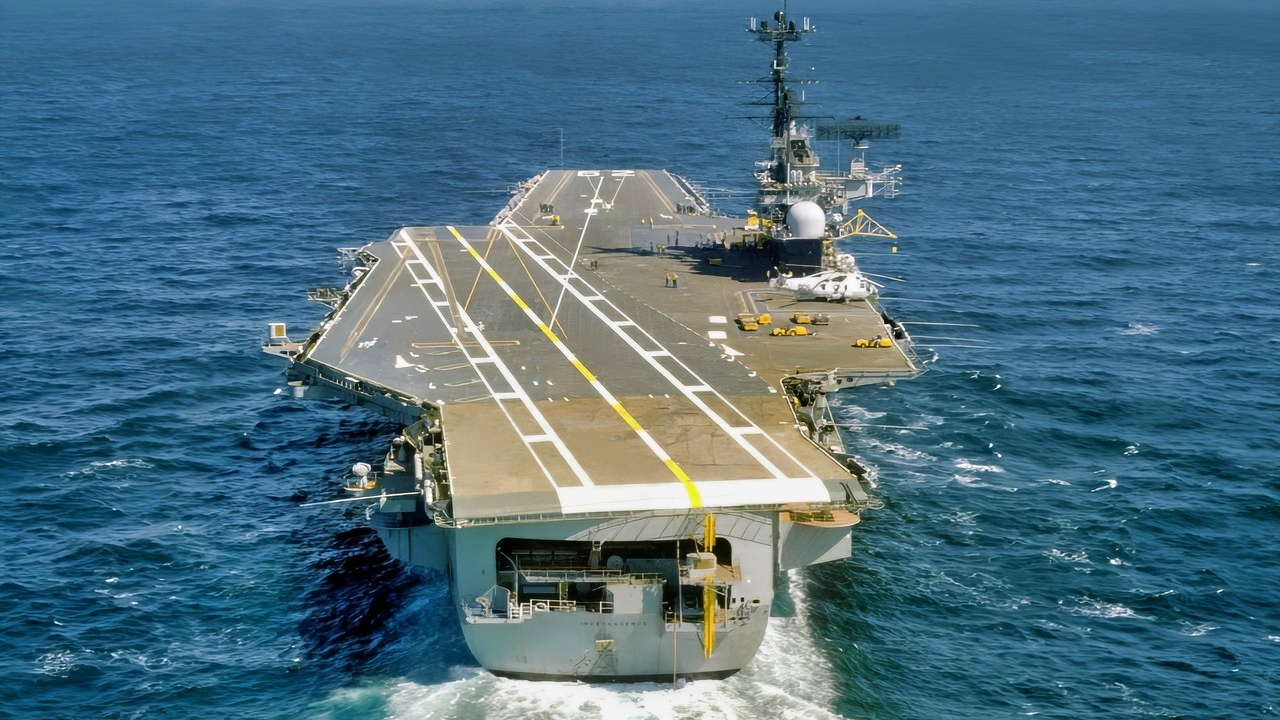
USS Independence (CV-62). Image Credit: Creative Commons.
In March 1996, the People’s Republic of China conducted a series of ballistic missile tests in the waters off Taiwan to intimidate the island during its first direct presidential election. The Clinton administration’s response was to deploy two American aircraft carrier strike groups — the USS Nimitz and the USS Independence — to the Taiwan Strait. The carriers operated openly within striking range of the Chinese mainland. The PLA had nothing that could threaten them. China backed down. Some reports even suggest China could even find them in the open ocean. Taiwan held the election.
That single episode, from the Chinese strategic perspective, defined the next 30 years of the People’s Liberation Army’s modernization. Beijing concluded that American carrier strike groups operating freely off the Chinese coast posed the central military challenge to Chinese strategic autonomy. Solving that problem — making the Western Pacific too dangerous for U.S. carriers to enter — became the explicit organizing principle of Chinese military investment from 1996 onward.
The result, three decades later, is the largest conventionally armed missile arsenal on Earth. The PLA Rocket Force operates an integrated family of anti-ship ballistic missiles, hypersonic glide vehicles, supersonic and hypersonic cruise missiles, and land-attack precision-strike weapons collectively designed to deny U.S. Navy carriers access to the entire First Island Chain — and increasingly, to the Second Island Chain stretching out to Guam and beyond.
The Navy’s missile defense architecture, built around Aegis-equipped Arleigh Burke destroyers and the older Ticonderoga-class cruisers, was not designed for the threat density that China now fields. The numbers do not work. There are not enough interceptors. There is not enough time. And the platforms most vulnerable to the threat — the $13 billion Ford-class supercarriers — are the most strategically valuable ships in the U.S. fleet.
Full disclosure: I have been obsessed with this story for nearly two decades now. China’s growing missile force has become a passion of mine, and I have done my best to engage experts and their literature on this issue. It is the reason I left the telecommunications industry in the early 2010s and did all I could to study this issue professionally.
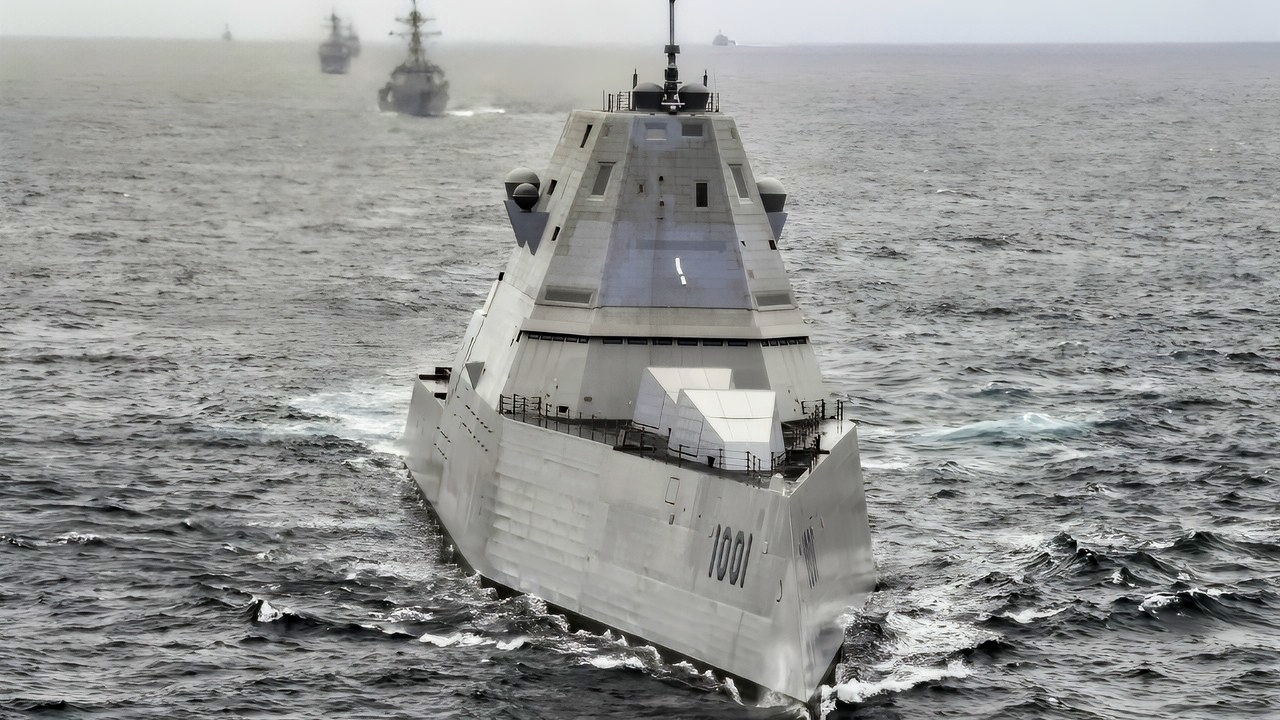
(April 21, 2021) The Zumwalt-class guided-missile destroyer USS Michael Monsoor (DDG 1001) leads a formation including the Arleigh Burke-class guided missile destroyers USS Fitzgerald (DDG 62), USS Spruance (DDG 111), USS Pinckney (91), and USS Kidd (DDG 100), and the Independence-variant littoral combat ship USS Coronado (LCS 4) during U.S. Pacific Fleet’s Unmanned Systems Integrated Battle Problem (UxS IBP) 21, April 21. UxS IBP 21 integrates manned and unmanned capabilities into challenging operational scenarios to generate warfighting advantages. (U.S. Navy photo by Chief Mass Communication Specialist Shannon Renfroe)
The 1995-1996 Crisis That Changed Everything
The Taiwan Strait Crisis of 1995-1996 was the formative experience for an entire generation of Chinese military planners.
Beijing’s missile tests off Taiwan were intended as coercive diplomacy against then-president Lee Teng-hui and the broader push toward formal Taiwanese independence. The American carrier response — two full strike groups, including the USS Nimitz transiting the Taiwan Strait itself — demonstrated in the most public possible way that the PLA could not contest American naval power within range of its own coast.
The man who became the most authoritative Western analyst of what came next was Andrew Erickson, then a young scholar of Chinese military affairs and now a professor at the U.S. Naval War College. There is no one on planet Earth who knows these issues better than him. Erickson has spent the past two decades documenting the systematic Chinese effort to convert that 1996 humiliation into a comprehensive maritime denial capability. Much of this article could not have been written without his research.
Per Erickson’s foundational 2010 paper documenting the initial operational capability of the DF-21D, Beijing’s anti-ship ballistic missile development was directly catalyzed by the 1995-96 Taiwan Strait crisis. As Erickson wrote: “Chinese open source publications provide strong indications that Beijing has been developing an ASBM ever since the 1995-96 Taiwan Strait Crisis. The deployment of the USS Nimitz and Independence CSGs in response to China’s missile tests and military exercises in the Taiwan Strait then was a move that China could not counter.”
The PLA’s strategic conclusion was straightforward. China would build a missile force capable of holding U.S. carriers at risk at progressively greater ranges, anchored by ground-based mobile launchers that could not be eliminated by carrier strikes. The doctrinal framing the PLA adopted was “use the land to control the sea” — a Chinese expression Erickson has documented in his work tracing the genealogy of Chinese anti-access strategy.
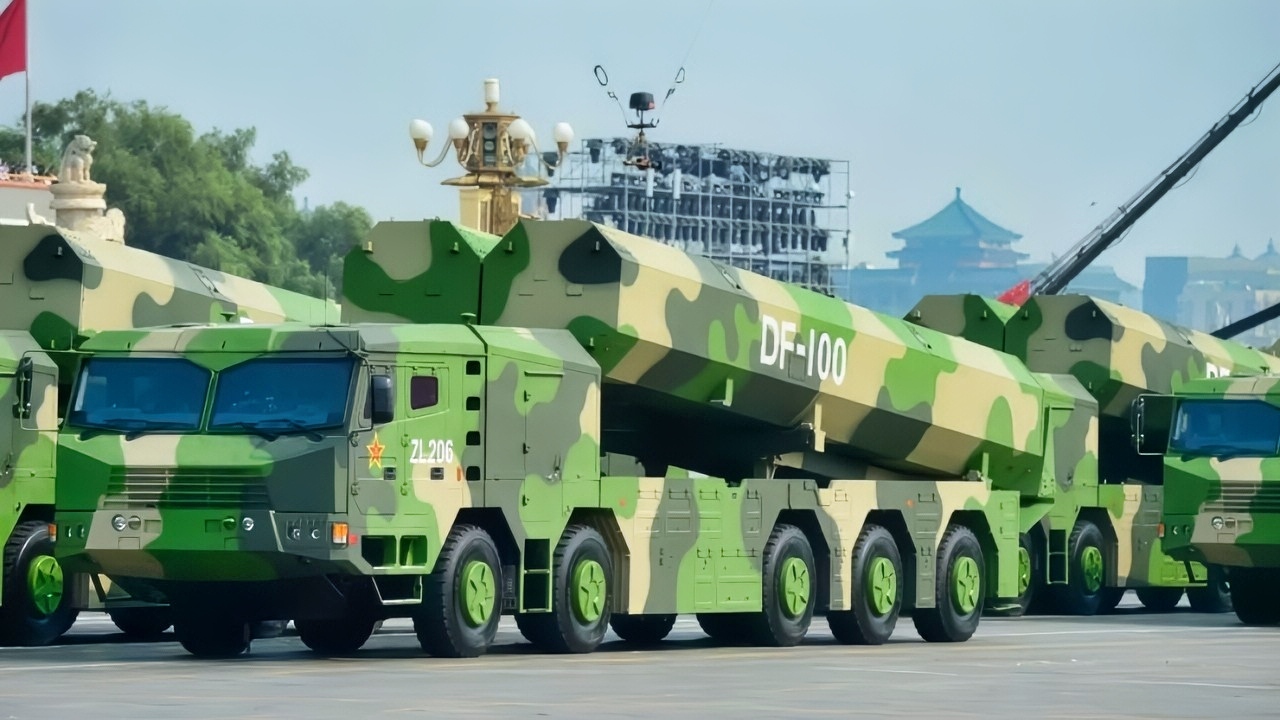
DF-100 Missiles: X Screengrab.
That framework now anchors the entire PLA Rocket Force structure.
The DF-21D: The First Carrier Killer
The Dongfeng-21D was the first weapon explicitly designed to address the Taiwan Strait carrier problem. The missile, derived from the earlier DF-21 medium-range ballistic missile family that dates to the 1980s, is the world’s first land-based anti-ship ballistic missile — a category of weapon that did not exist before China built one.
Chinese engineers drew heavily on American technology concepts, some even say stolen tech, to develop the DF-21D. The closest U.S. analog was the MGM-31B Pershing II — an 1980s-era American intermediate-range ballistic missile equipped with a maneuvering reentry vehicle that enabled the warhead to adjust course during atmospheric descent for terminal precision. The Pershing II was retired under the 1987 Intermediate-Range Nuclear Forces Treaty. Chinese engineers studied the design extensively and applied the maneuvering reentry vehicle concept to the DF-21D, with modifications to enable the missile to engage moving sea-surface targets — a substantially harder problem than hitting a fixed land target.
The DF-21D has an estimated range of 1,500 to 1,700 kilometers and uses maneuverable reentry vehicles to complicate interception. The missile reached initial operational capability in late 2010, with Erickson’s analysis confirming the achievement based on Chinese and Taiwanese open-source reporting.

The aircraft carrier USS Nimitz (CVN 68) arrives at Joint Base Pearl Harbor-Hickam, Hawaii, for a scheduled port visit Dec. 3, 2013. The Nimitz was in the process of returning to its home port, Everett, Wash., following an eight-month deployment to the U.S. 5th Fleet, U.S. 6th Fleet and U.S. 7th Fleet areas of responsibility. (U.S. Navy photo by Mass Communication Specialist Seaman Apprentice Rose Forest/Released)
The reconnaissance-to-strike kill chain required to actually hit a moving carrier with a ballistic missile is what makes the DF-21D operationally meaningful. The PLA built a layered surveillance architecture combining satellite imaging, over-the-horizon backscatter radar, maritime patrol aircraft, and underwater sensor networks — all feeding targeting data to the Rocket Force in real time. Without that kill chain, the DF-21D would be a weapon looking for somewhere to shoot. With it, the missile becomes the anchor of an integrated maritime denial system.
The DF-26: The Guam Express
If the DF-21D was the first-generation carrier killer optimized for the First Island Chain, the DF-26 was the second-generation system designed to reach the Second Island Chain.
The DF-26 was first revealed publicly at the September 3, 2015, Chinese military parade commemorating the 70th anniversary of the end of World War II. The missile is a dual-capable intermediate-range ballistic missile — capable of carrying either conventional warheads or nuclear payloads — with an estimated range of approximately 4,000 kilometers. That reach is what earned it the Western nickname “Guam Killer” or “Guam Express,” because it can target the American military installations on Guam from launchers based deep inside continental China.
Per GlobalSecurity’s profile of the DF-26, the missile is mobile-launched and does not require pre-surveyed launch sites — meaning the PLA Rocket Force can disperse launchers across vast areas of Chinese territory and reload them between salvos. Each DF-26 missile brigade reportedly fields at least 25 launch vehicles, each supported by two transport vehicles carrying three reserve missiles, providing 75-missile salvo capacity per brigade.

U.S. Navy Aircraft Carrier Sailing. Image Credit: Creative Commons.
The dual-capable design is a deliberate ambiguity. The same launcher can fire a conventional anti-ship variant against a U.S. carrier or a nuclear-armed variant against a regional target. American intelligence cannot determine which warhead is loaded until impact. That ambiguity is itself a deterrent — any American strike against a DF-26 brigade carries the risk of triggering a nuclear response.
The Pentagon estimates that China currently operates between 250 and 400 DF-26 launchers across at least seven brigades. The missile entered formal service with the PLA Rocket Force in 2018.
The DF-17: Hypersonic Glide Vehicles Enter The Picture
The DF-17 was the third major addition to the Chinese anti-carrier missile arsenal — and the first weapon to use hypersonic glide vehicle technology in operational deployment.
The system pairs a solid-fueled medium-range ballistic missile booster with a DF-ZF hypersonic glide vehicle that detaches after the boost phase and skims the upper atmosphere at speeds between Mach 5 and Mach 10. The glide vehicle’s flight profile makes it substantially harder to intercept than a conventional ballistic warhead. Per the Center for Strategic and International Studies’ profile of the DF-17, the DF-17 has an estimated range of 1,800 to 2,500 kilometers and was first publicly displayed at the October 1, 2019 National Day parade in Beijing.

DF-17 Missile from China. Image Credit: PLA.
The DF-17’s strategic role is twofold. First, the system can be employed against U.S. and allied missile defense radars and command nodes early in a conflict to degrade defensive capability before less survivable ballistic and cruise missile salvos arrive. Second, the hypersonic glide vehicle architecture provides a proof-of-concept platform for future Chinese hypersonic weapons, including the substantially longer-ranged systems that have followed.
The DF-ZF glide vehicle entered formal PLA Rocket Force service alongside the DF-17 in October 2019 — making China the first nation to field an operational hypersonic glide vehicle. Per the Missile Defense Advocacy Alliance’s profile of the DF-ZF, the glide vehicle is capable of “extreme maneuvers” to evade missile defenses, and the technology is expected to be adapted to other Chinese ballistic missile platforms over the coming decade.
Per Army Recognition’s technical profile of the DF-17, between January 2014 and November 2017 China conducted at least nine flight tests of the DF-17 at the Taiyuan Satellite Launch Centre in Shanxi Province. The PLA had functional hypersonic strike capability years before any comparable American or Russian system reached the same operational threshold.
The DF-27: Reaching Hawaii And The Second Island Chain
The DF-27 is the newest and longest-ranged member of the Chinese anti-ship and strategic precision strike family — and the most strategically significant for U.S. Navy carrier operations.
The Pentagon first publicly identified the DF-27 in its 2021 annual China Military Power Report. The missile remained largely classified until February 2023, when a leaked U.S. Air National Guard intelligence document — part of the broader Discord leak case — revealed that the DF-27 had been successfully flight-tested on February 25, 2023, for 12 minutes and traveling approximately 2,100 kilometers.

(Left to right) Australian ANZAC Class frigate HMAS Stuart (FFH 153) and USS Jack H. Lucas (DDG 125) wait off the coast of the Pacific Missile Range Facility in Kauai, Hawaii, as they prepare for Flight Test Aegis Weapon System-32 (FTM-32), held March 28, 2024.
Per the Missile Defense Advocacy Alliance’s profile of the DF-27, the leaked intelligence assessment described the DF-27 as designed to enhance China’s ability to hold targets at risk beyond the Second Island Chain, with the missile possessing a high probability of penetrating U.S. ballistic missile defenses. Per official PLA documents quoted in the leaked assessment, the DF-27 has a range of 5,000 to 8,000 kilometers — putting it in the intermediate-range to intercontinental ballistic missile class.
That range means the DF-27 can reach Guam (approximately 3,000 kilometers from the Chinese coast), Wake Island (approximately 5,500 kilometers), and the Hawaiian Islands (approximately 7,500 kilometers). U.S. Navy carrier strike groups operating anywhere within that envelope are now within range of a Chinese ballistic missile that incorporates a hypersonic glide vehicle and was specifically designed to defeat American missile defense systems.
The DF-27 has been deployed in limited numbers since approximately 2022, according to a leaked classified assessment. Variants capable of striking both land and naval targets have been observed in PLA Rocket Force inventories.
The DF-100 / CJ-100: The Long Sword Cruise Missile
The DF-100 — also designated CJ-100 (“Long Sword 100”) in some PLA documentation — adds a long-range supersonic to hypersonic cruise missile capability to the Chinese anti-ship architecture.

(June 18, 2021) As seen from the Ticonderoga-class guided-missile cruiser USS Shiloh (CG 67), the Navy’s only forward-deployed aircraft carrier USS Ronald Reagan (CVN 76) transits the Strait of Malacca with the Arleigh Burke-class guided missile destroyer USS Halsey (DDG 97). The ships are part of Task Force 70/Carrier Strike Group 5, conducting underway operations in support of a free and open Indo-Pacific. (U.S. Navy Photo by Mass Communication Specialist 1st Class Rawad Madanat)
The missile was first publicly revealed during the October 1, 2019, National Day parade. It is a road-mobile, supersonic-to-hypersonic cruise missile launched from a ten-wheel truck-based transporter erector launcher. Chinese commentators have described the missile as capable of sustained cruise speeds between Mach 3 and Mach 5, with terminal speeds potentially higher. The reported range varies across Chinese and Western sources from 2,000 kilometers to as much as 4,000 kilometers depending on the variant and trajectory.
Per the China Aerospace Studies Institute’s analysis of the first operational CJ-100 unit, the PLA Rocket Force’s 656th Brigade was identified in 2020 as the first operational unit fielding the system. Subsequent satellite imagery analysis has linked the brigade to a site near Laiwu in Shandong province, identified by distinctive orange storage sheds and a training hangar characteristic of PLA Rocket Force facilities.
Per Eurasian Times’ coverage of the August 2025 DF-100 footage release, the PLA Rocket Force released a two-minute training video showing a DF-100 brigade conducting a launch from an urban environment — a departure from previous launches from desert test sites. The launch from urban terrain demonstrated the system’s operational flexibility and survivability in dispersed deployment configurations. The 4,000-kilometer reach places most of the Second Island Chain within DF-100 range.
The DF-100 is the cruise missile complement to the ballistic and hypersonic systems described above. Where the DF-21D, DF-26, and DF-17 follow ballistic or quasi-ballistic trajectories, the DF-100 cruises at low altitude using terrain masking and supersonic speed to defeat air defense radars. The combination of attack vectors — ballistic from above, hypersonic glide from oblique angles, supersonic cruise from low altitude — is what makes the integrated Chinese anti-ship architecture so difficult to defend against.
The Volume Problem
Individual weapons are not the only problem the U.S. Navy faces. The volume of Chinese missiles in service is what makes the threat strategically decisive.
Per The Defense Watch’s compiled assessment of the Chinese anti-ship missile inventory, the PLA Rocket Force fields approximately 250 to 400 DF-26 launchers, multiple DF-21D brigades, growing inventories of DF-27 systems, and expanding numbers of YJ-21 hypersonic anti-ship missiles deployed aboard PLA Navy destroyers and H-6 bombers. The total Chinese anti-ship and anti-base missile inventory across all variants, including reload rounds, is estimated at several thousand missiles.
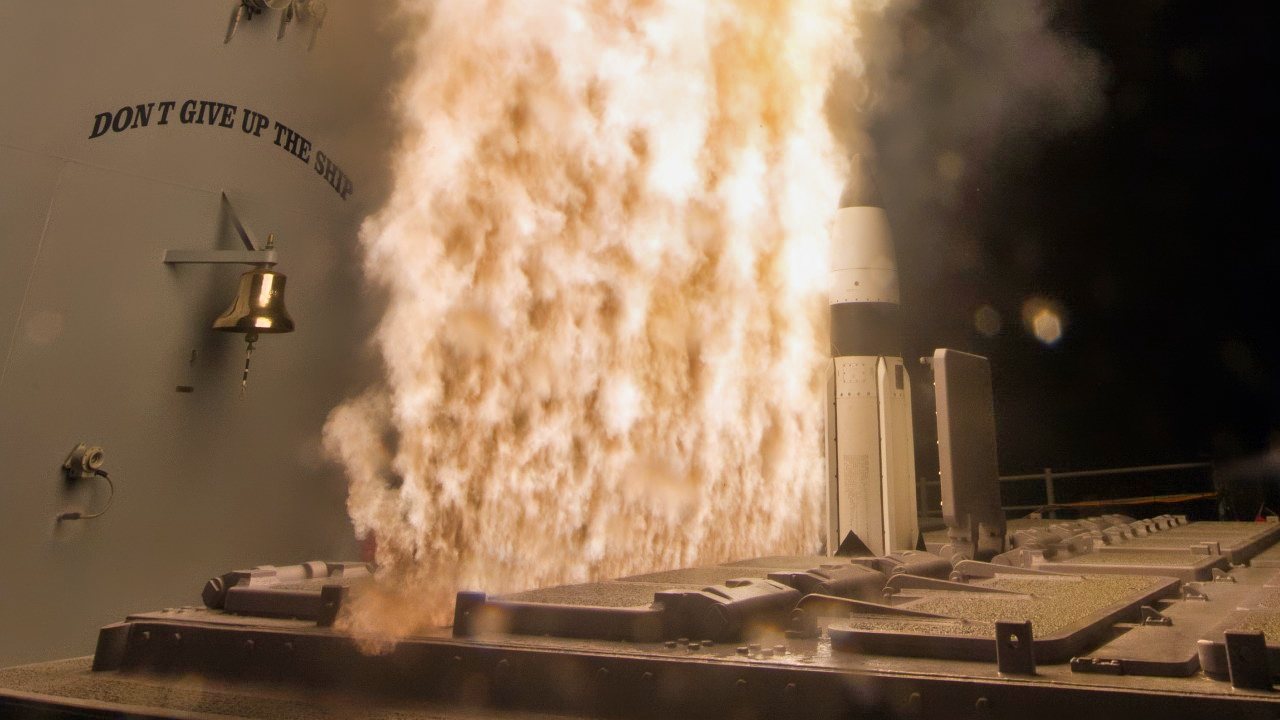
(Feb. 13, 2013) A Standard Missile-3 (SM-3) Block 1A interceptor is launched from the guided-missile cruiser USS Lake Erie (CG 70) during a Missile Defense Agency and U.S. Navy test in the Pacific Ocean. The SM-3 Block 1A successfully intercepted a target missile that had been launched from the Pacific Missile Range Facility, Barking Sands, Kauai, Hawaii. (U.S. Navy photo/Released)
The volume is what defeats American missile defense architecture. An Aegis-equipped Arleigh Burke Flight III destroyer carries 96 Vertical Launch System cells. A Ticonderoga-class cruiser carries 122. Both ship classes have to balance their VLS loadouts between air defense missiles (SM-2, SM-6, ESSM), ballistic missile interceptors (SM-3), and strike weapons (Tomahawk). A carrier strike group, escorted by three to four Aegis warships, carries between 300 and 500 VLS cells. Not all of those cells are loaded with interceptors. Many are loaded with offensive weapons.
A Chinese saturation salvo — three to four DF-26 brigades firing simultaneously, supported by DF-21D, DF-17, and DF-100 cross-domain attacks — could put hundreds of inbound weapons against a single carrier strike group inside ten minutes. The American defensive architecture was not designed for that volume. It cannot intercept all of them. The math, in the words of multiple American naval analysts, simply does not work.
Why The U.S. Navy Has No Real Answer
The problem with the defensive architecture is structural, not just numerical.
American shipboard air defense is built around the Aegis Combat System paired with the Standard Missile family. The SM-6 provides terminal ballistic missile defense and anti-air warfare engagement. The SM-3 provides mid-course ballistic missile defense against exo-atmospheric targets. The Evolved SeaSparrow Missile provides close-in air defense. The system was designed during the late Cold War to defeat Soviet anti-ship cruise missiles and was upgraded across the 2010s to handle ballistic missile threats. It was not designed to handle hypersonic glide vehicles operating in near-space at Mach 5 to Mach 10, executing aggressive course changes during the terminal phase, while arriving simultaneously with conventional ballistic warheads and supersonic cruise missiles.

3rd Multi-Domain Task Force (3MDTF) conducts the first Mid-Range Capability live fire exercise outside of the continental United States successfully sinking a maritime target with a Standard Missile-6 Force during Exercise Talisman Sabre 25 on July 16, 2025. US Army photo
The DF-17 and DF-27 hypersonic glide vehicles, in particular, pose challenges that current American missile defenses are not optimized to address. Per the open-source assessments cited above, the DF-ZF glide vehicle can execute course changes at Mach 5 to Mach 10 while operating at altitudes too low for exo-atmospheric interceptors but too fast for traditional atmospheric SAM engagement. The U.S. Navy’s defensive systems can engage some hypersonic threats — particularly with the upgraded SM-6 Block IB — but the engagement geometry is unfavorable, the success probability per engagement is significantly below conventional missile defense rates, and the inventory of interceptors is finite.
The strategic implication is straightforward. American carrier strike groups operating inside the first island chain — within the engagement envelope of the DF-21D and the inner ring of the DF-26 — are operating in waters where defensive failure could lose a $13 billion carrier and approximately 5,000 sailors in a single attack. The Pentagon’s wargaming community has been modeling those scenarios for the past decade.
The results, across all public accounts, have not been favorable to American carrier survivability.
Why The Chinese Carrier Fleet Matters Less Than The Missile Force
China’s aircraft carrier fleet — currently three operational hulls with up to nine projected by 2035 — has received substantial Western press coverage. The Liaoning, the Shandong, and the EMALS-equipped Fujian are real platforms that provide the PLA Navy with growing blue-water capability.
But the carriers are not the strategic anchor of Chinese maritime denial. The missile force is.
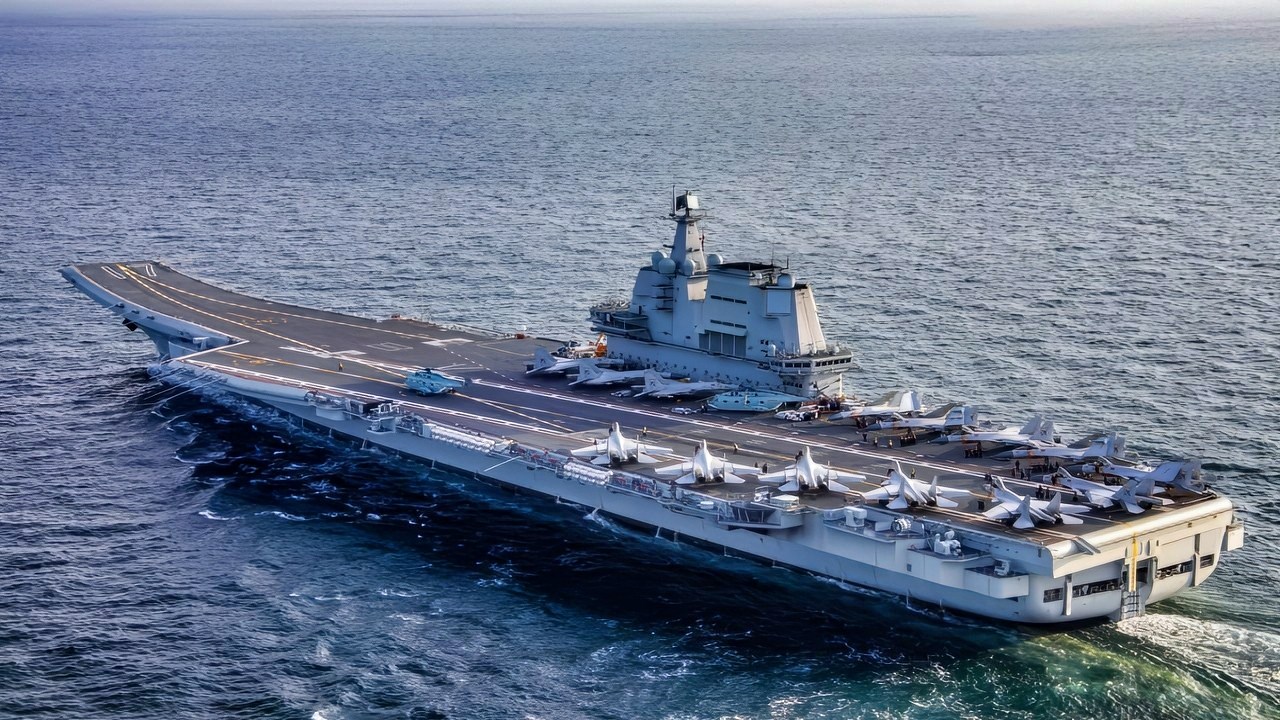
New China Aircraft Carrier. Image Credit: Weibo.
A Chinese carrier strike group operating in the Western Pacific would face the same vulnerabilities as a U.S. carrier strike group — exposed to long-range strike, dependent on a vulnerable escort screen, expensive to lose, and limited in inventory. The PLA’s actual strategic asset is the ground-based, dispersed, road-mobile missile force that can mass thousands of weapons against any American naval formation within range — and that cannot be eliminated without striking the Chinese mainland.
That asymmetry is the strategic logic Beijing has been building since 1996. American naval power could approach the Chinese coast in the 1990s because the PLA had no answer. The PLA spent the next three decades building the answer. The answer is the missile force.
What This Actually Means
The U.S. Navy has been operating in the post-1996 world without fully adapting to it.
The Ford-class supercarrier program proceeds on the assumption that the carrier remains the right anchor for American power projection. The F-35C and the future F/A-XX are designed to extend carrier reach into contested airspace. The Arleigh Burke Flight III and the planned DDG(X) destroyers are being designed to absorb saturation attacks that the older Aegis variants cannot handle.
None of those programs solves the basic arithmetic problem. A finite American defensive missile inventory cannot indefinitely defeat a Chinese offensive missile inventory measured in the thousands. The carrier strike group is no longer the offensive platform it was in 1996. It is, increasingly, a defensive platform — and the defense it has to mount is against an opponent who has built the largest precision-strike missile force in human history specifically to defeat it.
That is what Beijing learned from the 1996 Taiwan Strait crisis. That is what thirty years of Chinese missile investment has produced. And that is the strategic environment in which the next major Pacific conflict — if it comes — will be fought. The U.S. carrier era is not over. But the era of American carriers operating freely off the Chinese coast ended a long time ago. The PLA Rocket Force is the reason why.
MORE – The Dodge Durango of Submarine: The Virginia-Class Is Best on Planet Earth
About the Author: Harry J. Kazianis
Harry J. Kazianis (@Grecianformula) was the former Senior Director of National Security Affairs at the Center for the National Interest (CFTNI), a foreign policy think tank founded by Richard Nixon based in Washington, DC. Harry has over a decade of experience in think tanks and national security publishing. His ideas have been published in the NY Times, The Washington Post, The Wall Street Journal, CNN, and many other outlets worldwide. He has held positions at CSIS, the Heritage Foundation, the University of Nottingham, and several other institutions related to national security research and studies. He is the former Executive Editor of the National Interest and the Diplomat. He holds a Master’s degree focusing on international affairs from Harvard University.


