

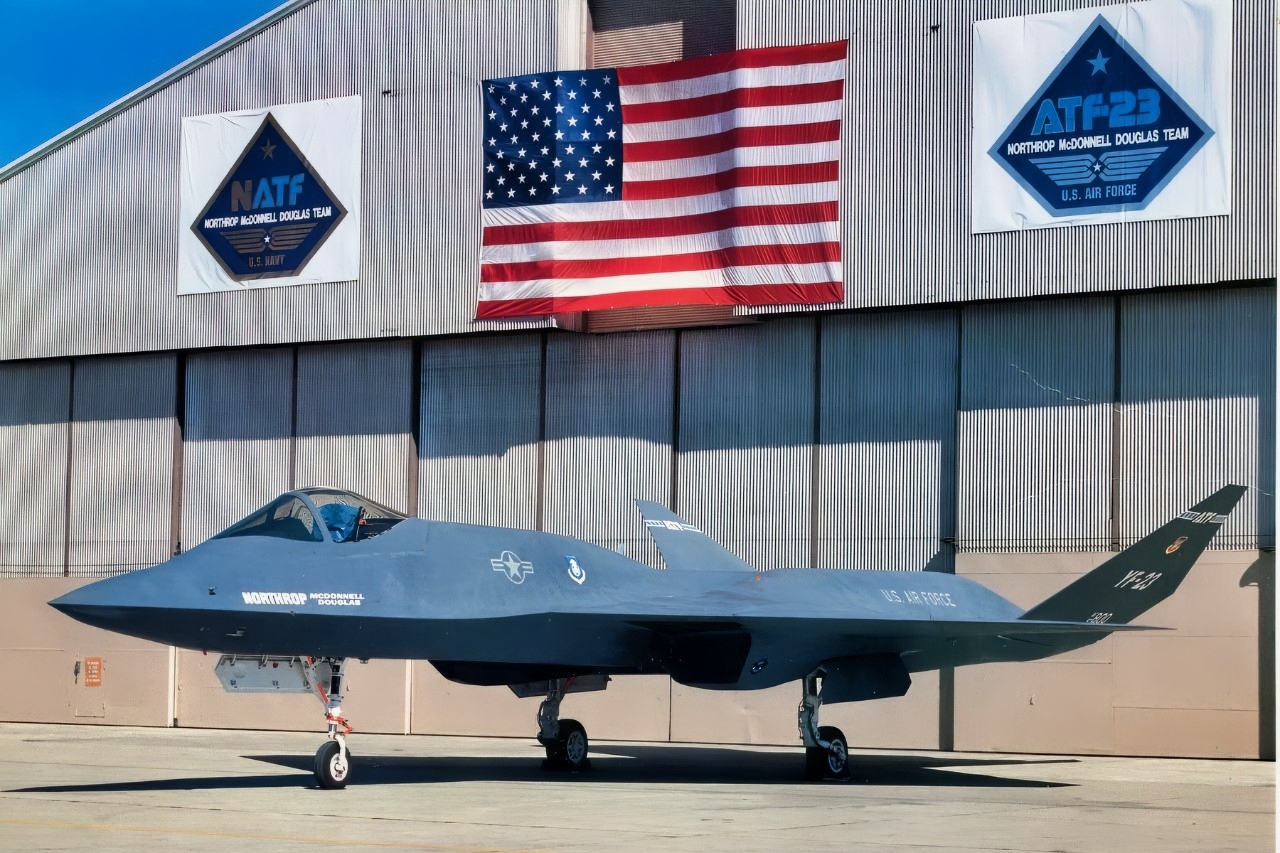
Key Points and Summary – Lockheed’s YF-22 wasn’t the inevitable winner of the Air Force’s Advanced Tactical Fighter contest.
-Northrop’s YF-23 “Black Widow II” offered cleaner stealth shaping, stronger supersonic cruise, and a powerful engine option—and even drew praise from Chuck Yeager.

YF-23 Black Widow II July 2025 National Security Journal
-Yet the Pentagon ultimately selected the YF-22, in part because Lockheed needed a marquee fighter program while Northrop already had major work on the B-2 and other projects.
-The result: the F-22 became America’s first true stealth air-superiority fighter, while the YF-23 survives only as museum history.
-The decision still fuels debate about performance versus politics—and what the Air Force may have forfeited.
-Original Photos of YF-23: The National Security Journal has visited the only two YF-23 fighters ever built and included a large number of photos from those visits for your viewing.
The F-22’s Origin Story Has a Message: The YF-23 Was No Long Shot
The Pentagon allegedly chose the YF-22 to ensure the survival of Lockheed’s fighter jet division, as Northrop was already busy with the B-2 bomber and F/A-18 programs, dooming America’s other “super” stealth fighter to a museum.
Believe it or not, Lockheed Martin’s F-22 Raptor, America’s first *true* stealth fighter—the original so-called “Stealth Fighter, the F-117 Nighthawk (which was also a product of Lockheed’s legendary Skunk Works division), functioned in practice strictly as a bomber—is already over two decades old now, having made its maiden flight on September 7 1997 and entering official operational service with the United States Air Force on December 15 2005.
The Raptor has been around long enough that one might be inclined to think that it was a shoo-in from the get-go to become America’s (and the world’s) first 5th Generation fighter, especially given Skunk Works’ prestigious history. But those of us who are old enough to remember the Advanced Tactical Fighter (ATF; obviously not to be confused with the Federal firearms tax stamp agency) program in the early 1990s will recall that the success of what was then initially known as the YF-22 was far from guaranteed. It had to beat out a formidable competitor in the form of the Northrop YF-23.
To this day, many experts and airpower history buffs maintain that the YF-23 was actually the better ATF candidate. So then, how and why did the Northrop product ultimately lose to the Lockheed offering?

YF-23A Black Widow Outside. Taken by Harry J. Kazianis for National Security Journal on August 16, 2025.

YF-23A Side View Western Museum of Flight. Image by National Security Journal.
Advanced Tactical Fighter (ATF) Program Origins and Motivations
The ATF program traced its roots back to 1981, whereupon its brain trust conceptualized an air superiority fighter that would succeed the then-McDonnell Douglas (now Boeing) F-15 Eagle, and thus put the Air Force in a more advantageous position to counter the emerging threats of the Soviet Union’s then-newfangled Mikoyan MiG-29 “Fulcrum” and Sukhoi Su-27 “Flanker” 4th Generation fighters. Little could anyone have known back then that one decade later, (1) the Soviet Union would end up collapsing, and (2) the Eagle would end up handling the Fulcrum just fine in air-to-air combat.
In any event, by 1986, the USAF had narrowed the list of ATF candidates down to two contenders: Lockheed, teaming with Boeing, and General Dynamics, with the YF-22; and Northrop, in tandem with McDonnell Douglas, with the YF-23.
The YF-23—nicknamed “Black Widow II” in homage to the WWII-era P-61 Black Widow night fighter—would make her maiden flight on August 27, 1990. Two YF-23 airframes were built.
A Legendary Aviator Endorses the YF-23
The YF-23 earned a prestigious endorsement from no less than Brig. Gen. Chuck Yeager, the first human being to break the sound barrier.
Amongst the General’s comments and observations: “No one test pilot was allowed to fly both the F-22 and the F-23 for real comparisons at the critical time,” and “There were many problems with the F-22.”

YF-23 Black Widow II Up Close National Security Journal Photo.

YF-23 Black Widow II from National Security Journal Photo Shoot.

YF-23 Fighter at USAF Museum. Image by Harry J. Kazianis/National Security Journal.
Chuck’s sentiments were certainly understandable, as the “Black Widow II” indeed had multiple advantages over the soon-to-be Raptor: better supersonic cruise performance, better stealth, and superior raw performance from its then-state-of-the-art General Electric (G.E.) variable-cycle YF120 engine. The YF-22 did have better maneuverability at extremely low speeds than its competitor, but only slightly more so.
So then, the YF-23 should’ve been the no-brainer choice to be the winner of the ATF competition, right? Evidently not. Which, in turn, raises the question once again.
So Why/How Did The YF-22 Win?
In a word, politics, according to military expert Brandon J. Weichert. Mr. Weichert backs this claim by citing the YF-23A’s thermal designer, John Shupek, in an interview with Dario Leone of The Aviation Geek Club: “The real reason [Northrop] lost the program was that Lockheed had no new fighter programs at that time, while Northrop had the F/A-18E/F and the B-2 [long-range stealth bomber].” Mr. Shupek added that the Defense Department believed that “it was in the national interest of the U.S. to keep Lockheed alive as an airframer.”

YF-23 National Security Journal Photo. Taken by Harry J. Kazianis at U.S. Air Force Museum on 7/19/2025.

YF-23 National Security Journal Photo. Taken by Harry J. Kazianis at U.S. Air Force Museum on 7/19/2025.
The end result was a fighter plane that, although still an excellent warbird in its own right, was of comparatively lower quality than its competitor *and* more expensive to boot!
Where Are They Now?
If there’s any consolation for YF-23 advocates, it’s that both airframes have been preserved for historical posterity. One is on display at the National Museum of the United States Air Force on the grounds of Wright-Patterson AFB, Ohio (in the vicinity of Dayton), whilst the other sits at the Western Museum of Flight in Torrance, California.
About the Author: Christian D. Orr, Defense Expert
Christian D. Orr is a Senior Defense Editor. He is a former Air Force Security Forces officer, Federal law enforcement officer, and private military contractor (with assignments worked in Iraq, the United Arab Emirates, Kosovo, Japan, Germany, and the Pentagon). Chris holds a B.A. in International Relations from the University of Southern California (USC) and an M.A. in Intelligence Studies (concentration in Terrorism Studies) from American Military University (AMU).


