

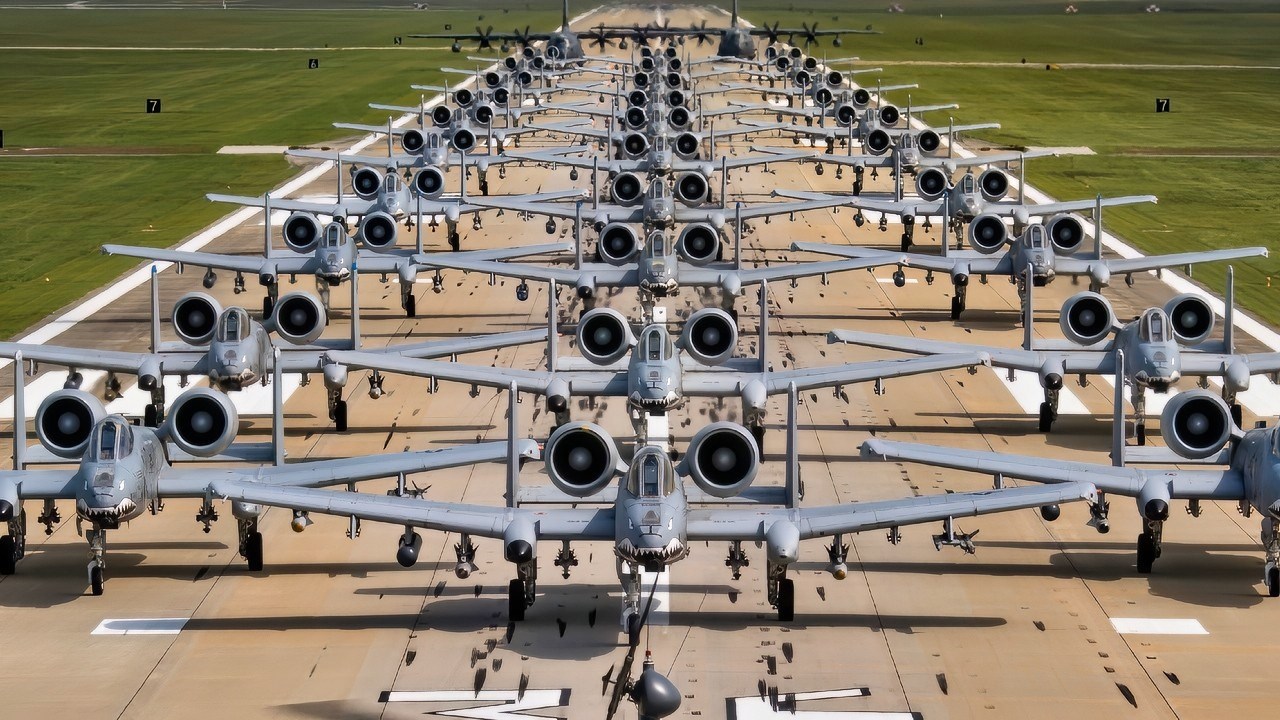
In April of 2003, during the initial invasion phase of Operation Iraqi Freedom, Maj. Kim Campbell was flying an A-10 Thunderbolt II when it was struck by enemy fire over Baghdad. Maj. Campbell successfully landed and has told the story of her flight that day.
According to a DVIDS Hub account, Campbell told the story at a Women’s History Month luncheon seven years later, in March of 2010.
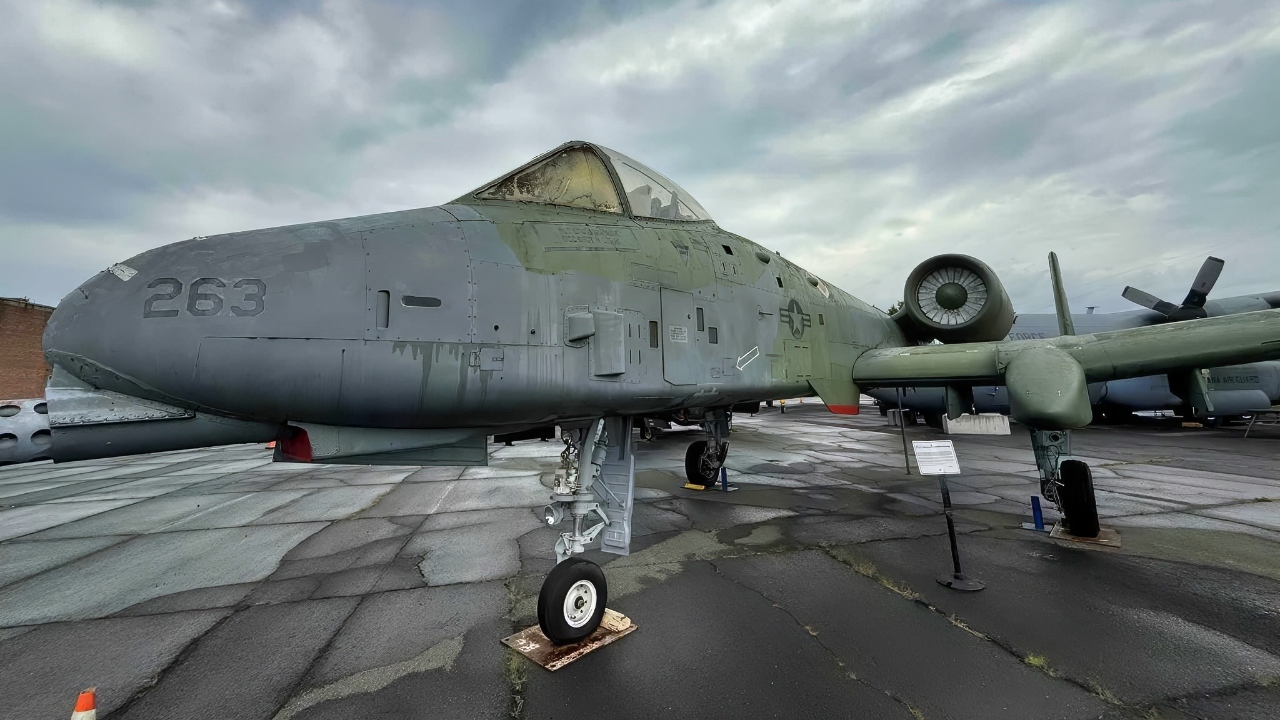
A-10 Warthog National Security Journal Photo. Taken by Jack Buckby on August 23, 2025.
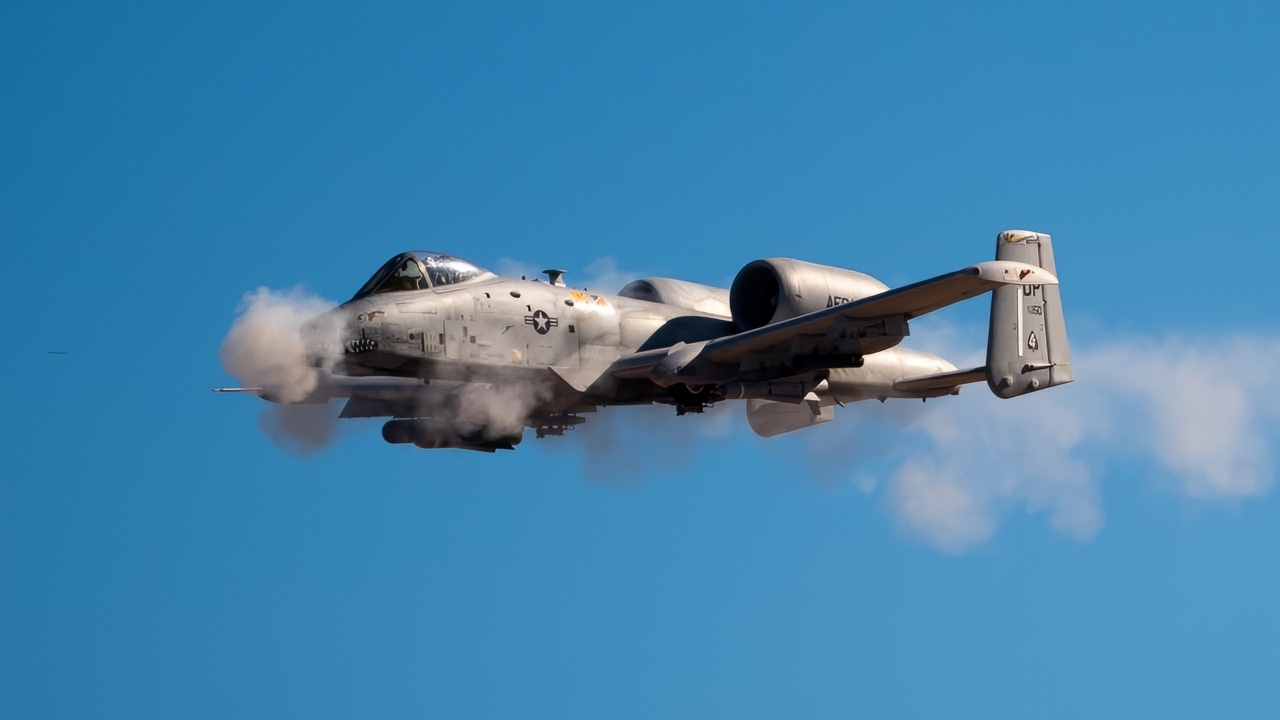
An A-10 Thunderbolt II from the 924th Fighter Group of the 944th Fighter Wing fires its 30mm GAU-8/A Avenger Gatling gun during Exercise Desert Hammer 25-1 at Barry M. Goldwater Range East near Gila Bend, Ariz., Nov. 14, 2024. Through joint and multinational collaboration, Desert Hammer tests the ability of over 700 participants and 131 aircraft to operate, defend, and sustain airbases under austere conditions. (U.S. Air Force photo by Senior Airman Jacob Dastas)
“We were originally tasked to target some Iraqi tanks and vehicles in the city that were acting as a command post,” Campbell, a 1997 Air Force Academy graduate, said at the 2010 luncheon, according to that account. “But on the way to the target area, we received a call from the ground [forward air controller], saying they were taking fire and needed immediate assistance.”
While flying the Thunderbolt, Maj. Campbell was accompanied by another, flown by a flight lead pilot. Then, both planes descended below the clouds.
“We could see the Iraqi troops firing [rocket-propelled grenades] into our guys,” she said. “It was definitely a high-threat situation, but within minutes, my flight lead was employing his 30 mm Gatling gun on the enemy location,” she said.
Both planes went on to fire 30 mm rounds and high-explosive rockets below.
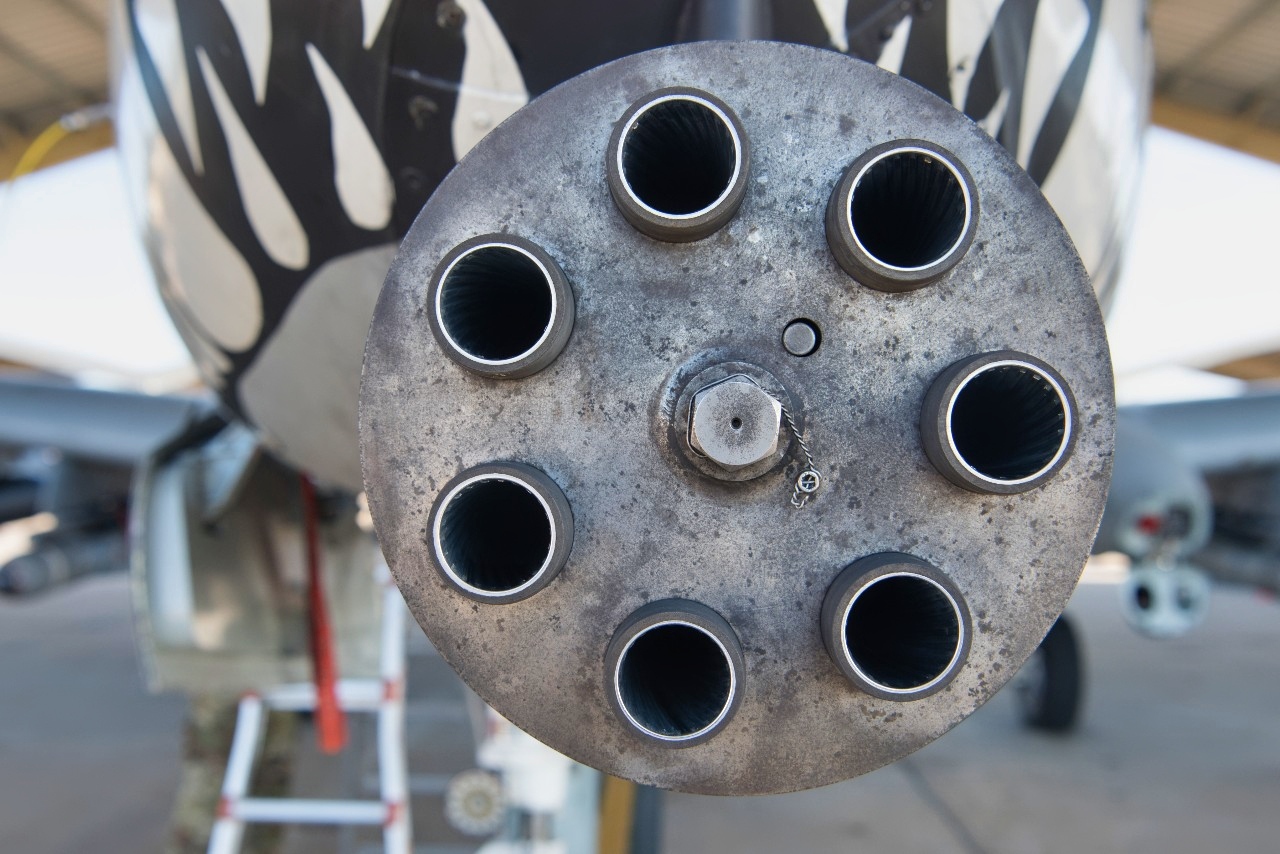
A GAU-8 Avenger 30mm cannon in the nose of an A-10 Thunderbolt II, assigned to the 442d Fighter Wing, at Whiteman Air Force Base, Missouri, April 9, 2021. The GAU-8 is a hydraulically-driven rotary autocannon capable of firing 3,900 rounds per minute with a variety of ammunition types for close air support missions. (U.S. Air Force photo by Senior Airman Parker J. McCauley)

A U.S. Air Force A-10 Thunderbolt II approaches a KC-135 Stratotanker for refueling over the U.S. Central Command area of responsibility, May 31, 2025. The KC-135 is the premier long-term aerial refueling capability for the U.S. Air Force, effectively providing fuel to fixed-wing aircraft operating with the USCENTCOM AOR. (U.S. Air Force Photo by Staff Sgt. John C.B. Ennis)
“Yes, there was risk involved, but these guys on the ground needed our help,” Campbell said. “It’s what any A-10 attack pilot would do in response to a troops-in-contact situation. That’s our job — to bring fire down on the enemy when our Army and Marine brothers and sisters request our assistance.”
During that process, Campbell “felt and heard” an explosion, which she quickly realized was caused by enemy fire.
“A Large Explosion”
The jet, per the account, “rolled violently left and pointed at Baghdad,” and did not respond to her attempts to control it. Since the hydraulic systems were impaired, Campbell realized she needed to place the jet into “manual reversion,” a process the DVIDS account likened to “a system of cranks and cables.”
“It was my last chance to try and recover the aircraft, or I would be riding a parachute down into central Baghdad,” she said, not a very promising fate at that time during the war.
That worked, and the two jets soon took off in their desired direction, while continuing to dodge anti-aircraft artillery.
“I couldn’t do much to keep the jet moving, so I was hoping that the theory of ‘big sky, little bullet’ would work in my favor,” Campbell said at the luncheon. “Amazingly, we made it out of Baghdad and above the clouds with no further battle damage.”

U.S. Air Force Major Lindsay “MAD” Johnson, A-10C Thunderbolt II Demonstration Team commander and pilot, flies during the National Cherry Festival Air Show in Traverse City, Mich., June 29, 2024. It took a team of highly skilled individuals to keep the A-10 flying and make Johson’s demonstrations possible. (U.S. Air Force photo by Senior Airman Devlin Bishop)

A-10 Warthog. Image Credit: Creative Commons.
But that left the pilot with another decision to make.
To Eject or Not to Eject?
“I could stay with the jet and try to land it or get to friendly territory and eject,” Campbell said of that point in the flight. Because the jet was responding and she had a flight lead alongside her, the pilot was confident she could fly the jet back to base, about an hour away in Kuwait.
And she did indeed land the plane safely, with no ejection necessary, with the help of a crash recovery team.
Campbell couldn’t see it at the time, but the damage sustained by the jet included “hundreds of small holes in the fuselage and tail section on the right side, as well as a football-sized hole on the right horizontal stabilizer.”
The pilot praised the crew at that luncheon.
“Both of my crew chiefs did tremendous work on that jet, and it performed better than I ever could have expected,” Campbell said. “We put an incredible amount of trust in these guys, and they do great work.”
Back to the Air
After that flight, Campbell was back in the air just one day later, to support a search-and-rescue mission for a downed A-10 pilot near Baghdad, per the DVIDS account. She was later awarded the Distinguished Flying Cross. Later on, she had a separate deployment to Afghanistan.
“I never really had time to think about the fact that I was going back to Baghdad, where just the day before I had escaped a possible shootdown,” Campbell told the audience. “In my mind, the only thing that I could think about was that I had a job to do. I knew that the search-and-rescue alert crews were there for me the day before, and I was going to do the same for this pilot.”
Praise For Campbell
When she received the Distinguished Flying Cross, the citation stated that “Captain Campbell’s aviation prowess and coolness under pressure directly contributed to the successful completion of the critical mission and recovery of a valuable combat aircraft. The outstanding heroism and selfless devotion to duty displayed by Captain Campbell reflect great credit upon herself and the United States Air Force.”
After her service in those wars, Campbell had a series of other positions, including working as a trainer and instructor. She has also served as an Air Force Fellow with the Atlantic Council, as a Military Assistant to the Under Secretary of Defense for Policy, and as Commander of the 612th Theater Operations Group and the 474th Air Expeditionary Group at Davis-Monthan AFB, and later as Chair, Airpower Innovation & Integration at the U.S. Air Force Academy.
Before retiring from the Air Force in 2021, Campbell was Director, Center for Character and Leadership Development at the U.S. Air Force Academy. She has also done work as a motivational speaker, including telling the story of that famous 2003 flight.
“Major Campbell’s story was nothing short of phenomenal,” Air Force 2nd Lt. Sandy Spoon, chief of force management operations for the 355th Force Support Squadron, said in response to that luncheon in 2010, per the DVIDS account. “It provided everyone, not just females, a small glimpse of the sheer awesomeness the A-10 provides at the warfront. Major Campbell also drove home the realization that everything we are able to do is because someone else has done his or her job right.”
About the Author: Stephen Silver
Stephen Silver is an award-winning journalist, essayist, and film critic, and contributor to the Philadelphia Inquirer, the Jewish Telegraphic Agency, Broad Street Review, and Splice Today. The co-founder of the Philadelphia Film Critics Circle, Stephen lives in suburban Philadelphia with his wife and two sons. For over a decade, Stephen has authored thousands of articles that focus on politics, national security, technology, and the economy. Follow him on X (formerly Twitter) at @StephenSilver, and subscribe to his Substack newsletter.


