


The USS John F. Kennedy (CVN-79) is the second Gerald R. Ford-class carrier, currently nearing delivery after major delays. As of recently, the Kennedy has completed builder’s sea trials and is expected to be delivered around March 2027.
But amidst the evolving threat environment, could the Kennedy be either the last Ford-class carrier or the last US aircraft carrier ever built? The answer is almost certainly no on both counts.
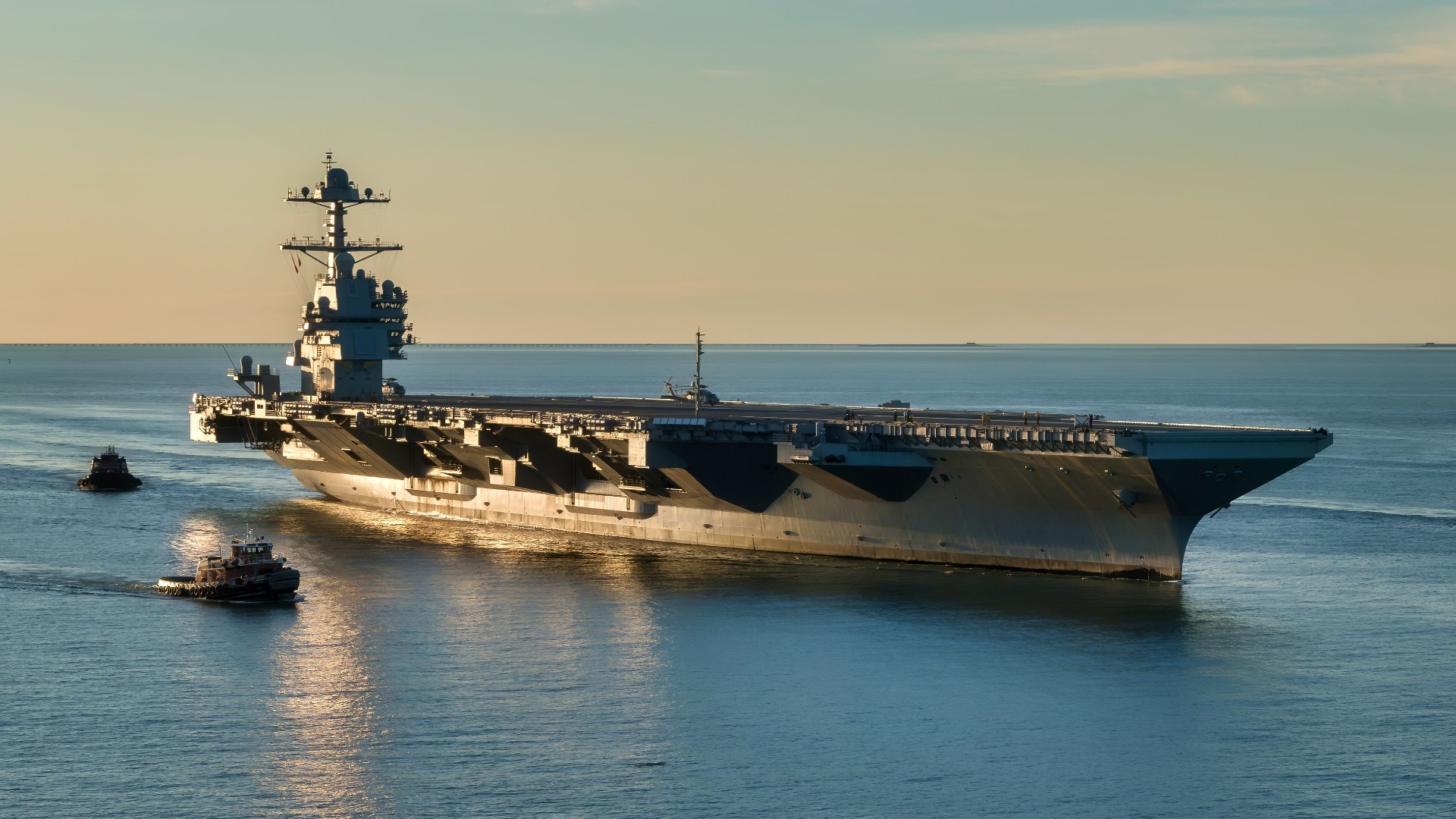
(April 14, 2017) The aircraft carrier Pre-Commissioning Unit (PCU) USS Gerald R. Ford (CVN 78) pulls into Naval Station Norfolk for the first time. The first-of-class ship – the first new U.S. aircraft carrier design in 40 years – spent several days conducting builder’s sea trails, a comprehensive test of many of the ship’s key systems and technologies. (U.S. Navy photo by Matt Hildreth courtesy of Huntington Ingalls Industries/Released)
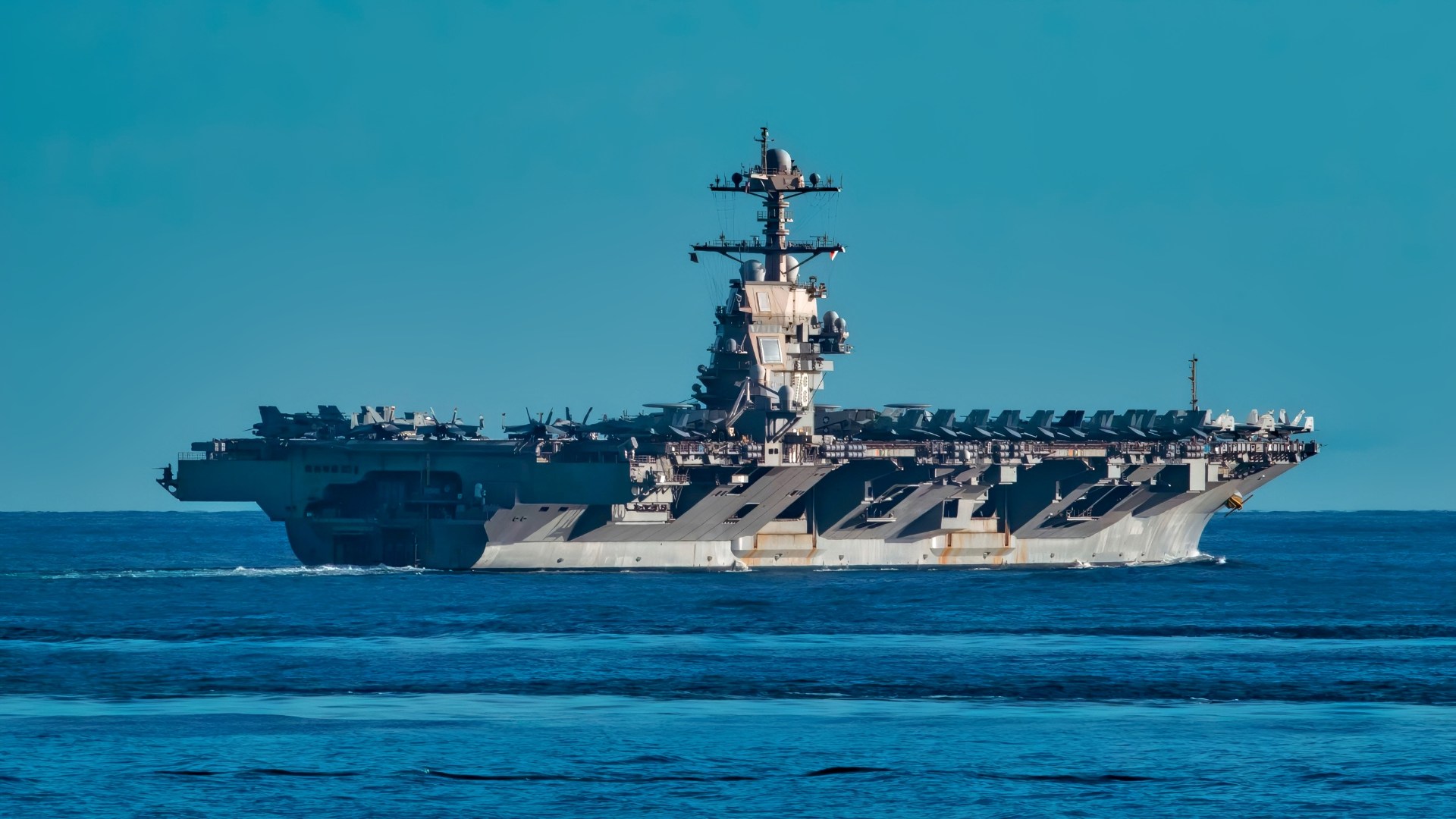
The Arleigh Burke-class guided-missile destroyer USS Winston S. Churchill (DDG 81) sails alongside the world’s largest aircraft carrier the USS Gerald R. Ford (CVN 78), Sep. 24, 2025. Winston S. Churchill, as part of Carrier Strike Group 12, is on a scheduled deployment in the U.S. 6th Fleet area of operation to support the warfighting effectiveness, lethality and readiness of U.S. Naval Forces, Europe-Africa, and defend U.S. Allied and partner interest in the region. (U.S. Navy photo by Mass Communication Specialist Seaman Hector Rodriguez)
The Kennedy is not the end of carrier aviation, yet she will arrive at a moment when the supercarrier model is under sincere review. While Kennedy does expose the cost, the complexity, and the industrial strain involved in fielding a modern carrier, the concept remains too strategically valuable to disappear.
Ford-Class USS John F. Kennedy: Why Is This Aircraft Carrier Delayed?
Despite major delays, the Kennedy is structurally far along, with sea trials completed, and is currently undergoing final testing, certification, and corrections. She is almost ready. The builder’s trials will test propulsion, steering, and basic ship handling before the Kennedy is cleared for Navy delivery.
The final adjustments are being made at Newport News Shipbuilding, where combat systems are being integrated, aircraft compatibility work is ongoing, and the launch/recovery systems are being certified. The ship’s delivery has been delayed from earlier estimates and is now expected around March 2027.
The Navy wants the Kennedy ASAP because the USS Nimitz, a 50-year-old vessel, has had its scheduled retirement postponed to fill the gap left by the Kennedy’s delays. When the Kennedy finally arrives, she will likely be stationed on the West Coast, becoming the first Ford-class ship to be stationed in the Pacific, with obvious relevance to great power competition in the Indo-Pacific.
Why the Delays?
The Kennedys’ delays are not the result of a single problem but rather of developing novel technologies on the fly, shifting requirements, industrial strain, and lessons learned from the USS Gerald R. Ford (CVN-78).
Originally, the Kennedy rollout was supposed to be a dual-phase delivery: the ship was delivered first, with upgrades added later. But that plan shifted toward a single-phase delivery to deliver a more complete and combat-ready vessel.
The trade-off for the later delivery was a ship that would require fewer post-delivery modifications. In theory, at least. The Ford herself suffered painful early delays after delivery; the Navy wants to avoid a similar situation with the Kennedy delivery.
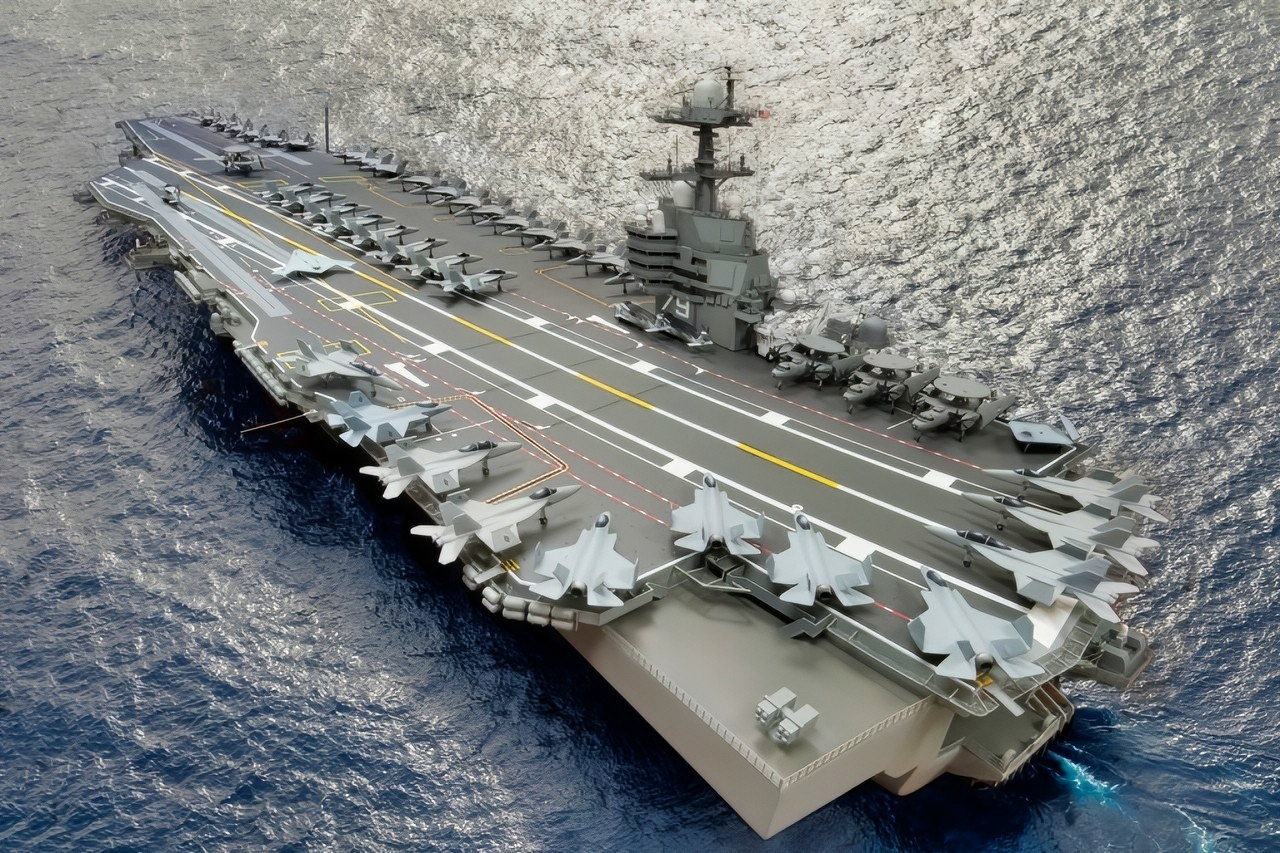
USS John F. Kennedy Aircraft Carrier Model
Accommodating the F-35C
One major source of delay is the requirement that the Kennedy be F-35C capable the moment she is delivered.
This imposes different requirements on the carrier than F/A-18 capability; the flight deck must be adjusted, with thermal protection, jet blast deflector upgrades, and deck coatings that can tolerate F-35 engine heat.
System changes are required, too, like JPALS integration, F-35 logistics systems, data links, classified support spaces, and server and cooling requirements. Unfortunately, these requirements were only added to the Kennedy after construction had begun, forcing builders to retrofit mid-build.
In theory, the delays will result in a carrier that is more capable on day one.
The New Tech Problem
The Ford-class is packed with novel technologies, most notably EMALS and AAG. The EMALS is an electromagnetic aircraft launch system that replaces the traditional steam catapult found on the Nimitz-class. The AAG is an Advanced Arresting Gear that replaces older arresting systems.
The purpose of these upgrades is to achieve smoother aircraft launches that place less stress on the aircraft, plus the ability to launch a wider range of aircraft (including drones and future aircraft), resulting in a higher sortie generation rate.

The world’s largest aircraft carrier, USS Gerald R. Ford (CVN 78), conducts flight operations in the North Sea, Aug. 23, 2025. Gerald R. Ford, a first-in-class aircraft carrier and deployed flagship of Carrier Strike Group Twelve, is on a scheduled deployment in the U.S. 6th Fleet area of operations to support the warfighting effectiveness, lethality, and readiness of U.S. Naval Forces Europe-Africa, and defend U.S., Allied and partner interests in the region. (U.S. Navy photo by Mass Communication Specialist 2nd Class Maxwell Orlosky)
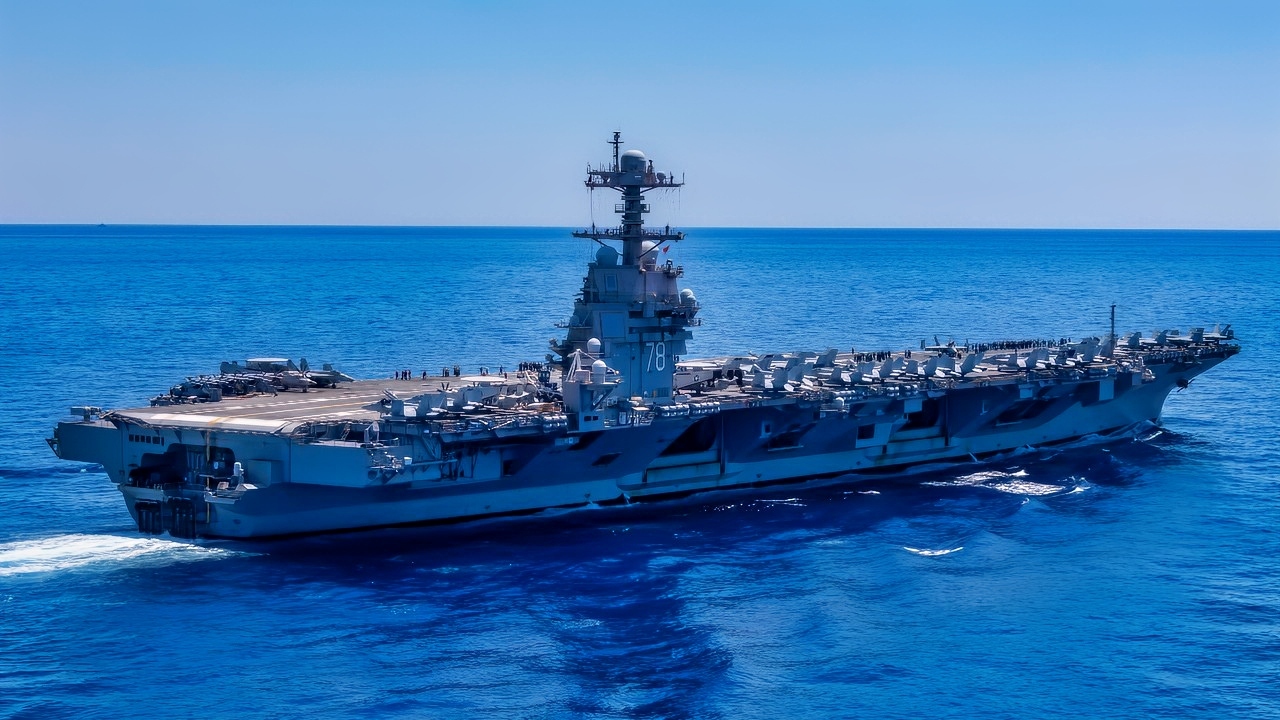
The world’s largest aircraft carrier, USS Gerald R. Ford (CVN 78) transits the Mediterranean Sea, August 1, 2025. Gerald R. Ford, a first-in-class nuclear aircraft carrier and deployed flagship of Carrier Strike Group Twelve, is on a scheduled deployment in the U.S. 6th Fleet area of operations to support the warfighting effectiveness, lethality, and readiness of U.S. Naval Forces Europe-Africa, and defend U.S., Allied, and partner interests in the region. (U.S. Navy photo by Mass Communication Specialist Seaman Brianna Barnett)
The claim holds that the Ford-class will be able to generate roughly one-third more sorties than the Nimitz-class, offering US forces a significant advantage in theater.
The problem, however, is that both the EMALS and AAG are brand-new technologies that were immature on the first-in-class Ford, requiring significant adjustments after delivery.
The Kennedy is hoping to feature more mature systems and be more generally capable on the day of delivery. Both the EMALS and AAG on the Kennedy are more mature than the systems installed on the Ford, but each will require extensive certification.
And the Elevator System
The Advanced Weapons Elevators, or AWE, are also causing problems. An electromagnetic weapons elevator that moves bombs and missiles from their magazines to the flight deck, the AWE facilitates higher sortie generation by enabling quick, safe movement of weapons.
Again, in theory. But in reality, the AWEs have been a major source of embarrassment, delaying full combat readiness due to software and certification problems.
The Kennedy learned from Ford’s initial AWE problems and made earlier adjustments, but those adjustments have caused schedule delays.
The problem with the AWE is that the elevators pass through the ship’s core, so they can’t just be fixed later without significant disruption to surrounding compartments.
The Industrial Problem
Part of the Kennedy’s delays is bigger than the ship itself, stemming from the current strain on US industrial capacity. Newport News, where the Kennedy is currently being built, is the only US shipyard capable of building nuclear-powered aircraft carriers.
This creates a bottleneck. Similarly, labor issues have delayed construction. Specifically, there is a shortage of nuclear-qualified welders and electricians, while the workforce is generally aging and the training pipeline is pinched.
The supply chain also contributes to delays due to single-source vendors, long-lead parts, inflation, and the need for specialty components.
The Ford-class is actually competing directly with the Virginia-class submarines and the Columbia-class ballistic missile submarines for shipbuilding space and labor. And when critical bottlenecks appear, submarines often win out over aircraft carriers, pushing the Kennedy down the priority list. So the Kennedys’ delay isn’t simply about the US Navy but about US industrial capacity as a whole.
Parts Cannibalization
Reports suggest that when Ford needed highly specialized replacement parts, the USS John F. Kennedy may have been used as a source.
But these borrowed parts are not free; replacements often faced long lead times, with reorders meeting inflation and backlog.

Ford-Class Aircraft Carrier. Image Credit: Creative Commons.
The lesson here is that small production runs make supply chains fragile. The Ford-class in general shows what can happen when complicated, sophisticated machines are built through fragile supply chains.
Is Kennedy the Last Ford?
No. The USS Enterprise (CVN-80) is already under construction. The USS Doris Miller (CVN-81) is already under contract.
The Navy bought the Enterprise and Doris Miller together with the intention of saving billions. The more interesting question is whether CVN-82 and beyond will be Ford-class ships, lightly modified, or heavily modified. Currently, the Navy is reviewing the Ford-class design and cost, which could lead to changes to hulls beyond those already under construction or under contract. There are a variety of possible outcomes here.
The Ford design could remain unchanged or be modified.
Or the Navy may depart more radically from its current pathway, perhaps with an increased emphasis on drones or automation. Regardless, the Kennedy won’t be the last Ford-class, but she may be part of a transition toward a new supercarrier model.
Is the USS John F. Kennedy the Last Aircraft Carrier?
Again, no. The carrier fleet is deeply important to the US Navy’s global presence; the US has built a strategy based on mobile air power, and carriers reduce dependence on foreign air bases. No other platform can replicate the ability to transport dozens of aircraft anywhere in the world.
The aircraft carrier, though more vulnerable now than in decades past, still has a unique capability to deploy 70-plus aircraft and conduct sustained air operations. No combination of submarines, bombers, and foreign bases can reproduce the carrier’s capabilities precisely.
So while carriers are indeed more vulnerable, that vulnerability does not fully offset the value the platform provides, and does not yet push the platform into obsolescence.
About the Author: Harrison Kass
Harrison Kass is a writer and attorney focused on national security, technology, and political culture. His work has appeared in City Journal, The Hill, Quillette, The Spectator, and The Cipher Brief. He holds a JD from the University of Oregon and a master’s in Global & Joint Program Studies from NYU. More at harrisonkass.com.


