


Abu Dhabi could soon spend tens of billions of dollars on ports and other infrastructure to decouple the United Arab Emirates from the Strait of Hormuz, as the war with Iran forces Gulf governments to rethink the trade routes their economies depend on.
Diversification On the Way
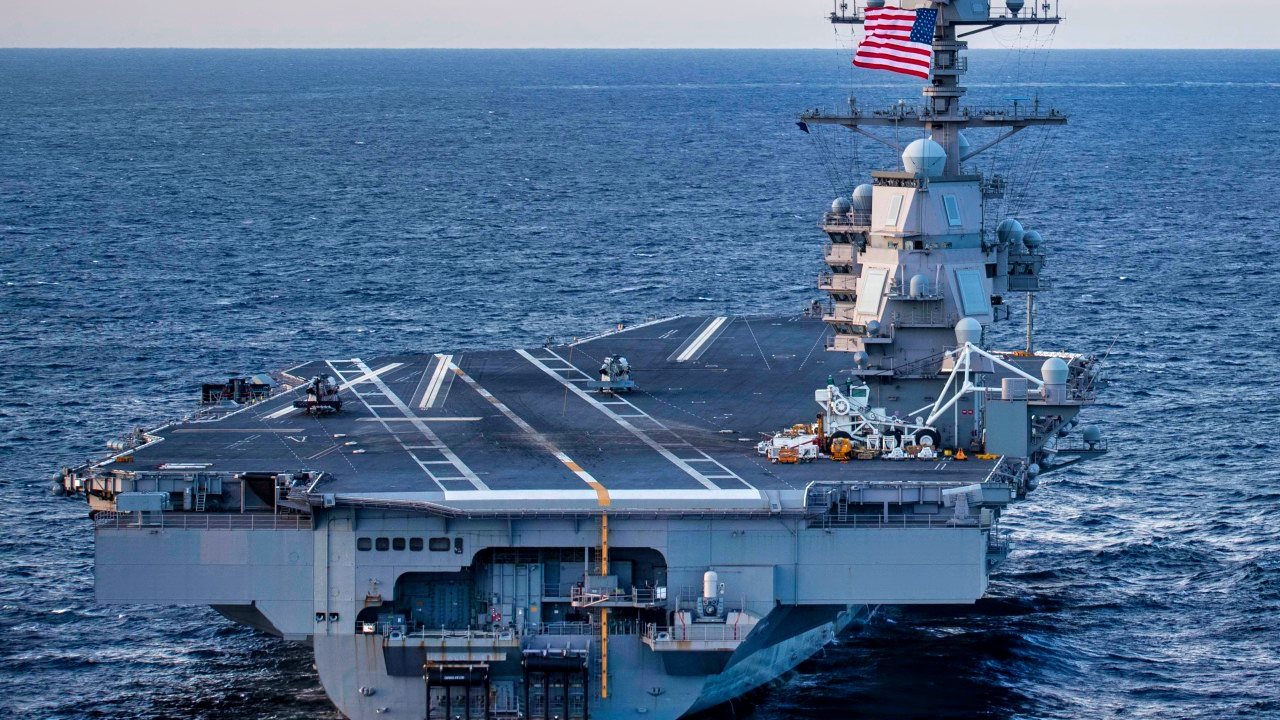
The Ford-class aircraft carrier USS Gerald R. Ford (CVN 78) and the Italian aircraft carrier ITS Cavour (CVH 550) transit the Atlantic Ocean March 20, 2021, marking the first time a Ford-class and Italian carrier have operated together underway. As part of the Italian Navy’s Ready for Operations (RFO) campaign for its flagship, Cavour is conducting sea trials in coordination with the F-35 Lightning II Joint Program Office’s Patuxent River Integrated Test Force to obtain official certification to safely operate the F-35B. Gerald R. Ford is conducting integrated carrier strike group operations during independent steaming event 17 as part of her post-delivery test and trials phase of operations. (U.S. Navy photo by Mass Communication Specialist 3rd Class Riley McDowell)

Puget Sound Naval Shipyard, Wash. (Aug. 14, 2003) — Illustration of USS Ohio (SSGN 726) which is undergoing a conversion from a Ballistic Missile Submarine (SSBN) to a Guided Missile Submarine (SSGN) designation. Ohio has been out of service since Oct. 29, 2002 for conversion to SSGN at Puget Sound Naval Shipyard. Four Ohio-class strategic missile submarines, USS Ohio (SSBN 726), USS Michigan (SSBN 727) USS Florida (SSBN 728), and USS Georgia (SSBN 729) have been selected for transformation into a new platform, designated SSGN. The SSGNs will have the capability to support and launch up to 154 Tomahawk missiles, a significant increase in capacity compared to other platforms. The 22 missile tubes also will provide the capability to carry other payloads, such as unmanned underwater vehicles (UUVs), unmanned aerial vehicles (UAVs) and Special Forces equipment. This new platform will also have the capability to carry and support more than 66 Navy SEALs (Sea, Air and Land) and insert them clandestinely into potential conflict areas. U.S. Navy illustration. (RELEASED)
Abu Dhabi is already investing in its diversification away from Hormuz.
Bloomberg reported Tuesday that L’IMAD Holding, the roughly $300 billion sovereign investment platform chaired by Crown Prince Sheikh Khaled bin Mohamed Al Nahyan, is set to spend tens of billions on port infrastructure out of the strait, people familiar with the matter said.
This figure is a projection, not an announced government spending plan, but an estimate of how much L’IMAD will invest in these projects as they get underway.
Foreign Trade Minister Thani Al Zeyoudi said last June that the UAE was “moving toward having zero Hormuz dependency,” focusing first on the eastern ports of Fujairah, Dibba and Khor Fakkan.
The government is also considering another harbor on the Gulf of Oman and new pipeline, rail and road connections to link the coast with the country’s oilfields, gas facilities and industries.
The Financial Details
L’IMAD has recently consolidated its grip on one company that would be key to the project. In August, its wholly owned subsidiary ADQ made a 6.25 dirhams-per-share offer for the 24.58% of AD Ports Group it didn’t already own.
The bid values the entire ports company at around 31.8 billion dirhams ($8.7 billion) – not just the 24.58% being purchased.
The offer price is 23% higher than AD Ports’ Aug. 14 closing stock price.
The tender closed Sept. 15, and settlement of the offer was completed on Sept. 25, when payment was made to accepting shareholders and the acquired shares were transferred to ADQ.
The transaction increased ADQ’s ownership of AD Ports from 75.42% to 98.93%.
L’IMAD itself stated its interest in such a large acquisition in its official offer document, filed with the Abu Dhabi Securities Exchange.
It said AD Ports would require “continued and sustained investment” in its infrastructure and characterized the company’s future growth as capital-intensive and long-term.
AD Ports is part of L’IMAD’s Ports & Logistics platform along with Etihad Rail and Aramex, giving the sovereign investor a presence in ports, freight, rail and logistics to complement its push to develop alternative trade routes outside the Strait of Hormuz.
Chief executive Jassem Bu Ataba Al Zaabi said in May that “Infrastructure forms one of the key pillars of our investment strategy.” The fund, ADNOC, BlackRock’s Global Infrastructure Partners, and Singapore’s Temasek also announced plans for a partnership targeting $30 billion in investment, reflecting “continued global investor interest in the UAE and the wider region,” the companies said.
The build-out is also underway. ADNOC chief executive Sultan Al Jaber said in May that “too much of the world’s energy still moves through too few chokepoints,” as the company accelerated construction of a second pipeline to double export capacity through Fujairah.
“Hormuz is not just an oil story.
It is an everything story,” Al Jaber said. ADNOC said the second pipeline was already 50% complete and could possibly be delivered next year.
Building Outside the Strait
Dubai-based DP World is taking the same approach.
In July, it agreed to develop two new terminals in Fujairah under a 50-year concession: Al Rugaylat container and multipurpose terminal and a general cargo terminal at Dibba.
Combined, the projects will increase DP World’s UAE container capacity from 19.4 million to almost 22 million TEUs.
“Fujairah strengthens what Jebel Ali already delivers,” DP World chief executive Yuvraj Narayan said. It means “greater flexibility, more choice and stronger supply chain resilience” for cargo owners, he added.
DP World chairman Essa Kazim said the investment “reflects our confidence in its future as one of the world’s leading trade and logistics hubs.”
The Strait of Hormuz: ‘A Worthless Piece of Water’?
The UAE is also partnering with Oman to move cargo through Sohar and Duqm. Al Zeyoudi said this month, “We cannot allow individual nations to determine our trade ambitions.”
“These are not short-term fixes,” he said of the new corridors. “No single checkpoint can be allowed to threaten our economic viability.”
But decoupling the UAE from Hormuz doesn’t make the waterway any less valuable.
Treasury Secretary Scott Bessent argued earlier this month that in two years the strait could become “a worthless piece of water” as new pipelines come online.
Qatari Energy Minister Saad Al-Kaabi, whose Islamist monarchy remains heavily reliant on Hormuz for LNG exports, disagreed.
“I think this is completely wrong,” Al-Kaabi said at the Qatar Economic Forum. He argued that Hormuz is crucial for trade well beyond oil and gas.
About the Author: Georgia Gilholy
Georgia Gilholy is a journalist based in the United Kingdom who has been published in Newsweek, The Times of Israel, and the Spectator. Gilholy writes about international politics, culture, and education. You can follow her on X: @llggeorgia.


