

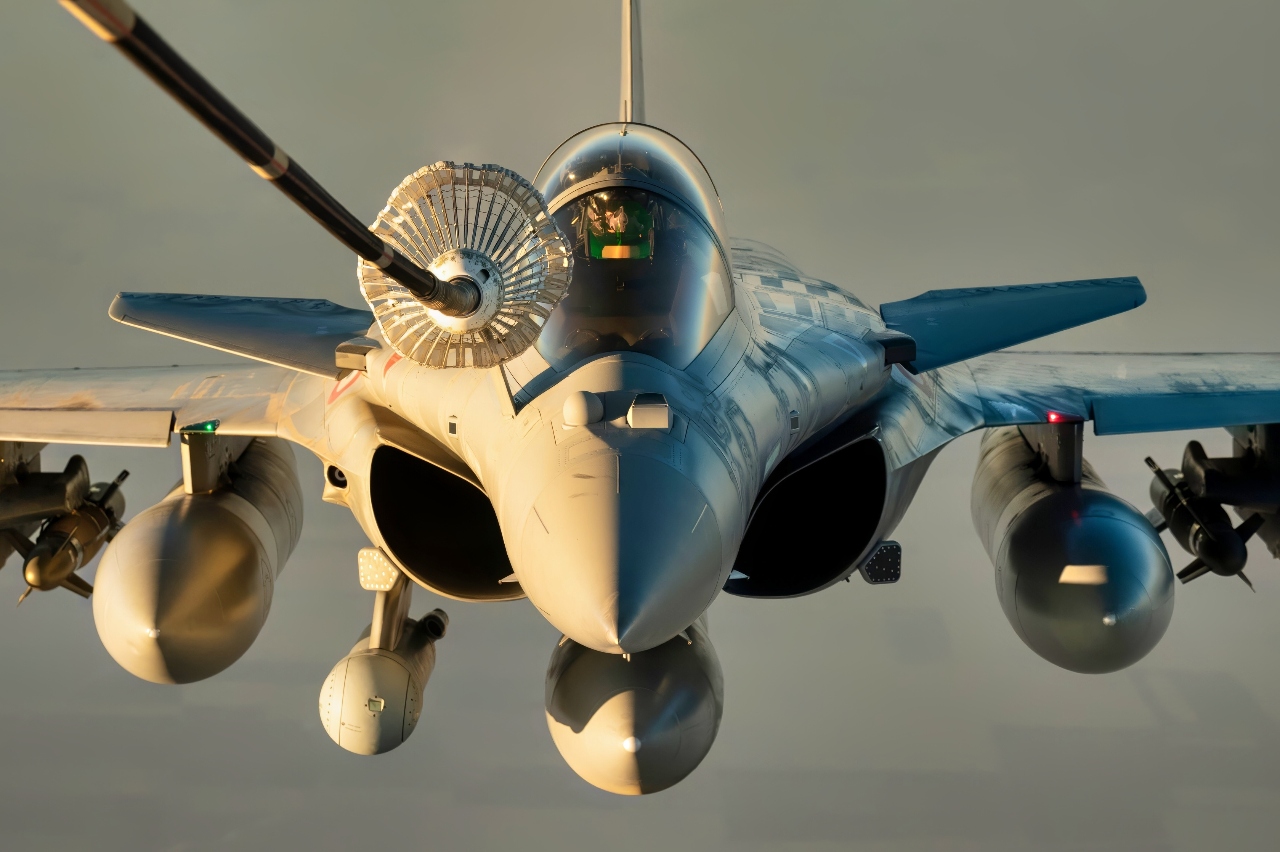
PUBLISHED on August 16, 2025, 10:55 AM EDT – Key Points and Summary: France’s Dassault is using its newest Rafale F5 upgrade as a technological “bridge” to the multinational Future Combat Air System (FCAS), Europe’s planned sixth-generation fighter.
-The F5 will pioneer key FCAS technologies, including the ability to control “loyal wingman” drones. However, the entire FCAS project is at risk due to deep friction between the partners.
-Dassault’s CEO has hinted at a possible French withdrawal, while Paris is reportedly demanding an 80% workshare of the program, a move that could cause the complex European collaboration to collapse, leaving the future of European air power in question.
Super Rafale F5 Is Coming Soon
French aerospace giant Dassault has a long and storied history of building military aircraft, and they do not build them just for France.
A number of international partners have stored French-built jets in their hangars since the end of the Second World War, including partners in Europe, the Middle East, and beyond.
It is a testament to the firm’s ability to steadily and reliably produce high-quality fighter jets and other aircraft at an attractive price point, without compromising on capabilities.
Currently, the firm is jockeying for position with its European partners in Germany and Spain to determine who will decide not only what the Future Combat Air System (FCAS) will look like, but also what it will be capable of.
Although that friction has yet to be ironed out, the firm is already preparing to roll out some features on its newest Rafale fighter that will later be incorporated into the FCAS sixth-generation fighter.
Rafale F4.3
The F4.3 standard is the last of the F4 upgrades to the Rafale platform and will act as a bridge between the F4 and F5 standards.
The F5 standard will usher in teaming between manned Rafale fighters and unmanned loyal wingman drones. But for now, Dassault is teasing out potential issues with the pre-FCAS standard.
Recent evaluations “in operational mission situations,” covered a “wide range of use of the aircraft while analyzing the performance of its various systems with appropriate measurement elements, particularly focused on connectivity and weapons systems,” the French Defense Ministry explained in a recent statement.
It added that “seven missions took place with scenarios covering the air-to-air, air-to-ground and air-to-sea domains.” So far, so good, but the F4 standard is not the end of the Rafale platform. Far from it.
Rafale F5
This F5-level upgrade is, if all goes according to plan, an opportunity for Dassault to showcase some of the technologies it would like to eventually integrate into the Future Combat Air System.
The FCAS is a multinational European effort to develop and build a sixth-generation fighter that would replace many of the Cold War- and post-Cold War-era aircraft in European air forces.
“This stealth combat drone will contribute to the technological and operational superiority of the French Air Force by 2033.
It is significant that it is being initiated today, as we mark the 60th anniversary of the Strategic Air Forces and the 90th anniversary of the Air and Space Force: in aeronautics — a highly complex field — the future has deep roots, and innovation is built on experience,” Éric Trappier, Dassault Aviation’s Chairman and CEO, said.
The French firm intends for its F5-tranche to serve as a technological lifeline; a bridge of sorts between the Rafale and the FCAS, and potentially an opportunity to troubleshoot some of the technologies that will feature more prominently on the FCAS.
Future Combat Air System
Dassault’s CEO has asserted several times that his firm would be capable of building a sixth-generation fighter from scratch without the assistance of other countries or their aerospace firms.
Such statements raise the specter of French withdrawal from European aerospace projects. Earlier this summer, Trappier, speaking at the Paris Air Show, hinted that Dassault could simply drop out of the FCAS.
The website Hartpunkt reported that the French government, through the Ministry of Defense, has informed Berlin that it seeks an 80 percent share of the work that will go into the FCAS.
One of the big hopes is that the Future Combat Air System will fly alongside attritable loyal wingmen drones — in essence, expendable unmanned platforms with organic stealth and weapons capabilities that would fly into highly contested airspace in place of manned platforms such as the FCAS.
While human pilots would control the drones, they would remain out of harm’s way. The expansion of a pilot’s capabilities in this way has not yet been seen on the battlefield, but the projected capability could translate to dominance for the air force that boasts a significant and mature loyal wingman capability.
What Happens Now?
The question now is whether the European partners involved in the Future Combat Air System will acquiesce to French demands.
Another lingering question is whether the French Defense Ministry should follow the precedent set by previous governments faced with friction in aerospace projects — that is, leave the project. Should that happen, the remaining parties would have to choose whether they can still go forward with the joint effort.
Europe is a continent rich with aerospace and defense expertise, but national interests run deep – as does the desire for strategic autonomy in Paris.
But without French experience and money, both the build and the burden-sharing will place additional strain on an already complex multinational initiative. It may prove hard to pin down, but for all parties involved, a compromise solution on the Future Combat Air System would be the most practical option.
About the Author: Caleb Larson
Caleb Larson is an American multiformat journalist based in Berlin, Germany. His work covers the intersection of conflict and society, focusing on American foreign policy and European security. He has reported from Germany, Russia, and the United States. Most recently, he covered the war in Ukraine, reporting extensively on the war’s shifting battle lines from Donbas and writing on the war’s civilian and humanitarian toll. Previously, he worked as a Defense Reporter for POLITICO Europe. You can follow his latest work on X.
Military Matters
The F-22 Raptor Just Keeps Getting Better


