

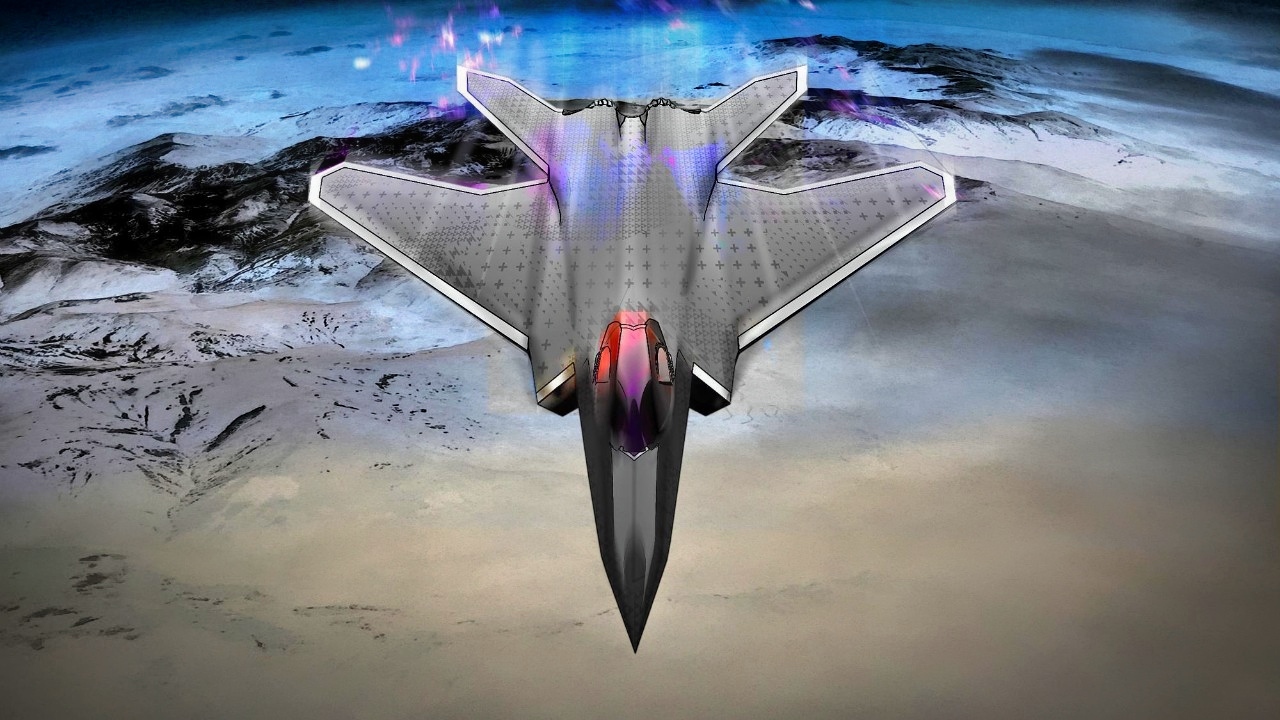
FCAS Key Points and Summary – Europe’s Future Combat Air System (FCAS), an ambitious sixth-generation stealth fighter program involving France, Germany, and Spain, is at a critical crossroads.
-The project holds the promise of revolutionizing European air power and fostering unprecedented industrial cooperation.

FCAS Fighter Mock Up. Image Credit: Creative Commons.
-However, it is also hobbled by the very real threat of political fragmentation, competing national priorities, and budgetary constraints—pitfalls that have doomed past multinational European defense efforts.
-As it vies to keep pace with the American NGAD/F-47 and the UK-led GCAP programs, the ultimate success of FCAS will depend on whether its partners can overcome their differences for the sake of collective security.
FCAS: Will This Fighter Fly?
In an era of unprecedented technological progress and fluid geopolitical landscapes, Europe’s Future Combat Air System (FCAS) is emerging as a daring project to reshape aerial warfare.
For all the ambition of this sixth-generation stealth fighter program to integrate state-of-the-art technologies and unite European nations, it presents a double-edged sword of challenges and opportunities.
Comparing it against the US F-47 or Next Generation Air Dominance (NGAD) and the UK-led Global Combat Air Programme (GCAP) highlights the fact that while FCAS has the potential to revolutionize European air power, it faces a labyrinth of political, technological, and financial obstacles that could either see it succeed or fail miserably.

NGAD Artist Photo. Image Credit: Creative Commons.
Fundamentally, the FCAS is expected to represent a next-generation fighter combat system, one that excels not only in traditional air-to-air combat but also integrates with unmanned assets and advanced networked warfare capabilities. There are real challenges to make this vision work, however, rooted in the nature of defense cooperation in Europe.
Whereas the NGAD has a more concentrated approach and leverages the unity of strategy (hence the defense budget) of the US, the FCAS will have to deal with differing priorities of several countries, each with their own defense priorities and budget restrictions.
Such fragmentation can result in delays, widespread overruns, and a strategic coherence void, as evidenced in previous European defense initiatives.
A 6th Generation Fighter World
The race for high-tech sixth-generation aircraft is also increasing. The NGAD program is already surging forward with capabilities including artificial intelligence, hypersonic weapons, and more stealth.
FCAS, meanwhile, is in the early stages of development as it attempts to integrate these technologies into a coherent, unified service. This poses a double risk: that FCAS could become a second fiddle to its American counterpart, and also that by the time FCAS rolls out its first aircraft, it may find itself reacting to threats posed by adversaries who are moving at a pace and developing their own military capabilities. The imperative to innovate is mission-critical, and time will always be of the essence.
But the problems faced by FCAS can also represent particular opportunities. The project is collaborative, with knowledge shared and resources pooled among European nations, which, in theory at least, would result in a better and more adaptable fighter than any one country could have built alone. This cooperation may promote a joint approach among European allies and may be linked to a collective defense mechanism in an increasingly multipolar world. Additionally, integration with NATO forces and other allied systems supports a focused and unified effort towards more effective European air power capabilities, the kind of integrated stance that will be critical in managing increasingly sophisticated threats.

A U.S. F-35A Lightning II departs after conducting aerial refueling with a KC-10 Extender from the 908th Expeditionary Air Refueling Squadron, June 11, 2019 at an undisclosed location. The fifth generation fighter provides the pilot with comprehensive situational awareness in a sphere around the aircraft for missile and aircraft warnings, day and night vision, extended range detection and precision targeting against air and ground threats, granting the U.S. Air Force and its allies’ air superiority. (U.S. Air Force photo by Staff Sgt. Keifer Bowes)
The GCAP program, however, is more focused on the UK’s own defense requirements and its defense-industrial relationship with Japan, Italy, and potentially Saudi Arabia. By concentrating largely on the UK’s needs and leadership, decisions can be made more quickly, and development times may be shorter. However, it also risks involving the project a combatant that may not quite fit the broader picture of European defense. The key for the UK will be in making GCAP relevant in the context of NATO and European defense efforts, so as not to fall into the trap of self-isolation that has surrounded past national capability programs.
When we consider the implications of these programs, we must take into account the financial reality that underpins them. The FCAS project is so vast in scale and ambition that substantial national investments are required. However, with defense budgets under the microscope across Europe, how can European countries afford to invest in what is needed to make FCAS a reality?
The solution may be for European leaders to focus on defense spending to foster a culture of collaboration and mutual benefit, extending beyond their national interests. If it works, FCAS could become a model for future defence projects, demonstrating how political and military will combine to produce something powerful.
The NGAD program, by contrast, is bolstered by the United States’ deep pockets, despite repeated accusations that it’s “underfunded,” which enables fast prototyping and iterative design. This financial cushion allows the US to explore a broader range of technological advancements, which have the potential to alter the calculus of air combat. However, this has also raised concerns about whether it can be maintained. However, as the US military faces fiscal belt-tightening and conflicting demands on scarce defense dollars, the fate of NGAD may be murkier in the longer term. The task for the US will be to strike an innovative balance between investment and fiscal responsibility, ensuring its air dominance remains technically superior while being fiscally sustainable in the long run.
On the one hand, FCAS must not only rival NGAD and GCAP but also maintain its own distinct identity in a crowded global defense environment. That will require a clear statement of its strategy and a willingness to nurture innovation that is both groundbreaking and achievable. The incorporation of ‘disruptive technology’ like AI, cyber, and next-generation sensors will be essential to keeping FCAS abreast of a rapidly evolving battlespace.

NGAD. Image Credit: Creative Commons
The FCAS programme could also help to develop new technologies that could be used for both military and non-military purposes. The program’s collaborative approach could help drive innovation in industries such as aerospace, cybersecurity, and artificial intelligence, with a ripple effect extending to enhanced technological capabilities across Europe. Investing in FCAS could also help European countries emerge as leaders in the global defense industry, luring talent and investment that would benefit their economies as well.
Yet the journey to success is pitted with challenges. A history of European defence cooperation has seen a succession of grandiose plans that are rarely realised. The A400M military transporter and the Eurofighter Typhoon are both shining examples of how political divisions and financial constraints can compromise well-conceived projects. If FCAS is not to suffer a similar fate, it needs to establish governance that ensures transparency, accountability, and efficiency in decision-making among the contributing nations. This would entail a willingness to transcend nationalist impulses and promote a culture of cooperation that prioritizes collective security over the vagaries of individual interests.
Furthermore, the global geopolitical situation is evolving rapidly, with multipolarity replacing the unipolar reality of the post-Cold War era. Relatedly, the growing prominence of hybrid warfare, cyber challenges, and the availability of advanced missile systems necessitate a reevaluation of traditional defense concepts. FCAS will therefore need to be flexible and adapt to these new dynamics, while effectively countering the new threats, while retaining its technological superiority. That flexibility will be vital to maintaining relevance in a future that is anything but clear and straightforward.
It seems obvious that the failure or success of the FCAS project will depend on whether European countries can transcend their historical divisions and stand united behind a shared vision. This will require not only political will but also a realization of the common security challenges that Europe confronts in the 21st century. The time for a European defence approach is now more urgent than ever. To have a chance to improve European air power at the same time as strengthening cooperation between countries that have a kind of innate commitment to collective defence.
MORE – A 7th Generation Fighter Is Possible
FCAS Fighter Headed for Failure?
In conclusion, the Future Combat Air System is at a crossroads, with challenges in equal measure to great opportunities. As it aims to stand alongside NGAD and GCAP, FCAS now urgently needs to navigate the complexities of the European defense landscape while also being agile in the face of technological progress and geopolitical developments.
It will not be simple, but with some clear vision and a willingness to work together, FCAS has all the potential to shape the future of European air power and ensure that Europe continues to play a credible role in global defence. The existential stakes are high, and the moment calls for decisive action—the Future for European Defense.
The success of FCAS will determine whether future defense initiatives are a shining testament to cooperation and innovation in a global setting or simply the latest chapter in a long tale of missed opportunities.
About the Author: Dr. Andrew Latham
Andrew Latham is a non-resident fellow at Defense Priorities and a professor of international relations and political theory at Macalester College in Saint Paul, MN. You can follow him on X: @aakatham.
Military Matters
Russia’s Su-57 Felon Stealth Fighter Is a Waste of Rubles


waco
July 16, 2025 at 5:33 pm
FCAS is as good as 100% totally dead in the water.
Germany and spain need to ditch macron land and replace it with south korea. Asap.
As a worthy rival to the UK-italy-jap gcap.
Speaking of korea, russia needs to work with north korea to produce an oreshnik-type IRBM that can land in the waters off south-eastern taiwan.
Instead of always in the waters of the japan sea or sea of japan.
The new IRBM must be a maneuvering type fully capable of dodging interception.
Also capable of hitting Taipei with miniaturized nuke warhead or warheads.
That’s important bwcuz donald trump is secretly planning with NATO cronies to do a number on moscow city.
D-O-Y-L-E
July 16, 2025 at 7:49 pm
Rumors are swirling within NATO circles trump or hegseth could soon be providing tomahawk missiles to ukraine.
That’s a good move as tomahawks will definitely jolt putin right in the backside and finally force him to wake up and smell the air around him.
What’s the air around putin.
It’s full of death and putrefaction cause by ineptitude and sheer stupidity.
But putin is still unaware of it. Hopefully, the tomahawks fired by zelenskyy will do something good and….
And finally and at last end the biden-authored war in donbass.
It takes a biden to start a bloody war and another biden to end it. QUOTE OF THE DAY.
One-World-Order
July 16, 2025 at 8:29 pm
Today, Wednesday, the 16th of July 2025, the world is collapsing, tumbling and crashing.
Israel not satisfied with the daily slaughter in Gaza, is attacking and bombings Damascus.
In Donbass or eastern Ukraine, the two sides are going thongs and hammers at each other, never mind any talk of ceasefire.
The reason is because trump is slowly becoming unhinged, and unable to control and running the world (in biden’s words).
Why. Reason why is the MAGA faithful have been pricked by Elon musk posting on X on 5 June 2025.
“Time to drop the really BB. @realDT name is in the Epstein files. That’s the reason they have not been made public.”
Due to MAGA unease, the whole world is collapsing.
Donbass is collapsing, middle east is collapsing. The far east is collapsing as Australia ramps up its military exercises and military cooperation with pacific forces ready for ww3.
Everything today is collapsing as trump slowly detaches from his grip on reality.
It’s finish for trump.
Remember, to stock up your larder now. Keep yer pantry full. To the brim.to overflowing.
pagar
July 16, 2025 at 8:58 pm
The USA could be swearing in a new president, very soon, or sometime later this year.
JD vance could very well become the 48th president of the USA. By christmas 2025.
Donald trump, the current president of USA, is seen quite heavily aged, and in just a matter of days.
Visibly hagged and drawn. The ravages of age can’t be hidden now, today, even by cleverly positiond camera angles.
The cause is trump’s own obnoxious boasting and bombasting and embellishing of his abilities and brain power.
After berating zelenskky in the US white house living room on 28 feb 2025, trump failed to do the critical follow-up.
He failed to draw up the map so greatly NEEDED for a peaceful ukraine and he failed to shut down the weapons and ammo pipeline to gaza.
Trump failed, and failed badly. Very badly.
He harangued the entire world with endless lectures about the effectiveness of tariffs, not realising the ground was already beginning to move right under his feet.
Trump has failed and his glaring failure is showing via his aged appearance on camera.
Smile, ya on candid camera !
SMILE !!!