

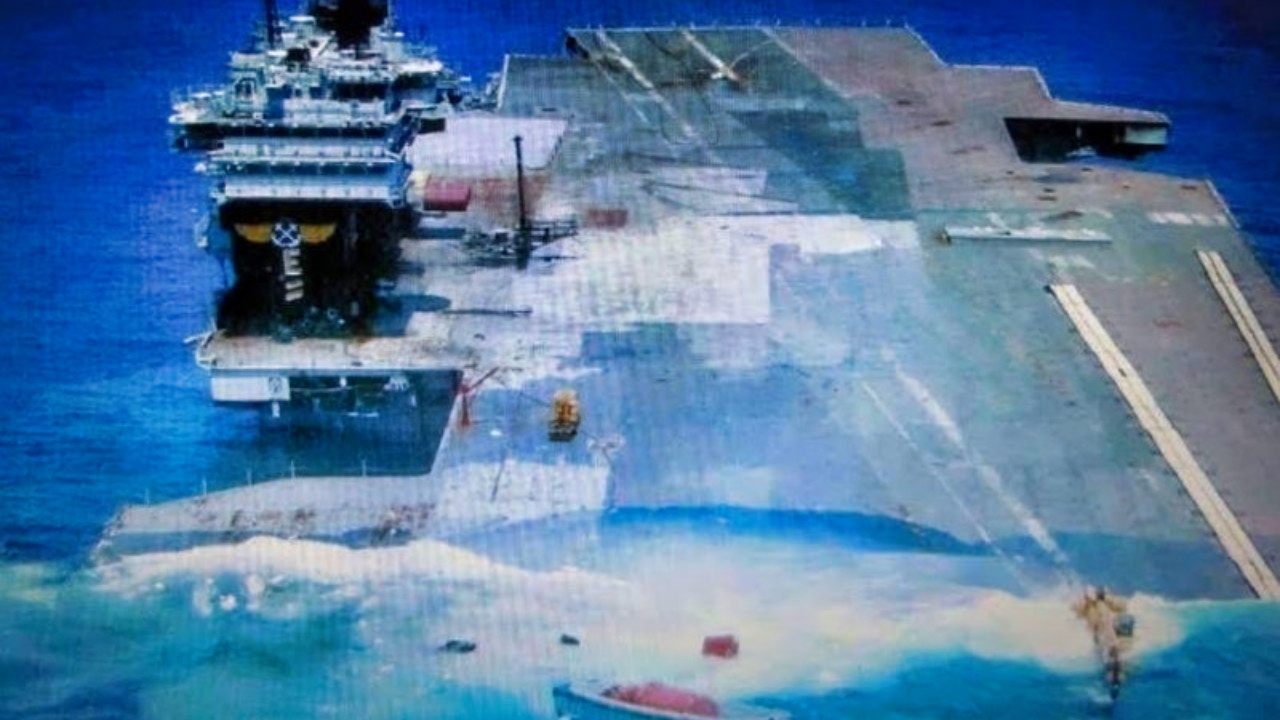
Key Points and Summary – In 2005, the U.S. Navy turned retired aircraft carrier USS America into the ultimate test article, subjecting her to a four-week sinking exercise to understand how modern supercarriers actually die.
-Explosives placed below the waterline failed to finish the job, forcing teams aboard to scuttle the ship from inside.
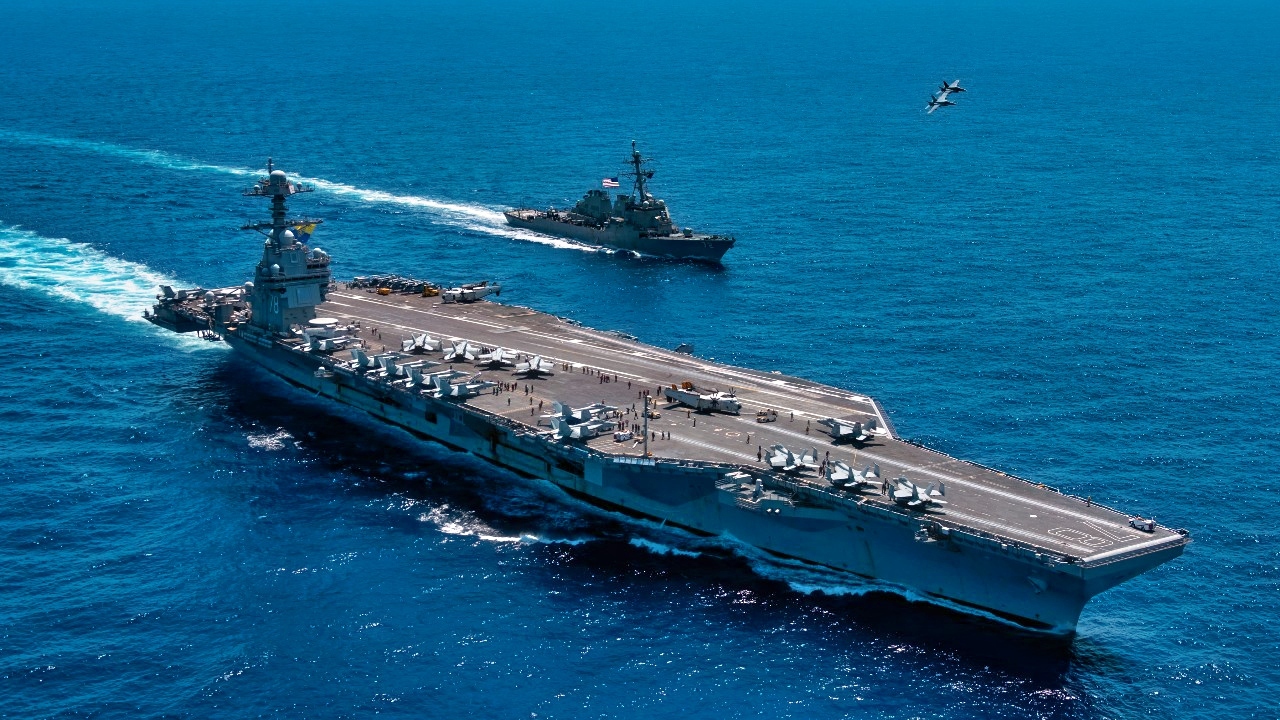
An F/A-18F Super Hornet, attached to the “Blacklions” of Strike Fighter Squadron (VFA) 213 and a F/A-18E Super Hornet, attached to the “Golden Warriors” of Strike Fighter Squadron (VFA) 87 fly over the world’s largest aircraft carrier, USS Gerald R. Ford (CVN 78), the Arleigh Burke-class guided-missile destroyer USS Mahan (DDG 72), April 11, 2025. The Gerald R. Ford Carrier Strike Group is underway in the Atlantic Ocean completing integrated naval warfighting training. Composite Training Unit Exercise (COMPTUEX) is the Joint Force’s most complex integrated training event and prepares naval task forces for sustained high-end Joint and combined combat. Integrated naval training provides America’s civilian leaders and commanders highly-capable forces that deter adversaries, underpin American security and economic prosperity, and reassure Allies and partners. (U.S. Navy photo by Mass Communication Specialist 2nd Class Maxwell Orlosky
-The results underscored how tough carriers really are: double hulls, compartmentalization, and sheer size make them far harder to kill than many “carrier-killer” narratives suggest.
-Lessons from America fed directly into Nimitz- and Ford-class design, reinforcing that sinking a carrier likely requires massed, coordinated strikes—not a single lucky hit.
Purposeful Sinking of the Aircraft Carrier USS America Instrumental in Fleet Survivability
The U.S. Navy sometimes uses a sinking exercise, or SinkEx, to destroy a retired ship by using it as a target for gunnery practice. The exercise is a way to test weapons and see how survivable a vessel is. Starting on April 19, 2005, the aircraft carrier USS America (CVA-66) was the subject of a SinkEx to remember—it took four weeks to send the carrier to the bottom of the sea.
The America was the Navy’s third Kitty Hawk-class carrier. The ship was decommissioned in 1996 and spent its final years at the Naval Inactive Ship Maintenance Facility in Philadelphia. The Navy towed it off the coast outside Philadelphia to destroy it, an event that made the America the only modern-era U.S. “supercarrier” to be sunk.
What the USS America Had Going For It
“It took four weeks and they ended up having to scuttle her from on board due to her not sinking. She is not only far larger than WWII battleships, but she is also a lot tougher,” said Navy mechanical engineer Blake Horner, as quoted by the Aviation Geek Club. “While she does not have the heavy armor the battleships of yore had, she does have a double layered hull, meaning weapons have to push through alternating layers of steel and empty pockets to reach her internals.”
Can a Carrier Take Multiple Hits from Modern Weapons?
The Navy used controlled explosives to sink the America instead of the bombs, anti-ship missiles, and torpedoes that would usually be used during a SinkEx.
The Navy wanted to see just how survivable a carrier can be when its limits are pushed.

Kilo-Class Submarine. Image Credit: Creative Commons.
Engineers and technicians found that carriers, thanks to their immense size, heavy armor, and stubborn bulkiness, are difficult to bring down. Explosives experts ended up having to go onboard the America after charges placed under the waterline couldn’t do the job.
Some Wanted the USS America to be a Museum Ship
Some of the America’s former sailors joined other aircraft carrier enthusiasts in a push to make the carrier into a museum ship.
But the Navy wanted the data collected during the SinkEx to inform the design of other carriers, such as the Nimitz-class.
Many Enemy Weapons Are Designed to Kill Carriers
The survivability of U.S. carriers has recently been a major topic of contention. Some analysts think the ships could be highly vulnerable to Chinese “carrier-killing” missiles such as the DF-17, DF-26, and DF-21D. These are fearsome weapons, but they have smaller warheads than the explosives that were used to sink the America. It would likely take numerous hits by missiles and torpedoes to sink a newer aircraft carrier.
Even if one of the carriers were struck, these vessels might be strong enough to hold out for all hands to be rescued, and perhaps survive to be repaired.
Escort Ships Are Effective at Protecting Carriers
To sink a carrier, multiple airplanes, missiles, and submarines would have to attack at once. The carrier’s escorts—ships such as Arleigh Burke-class destroyers and Ticonderoga-class cruisers—provide a protective bubble, and the Aegis Weapon System provides early warning of incoming attacks. For a last layer of defense, U.S. carriers have the Phalanx close-in weapon system to fire at munitions that sneak through the protective screen.
Carriers are built with thick steel plating and tight compartments that can be closed if water rushes in after a hit from enemy weapons. Thus they are built to sustain some damage and continue operations.

J-20 with PL-15 Missile. Image Credit: Creative Commons.
Further, any adversary that wants to hit a carrier would first have to deal with the air wing that flies out ahead of the flotilla to provide early warning and destroy enemy airplanes.
Anti-submarine helicopters conduct undersea warfare to ward off adversarial boats, and the Navy’s own submarines protect strike groups as well.
The Houthis in Yemen launched numerous anti-ship missiles and unmanned kamikaze craft at U.S. carriers.
There were some close calls, but no attack struck home.
The Chinese would be a far greater threat, but a carrier strike group has ways to survive even if a hit gets through: Sailors are trained in damage control after strikes from missiles, bombs, or torpedoes.
Firefighting and flooding prevention are second nature for any sailor onboard a carrier.
The USS America demonstrated that sinking a carrier would be quite a task, and the designers of newer carriers incorporated lessons learned from SinkEx.
While losing a carrier is always plausible, destroying one is not easy. A lucky strike would likely not suffice, but luck would be needed to get through the defenses of a carrier strike group.
About the Author: Brent M. Eastwood
Author of now over 3,000 articles on defense issues, Brent M. Eastwood, PhD is the author of Don’t Turn Your Back On the World: a Conservative Foreign Policy and Humans, Machines, and Data: Future Trends in Warfare plus two other books. Brent was the founder and CEO of a tech firm that predicted world events using artificial intelligence. He served as a legislative fellow for US Senator Tim Scott and advised the senator on defense and foreign policy issues. He has taught at American University, George Washington University, and George Mason University. Brent is a former US Army Infantry officer. He can be followed on X @BMEastwood.
More Military
The Army’s AH-64E Apache Helicopter Can Destroy Drones with Missiles
U.S. Navy Iowa-Class Battleship USS New Jersey’s ‘Comeback’ Is Now Complete
Blaze of Glory: The SR-71 Blackbird Retired Hitting Mach 3.21


