

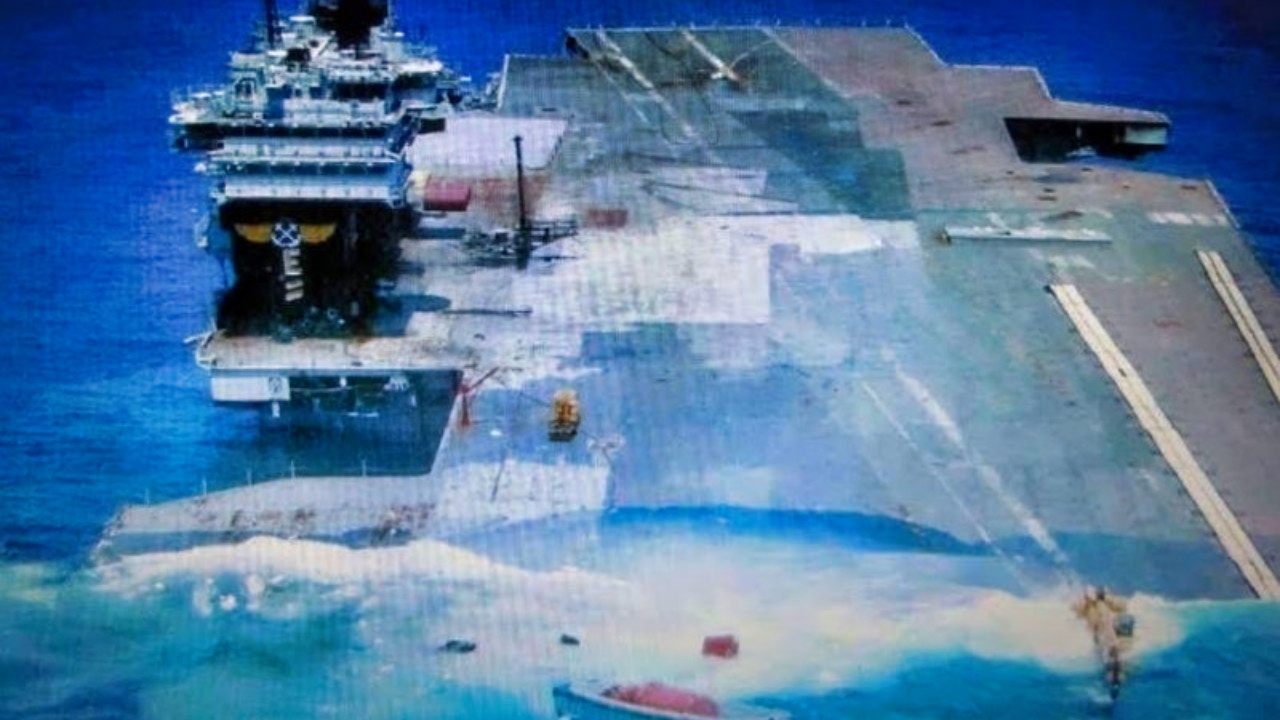
Key Points and Summary – USS America, a conventionally powered Kitty Hawk-class supercarrier, served from Vietnam through Desert Storm before retiring in 1996.
-In 2005, she undertook a final mission: a 25-day at-sea live-fire evaluation off North Carolina. Ordnance was choreographed to study blast effects, flooding, and structural resilience—not to sink her quickly.
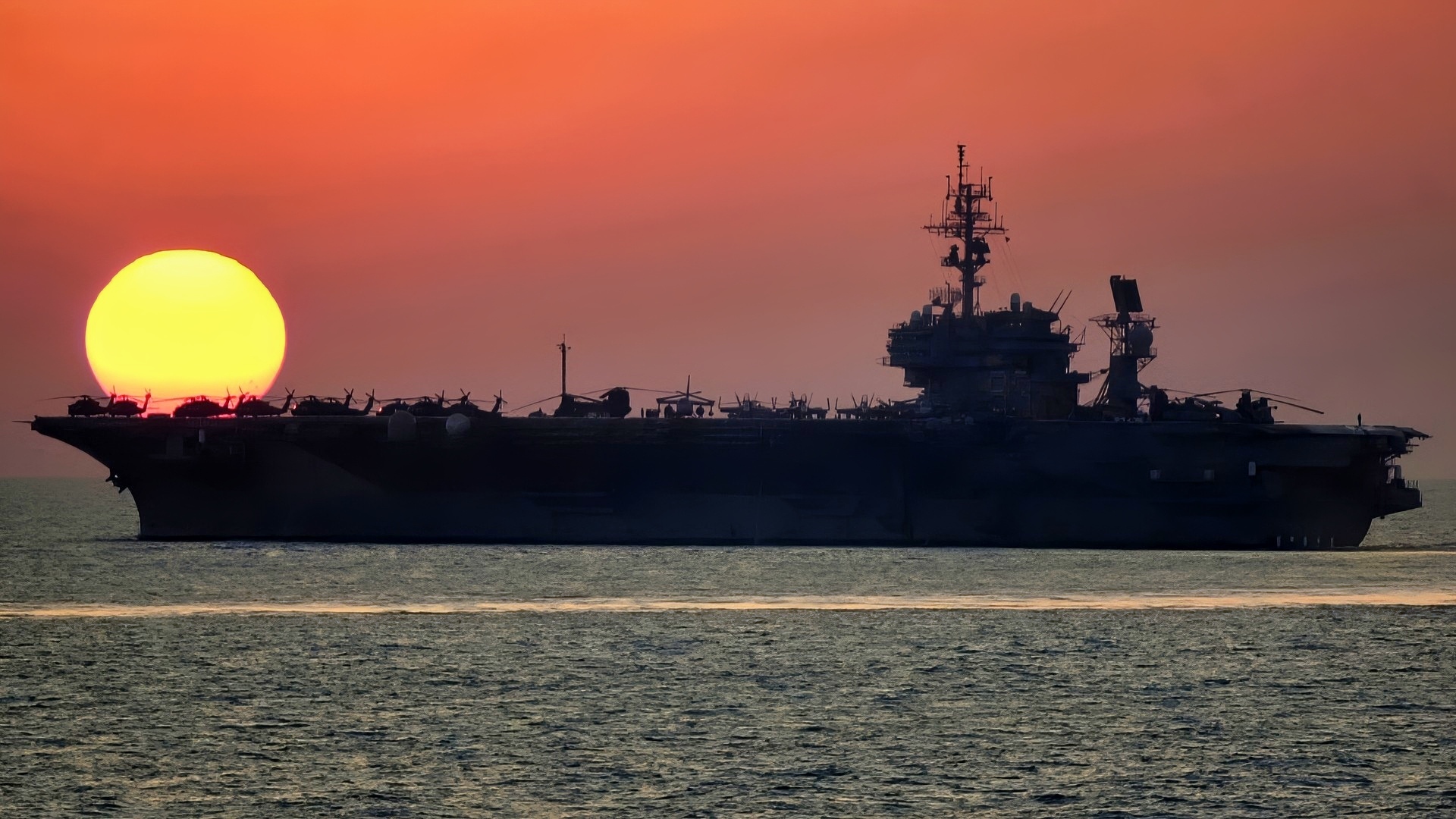
USS Kitty Hawk of Kitty-Hawk-Class. Image Credit: Creative Commons.
-Armor, compartmentation, and damage-control features kept the hulk afloat until scuttling charges finished the job.
-The data informed carrier survivability choices that carried into the Gerald R. Ford class and beyond.
-America earned five Vietnam battle stars—but her last act, dying by design, may be the most enduring contribution to U.S. carrier warfare.
The USS America and Kitty Hawk-class Aircraft Carrier
The USS America (CVA-66) was a Kitty Hawk-class supercarrier that was commissioned into U.S. Navy service in 1965. The carrier operated for just over three decades — it was removed from active duty and retired in 1996.
Unlike the Nimitz-class aircraft carriers that came later, or today’s Gerald R. Ford-class supercarriers, the USS America and the rest of the Kitty Hawk-class were conventionally powered, non-nuclear propelled carriers.
Despite the obvious limitations of conventional propulsion, the Kitty Hawk-class carriers were the pinnacle of Navy aircraft carrier design before nuclear carriers stole the show.
Newport News Shipbuilding, located in Virginia, constructed the USS America, with work commencing in 1961.
Measuring more than 1,050 feet in length, with a displacement of 82,000 tons when fully loaded, the America was the largest warship ever commissioned for the Navy when it debuted.
The America deployed to Vietnam three times in support of U.S. and South Vietnamese forces.
It later saw service in the Mediterranean as well as in the Persian Gulf, with the ship’s carrier wing serving brief combat stints over Libya in 1986 as part of Operational El Dorado Canyon. In 1991, the America played a role in Operation Desert Storm.
The Navy published a full account of the USS America’s service record online.
Despite America’s formidable capabilities, and a series of deep modernization efforts that saw upgrades to the carrier’s radar, electronics, and defensive systems, by the 1990s the ship’s aged hull and range limitations made it quite costly to maintain — especially compared to the servicing and maintenance advantages offered by the Nimitz-class’ nuclear propulsion.
The Navy, therefore, decided to decommission the carrier in the mid-1990s.
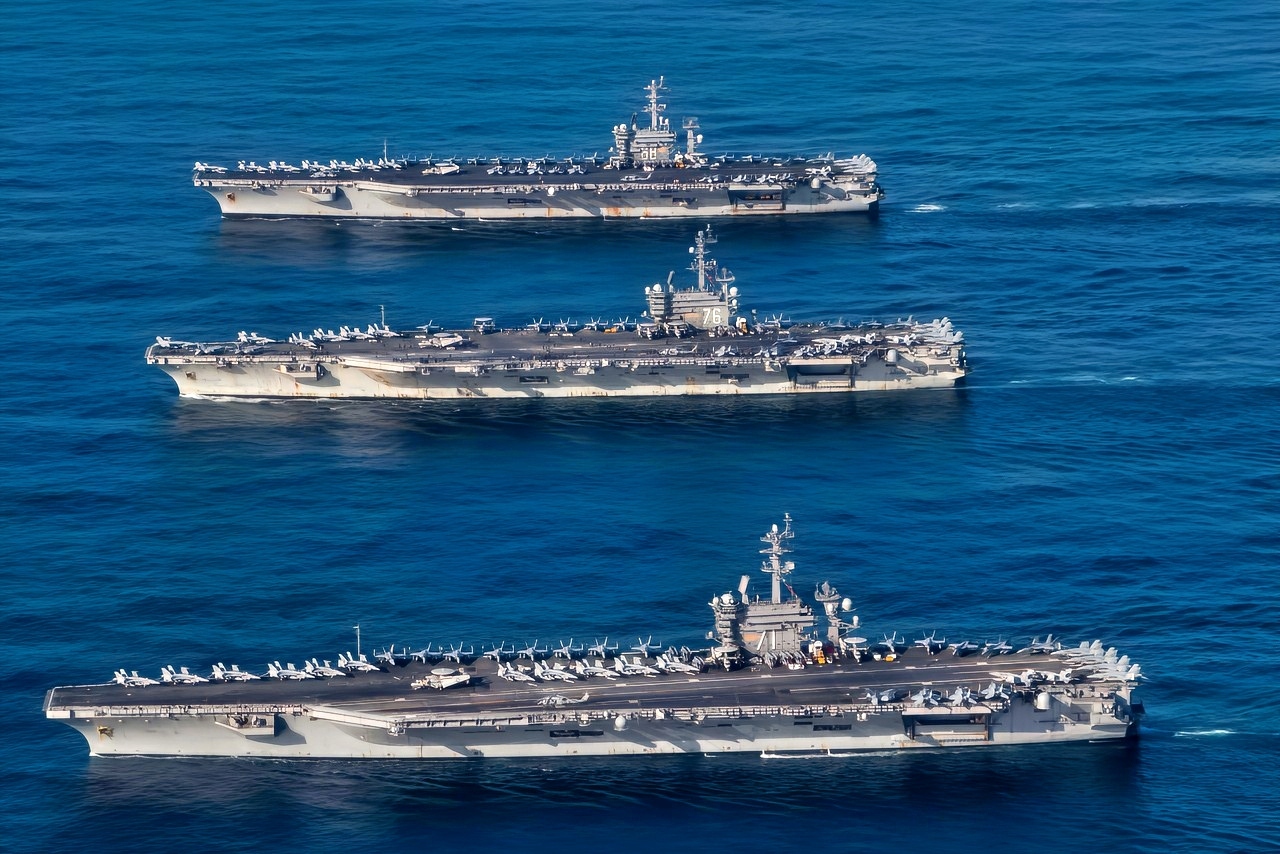
The U.S. Navy aircraft carriers USS Nimitz (CVN-68), USS Theodore Roosevelt (CVN-71) and USS Ronald Reagan (CVN-76) underway in the Western Pacific on 12 November 2017. The strike groups were underway and conducting operations in international waters as part of a three-carrier strike force exercise. This was the first time since August 2007 that three U.S. Navy carriers operated together. In 2007, USS Kitty Hawk (CV-63), USS Nimitz (CVN-68) and USS John C. Stennis (CVN-74) participated in exercise “Valiant Shield”.
The Final End
Rather than scrapping the America or turning her into a floating museum ship, the Navy decided to tow the enormous aircraft carrier out to sea for live-fire testing in 2005. Unlike some live-fire exercises, the America’s sinking was not only meant to better the abilities of sailors and airmen.
An additional goal was to evaluate how a Navy aircraft carrier — albeit an older, somewhat dated design — would fare after sustaining combat damage.
In essence, the America’s last role for the Navy would be to inform future carrier design with real-world explosive tests.
In May 2005, the Navy stationed the decommissioned carrier off the North Carolina coast. During a four-week period, the Navy subjected the America to a number of explosive and missile tests designed to recreate conventional anti-ship attacks. The objective was not to sink the America as quickly as possible. Instead, the ordnance leveled at the carrier was carefully choreographed to evaluate the effects on the ship’s hull, flight deck, and superstructure.
The ship was tested for its ability to isolate breaches to the hull and prevent rapidly filling with water and sinking. The America’s damage control systems were also evaluated for effectiveness.
Although the America took multiple hits, both direct and indirect, the aircraft carrier did not immediately sink — it was only after the Navy detonated a series of charges on the hull designed to scuttle the ship that it fell to the deep.
The evaluation demonstrated the Kitty Hawk-class’ resilience. The USS America stayed afloat under massive bombardment. Thanks to extensive armor plating, multiple redundancies in the ship’s design, and internal compartmentalization, the carrier showed an ability to absorb a great amount of punishment and remain afloat, albeit not necessarily combat-effective.
Postscript: RIP, USS America Aircraft Carrier
“On 14 May at approximately 1130 am EDT, a solemn moment of silence was held as the aircraft carrier ex-America slipped quietly beneath the waves. The data collected during the 25 days at sea from these test events will be of great value to Navy engineers and designers to improve the design and survivability of the nation’s future aircraft carrier fleet,” Naval Sea Systems Command reported in a 2005 statement.
“The Navy will provide a video and bronze plaque to members of the USS America Carrier Veterans Association and the America Museum Foundation at a yet to be determined time in the future. We thank and honor all the veterans of the USS America who lived and fought for freedom and democracy aboard this majestic vessel.”
Despite the USS America’s colorful combat legacy — the ship earned five combat stars for its service in Vietnam — its destruction was one of the carrier’s most important acts.
It helped inform the design of future aircraft carriers, notably the Gerald R. Ford-class, which is slowly coming online today.
Although the performance of the Ford-class’ new technologies has drawn some criticism — including of its weapons, aircraft elevators, and the class’ electromagnetic aircraft launch system — the insights gained from the USS America’s long and torturous sinking were a boon to the Ford’s survivability.
About the Author: Caleb Larson
Caleb Larson is an American multiformat journalist based in Berlin, Germany. His work covers the intersection of conflict and society, focusing on American foreign policy and European security. He has reported from Germany, Russia, and the United States. Most recently, he covered the war in Ukraine, reporting extensively on the war’s shifting battle lines from Donbas and writing on the war’s civilian and humanitarian toll. Previously, he worked as a Defense Reporter for POLITICO Europe. You can follow his latest work on X.
More Military
Ready, Aim, Fire! The 5 Best Battleships of All Time
The F-35 Stealth Fighter Still Haunts the U.S. Military
Does Russia Even Need a Powerhouse Navy?
The YF-118G Bird of Prey Stealth Fighter Haunts the U.S. Air Force


RC
October 10, 2025 at 3:24 pm
Having a bunch of these retired assets in reserve seems far more prudent than sinking all of them. Especially the conventionally powered ones that store better, I assume.