
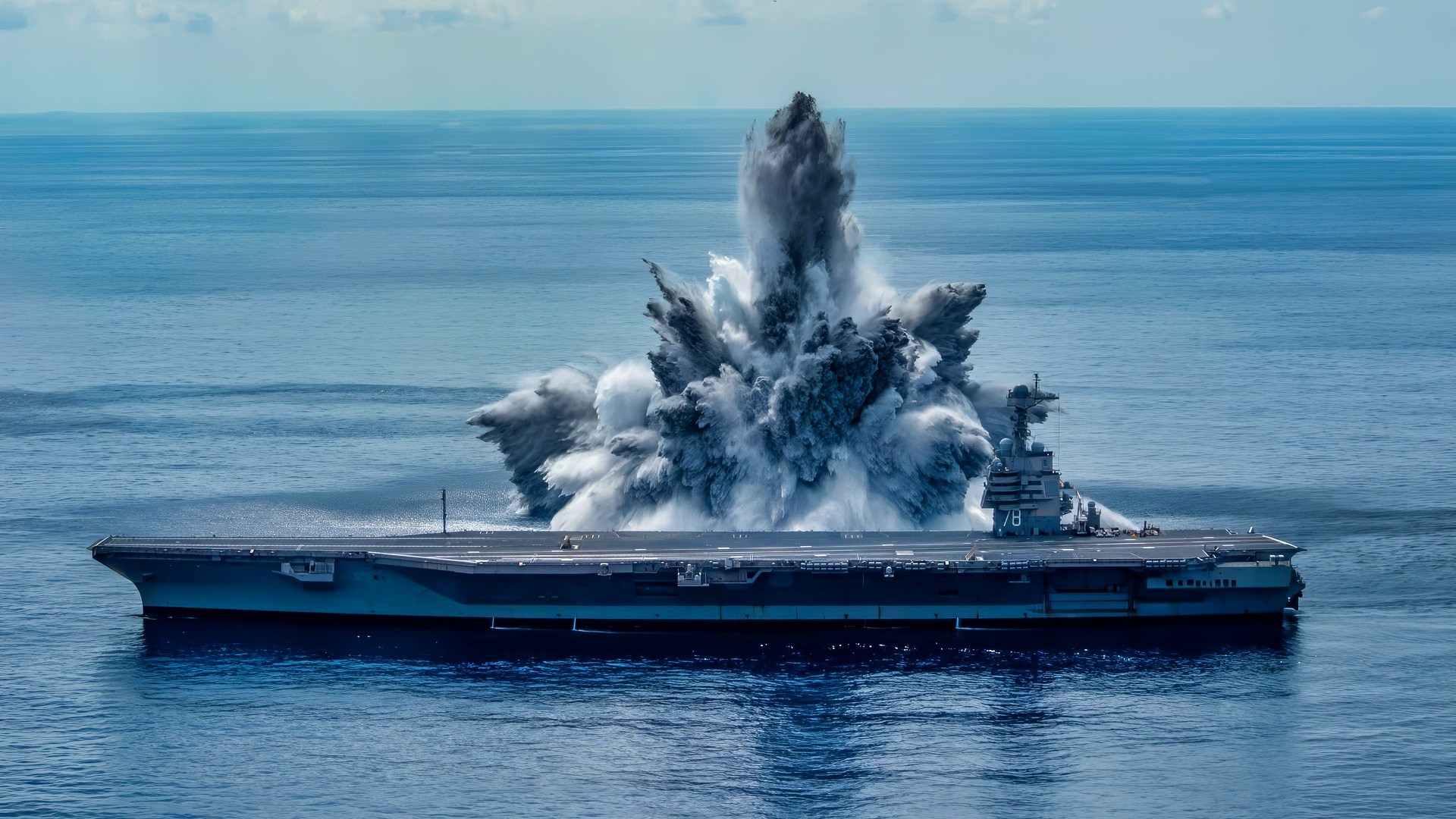
Key Points and Summary – Aircraft carriers face real peril from anti-ship ballistic missiles, hypersonics, quiet submarines, and massed drones—threats that could sideline traditional, manned-fighter air wings.
-But the platform isn’t dead; it must evolve.

USS Constellation Aircraft Carrier. Image Credit: Creative Commons.
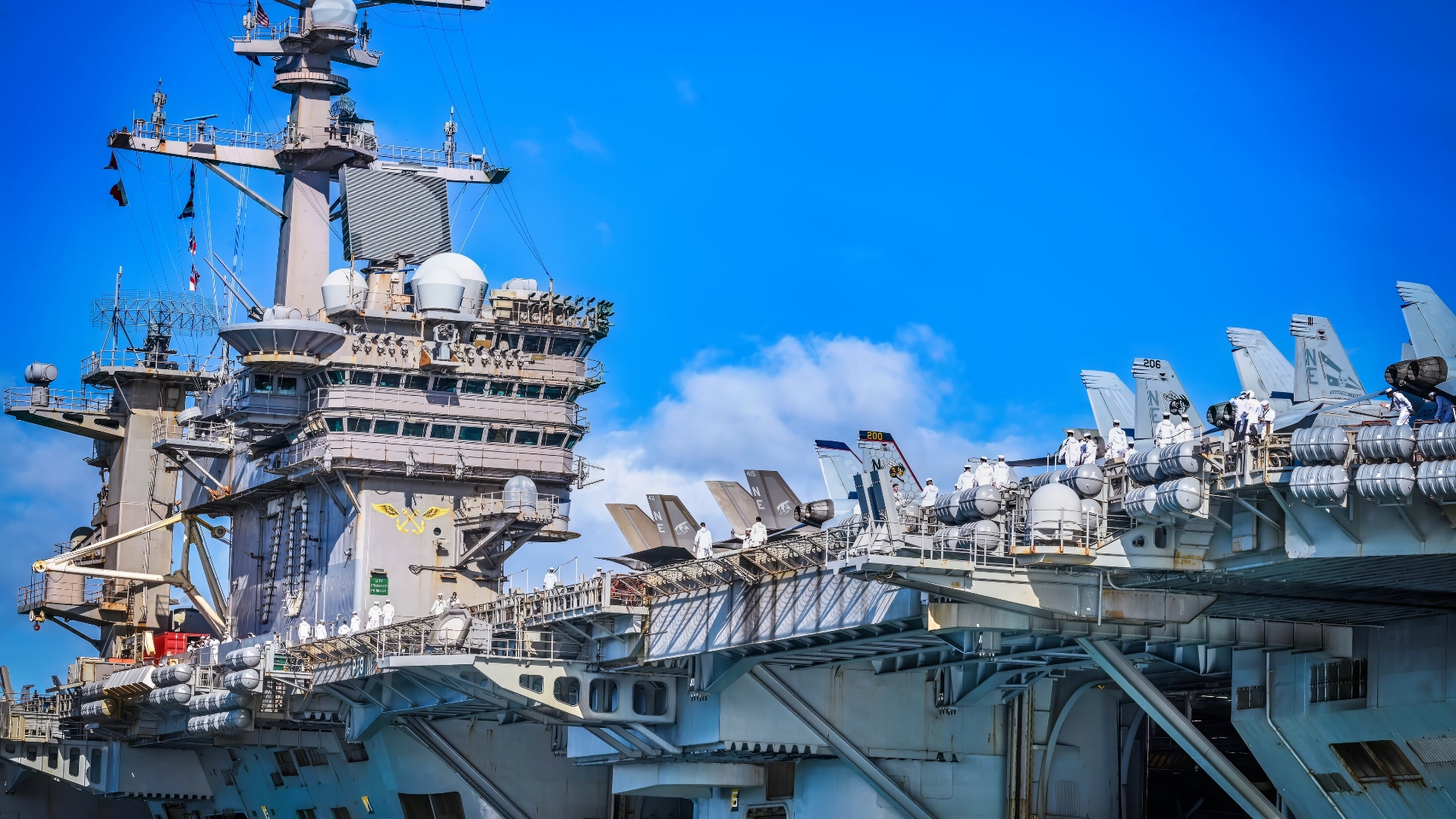
The Nimitz-class aircraft carrier USS Carl Vinson (CVN 70) arrives in Joint Base Pearl Harbor-Hickam, Hawaii, for a scheduled port visit, July 30, 2025. Vinson, the flagship of Carrier Strike Group ONE, is underway conducting routine operations in the U.S. 3rd Fleet area of operations. (U.S. Navy photo by Roann Gatdula)
-The winning model turns carriers into drone motherships and battle-network hubs: launching loyal wingmen, stealth UAV bombers, and swarms; fusing sensors across satellites, ships, and subs; and defending with directed energy, advanced EW, and tighter kill chains.
-China’s Fujian and planned Type 004 show adversaries are doubling down, not quitting. If the U.S. accelerates unmanned integration, boosts range, and distributes risk, carriers can remain pivotal to power projection and deterrence for decades.
Are Aircraft Carriers Doomed to Obsolescence?
While the U.S. forges ahead with its plans for the new Ford-class aircraft carriers and China builds its Type 004 supercarrier, the debate over whether aircraft carriers are becoming obsolete continues to rage.
On the one side, the case is made that carriers are expensive, vulnerable, and soon to be outmatched by emerging technologies. On the other hand, it’s clear that America’s biggest adversaries – most notably, China – still believe in the aircraft carrier as a platform and are working to adapt new platforms for new tech.
It’s clear that aircraft carriers, as they exist today, will soon be rendered obsolete by, at the very least, a combination of next-generation submarines and more widespread use of unmanned systems.
With appropriate modifications, however, aircraft carriers could serve as platforms for new technologies and continue to provide essential support for long-range bomber fleets, unmanned aircraft, and fighter jets well into the future.
Why Some Say Aircraft Carriers Are Becoming Obsolete
Aircraft carriers have long symbolized maritime dominance because that’s precisely what they’re designed to achieve.
A growing number of analysts and observers, including SpaceX CEO Elon Musk, now argue that carriers are becoming increasingly vulnerable.
They make that case for a straightforward reason: they’re right.
China’s so-called “carrier killer” missiles are a good example of why the likes of Musk are on to something. The missiles, the DF-21D and the DF-26, are equipped with technologies designed to destroy large maritime targets.

PHILIPPINE SEA(Feb. 22, 2016) USS John C. Stennis (CVN 74) sails through the Philippine Sea. Providing a ready force supporting security and stability in the Indo-Asia-Pacific region, Stennis is operating as part of the Great Green Fleet on a regularly scheduled 7th Fleet deployment. (U.S. Navy photo by Mass Communication Specialist Seaman Cole C. Pielop/Released) .

(Jan 31, 2009) An F/A-18 Super Hornet assigned to the “Tomcatters” of Strike Fighter Squadron (VFA) 31 launches from the flight deck of USS Theodore Roosevelt (CVN 71). The Nimitz-class aircraft carrier and embarked Carrier Air Wing (CVW) 8 are operating in the 5th Fleet area of responsibility and are focused on reassuring regional partners of the United States’ commitment to security, which promotes stability and global prosperity (U.S. Navy photo by Mass Communication Specialist 3rd Class Jonathan Snyder/Released)
The DF-21D, for example, is equipped with a maneuverable re-entry vehicle and terminal homing capabilities, making it perfect for striking moving maritime targets from long range. These technologies are expected to become a core element of Beijing’s anti-access/area-denial (A2/AD) posture.
And, in a full-scale conflict, swarms of hypersonic, unmanned aircraft, missiles, and loitering munitions could easily overwhelm the layered defenses of a carrier strike group. A move like that would force carriers to operate hundreds of miles farther from the conflict, reducing the strike range for that carrier group.
This is clearly inevitable, but it also presents U.S. military planners with an opportunity to explore new ways carrier strike groups can operate and new roles for aircraft carriers supported by advanced technology.
Submarines pose a threat, too. This is particularly true for nuclear attack submarines, which are among the few assets capable of striking aircraft carriers without being detected.
As naval warfare doctrine shifts towards the use of unmanned undersea vehicles (UUVs), unmanned surface vessels (USVs), and distributed sensor networks designed to locate targets from great distances, aircraft carriers risk becoming sitting ducks—especially if they remain the lead asset in the seas.
Aircraft Carriers Still Matter, But Only If They Adapt
The threat to aircraft carriers is real, but dismissing them outright is to overlook their crucial role in deterrence, crisis response, and power projection.
Without them, a significant power would need a greater number of air bases strategically located all over the planet, each equipped with substantial numbers of fighters and bombers. However, even then, aircraft carriers would still be essential for moving those aircraft around.
Carriers are the most visible and flexible form of maritime force; they can rapidly move across the oceans and deliver precision strike power anywhere in the world, and they can help a significant power assert control of airspace without relying on those foreign bases.
Even in peacetime, aircraft carriers remain an invaluable asset, providing support for a range of operations, from humanitarian relief to deterrence patrols.
How to Save the Aircraft Carrier?
That relevance can remain, but only if the United States adapts now.
The future of carriers lies in transitioning from their current state and role to providing a platform for both unmanned and hybrid air wings.
Future decks must host loyal wingmen, stealthy UAV bombers, swarming drones, and a wide range of other aerial assets capable of reconnaissance, striking, and escorting.
Rather than leading with manned fighters alone, as aircraft carriers do to this day, tomorrow’s carriers should serve as motherships for autonomous fleets.
Equally important, though, is the role carriers can play in terms of networking. By functioning as network command nodes, aircraft carriers can coordinate sensors, satellites, submarines, and surface ships over huge distances. And when kitted out with new laser-based weapon systems, electromagnetic railguns, and even AI-powered counter-drone defense systems, these carriers are only ever as vulnerable as an adversary’s carriers.

The Ford-class aircraft carrier USS Gerald R. Ford (CVN 78) and the Italian aircraft carrier ITS Cavour (CVH 550) transit the Atlantic Ocean March 20, 2021, marking the first time a Ford-class and Italian carrier have operated together underway. As part of the Italian Navy’s Ready for Operations (RFO) campaign for its flagship, Cavour is conducting sea trials in coordination with the F-35 Lightning II Joint Program Office’s Patuxent River Integrated Test Force to obtain official certification to safely operate the F-35B. Gerald R. Ford is conducting integrated carrier strike group operations during independent steaming event 17 as part of her post-delivery test and trials phase of operations.

USS John C. Stennis Aircraft Carrier. Image Credit: Creative Commons.
China’s rapid advances in this field show why this kind of evolution is now essential and urgent. The Type 003 Fujian is the country’s first CATOBAR carrier, built to operate stealth J-35 fighters and early-warning UAVs.
Beijing is even working on the nuclear-powered Type 004, signaling its long-term commitment to establishing blue-water carrier power.
China, therefore, recognizes that there is a future for this platform – and for the United States to abandon the strategy entirely, it must have an alternative plan in place to counter China’s growing naval capabilities.
Carriers are by no means obsolete; at least, not yet. The next generation of aircraft carriers is already on its way. As long as their operators ensure that they are adapted for modern warfare, there’s no reason these vessels cannot play a vital role in America’s naval dominance for decades to come.
At the current rate of technological development, however, it’s anyone’s guess what happens after that.
About the Author:
Jack Buckby is a British author, counter-extremism researcher, and journalist based in New York who writes frequently for National Security Journal. Reporting on the U.K., Europe, and the U.S., he works to analyze and understand left-wing and right-wing radicalization, and reports on Western governments’ approaches to the pressing issues of today. His books and research papers explore these themes and propose pragmatic solutions to our increasingly polarized society. His latest book is The Truth Teller: RFK Jr. and the Case for a Post-Partisan Presidency.
More Military
Russia’s ‘New’ Su-75 Checkmate Stealth Fighter Could Soon Be In the Air
China’s New Aircraft Carriers Have 1 Big Advantage over the U.S. Navy
Russia’s Airspace Provocations Are a Tell — And a Weakness
USS Parche: A U.S. Navy Nuclear Spy Submarine That Had Its Own Self-Destruct Mode
How a ‘Cheap and Tiny’ Submarine ‘Sank’ a $4,500,000,000 Nuclear Navy Aircraft Carrier


angelo corbin
October 7, 2025 at 7:01 pm
But they are not considering that out war ships are getting hi energy lasers installed with upgraded radar, I do remember, light is faster than a hypersonic missile that the Russians and Chinese really do not have. There is too much disinformation out there on the capabilities our enemy have.