

Iran Threatens U.S. With Retaliatory Blockade – Iran has threatened to respond to the U.S. blockade with its own maritime restrictions.
The threats came after a new round of U.S.-Iranian exchanges and a Houthi attack on Saudi Arabia that wounded 73 people and set energy facilities ablaze. On Tuesday, Brent crude surged above $99 a barrel as markets scrambled to react to attacks on energy sites.
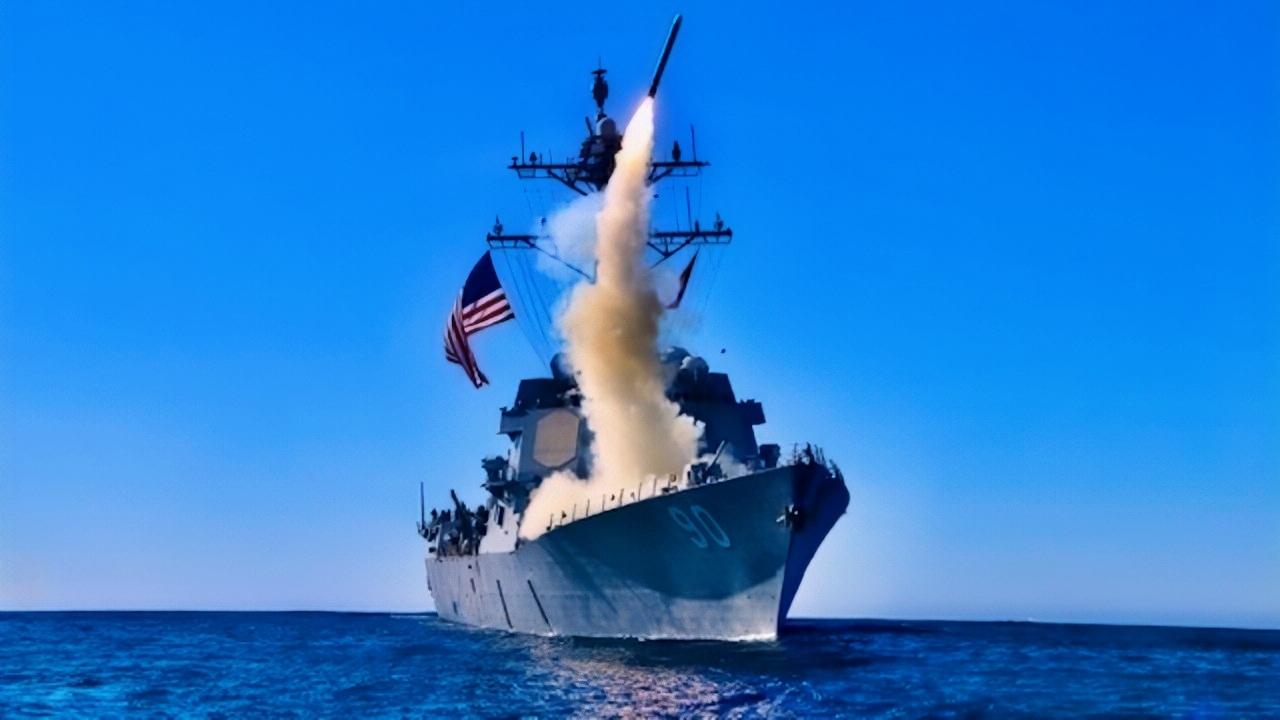
(Dec. 01, 2020) – The guided-missile destroyer USS Chafee (DDG 90) launches a Block V Tomahawk, the weapon’s newest variant, during a missile exercise. This event marked the first time a Block V Tomahawk missile was operationally tested, marking the Navy’s transition to a more advanced capability for the fleet. Block V includes an upgrade that will enhance navigation performance and provide robust and reliable communications. Chafee is currently assigned to Carrier Strike Group ONE and is homeported in Pearl Harbor. (U.S. Navy photo by Ens. Sean Ianno/Released)
The secretary of Iran’s Supreme National Security Council, Mohsen Rezaei, said the “maritime exclusion zone” would stretch from the U.S. blockade perimeter toward the narrow Strait.
Washington’s ‘Warning’
Rezaei said that “Washington has received a clear warning from Iran’s new missiles” in recent days. He also noted that “Economic warfare will be met by a maritime exclusion zone across the Persian Gulf to the blockade perimeter.”
Iran has yet to officially reveal the boundaries or rules of the zone. Rezaei separately warned that ships entering the proposed zone risked sanctions from Tehran.
He reiterated that the regime would “only commit to the Strait of Hormuz being open when they [the Americans] stop the sabotage, threats and attacks,” on the Islamic Republic.
Tehran is also carrying on talks with Oman over a potential shipping corridor via the Strait of Hormuz. Rezaei said maps for the route and an agreement could be made official in the coming days.
U.S. Hits Back Over IRGC Attacks
On Saturday, U.S. Central Command struck three Iranian crude carriers. CENTCOM said the operation came after the Islamic Revolutionary Guard Corps (IRGC) fired ballistic missiles toward an American aircraft carrier and guided-missile destroyer. No U.S. casualties were reported.
CENTCOM also said it had since “permanently disabled” the M/T Downy off Kharg Island and the M/T Stark 1 close to Jask. The unladen M/T Kylo, also known as Noxen, was destroyed in the Gulf of Oman after its crew was told to abandon ship.
“Let the message to the IRGC be clear: If you shoot at two of our ships, we will impose an even higher economic cost — taking out three of yours,” CENTCOM commander Adm. Brad Cooper said.
“We will not hesitate to defend American forces, and if necessary, destroy Iran’s limited and exposed oil fleet.”
Iran Threatens ‘Exposed’ U.S. Energy Interests
Iranian Parliament Speaker Mohammad-Bagher Ghalibaf answered with an explicit threat against U.S.-linked oil and gas interests.
“The oil and gas production chain here is sprawling, accessible, and exposed,” Ghalibaf wrote. “American oil and gas companies across these waters and facilities share that exposure.”
“Strike our assets and you get struck,” he added. Later on Tuesday, the Houthis, an Iran terror proxy based in Yemen, launched their biggest attack on Saudi Arabia since the U.S.-Israel war against Iran began in February. The Iran-backed group said it fired missiles and drones at a Saudi airbase in Khamis Mushait and Saudi Aramco targets in Abha, Najran and Jazan.
Saudi authorities said 73 people were wounded, while fires broke out and operations were halted at some energy facilities. Houthi-controlled media later reported four Saudi airstrikes in Yemen.
The Saudi-led coalition promised to “take all necessary operational measures to deter this terrorist militia and resolutely confront its hostile approach.”
U.S. Tries to Keep Oil Moving
The attacks put the stakes of Iran’s strategy in concrete terms. Before the war, about one-fifth of the world’s oil and liquefied natural gas shipments passed through Hormuz. Washington is trying to keep non-Iranian oil moving through the Strait while preventing Tehran from exporting its own crude.
Hamidreza Azizi, a senior Iran analyst at the International Crisis Group, told CNN that Tehran may now be trying to make that arrangement intolerable without immediately returning to full-scale fighting.
“This does not necessarily mean Iran wants another large-scale war,” Azizi said. More likely, he said, is “calibrated escalation” through greater pressure on shipping, U.S. bases, naval assets or regional energy infrastructure.
The objective is to make the “current situation sufficiently costly” that diplomacy again “becomes preferable,” Azizi said.
But there is an obvious danger in repeatedly pushing up against the other side’s limits.
“Once both sides begin testing each other’s red lines, the risk of miscalculation increases significantly,” Azizi warned. A strike causing substantial American casualties, or a U.S. response crossing one of Tehran’s red lines, could quickly push the conflict “back toward full-scale war.”
About the Author: Georgia Gilholy
Georgia Gilholy is a journalist based in the United Kingdom who has been published in Newsweek, The Times of Israel, and the Spectator. Gilholy writes about international politics, culture, and education.


