

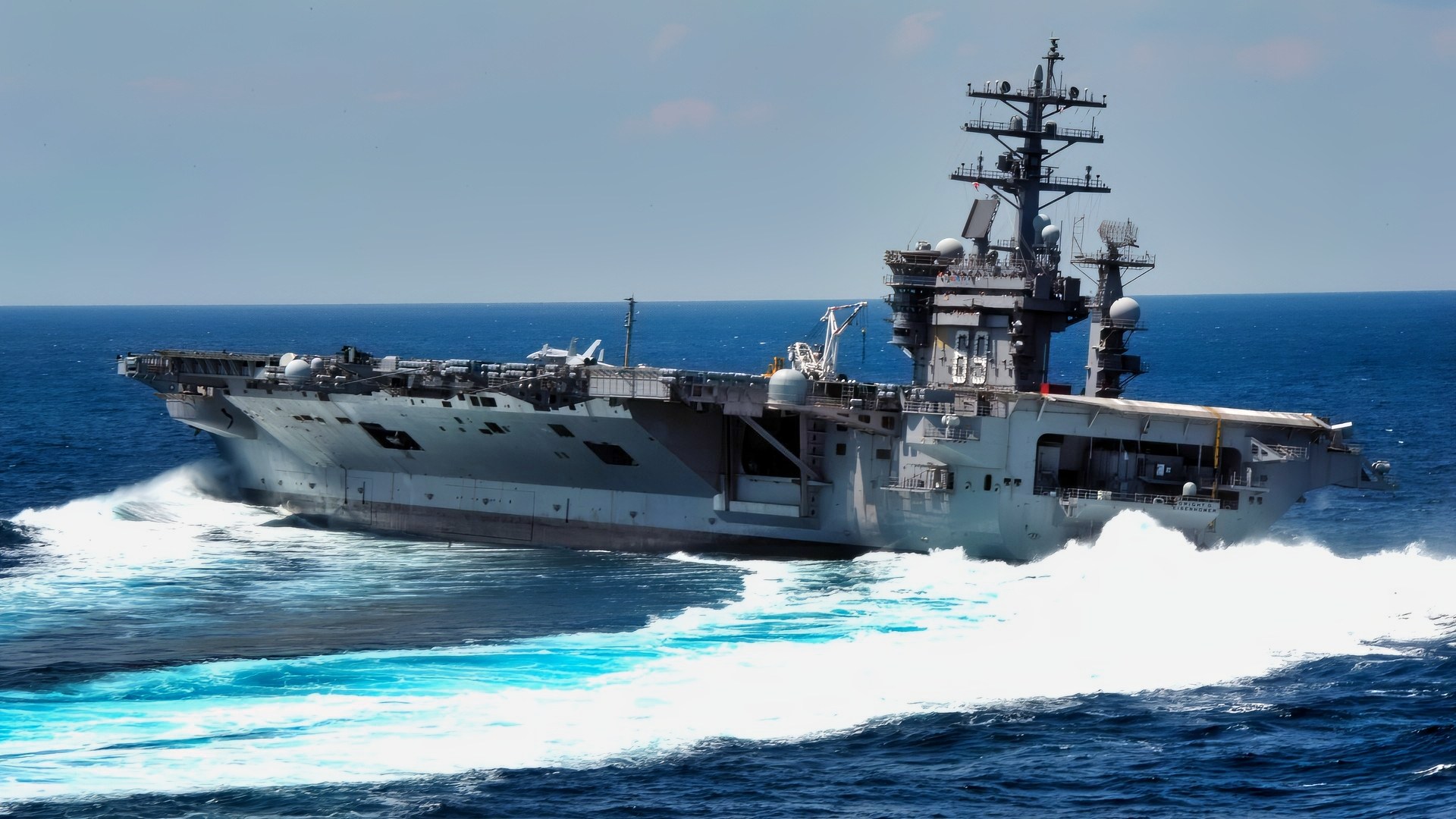
Three aircraft carriers make a statement. They don’t make a strategy. The USS Theodore Roosevelt entered U.S. Central Command’s area of operations on Sunday, joining the USS George H.W. Bush and USS George Washington, which have been working in the Arabian Sea.
The Roosevelt was supposed to relieve the Washington. However, both remain on station, and about 2,000 Marines are also en route. CENTCOM won’t say whether all three strike groups stay.
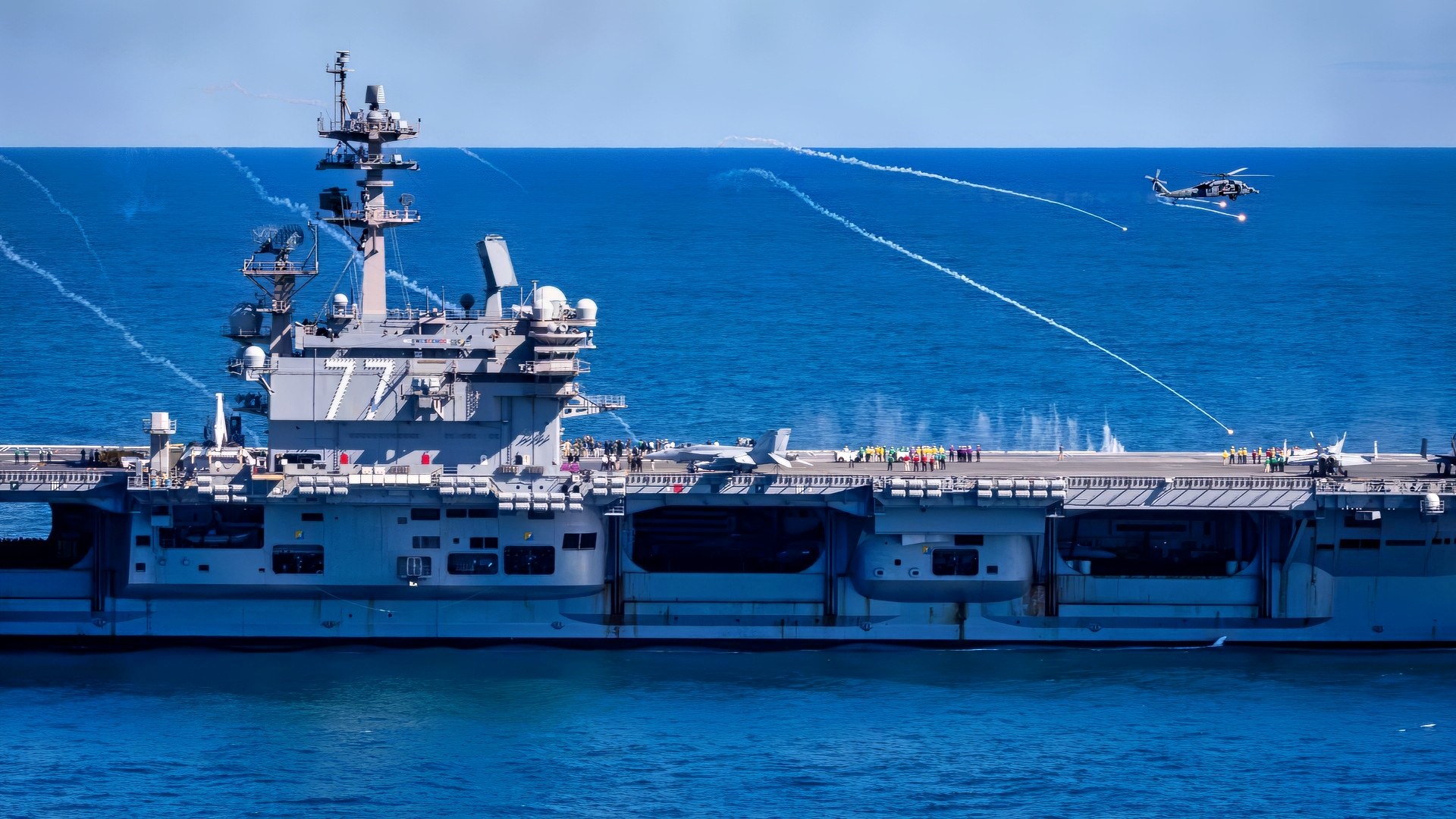
(Oct. 5, 2025) An MH-60S Sea Hawk attached to the “Dusty Dogs” of the Helicopter Sea Combat Squadron (HSC) 7 fires flares above the Nimitz-class aircraft carrier USS George H.W. Bush (CVN 77) in support of the Titans at Sea Presidential Review. The Titans of the Sea Presidential Review is one of many events taking place throughout the country to showcase maritime capabilities as part of the U.S Navy’s 250th birthday. America is a maritime nation. For 250 years, America’s Warfighting Navy has sailed the globe in defense of freedom. (U.S. Navy photo by Mass Communication Specialist 2nd Class Mitchell Mason)
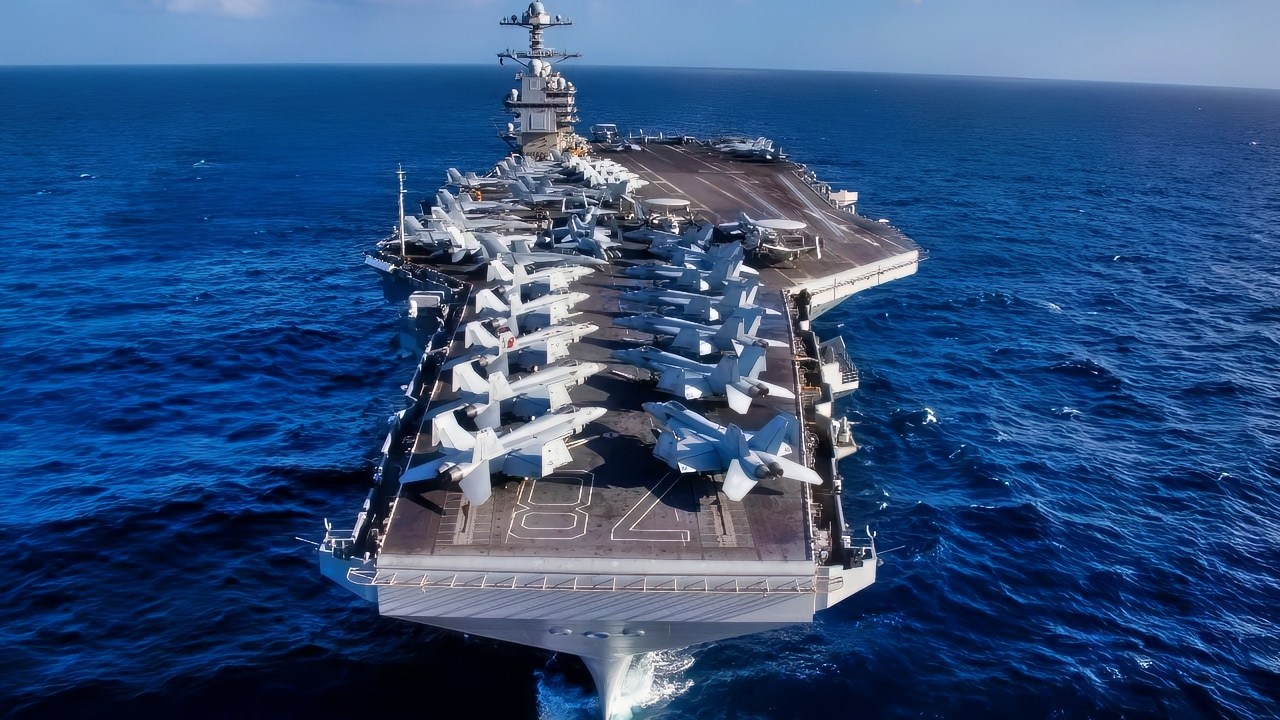
USS Gerald R. Ford Aircraft Carrier At Sea. Image Credit: U.S. Navy.
The Telegraph laid out the choice now sitting on the President’s desk: renew the shooting war or keep tightening the blockade and let Iran’s economy do the bleeding. It’s the right question.
Tehran isn’t waiting politely for Washington to decide.
On Tuesday, Iran fired drones at a U.S. radar facility in Bahrain, the third attack on American targets there in a matter of days. All of the drones were intercepted. No Americans were hurt.
Meanwhile, a tanker north of Oman was reportedly hit twice, and two more ships struck mines. Iran continues to push.
That’s what you do when you want to know how much rope you have.
At the same time, U.S. and Israeli planners have reportedly drawn up plans to hit Iran’s energy infrastructure and other facilities that keep its economy breathing. Even the officials briefing that story admit nobody knows whether another round of strikes would actually force Tehran to concede anything.
That’s the whole problem in one sentence.
The Blockade Is Having An Effect
The blockade isn’t glamorous. It doesn’t make for dramatic strike footage on cable news. However, it’s working. Treasury Secretary Scott Bessent said this weekend that Iran’s economy could contract by more than 25 percent over the coming year, calling it one of the fastest collapses in history.
U.S. intelligence agencies have separately assessed that the blockade and sanctions are hurting Iran’s economy and will keep the pressure on.
The President himself reached this conclusion back in April. According to The Wall Street Journal, he judged that his other options—resuming the bombing or walking away—carried more risk than maintaining the blockade.
On November 9, he said he’d hold off on new strikes for now after appeals from Gulf leaders.
He’s still holding a renewed bombing campaign as leverage if Iran continues launching missiles and drones at Gulf nations.
Air Power Alone Doesn’t Make Regimes Quit
Say what you will about the strikes since February.
They did real damage. Iran’s leadership was decapitated, its navy was wrecked, and the regime is still standing with Mojtaba Khamenei in his father’s chair, although he hasn’t been seen since then.
The decapitation strikes didn’t collapse Iran’s government or force the IRGC to end its military campaign because Iran’s political and military system was built to absorb leadership losses and continue operating.
As the Center for Strategic and International Studies (CSIS) noted, the Iranians operate in a decentralized way (mosaic doctrine) across provinces and theaters.
History isn’t kind to the theory, either. Operation Rolling Thunder pounded North Vietnam from 1965 to 1968 and never broke Hanoi’s will.
Regimes that view survival as the only victory condition can absorb an astonishing amount of punishment. Iran has spent 47 years building itself around exactly that mindset.
While air power can degrade military targets, it struggles to achieve lasting political change, control territory, or end asymmetric threats in Iran on its own.
The US has not, and will not, commit ground troops to root out IRGC units inside Iran.
And a handful of Marines on the ships wouldn’t have made a dent in a ground incursion into the country.
The US Needed To Use Proxies, As Iran Does…And Didn’t
As I’ve written earlier, unconventional or asymmetric warfare teaches one lesson early.
Angry crowds don’t topple a regime. Security forces that refuse to fire do. Hungry people with cell phones don’t beat a Basij unit with rifles.
The violent crackdown in January, where tens of thousands of people were killed during protests, strengthened the IRGC’s position, rather than weakened it.
Anyone with even a hint of disloyalty to the regime was eliminated.
This is where US and Israeli hopes for regime change failed.
The regime survived because none of the protesters were armed.
This is where the CIA and Mossad should have been funneling arms into the factions that want the regime out.
It was an opportunity lost to put the IRGC in a reactive position, against a proxy force, something they constantly use, and put the US in a proactive mode.
Proxies doing the fighting for the US means that no American service members are getting put in harm’s way. Iran has used Hezbollah, Hamas, the Houthis, and the Iraqi militias to do their bidding for years, and the US has failed to learn the lessons of proxy warfare.
The Targets Got Smarter
Analyst Afzal Ashraf told Al Jazeera: Iran has fewer launchers now, but it conceals them better. A new campaign would likely result in diminishing returns. The Iranians have learned their lessons, dispersed their launchers, dug deeper, and have taken the easy, lay-up targets off the grid.
Tomahawk Stocks Were Depleted
The U.S. fired more than 1,000 Tomahawks early in the conflict, and CSIS estimates full restocking could take until 2030.
The US is shooting million-dollar interceptors at drones that cost a fraction of that.
The NYT reporting notes that planners must weigh Iranian retaliation given depleted stocks of air-defense interceptors.
Every munition expended over Iran isn’t available for the Western Pacific. Beijing is keeping score at home, and so should we.
The Asymmetric Weapons Being Used Are Plentiful
Iran’s real weapons in this fight are cheap and asymmetric.
Fast attack boats. Shore-based anti-ship missiles. Drones. Mines. None of that is defeated from 30,000 feet.
Mine clearance is slow, deliberate, dangerous work, and bombing Bandar Abbas doesn’t clear a single mine from the shipping lanes.
The IRGC has already promised “long and painful strikes” on U.S. positions in the region if Washington resumes attacks, even limited ones. Iran’s parliament speaker has said the era of proportionate responses is over.
The Gulf Neighbors Have A Vote
Saudi Arabia and Turkey have both urged the President not to resume strikes, and Qatar’s prime minister made the same case in person at the White House.
These aren’t neutral observers.
They host our bases, and their oil terminals sit within easy reach of Iranian drones.
And make no mistake, they have their own political interests in play, beyond US bases. Ankara is looking to enhance its own diplomatic profile in the region.
Hitting Iran’s energy infrastructure practically invites Tehran to return the favor across the Gulf. US bases are devoid of ships.
No US warships are currently docked in any Middle East port.
There’s No Plan To Disengage
Firepower is a tool, not a plan.
Bombing a country to the negotiating table assumes the other side wants to negotiate.
Tehran issued seven conditions, including lifting the blockade, before it will even entertain discussions on its nuclear weapons program.
Resuming the bombing campaign won’t weaken, but harden their resolve. A collapsing currency and empty storage tanks might.
At home, roughly 65 percent of Americans already disapprove of how the war is being handled. A renewed air campaign with no defined objective, against a dispersed enemy, with thin magazines and nervous allies, is a recipe for a longer war.
Not a shorter one.
The blockade is slow. It’s frustrating.
It requires patience, which is not Washington’s strong suit. However, it hits Iran where it is weakest while keeping American pilots and sailors out of the worst of it.
Three carriers make a statement. But the US still doesn’t have a strategy to end things there and get out.
About the Author: Steve Balestrieri
Steve Balestrieri is a National Security Columnist. He served as a US Army Special Forces NCO and Warrant Officer. In addition to writing on defense, he covers the NFL for PatsFans.com and is a member of the Pro Football Writers of America (PFWA). His work was regularly featured in many military publications.


