

Gulf oil exports are surpassing prewar levels despite Iranian attacks, as U.S. Navy and military protection, offshore cargo transfers, and alternative pipelines keep supplies flowing.
Tanker charges, insurance premiums, and crew bonuses make delivering Gulf oil expensive.
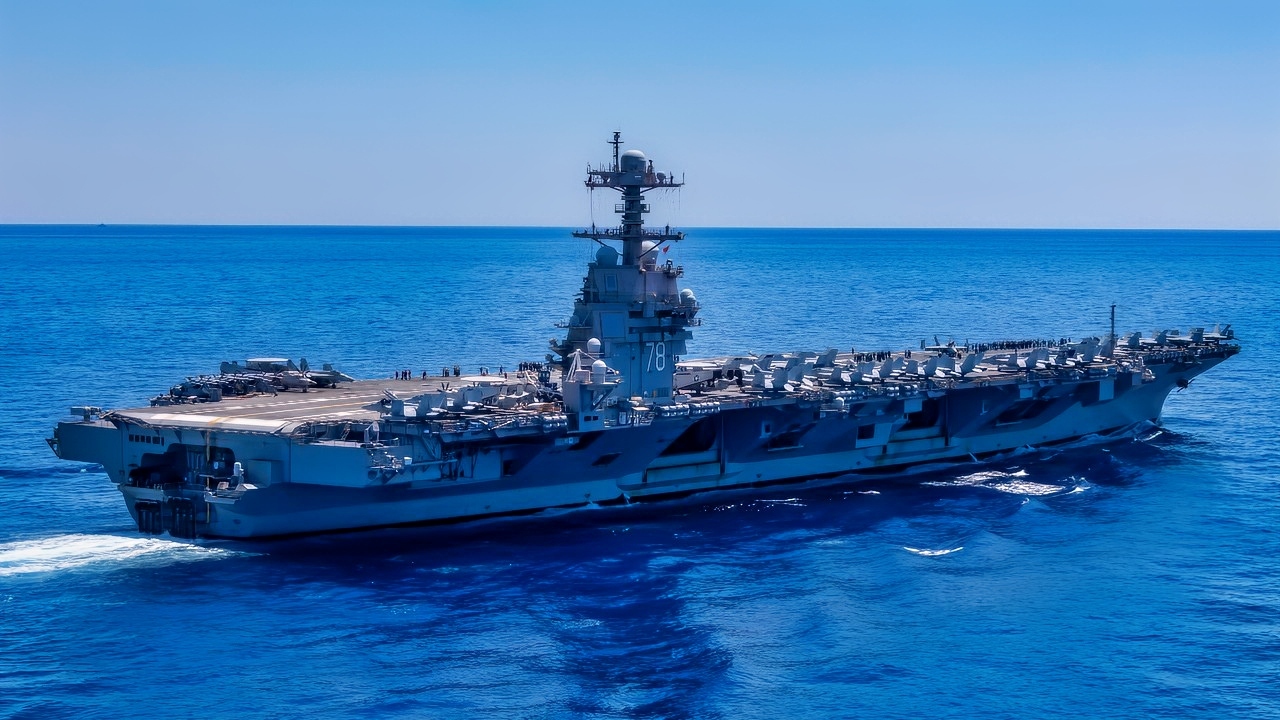
The world’s largest aircraft carrier, USS Gerald R. Ford (CVN 78) transits the Mediterranean Sea, August 1, 2025. Gerald R. Ford, a first-in-class nuclear aircraft carrier and deployed flagship of Carrier Strike Group Twelve, is on a scheduled deployment in the U.S. 6th Fleet area of operations to support the warfighting effectiveness, lethality, and readiness of U.S. Naval Forces Europe-Africa, and defend U.S., Allied, and partner interests in the region. (U.S. Navy photo by Mass Communication Specialist Seaman Brianna Barnett)

(Dec. 10, 2010) The Los Angeles-class attack submarine USS Houston (SSN 713) takes part in a photo exercise as part of Keen Sword 2011. Keen Sword is a joint, bilateral exercise designed to strengthen Japan-U.S. military operations. (U.S. Navy photo by Mass Communication Specialist 3rd Class Casey H. Kyhl)
Exports Rise as Pipelines Bypass Hormuz
Regional oil flows averaged more than 24 million barrels daily in the week through October 18, against 23.3 million before the war, The Wall Street Journal reported.
Preliminary estimates put Hormuz flows, including offshore transfers in the Gulf of Oman, at around 14 million barrels daily, or 82% of prewar levels.
The regional total includes alternative routes.
“The big picture is that the system for shipping through a dangerous Strait of Hormuz is now well-established and the risk appetite of those involved in exporting oil has risen,” Hamad Hussain, senior commodities economist at Capital Economics, told the Journal.
Kpler estimated that Saudi and Emirati pipelines bypassed Hormuz and handled 40% of non-Iranian Gulf crude exports in September, up from 17% before the war.
“Of course, we do wish and hope to see a resolution to the conflict … But Hormuz, probably in five years, may become redundant,” HSBC CEO Georges Elhedery said Tuesday.
Extra Profits Lure Tanker Owners
Some older tankers now make short shuttle runs through Hormuz under American air cover along Oman’s coast where they transfer cargoes offshore to vessels serving distant markets and return for more oil, according to the Journal.
Kpler’s Homayoun Falakshahi estimated traders could earn an additional $20 per barrel reselling Iraqi crude, or approximately $40 million per supertanker cargo.
“The volumes remain high despite rising attacks, because profits make it worth the risk,” he said.
Crews are also receiving inducements: one Chinese staffing company offered up to $25,000 for a round trip, the Journal reported.
The tanker Loyalty, carrying 2 million barrels of Iraqi crude, was struck October 16 by a rocket-propelled grenade that pierced a freshwater tank, according to the Journal’s account, citing maritime security company Vanguard and a crew member.
Shipping Attacks Are Still Underreported
“Iran is trying to reassert its blockade of the strait,” former British naval officer Christopher Long told the Journal.
UK Maritime Trade Operations recorded 12 attacks in its October 16 weekly report, including 10 in Hormuz. It said it was “struggling to accurately report true number of attacks,” with most attacked vessels refusing to report incidents.
Combined tracking and U.S.-reported figures put transits approximately 70% below prewar levels that week.
The Joint Maritime Information Center’s October 18 assessment warned: “Due to recent Iranian attacks, the threat level remains SEVERE, with deliberate hostile action considered as highly likely under current conditions.”
The center said that Washington’s naval blockade of Iranian ports remained ongoing.
The International Maritime Organization’s updated register listed 119 confirmed regional incidents and 24 seafarer fatalities as of October 21.
“Seafarers have continued to perish in these attacks, and around 6,000 seafarers remain trapped since the beginning of the conflict,” IMO Secretary-General Arsenio Dominguez told Fox News Digital on Sunday.
The Cost of Shipping Gulf Oil
Kpler told the Journal that shipping Gulf crude to China by supertanker cost nearly $37.37 a barrel this week.
Windward analyst Michelle Wiese Bockmann put war-risk insurance at up to 10% of a ship’s value, up from less than 3%.
JPMorgan’s Natasha Kaneva told the Journal: “In April, the problem was a shortage of crude. In October, it is the cost of moving it.”
Brent crude futures were up 1.9% at $110.85 a barrel by 10:48 a.m. GMT on Wednesday.
“Neither of the two geopolitical conflicts underpinning the market’s bullish sentiment has shown any signs of de-escalation,” PVM analysts said, referring to the Middle East and Ukraine wars.
In September, the Middle East was still exporting less than half its prewar volume of refined fuel. Shipments reached 1.9 million barrels a day, compared with 4.7 million before the war, the IEA reported.
The agency said “the gasoil market balance will remain tight well into 2027,” despite an expected increase in refinery output.
“Iran would have to be more aggressive to achieve the same degree of control it previously possessed over oil flows from the region,” Hussain told the Journal.
About the Author: Georgia Gilholy
Georgia Gilholy is a journalist based in the United Kingdom who has been published in Newsweek, The Times of Israel, and the Spectator. Gilholy writes about international politics, culture, and education.


