

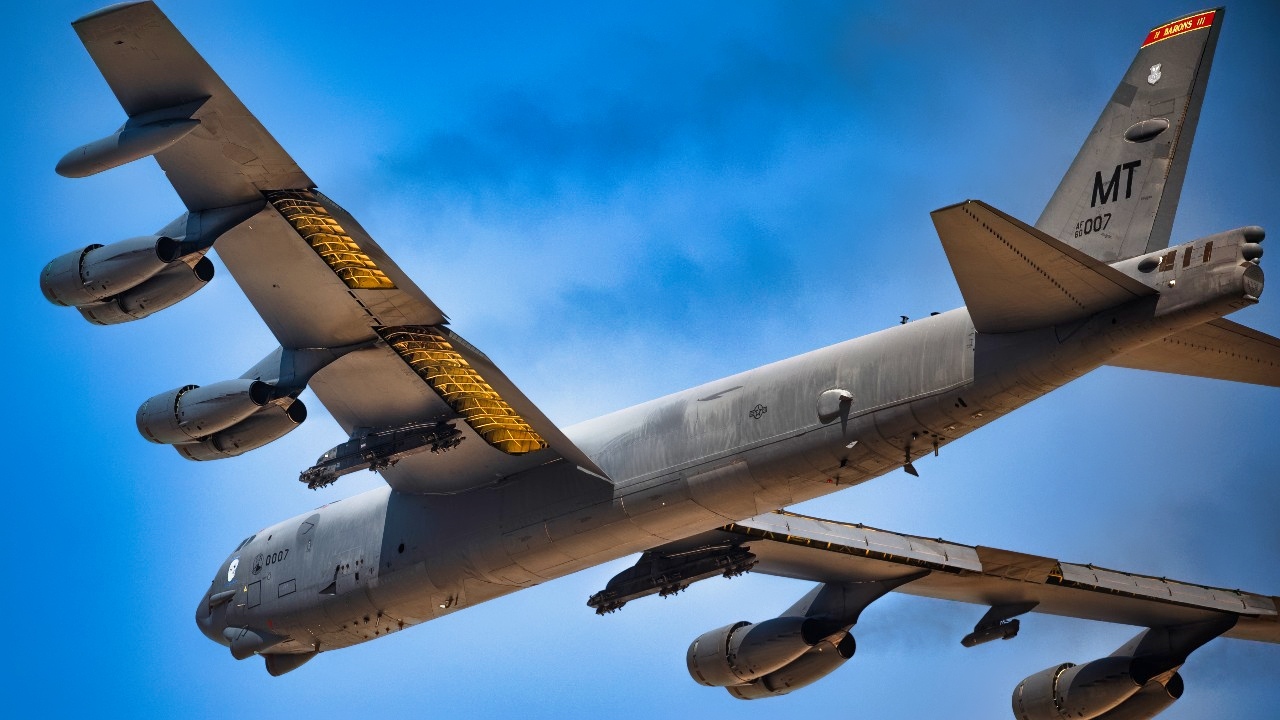
Key Points – The US Air Force’s B-52J Radar Modernization Program (RMP) faces a “significant” Nunn-McCurdy cost breach, with costs for replacing the bomber’s obsolete AN/APQ-166 with Raytheon’s AN/APQ-188 AESA radar rising around 17%.
-This breach requires formal congressional notification and intense program scrutiny to prevent a “critical” (25%+) increase that could force cancellation.
-While Air Force officials express confidence in continuing the vital upgrade—crucial for the B-52J’s service into the 2050s and offering enhanced targeting and EW capabilities—they are also exploring commercial off-the-shelf radar alternatives to mitigate further cost growth for the 76-bomber fleet.
Could the B-52J Radar Modernization Program Get Cancelled?
The Air Force is frustrated. The service branch has its hands full with the B-52J bomber upgrade program. Now, the news is even more dire. The B-52J radar modernization project has triggered a Nunn-McCurdy cost breach. This condition strikes fear into the hearts of defense acquisition professionals. Under the law, the personnel in charge of the B-52J radar modernization program must notify Congress of its schedule slip and cost overruns.
This is not good news for such a time-consuming and expensive project that had many thinking early on that it would be on time and under budget with no problems.
Why the Nunn-McCurdy Act Is Scary for B-52J
I first learned about the Nunn-McCurdy Act violations when I was in graduate school, working as an analyst with the RAND Corporation. I worked in defense acquisition and was instructed about how serious the breaches could be. This was a law that no one wanted to be associated with. Violations could end the careers of uniformed officers serving as leaders of major end items that have exceeded original baseline cost estimates.
Some doomed programs have had to declare a “critical” breach. This means that a 25 percent cost increase or more would force the Department of Defense to reduce expenses or cancel the program.
Things Are Getting Serious
So far, the B-52J radar modernization has been classified as a “significant” breach—a “deviation” of 15 percent or more. The Air Force estimates prices have risen 17 percent more on the radar project, which would qualify as significant. Fortunately, at this level, the Department of Defense does not have to pull the trigger on cancellation. Still, it is a shot fired across the bow, warning procurement professionals to get their act together or risk losing the program.
Air Force ‘Word Salad’ Provides Little Clarity About the Future
Once the problem had been identified, the Air Force delivered a word salad in a news release. “The Air Force Program Executive Officer for Bombers submitted a program deviation report to the Air Force Service Acquisition Executive regarding the radar modernization program on April 11,” an Air Force spokesperson said. “The Air Force is assessing the cost and schedule growth on the program and initial review of the PDR indicates it will be a significant cost breach.”
That has a “yuck” factor, and the Air Force now needs to tread carefully. The Secretary of the Air Force has to formally notify Congress by May 24, which may mean Acting Secretary Gary A. Ashworth could be called before the House and Senate Armed Services Committees to explain the situation in more detail.
For years, the B-52 has been forced to use an obsolete radar known as the AN/APQ-166. The service branch is aiming to replace it with the Raytheon AN/APQ-188, a hybrid system of sensors used aboard the F-15 and F/A-18. The replacement will be an active electronically scanned array (AESA) radar.
Congress Is Mollified, For Now
Thankfully for Secretary Ashworth, Darlene Costello, principal deputy assistant secretary of the Air Force for acquisition, technology, and logistics, already told a House Armed Services subcommittee on May 8 that there was a breach. When Congressman Trent Kelly (R-Miss.) asked if Costello is confident the radar project won’t hit the “critical area,” Costello said she is “pretty confident.”
Costello did not say “extremely” or “very” confident. This makes one wonder if the Air Force is ready to make the changes to prevent the program from incurring more price creep and Nunn-McCurdy breaches. But Costello aims to continue the project and hopes that workers can make the replacement without further problems.
To cover its bases, the Air Force requested information about whether commercial off-the-shelf radars could replace the old AN/APQ-166. This means they are open to other solutions to outfit the 76 B-52s that will need the upgrade.
Turning Up the Heat
The existing radar dates back to the 1960s, so the modernization program is necessary. However, Congress has been warned, and acquisition officers may be holding their breath as costs multiply over the original baseline estimates. There is nothing like congressional scrutiny to put people in the hot seat and create pressure to get workers to operate at high efficiency.
B-52J air crews desperately need the new radar, and failing to keep the modernization plan in place would be a dangerous outcome for the Air Force. The procurement experts should be on notice that there will be penalties for failure and potential cancellation if the situation does not improve, which would hurt the future survivability of the B-52J when it performs its missions of long-range nuclear and conventional strike.
About the Author: Dr. Brent M. Eastwood
Brent M. Eastwood, PhD is the author of Don’t Turn Your Back On the World: a Conservative Foreign Policy and Humans, Machines, and Data: Future Trends in Warfare plus two other books. Brent was the founder and CEO of a tech firm that predicted world events using artificial intelligence. He served as a legislative fellow for U.S. Senator Tim Scott and advised the senator on defense and foreign policy issues. He has taught at American University, George Washington University, and George Mason University. Brent is a former U.S. Army Infantry officer. He can be followed on X @BMEastwood.
What Are Europe’s Best Weapons of War?


Pingback: The Air Force's 'New' B-52J Bomber Is 'Circling the Drain' - National Security Journal