

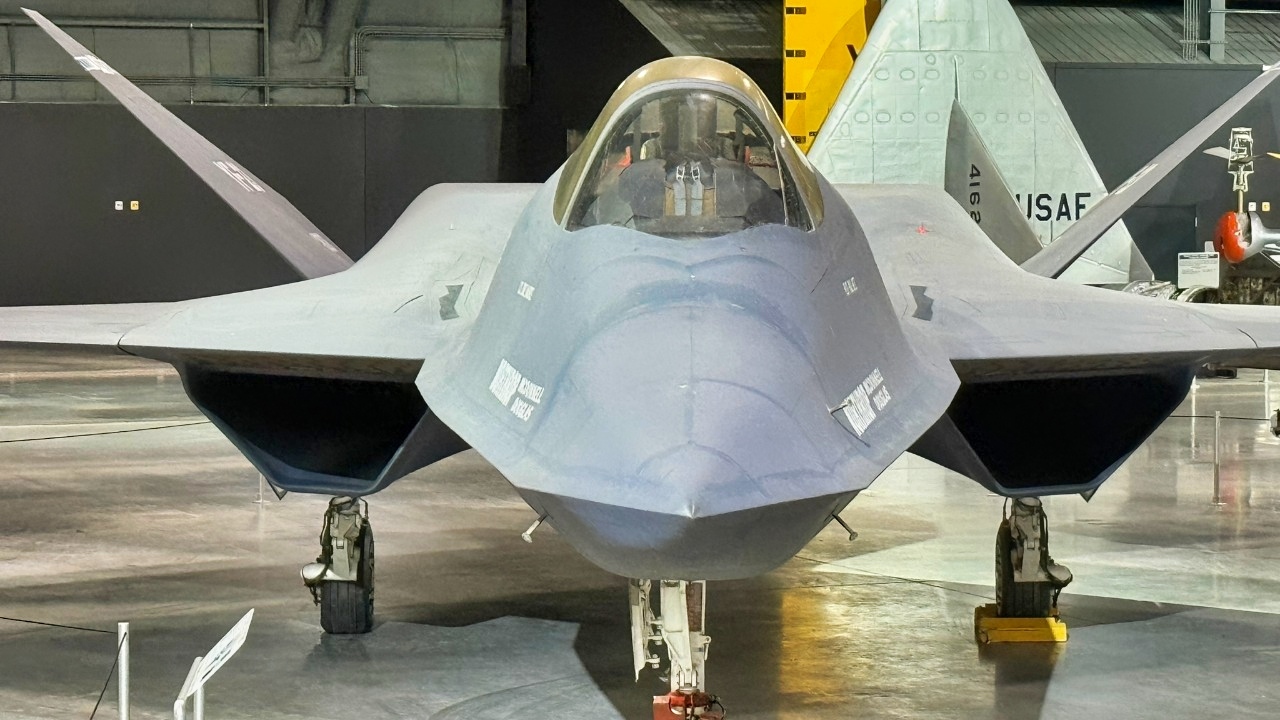
When the United States Air Force was looking for a fifth-generation air superiority fighter, the two competing planes were the YF-22 Raptor and the YF-23 Black Widow II. Ultimately, the Air Force chose the Raptor. Alas, we have a special place in our National Security Journal for the YF-23, as we have visited the only two of these warplanes ever built. We have included original photos of those visits in this article.
But the Black Widow was the preferred plane among the pilots–including the great Chuck Yeager–who argued the better bird was the YF-23. In fact, there was even talk about a navalized YF-23, known as the NATF-23, being made.

YF-23A Black Widow Outside. Taken by Harry J. Kazianis for National Security Journal on August 16, 2025.

YF-23A Side View Western Museum of Flight. Image by National Security Journal.
Developed for the US Air Force’s Advanced Tactical Fighter (ATF) competition, the YF-23 Black Widow II displayed high-speed air dominance, stealth, supercruise, and long-range interception. For the Navy, though, its requirements are quite different from the Air Force’s.
That’s because the Navy flies planes from aircraft carriers.
Why the Navy Needed a Very Different Fighter
So, Navy planes must be able to land at lower speeds than their Air Force counterparts. Naval warplanes require reinforced landing gear and must be corrosion-resistant. Meanwhile, navalized warplanes must have compact wings for storage.
These planes must withstand the brutal catapult and arrestor stresses.
Trying to adapt warplanes, even the mighty YF-23, for carrier flight operations essentially meant redesigning the plane itself.
The Navy’s NATF-23, at least on paper which it never left as it was just a concept, actually faster and stealthier than the Air Force’s YF-23. It also enjoyed an extremely low radar signature.

YF-23 Fighter at USAF Museum. Image by Harry J. Kazianis/National Security Journal.
The NATF-23 had impressive long-range capability largely due to its efficient cruise.
Enter the NAFT-23: A Stealth Beast That Didn’t Belong at Sea
But the flaws with the NATF-23 were legion. And, again, it never left the concept stage.
Among them, the plane had poor low-speed handling, which made it awful for carrier flight operations. That long, sleek airframe that gave the NATF-23 such impressive stealth features while flying also negated its compactness.
The Navy couldn’t store these birds in the cramped hangar decks of the aircraft carriers in their service.
And by engaging in a total structural redesign to make the NATF-23 friendlier to the demands of carrier flight operations, the Navy opened itself to all manner of complications unique to its potential YF-23 variant.

YF-23 National Security Journal Photo. Taken by Harry J. Kazianis at U.S. Air Force Museum on 7/19/2025.

YF-23 National Security Journal Photo. Taken by Harry J. Kazianis at U.S. Air Force Museum on 7/19/2025.

YF-23 National Security Journal Photo. Taken by Harry J. Kazianis at U.S. Air Force Museum on 7/19/2025.
At the time, the Navy was looking at the navalized YF-23 variant, and many of the systems undergirding the plane were still immature compared to those of the YF-22.
A Fighter Built for Tomorrow’s War–Not Yesterday’s Dogfights
Even though the NATF-23 did not become the Navy’s new carrier-based warplane, the YF-23 may have been the more advanced system (compared to the YF-22) in the long term. The YF-23 emphasized speed, range, and stealth over dogfighting.
Thus, the YF-23 was better suited to the very kind of beyond-visual-range (BVR) warfare that today defines modern battlefields. This belief is all the more incredible because air combat today is trending toward networked, long-range engagements in which stealth and persistence matter more than knife-fight agility.
Ultimately, the Air Force chose Lockheed Martin’s YF-22.
The Defense Department’s choice stemmed from recent bad memories of the schedule and cost overruns on Northrop’s B-2 Spirit long-range stealth bombers and the cancellation of the A-12 warplane.
Since Northrop was behind the YF-23, the Air Force went with the YF-22, which it believed was a lower-risk, more producible system.
The Ghost of the YF-23 Lives On in the YF-22
As for the Navy’s variant, the NATF-23, while never embraced, its legacy may live on in the Navy’s newest sixth-generation F/A-XX warplane.
Indeed, the tailless and semi-tailless design proposals for the F/A-XX put forward by Northrop strongly echo that of the NATF-23.
So, too, do the extreme stealth shaping of Northrop’s proposed F/A-XX. Its fixation with long-range endurance reinforces the notion that the canceled NATF-23 inspires the F/A-XX.
Therefore, the design philosophy that lost in 1991 might be the one that wins in 2035 and beyond.
And if the new F/A-XX design has many similarities with the old NATF-23, many should question the wisdom of the Pentagon’s decision to choose the YF-22 over the YF-23 and to cancel the NATF-23 outright in 1991.
About the Author: Brandon J. Weichert
Brandon J. Weichert is the Senior National Security Editor at 19FortyFive.com. Recently, Weichert became the editor of the “NatSec Guy” section at Emerald. TV. He was previously the senior national security editor at The National Interest. Weichert hosts The National Security Hour on iHeartRadio, where he discusses national security policy every Wednesday at 8 pm Eastern. He hosts a companion show on Rumble entitled “National Security Talk.” Weichert consults regularly with various government institutions and private organizations on geopolitical issues. His writings have appeared in numerous publications, among them Popular Mechanics, National Review, MSN, and The American Spectator. And his books include Winning Space: How America Remains a Superpower, Biohacked: China’s Race to Control Life, and The Shadow War: Iran’s Quest for Supremacy. Weichert’s newest book, A Disaster of Our Own Making: How the West Lost Ukraine, is available for purchase at any bookstore. Follow him via Twitter/X @WeTheBrandon.


