

In the wake of utterly disastrous losses suffered by the Republican Party in the November 2026 midterm elections, thanks in no small part to the Iran War—aka Operation Epic Fury in the United States and Operation Roaring Lion in Israel—U.S. President Donald John Trump has declared that “Iran militarily is effectively over.” However, that doesn’t mean Mr. Trump is ending the naval blockade of Iran.
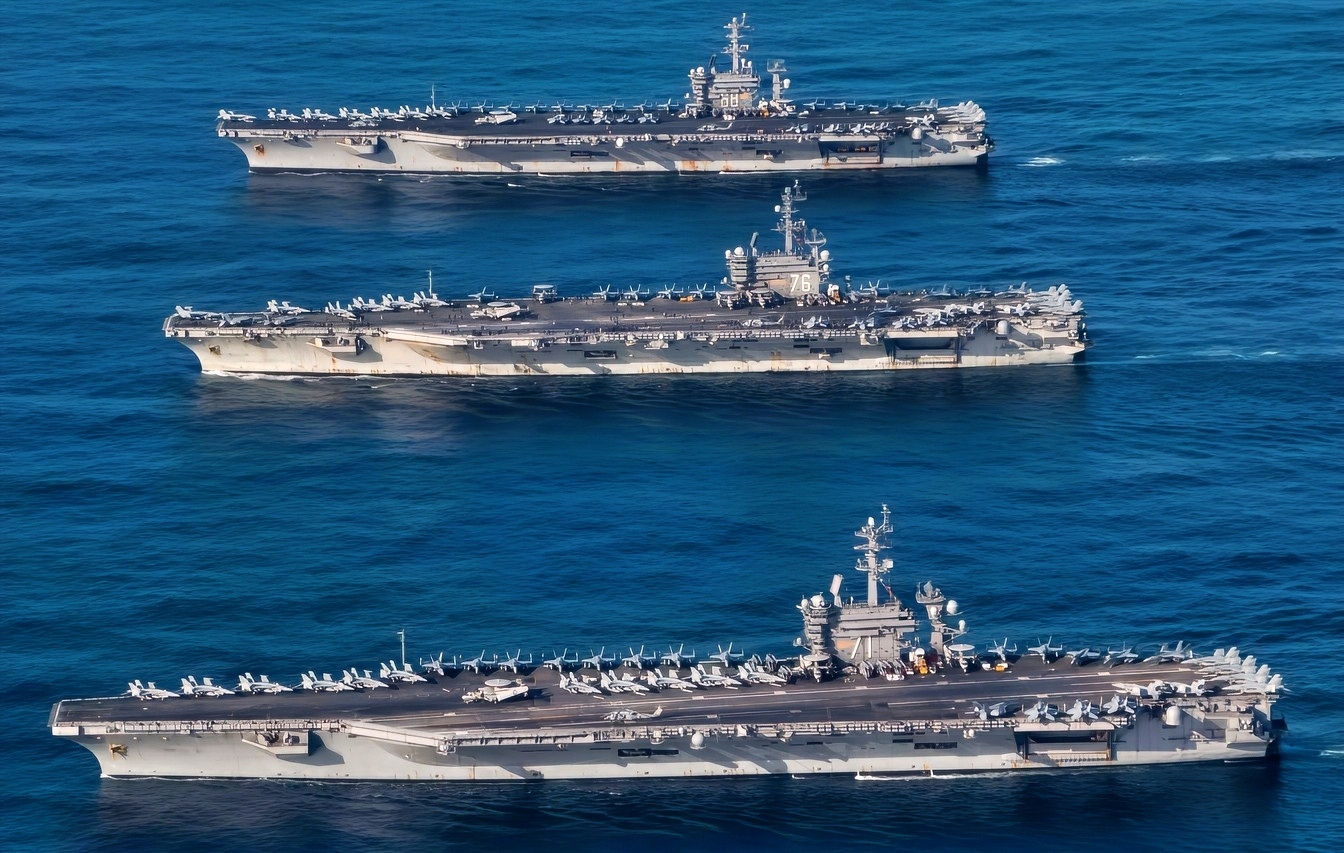
Indeed, the latest reports indicate that he may be doubling down, or indeed tripling down, on the blockade, to the tune of three U.S. Navy aircraft carriers being ready for action in the region.
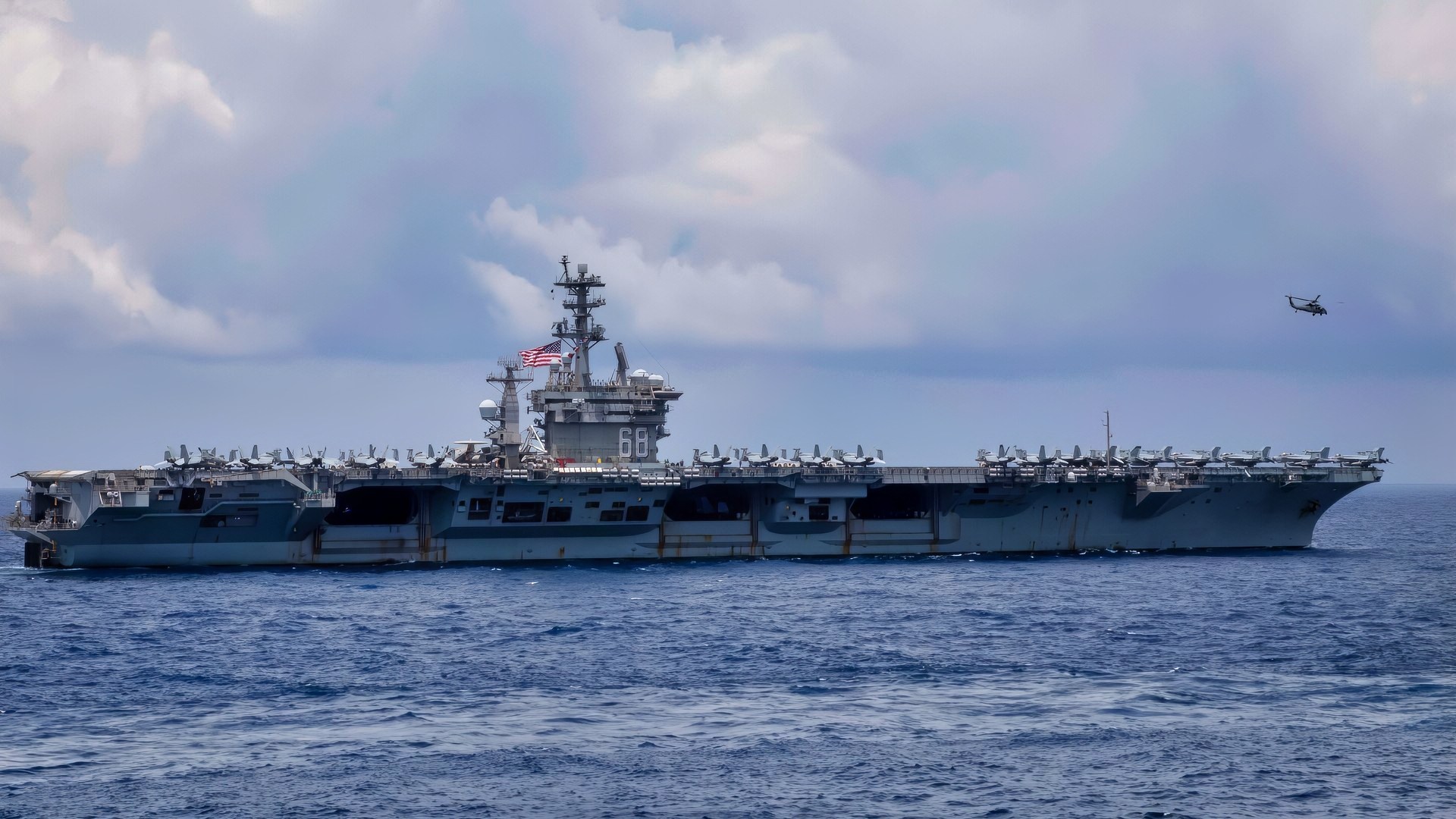
(Feb. 15, 2023) U.S. Navy aircraft carrier USS Nimitz (CVN 68) flies the battle ensign during expeditionary strike force operations with the Nimitz Carrier Strike Group including the Arleigh Burke-class guided-missile destroyer USS Decatur (DDG 73). Nimitz Carrier Strike Group (NIMCSG) and Makin Island Amphibious Ready Group (MKI ARG) with embarked 13th Marine Expeditionary Unit (MEU) are conducting combined ESF operations, demonstrating unique high-end war fighting capability, maritime superiority, power projection and readiness. Operations include integrated training designed to advance interoperability between the two groups while simultaneously demonstrating the U.S. commitment to our alliances and partnerships in the Indo-Pacific region. (U.S. Navy photo by Mass Communication Specialist 2nd Class David Negron)
Bottom Line Up Front (BLUF)
As reported in the Breaking News section of Army Recognition on 12 November 2026, the Navy may soon be concentrating three Nimitz-class nuclear-powered supercarriers in the Middle East, namely the USS Theodore Roosevelt (CVN-71), USS George H.W. Bush (CVN- 77), and the USS George Washington (CVN-73), for “adding aviation capacity for surveillance, force protection, and maritime security.”
In the case of the Roosevelt—affectionately nicknamed “TR” and “Big Stick”—she will be joining the latter two carriers after a port visit to Singapore. She should arrive any day according to the latest reports.
Deeper Dive
Beyond the sheer show of force, this pending deployment matters because it “could temporarily create a rare three-carrier strike group overlap in the theater, signaling a massive operational surge pending the official departure timeline of the USS George Washington.” However, “The duration of any three-carrier presence remains uncertain because Theodore Roosevelt is expected to relieve George Washington.”
Given the shortage of available “flattops” affecting the Navy, this is kind of a big deal. As we’ve discussed several times previously, USN logisticians apply a “rule of thirds” to the employment of carriers: At any given time, one-third of the mighty warships are deployed, one-third are prepping for deployment, and one-third are undergoing maintenance.
With 11 carriers in the fleet, this means that only three to four of them are typically out to sea. Ergo, three such vessels concentrated in a single area would be quite a departure from the norm.
Regarding the “undergoing maintenance” bit, that’s where the refueling and complex overhaul (RCOH) procedure comes into play, and it is extremely time-consuming and labor-intensive.
Nuclear-powered carriers must undergo this every 25 years—the USS Harry S. Truman (CVN-75) is the latest of the bunch to go on the block—and it involves cutting a massive hole in the hull and replacing everything from catapult systems to water purifiers.

Navy Aircraft Carrier. Image Credit: Creative Commons.
Just how time-consuming and labor-intensive is RCOH? Case in point: the aforementioned CVN-73 was out of action for a whopping 2,100 days whilst awaiting the procedure.
So, it’ll be interesting to see how long this oh-so-rare triple flattop deployment lasts.
For however long it does last, it’ll hold additional significance from the standpoint of Multi-Domain Air Wing Interoperability.
In other words, having three embarked air wings will integrate advanced multi-role strike assets such as the F/A-18E/F Super Hornet and F-35B Lightning II, electronic warfare carrier decks such as EA-18G Growler, and early-warning nodes such as the E-2D Advanced Hawkeye to split defensive screening and complex strike profiles.
In short, a true force multiplier.
Last but not least, “The potential deployment serves as a highly visible, reversible tool for geopolitical signaling against Iranian rear-echelon regional networks, providing tactical commanders with maximum strategic flexibility before weapons release.”
Brief History of the Three Carriers
CVN-71, CVN-73, and CVN-77 are, respectively, the third, fourth, and tenth & final ships of the Nimitz class, commissioned on 25 October 1986, 4 July 1992, and 10 January 2009.
The Bush is one of only two members of the class commissioned in the 21st century; the other is the USS Ronald Reagan (CVN-76), commissioned on 12 July 2003.
The Way Forward and the Bigger Picture: One Good Blockade Deserves Another
This prospective uptick in the U.S. naval blockade lends credence to the President’s statement last week that “We’re keeping it going. We have the greatest military blockade ever.”
What’s more, the U.S. is piggybacking on the naval blockade by tacking on a new land blockade for good measure. Officially designated Task Force Iron Gate, it will be based in Tampa, Florida—presumably at MacDill Air Force Base, where U.S. Central Command (CENTCOM) is headquartered—with the goals of (1) cracking down on Tehran’s movement of advanced weapons and other sanctioned material over its land borders and through the Caspian Sea, and (2) halting the flow of dual-use technologies used by Iran and stemming what the Trump Administration labels as illegal revenue streams.
About the Author: Christian D. Orr
Christian D. Orr is a Senior Defense Editor. He is a former Air Force Security Forces officer, Federal law enforcement officer, and private military contractor (with assignments worked in Iraq, the United Arab Emirates, Kosovo, Japan, Germany, and the Pentagon). Chris holds a B.A. in International Relations from the University of Southern California (USC) and an M.A. in Intelligence Studies (with a concentration in Terrorism Studies) from American Military University (AMU). He is also the author of the book “Five Decades of a Fabulous Firearm: Celebrating the 50th Anniversary of the Beretta 92 Pistol Series,” the second edition of which was recently published.


