

Iran’s economy is in crisis, with inflation approaching 90% and unemployment rising.
U.S. sanctions have cut off the country’s primary source of government revenue, and the worsening economic situation is becoming so much of a problem for the regime that some in Trump’s orbit believe the resumption of military strikes may not even be necessary.
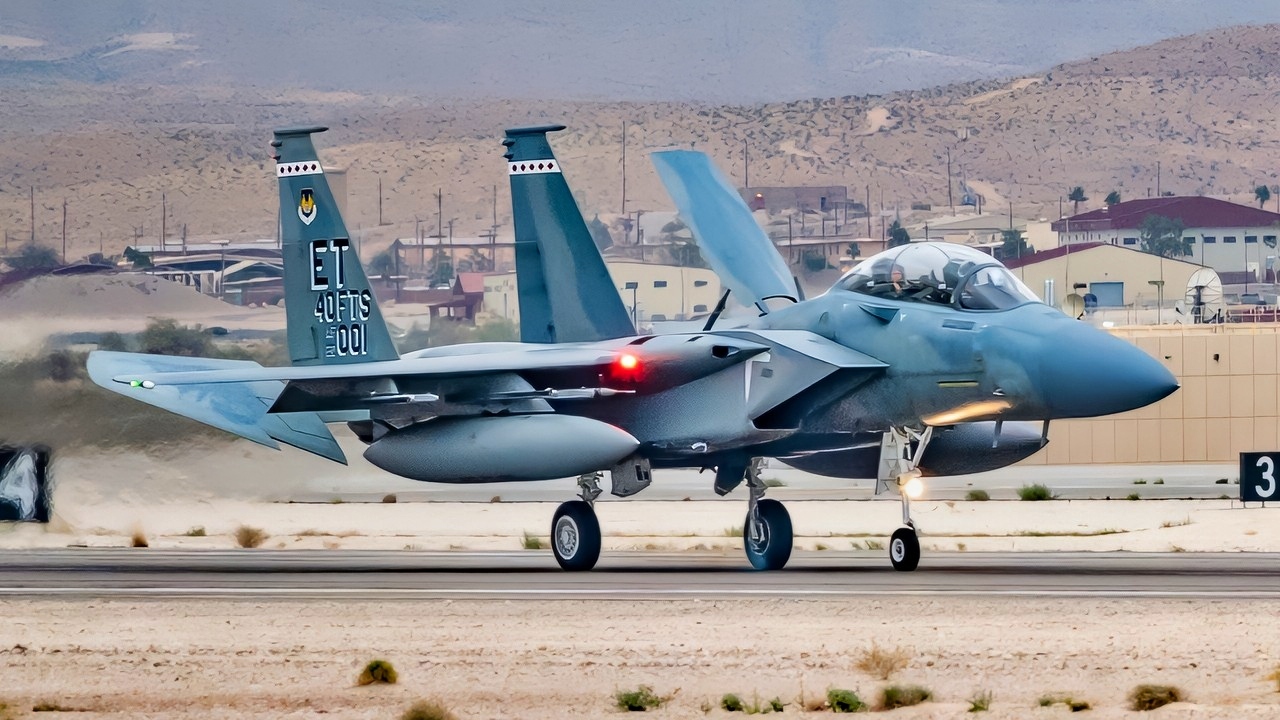
An F-15EX Eagle II lands on the flight line after a training operation at Nellis Air Force Base, Nevada, Nov. 15, 2023. The aircraft is able to fly at a speed of Mach 2.5, constituting it as the world’s fastest fighter jet. (U.S. Air Force photo by Airman 1st Class Elizabeth Tan)

Two U.S. Air Force F-15EX Eagle IIs assigned to the 85th Test and Evaluation Squadron, Eglin Air Force Base, Florida, taxi after landing at Kadena Air Base, Japan, July 16, 2025. Local units conducted integration and familiarization training with the F-15EX. (U.S. Air Force photo by Airman 1st Class Arnet Shayne Tamayo)
According to recent reports, several senior Trump administration officials are advising the president to avoid a return to full-scale fighting with Iran, arguing that sanctions could be enough to force Tehran to make concessions without the risk of more Iranian strikes on infrastructure in the Gulf region.
The president also appears receptive to the argument, telling Axios on Monday that he is in “no rush” to decide whether to resume the war, despite weeks of speculation that a strike could occur shortly after the midterm election.
What the Data Shows
According to the latest official economic data from Iran, published on October 28, consumer prices rose 88.7% compared with the same period last year.
The country’s 12-month average inflation rate also reached 76.8%, up from 73.6% in September.
The figures also show that rural communities in Iran are being hit particularly hard by the U.S. sanctions campaign, with prices increasing by 107% over the previous year.
Transportation costs are rising, too, up 128% nationally over the same period, and household equipment prices are up almost 129%.
That economic crisis is now causing employment problems, too, with Reuters reporting that Iran’s official unemployment rate reached 9.1% in the spring — an increase of 1.8 percentage points from a year earlier.
Almost a quarter of Iranians aged between 15 and 24 are now unemployed.
In late October, senior Iranian Labor Ministry official Seyed Malek Hosseini also warned that as many as 1.4 million additional people could leave the labor market by the end of the Iranian calendar year if the contraction continues.
And if Trump maintains economic pressure on Iran, that contraction is almost certain to continue, unless circumstances fundamentally change.
U.S. Treasury Says the Sanctions Are Working
After weeks of reports that the White House was preparing for imminent strikes against Iran, many analysts now expect the White House to maintain its economic sanctions campaign and force Iran to make concessions over a longer period of time in hopes of avoiding a retaliatory campaign.
A Treasury Department report obtained by Axios and published in October revealed the extent of the damage so far, with Iran’s rial losing roughly a quarter of its value since Washington launched the campaign in August.
The rial reached a record low of 2.687 million to the U.S. dollar in October, making imported goods more expensive.
The report also claimed that Iran had not loaded oil onto tankers since August 25, with U.S. sanctions and the naval blockade severely restricting the country’s ability to generate export revenue.
With its floating oil reserves sold out, revenue could dry up completely by Christmas.
Iran has also struggled to move goods over land, with reports of thousands of trucks facing delays of up to 20 days at the Turkish border.
And Iranian banks and airlines are facing more restrictions in neighboring countries in the wake of the announcement of secondary sanctions by the United States against companies and entities facilitating Iranian trade.
The measures are part of what’s known as Operation Economic Outcast, a campaign announced on August 24, designed to isolate Iran from international financial networks and trade.
Bessent Says Iranian Economy Could Shrink By 25%
According to Treasury Secretary Scott Bessent, Iran’s economic situation could worsen further.
Speaking to Iran International on October 26, Bessent predicted that the Iranian economy will contract by more than 25% between March 2026 and March 2027.
He also warned Iranian civilians that they are likely to face major fuel shortages over the winter and argued that the regime was running out of money and foreign currency. Bessent said that the regime risks going “bankrupt.”
That forecast is substantially worse than what the International Monetary Fund predicted in July, when it projected a 5.4% economic contraction in 2026.
Trump Urged to Refrain From Strikes
According to Axios, CIA Director John Ratcliffe, Treasury Secretary Scott Bessent, and Secretary of State Marco Rubio have all advised the president to maintain the economic pressure campaign rather than resume major military operations against Iran.
Ratcliffe, the report says, believes that prolonged economic hardship in Iran could force the regime to make further concessions, or potentially even create sufficient instability domestically that the regime could come under threat from its own citizens.
The officials are favoring what is being described as a “no war, no deal” strategy that gives sanctions more time to work. Defense Secretary Pete Hegseth, however, reportedly favors renewed military strikes.
About the Author: Jack Buckby
Jack Buckby is a British researcher and analyst specializing in defense and national security, based in New York. His work focuses on military capability, procurement, and strategic competition, and he produces and edits analysis for policy and defense audiences. He brings extensive editorial experience, with a career output spanning over 1,000 articles at National Security Journal, and has previously authored books and papers on extremism and deradicalization.


