

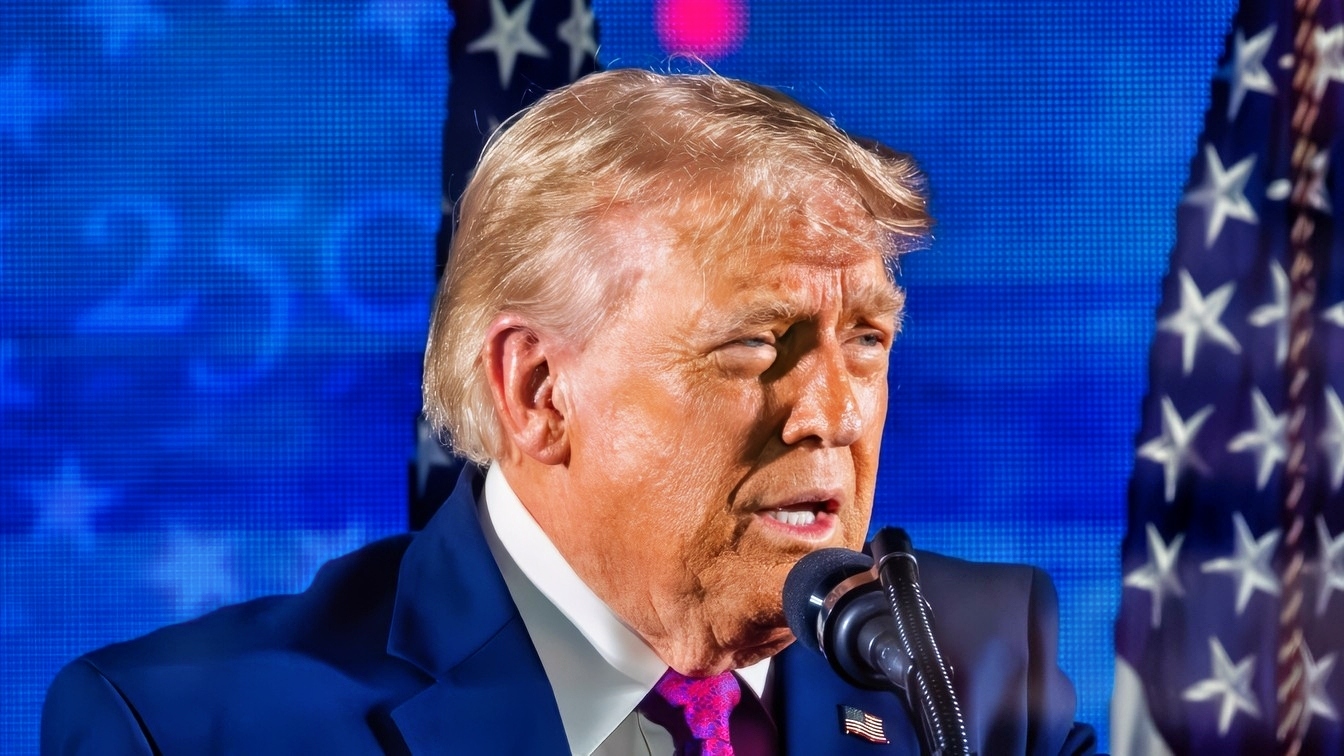
The world is wondering how President Donald Trump will take his party’s recent Midterm defeat. That’s because the president is a notorious sore loser.
And while he may at times claim that the election really wasn’t about him (since he wasn’t on the ballot), it is obvious that the American people rallied to vote against President Trump and his policies–especially the war of choice against Iran he started in February (that exacerbated the negative trends in the US economy that he inherited from President Joe Biden).

Former Vice President of the United States Joe Biden speaking with attendees at the 2019 Iowa Federation of Labor Convention hosted by the AFL-CIO at the Prairie Meadows Hotel in Altoona, Iowa.
What will the forty-seventh president do now that he is essentially a lame duck?
Well, the president removed his White House Chief of Staff, Susie Wiles, after the election, sending her to his campaign operation, while elevating the gonzo, Right-wing firebrand Stephen Miller to White House Chief of Staff.
Many are speculating that this indicates Trump is preparing to go scorched Earth on the Democrats. Attorney General Todd Blanche issued a bizarre threat to the incoming Democratic majority that he’d initiate a counter-investigation at the Department of Justice (DOJ) into any Democrat who opened congressional investigations into Trump administration officials or Trump family members.
Changes to the White House
The Trump administration appeared interested in resetting, at least in part, by reemphasizing its commitment to the “MAHA” agenda that Robert F. Kennedy, Jr., brought with him when he became the Health and Human Services (HHS) secretary.
Trump might become more aggressive on vaccination policy. Miller has publicly criticized childhood vaccinations and is considered a close ally of RFK’s MAHA movement.
Plus, the Republican defeat has ensured that many of the Big Pharma-backed Republicans are not going to be in Congress anymore.
People like Sen. Rand Paul (R-KY), a physician and longtime critic of government vaccination policies, could become an even more prominent voice in the Senate on federal health policy.
Democrats, of course, are not anti-vaccine, and they will have greater congressional power to assert over whatever Trump and RFK might want to do next.
However, RFK, as HHS Secretary, has considerable executive power to pursue changes to vaccine ingredients, authorization procedures, and the legal protections afforded to vaccine manufacturers.
A Washington Post essay expressed concern that these measures would undermine public confidence in immunization.
Supporters of RFK insist that greater scrutiny and transparency are needed to restore trust in federal health institutions.
These are things that Trump campaigned on and apparently abandoned when he had all levers of power. Now that the GOP is in the minority and Trump is on the ropes, looking for issues to win back angry voters, Trump might be calculating that this is his best shot.
The economy was a major reason why the Republicans lost the Midterms this November.
While the Iran War was a major factor in the collapsing economy, the unpopular tariffs were another.
The president remains committed to trade protectionism, viewing tariffs as tools to rebuild American manufacturing, generate federal revenue, and extract concessions from foreign governments.
Tariffs, meanwhile, have increased costs for American businesses and consumers.
According to Yale University’s Budget Lab, Trump’s tariffs could cost the average US household more than $1,000 annually. Before the midterms, Trump repeatedly indicated his desire to reduce or modify tariff policies based on inputs and positive responses from counterparties.
The president has wide-ranging authority in these affairs.
Therefore, as Congress restricts his freedom of movement in other policy domains, Trump might decide to increase his unpopular actions there.
Can Trump Punch Through Democrat Legislative Encirclement?
Then again, if Trump is looking for quick wins as Democrats encircle him, he could cut deals with countries like Canada.
There’s also some indication that, despite the presence of Stephen Miller as White House Chief of Staff, Trump might still push forward with his stated interest in getting an immigration deal with the Democrats that could include protections for Dreamers or even general amnesty for illegal immigrants.
Democrats have also indicated a willingness to create a meaningful compromise on immigration policy. However, there will likely be a fight over ICE’s future.
The Washington Post also highlights that Democrats are expected to intensify their opposition to Medicaid changes enacted through Trump’s One Big Beautiful Bill Act in 2025.
The legislation restricts Medicaid provider taxes, which states have used to help finance their programs and obtain federal matching funds.
Democrats contend the changes could leave vulnerable Americans without health coverage, including recipients who face administrative hurdles.
Trump must now decide whether to defend these reforms or seek compromises with congressional Democrats.
Ultimately, the GOP Midterm defeat doesn’t mean that Trump’s presidency has entered a period of complete paralysis.
Instead, the Trump administration faces a choice between confrontation and negotiation.
It will be interesting to see how the president navigates this dangerous moment for his presidency (and legacy).
About the Author: Brandon J. Weichert
Brandon J. Weichert is the Senior National Security Editor. He also manages The Weichert Brief on Substack. Weichert is the co-host of The Mario Nawfal Show on Twitter/X. He is the author of four bestselling national security books, most recently A Disaster of Our Own Making: How the West Lost Ukraine (Encounter Books). His next book, Fortress Americas: A New Monroe Doctrine (Tucker Carlson Books), is due out December 8. Follow him via Twitter/X @WeTheBrandon.


