

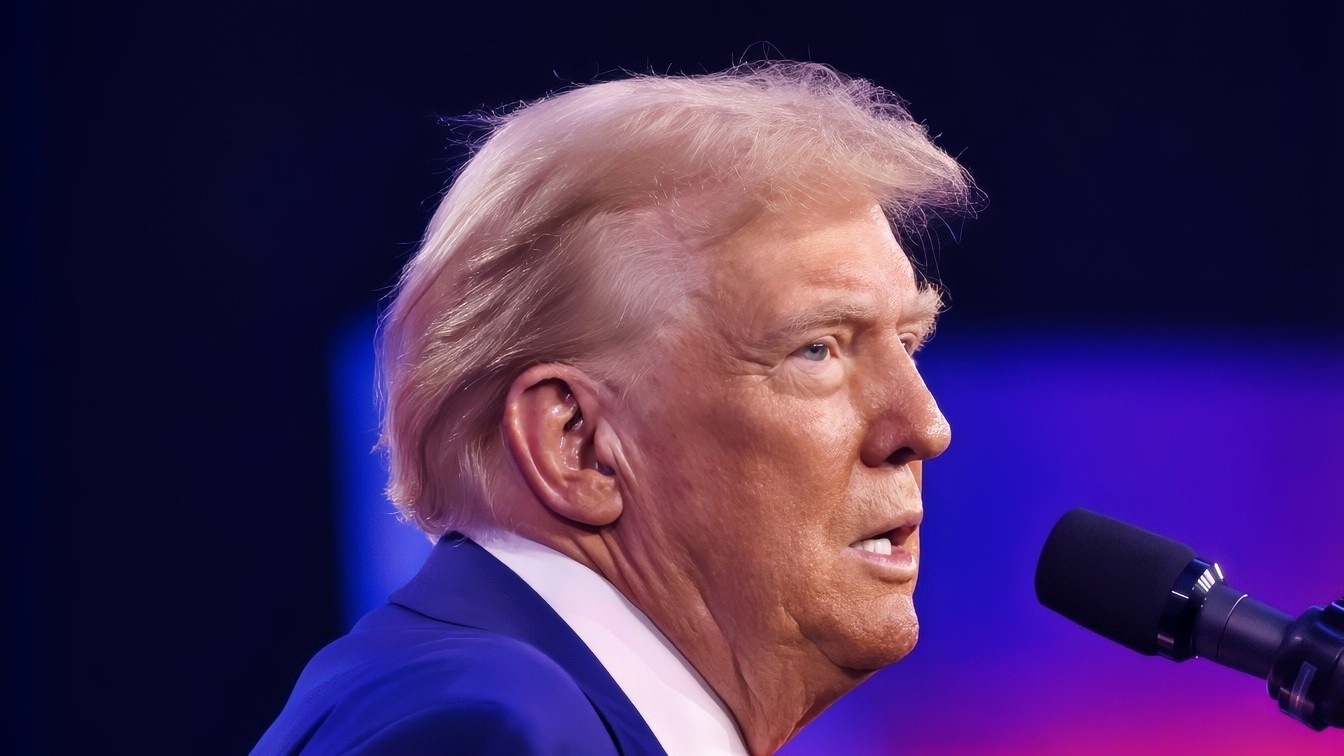
President Donald Trump has suggested he could be left with a narrow window in which to continue major military operations against Iran, noting that his military action is currently funded through January 2027.
In an Oval Office interview with the New York Post on Tuesday, November 24, Trump also said he believed Democrats were trying to thwart his Iran war efforts after the latter party’s success in this month’s midterm elections, in which they won control of both chambers of Congress.

The Air Force’s newest fighter, the F-15EX Eagle II, was revealed and named during a ceremony April 7 at Eglin Air Force Base, Fla. The aircraft will be the first Air Force aircraft to be tested and fielded from beginning to end, through combined developmental and operational tests. (U.S. Air Force photo/Samuel King Jr.)

A U.S. Air Force F-15EX Eagle II, assigned to 85th Test and Evaluation Squadron, Eglin Air Force Base, Florida, lands at Kadena Air Base, Japan, July 16, 2025.This short-term visit marked a key milestone in the Department of Defense’s ongoing effort to modernize U.S. airpower in the Indo-Pacific. (U.S. Air Force photo by Airman Nathaniel Jackson)
Democrats would “take a total win and make it a loss,” Trump said.
“But up until really the end of January, pretty much, you know, we’re funded,” he said when asked about the timeframe for further strikes.
There is now growing talk that both Washington and Jerusalem may recommence extensive military action against Iran.
Trump Differs with Israelis on War Goals
While there is talk of resuming military action, Trump has suggested that Washington and Israel may not agree on their war goals in Iran.
While recognizing that the Israeli aim of toppling Iran’s government was “probably doable,” Trump maintained that stopping Iran from obtaining nuclear weapons was his main goal.
“I just don’t want them to have a nuclear weapon. I was never for or against regime change; that was never a criterion for me,” he told the Post.
Former Mossad director David Barnea called for military action to be resumed on Monday, addressing the ELNET Jerusalem Summit in Israel’s capital.l
“A diplomatic agreement with the ayatollah regime will never succeed,” Barnea said, arguing that Israel should return to military action “as soon as all conditions allow.”
Barnea completed his five-year term as director of Israel’s foreign intelligence service in June.
White House Considers More Military Action
NBC News reported on Tuesday that members of the Trump administration were considering launching military action aimed at Iran’s leadership to end the war.
The report was based on comments by a U.S. official and someone with knowledge of the discussions.
However, those opposed to such action are concerned that it may leave U.S. personnel vulnerable to Iranian retribution and also hinder future peace talks.
An administration official told NBC News for a November 24 report that the U.S. naval blockade of Iranian ports would “continue with full effect.”
Mike Huckabee, U.S. ambassador to Israel, also commented on the possibility of renewed military action in a speech to Israel’s Institute for National Security Studies on Tuesday.
Trump has shown himself to be prepared to use military action against Iran, Huckabee said, adding that the president had “made it very clear he’s willing to do it again.”
Democrats Wish to End Iran War Funding
Growing attention is being paid on Capitol Hill to whether Trump can maintain his war effort.
On November 19, the Senate voted 48-51 to reject a war powers resolution which would have required the U.S. to pull out of its military conflict with Iran unless Congress authorized its continuation.
Democratic Sen. Michael Bennet of Colorado then proposed an amendment to war funding, inspired by congressional legislation that stopped U.S. air attacks on Cambodia in 1973.
“He has no strategy to win, let alone end the war on American terms,” Bennet said in a November 19 statement.
“We can fund the government and end this war,” he added.
Bennet’s amendment would permit ongoing defensive military action and U.S. protection for shipping in the Strait of Hormuz.
Furthermore, House Minority Leader Hakeem Jeffries has described the conflict as a “reckless and costly war of choice in Iran,” Roll Call reported on November 12.
There is also strong popular opposition to the war. Only 31 percent of Americans approve of the war, according to a Reuters/Ipsos poll carried out between November 13 and 16.
Iran Maintains U.S. blockade is Ineffective
Iran continues to assert that it can resist both economic and military pressure from the U.S.
Iranian First Vice President Mohammad Reza Aref claimed on Wednesday that greater use of other border routes proved that Iran was “not concerned about the enemy’s naval blockade.”
However, Iran’s official statistics agency shows that consumer prices rose by 88.7 percent in October year over year. Food and drink prices rose even more, increasing by 112.6 percent.
War Rages in the Strait of Hormuz
Iran’s Islamic Revolutionary Guard Corps (IRGC) Navy said on Wednesday that two oil tankers had hit mines and subsequently caught fire while trying to pass through the Strait of Hormuz.
The claim has not been independently verified.
Iranian parliament speaker Mohammad Bagher Ghalibaf has also said that peace talks with the U.S. will not restart “until Iran’s seven conditions are met,” according to Iranian state television. The Iranian regime has not publicly enumerated all seven conditions.
The lifting of sanctions, an end to the U.S. naval blockade, and the return of Iranian assets seized by the U.S. have all been cited by Iranian media as Tehran’s conditions for peace talks.
About the Author: Georgia Gilholy
Georgia Gilholy is a journalist based in the United Kingdom who has been published in Newsweek, The Times of Israel, and the Spectator. Gilholy writes about international politics, culture, and education.


