
The war with Iran reached its six-month mark on Friday, August 28. And after all that time, and despite the White House insisting this would not be a protracted conflict, Tehran is still calling the shots.
After beginning with massive U.S. and Israeli strikes on February 28 that killed Supreme Leader Ayatollah Ali Khamenei and other senior Iranian officials, and additional strikes targeting military and nuclear facilities across the country, the conflict with Iran has dragged on far longer than President Donald Trump had hoped.

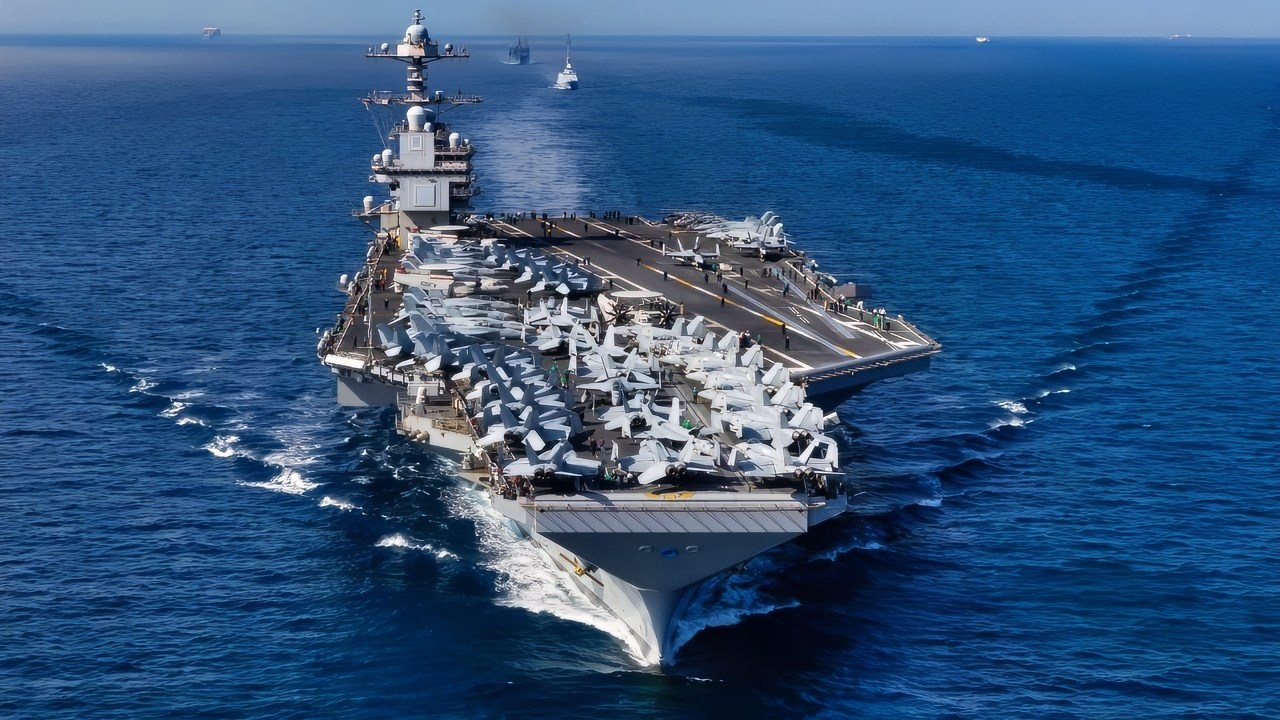
A U.S. Sailor, assigned to Airborne Command and Control Squadron 124, signals the launch of a Carrier Air Wing 8 E-2D Hawkeye aircraft on the flight deck of the world’s largest aircraft carrier, Ford-class aircraft carrier USS Gerald R. Ford (CVN 78), while underway in the Caribbean Sea, Nov. 29, 2025. U.S. military forces are deployed to the U.S. Southern Command area of responsibility in support of Operation SOUTHERN SPEAR, Department of War-directed operations, and the president’s priorities to disrupt illicit drug trafficking and protect the homeland. (U.S. Navy photo)

A U.S. Sailor inspects an aircraft catapult launch track on the flight deck of the world’s largest aircraft carrier, Ford-class aircraft carrier USS Gerald R. Ford (CVN 78), while underway in the Caribbean Sea, Nov. 25, 2025. U.S. military forces are deployed to the U.S. Southern Command area of responsibility in support of Operation SOUTHERN SPEAR, Department of War-directed operations, and the president’s priorities to disrupt illicit drug trafficking and protect the homeland. (U.S. Navy photo)
In the opening days of the conflict, the U.S. president insisted the war would be short, saying on March 1 that the fighting might last only four or five weeks.
But on Wednesday, August 26, the president told the press that he no longer has a timeline for ending the war, and that he was prepared to continue the war and do “whatever it takes.”
“We are winning very big,” Trump told Al Jazeera. “They’ve got massive inflation, their economy is falling apart, they’re treating their people very badly, they are killing many, many protesters. I have no time schedule; whatever it takes.”
It’s a very different story today.
A war that was only expected to include targeted strikes that encouraged the Islamic regime in Tehran to end its nuclear program has become a battle over control of the Strait of Hormuz, the cause of over 700 injuries to American soldiers, a global oil supply crisis, and more.
And despite destroying much of Iran’s conventional military capabilities, the regime is still calling the shots and making demands of Washington before it will consider reopening the Strait of Hormuz.
As we reach the six-month anniversary, Tehran is preparing a new list of conditions Washington must meet to fully reopen the waterway.
Trump Says the U.S. Is Winning
Speaking at the White House on Thursday, the day before the six-month mark, President Trump was upbeat about the war and offered a positive assessment of how it is going, claiming that Iran is in “deep trouble,” adding that it is “not paying their troops.”
Trump also claimed that 24 vessels had passed through the Strait of Hormuz the previous night as part of a protected U.S. convoy, and again insisted the waterway is open, saying the United States maintains both control of the Strait and a blockade that is preventing vessels from reaching or leaving Iran.
But independent shipping data keeps contradicting the president, with some analysts noting that Iranian oil is leaving the strait via ship-to-ship transfers and that traffic remains far below prewar levels overall.
Before February 28, more than 100 ships typically traveled through Hormuz every day.
Kpler data cited by The Washington Post showed only five vessels passing through on one day this week, though U.S. officials say the true figure is higher because some ships are traveling without transmitting their locations.
The U.S. Is Raiding Soldiers’ Paychecks, Though
Trump’s claim that Iran cannot pay its troops appears to be true, but it comes at an awkward moment. Reports suggest that the U.S. Navy is itself moving money out of personnel and payroll accounts to help finance the unexpectedly long war. The Guardian revealed the news on Thursday, citing internal documents and official sources.
The Navy has been among the services hardest hit by the cost of the conflict, having participated in the initial strikes and maintained extensive operations around Iran and the Strait of Hormuz ever since.
But the fiscal 2026 budget was written before the war began and did not account for those operations.
As a result, the Navy has reportedly moved money intended for payroll and other purposes to cover the immediate war costs, while also deferring some maintenance to save on expenditure.
The Trump administration has already asked Congress for $67.15 billion in additional military funding largely related to Iran, while Defense Secretary Pete Hegseth estimated in July that the war would cost at least $37.5 billion through September 30.
Iran Still Wants Major Concessions
To mark six months of conflict, Tehran also appears to be preparing to intensify its demands of Washington, with reports that the regime is now drawing up a formal list of conditions Washington must meet before it will reopen the Strait of Hormuz.
This follows regional mediators asking Tehran to explicitly set out its terms.
Mohsen Rezaei, secretary of Iran’s Supreme National Security Council, revealed details of the process on Thursday following a visit to Tehran by Qatari Prime Minister Sheik Mohammed bin Abdulrahman Al Thani.
But Rezaei has already confirmed one condition: to end the regional war.
An Islamic Revolutionary Guard Corps spokesperson also said on Wednesday that Washington must lift the blockade on Iranian ports and remove economic sanctions, as well as compensate Iran for damage caused during the war.
About the Author: Jack Buckby
Jack Buckby is a British researcher and analyst specializing in defense and national security, based in New York. His work focuses on military capability, procurement, and strategic competition, producing and editing analysis for policy and defense audiences. He brings extensive editorial experience, with a career output spanning over 1,000 articles at 19FortyFive and National Security Journal, and has previously authored books and papers on extremism and deradicalization.


