


The rift between US President Donald J. Trump and Ukraine’s President Volodymyr Zelenskyy is widening as the two leaders continue trading verbal barbs. Relations between the two have been rough since Trump began his second term in 2025, but tensions are nearing a critical point as both sides keep provoking each other.
The recent feud began when Trump decided to buy large quantities of diesel fuel from Moscow. Zelenskyy reacted strongly, calling it a “weak decision.” Since then, tensions have grown further after disruptions to Ukraine’s Starlink connection and claims that the U.S. has halted intelligence sharing with Kyiv.

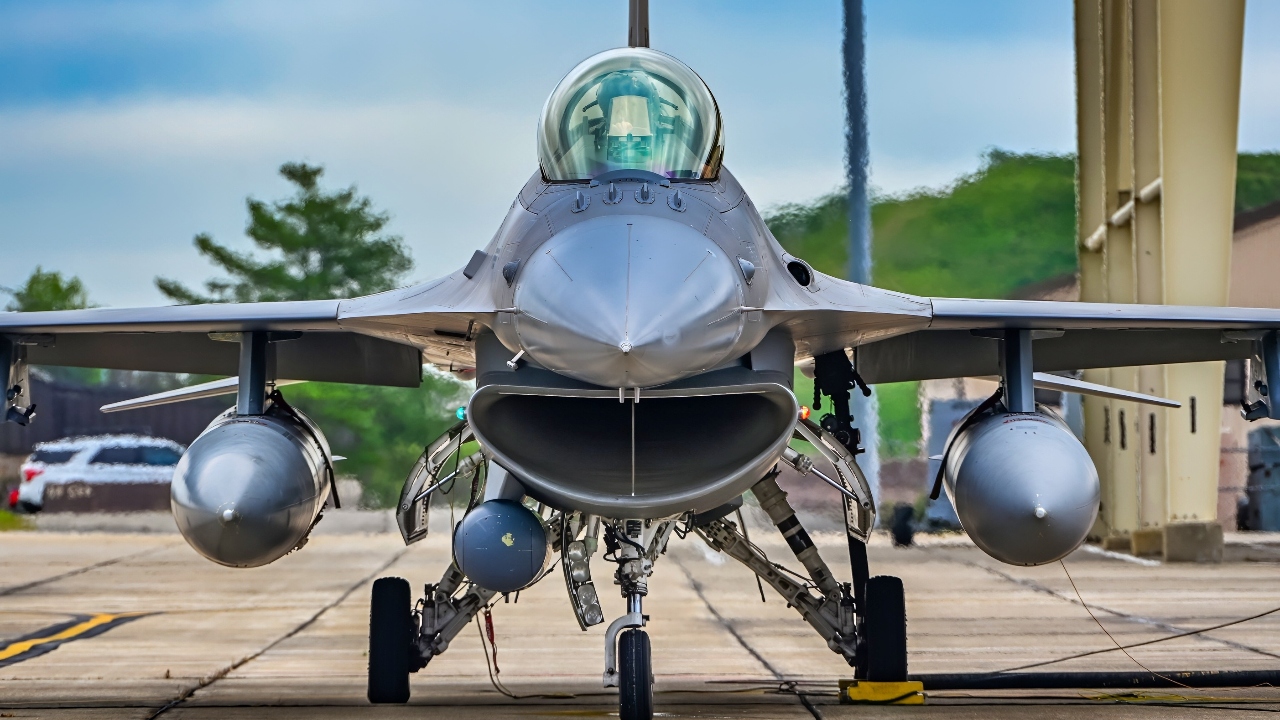
F-16 Fighting Falcons assigned to the 114th Fighter Wing sit ready on the ramp while conducting an elephant walk at Joe Foss Field, South Dakota, July 2, 2025. The 114th Fighter Wing conducted an elephant walk to demonstrate its ability to project fighter airpower. (U.S. Air National Guard photo by Master Sgt. Luke Olson)
Tensions Growing Between Trump and Zelenskyy
On Monday, October 19, Trump expressed his willingness to join in trilateral talks with Vladimir Putin and Xi Jinping to discuss possible avenues of ending the war in Ukraine.
The President also said the meeting could take place without Zelenskyy. “Anything I can do to end the war, whether somebody’s there or not,” he told reporters after a recent campaign rally in Kansas.
Trump also said that the talks could cover the issue of denuclearization and added that “Russia, frankly, has been fine on Ukraine. They haven’t been doing much.” Putin first suggested a trilateral meeting between the three leaders on October 9th, during a phone call with Trump.
The meeting date is not yet set, but it is expected to take place on November 18-19 at the Asia-Pacific Economic Cooperation summit in Shenzhen, China.
When asked about Zelenskyy’s recent criticisms, Trump again berated his Ukrainian counterpart. “Zelenskyy doesn’t know what he’s talking about,” he said. “Zelenskyy is a man that should have had this war settled a long time ago.” The President continued, “I think it’s time for somebody else to negotiate on behalf of Ukraine,” echoing his previous call for Kyiv to “get a new president.” Elections are a sensitive topic for Ukraine.
Secretary of the Army, Hon. Dan Driscoll, flies in an F-16 assigned to the 121st Fighter Squadron, 113th Wing, District of Columbia Air National Guard in a familiarity flight at Joint Base Andrews, MD, May 29, 2025. As the Secretary of the Army, Hon. Driscoll has been delegated the responsibility of command of the District of Columbia National Guard by the President of the United States. (U.S. Army photo by Sgt. David Resnick)
President Zelenskyy controversially suspended elections after Russia’s invasion began in 2022.
The decision was made amidst fears that the Russians could bomb polling stations and inflict mass casualties on civilian populations.
However, suspending elections has also raised concerns among some about Zelenskyy’s seemingly limitless term.
After his dismissal as Minister of Defense, Mykhailo Fedorov called for new presidential elections, directly challenging Kyiv’s current administration.
Although Zelenskyy has made several unpopular decisions since the war began, dissatisfaction with Kyiv has not yet reached the point where average Ukrainians want to hold new elections in a time of war.
Starlink Disruptions
Tensions between Washington and Kyiv have further degraded after disruptions to Ukraine’s Starlink connection and reports that the U.S. has stopped sharing intelligence with Kyiv.
We have covered claims that Washington refuses to share intelligence and why they may be false, but multiple sources associated with the Ukrainian military widely reported Starlink disruptions.
The Starshield package, which provides a secure data link for Ukraine’s drones, recently received new restrictions that imposed strict speed limits on all types of drones.
A couple of days ago, Zelenskyy said these restrictions were being slowly lifted, but he claimed that Ukraine was still experiencing disruptions.
Although the Ukrainian military continues launching drones every day, the restrictions, limited as they were, caused a shock across the frontline and hindered the military’s offensive and defensive drone operations.
The big question following the disruptions was who was responsible.
Elon Musk, owner of SpaceX, took to social media and claimed only the U.S. military and the White House had the authority to restrict the Starshield package.
According to a Reuters report, the White House ordered restrictions on Ukraine’s Starlink connection, but not necessarily Trump himself.
Trump, along with Secretary of State Marco Rubio and Treasury Secretary Scott Bessent, denied claims that the President ordered the restrictions. “President Trump and Secretary Rubio have categorically said that no one under the Trump administration did that, and I think it is very reckless for President Zelenskyy to make such a charge,” Bessent said on Meet the Press. “President Zelenskyy should be very careful about making statements like this that aren’t true.”
Russia Continues its Attacks
While relations between Washington and Kyiv crumble, Russia continues its attacks against Ukraine.
Over the past weeks, Russia has been attacking the Ukrainian capital non-stop with jet-powered drones and missiles.
Attacks were also carried out against Mykolaiv and Dnipro using drones and glide bombs.
Starlink disruptions have negatively affected Kyiv’s ability to use interceptor drones, which are vital for defending against Moscow’s low-cost drones.
Meanwhile, Moscow’s mood has been cautiously optimistic about the recent shift in Washington.
While pro-Russian channels have been ecstatic about the apparent falling out between the U.S. and Ukraine, some Russian officials remain skeptical that this latest drama will have long-term implications for the war or relations with the West. “We must acknowledge that relations between Russia and the US have once again been damaged for decades to come,” said former Russian President and current Security Council Deputy Chairman Dimitri Medvedev. “We have been, are, and will remain systemic adversaries.”
Medvedev attributes recent developments to “pragmatism” on Trump’s part and cynically noted that the passage of Lindsey Graham’s Sanctioning Russia Act suggests the U.S., as a political entity, is unlikely to change its stance on Russia.
About the Author: Isaac Seitz
Isaac Seitz, a Defense Columnist, graduated from Patrick Henry College’s Strategic Intelligence and National Security program. He has also studied Russian at Middlebury Language Schools and has worked as an intelligence Analyst in the private sector.


