

Russia’s long-anticipated escalation is coming, with Moscow saying it is preparing a new wave of “massive strikes” against Ukrainian energy infrastructure.
The warning comes after weeks of speculation among analysts that Ukraine’s power grid could come under attack ahead of or during the winter.
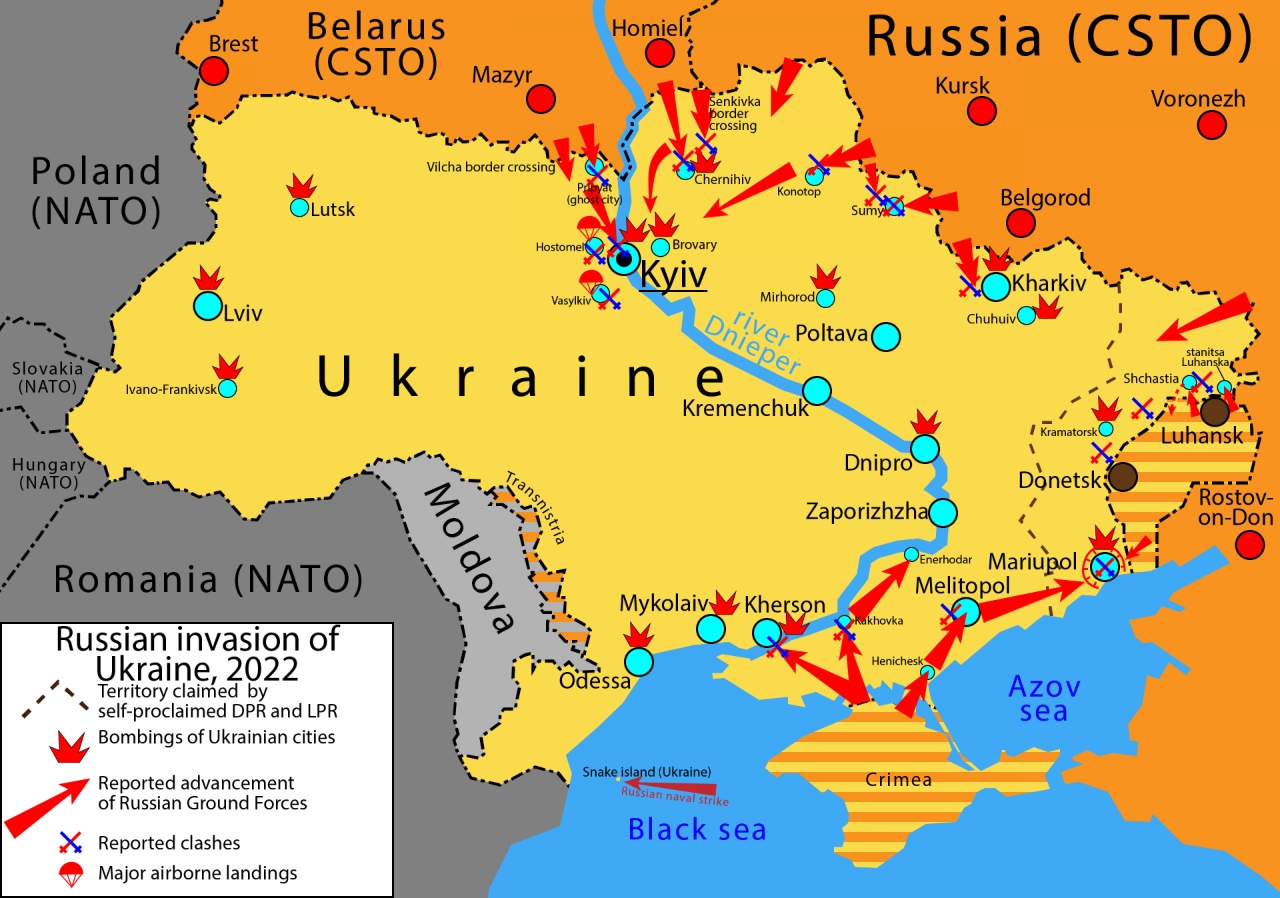
Ukraine War Map. Image Credit: Creative Commons.
It also comes after five consecutive days of Russian attacks on Kyiv and surrounding areas that are beginning to stretch out through the mornings, afternoons, and even evenings — meaning Ukrainian cities have been under a near-constant barrage for almost a week.
Moscow also appears to be introducing larger numbers of its faster jet-powered drones into its attacks, putting Ukrainian air defenses under extreme pressure as it struggles to replenish its critical Patriot interceptor missiles.
Over the weekend, the Russian Ministry of Defense said that preparations for new, large-scale assaults on Ukrainian energy infrastructure were underway and explicitly described them as retaliation for Ukrainian attacks on Russian infrastructure.
Russia’s response is entirely expected, too, with Ukrainian strikes having caused major problems for the Russian economy.
Strikes have targeted fuel infrastructure, logistics centers, drone bases, oil refineries, and commercial warehouses, and have caused extreme damage to both Russian military efforts and the civilian economy.
Russia Says Strikes Are Coming
On Sunday, August 30, the Russian Defense Ministry issued an update on its Telegram channel warning that it was preparing to escalate attacks against Ukrainian targets.
“Russian forces have begun preparations for massive strikes against facilities in Ukraine’s energy sector in response to the ongoing attacks by the Kyiv regime on civilian infrastructure and on Russia’s oil and energy complex,” the update reads.
The statement was issued alongside the ministry’s latest account of Russian operations overnight into Sunday, in which it said that Russian forces had conducted group strikes against Ukrainian defense and industrial facilities.
It specifically claimed that Russian attack drones had struck a cement plant in Kyiv whose warehouses were allegedly being used to store explosives for defense firm Smart Ammunition LLC.
Moscow says the company produces drones and drone munitions for Kyiv.
The announcement also came as Ukraine continued its own campaign against Russian energy infrastructure.
Overnight into August 30, Ukrainian forces struck the Kirishi oil refinery in Russia’s Leningrad region and targeted a military airfield in Krasnodar Krai.
Kirishi is one of Russia’s largest refining complexes, making the attack part of Kyiv’s broader attempt to disrupt Russian fuel production and the infrastructure supporting Moscow’s war.
Russia May Begin Winter Campaign Early
With signs that Western allies are working to supply Ukraine with Patriot missiles and other interceptors as urgently as possible, Russia may be preparing to begin its winter energy campaign earlier than expected to exploit that shortage.
The Institute for the Study of War (ISW) noted earlier in August that Moscow began its 2025-2026 campaign against Ukraine’s energy grid in early September 2025, but could bring this year’s campaign forward.
This’s troublesome for Kyiv because Ukraine is entering this winter in a significantly weaker defensive position than last year, with President Volodymyr Zelenskyy saying earlier in August that the country has around two-and-a-half times fewer interceptors than it had in 2025.
Russia is also now firing roughly twice as many ballistic missiles per month, and is expecting more to be sent from North Korea in the near future.
Zelenskyy also said Ukraine currently receives only around 1% of the Patriot interceptors it needs, and has asked Washington for 5% of U.S. stocks just to supply businesses and homes during the winter.
But with the Iran war raging on, and the U.S. returning to military strikes overnight into Monday, August 31, those interceptors may not arrive in the numbers Kyiv hopes.
Ukraine Races to Prepare
Ukraine is racing to strengthen the physical infrastructure needed to keep the lights on this winter if Russia penetrates its air defenses so deeply that its grid goes down for long periods.
In April, Zelenskyy ordered officials to prepare the energy system for the coming heating season, including by increasing overall electricity generation through decentralized operations and protecting critical facilities.
But the challenge is much bigger than simply producing sufficient electricity.
In previous winters, Russian strikes have targeted substations and transmission equipment needed to move power from power plants to Ukrainian towns and cities.
That means even if Ukraine generates enough electricity, it may struggle to move it to residential buildings and businesses if Russia continues its attacks.
But Ukraine still isn’t fully prepared for what might be coming. Beyond its interceptor shortage, the country still hasn’t secured sufficient backup power for critical heating and water infrastructure.
At an August meeting chaired by Restoration Minister Mykola Kalashnyk, officials calculated that the country’s heating and water facilities require 1,214.6 megawatts of backup power.
As of August 12, only 918.5 megawatts had been secured, leaving an almost 300-megawatt shortfall that regions are now under pressure to close before winter.
About the Author: Jack Buckby
Jack Buckby is a British researcher and analyst specializing in defense and national security, based in New York. His work focuses on military capability, procurement, and strategic competition, producing and editing analysis for policy and defense audiences. He brings extensive editorial experience, with a career output spanning over 1,000 articles at 19FortyFive and National Security Journal, and has previously authored books and papers on extremism and deradicalization.


