

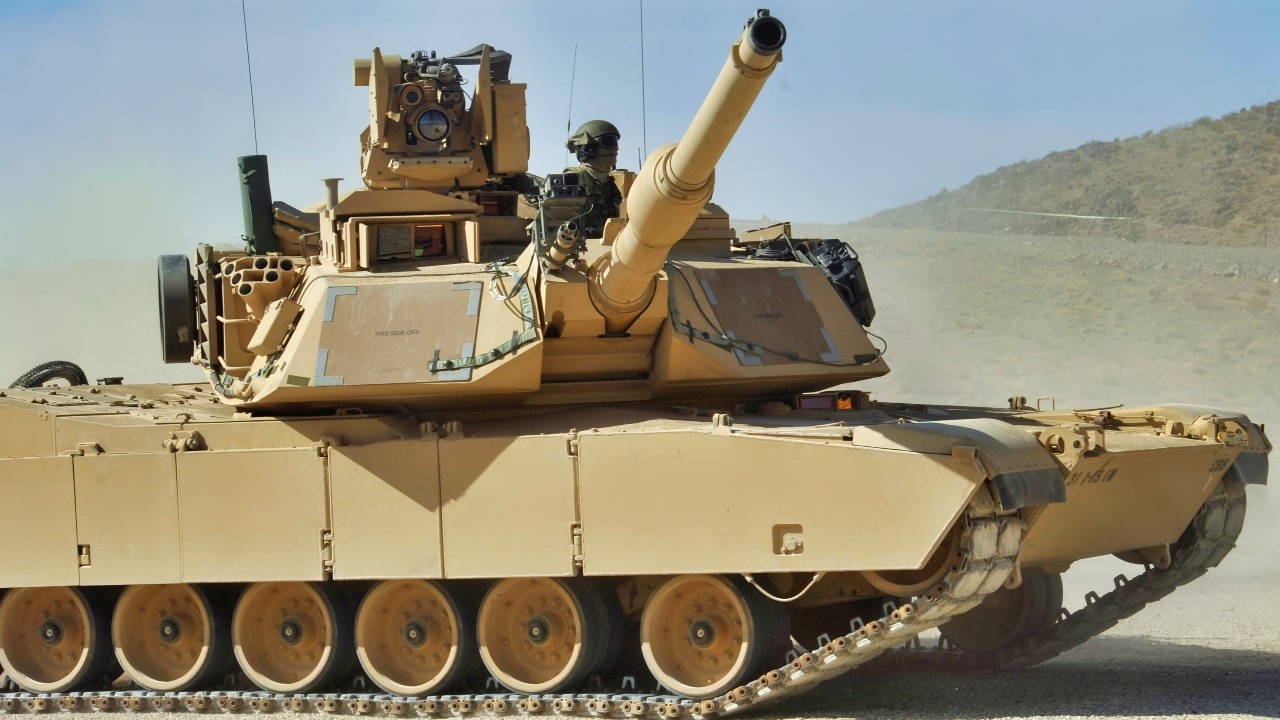
Key Points – Australia is sending 49 of its retired M1A1 Abrams tanks to Ukraine, a move that bolsters Kyiv’s armored firepower but raises significant questions about survivability on the modern battlefield.
-While the donation is a welcome gesture, US officials have reportedly expressed private frustration, warning that Ukraine struggles to sustain the complex tanks and highlighting their vulnerability to cheap, top-attack FPV drones.
-The war in Ukraine has become a “drone war,” where even advanced main battle tanks are at constant risk. The effectiveness of these donated Abrams will ultimately depend on Ukraine’s ability to counter this pervasive threat.
M1A1 Tanks for Australia: Bad Idea?
Australia recently sent Ukraine a set of 49 used M1A1 Abrams main battle tanks — older stock that Canberra was set to retire ahead of accepting the newer and more capable M1A2 Abrams into service more widely.
The move, though certainly a positive gesture, has some asking, is this actually helpful?
The crux of the issue is the Cold War-era tank’s ability to survive on today’s modern battlefield.
Old M1A1 Abrams Tanks for Ukraine: Will It Help? America Isn’t Happy About It
“This latest package, valued at approximately $245 million, will add to the Armed Forces of Ukraine’s firepower and mobility, and complement partners’ support for Ukraine’s armoured brigades,” the statement from Canberra said. “This announcement brings the total value of Australia’s military assistance to Ukraine since the start of Russia’s full-scale invasion to over $1.3 billion, and overall support to more than $1.5 billion.”
“As was announced in January 2022, the Australian Army M1A1 Abrams are to be replaced by the M1A2 fleet. To support the transition, the Australian Army will retain a small number of M1A1 Abrams tanks to assist the introduction of the new M1A2 fleet,” the statement elaborated.
“The Australian Defence Force also continues to make significant contributions to multinational efforts to train Ukrainian military personnel under Operation Kudu. The Australian Government will continue to work with the Government of Ukraine and our international partners to deliver meaningful support for Ukraine to end the conflict on its terms.”
The Right Choice?
It is not the first time Ukraine has accepted the Abrams main battle tank into service. Since virtually the beginning of Russia’s full-scale invasion of Ukraine in February of 2022, officials in Ukraine asked the United States, as well as partners and allies in Europe and farther afield, to send any and all military assistance as quickly as possible, part of Ukraine’s strategy to stave off the Russian war machine.
The United States ultimately sent 31 Abrams tanks to Ukraine after its promise to deliver unlocked the delivery of other Leopard tanks from German and other countries’ stocks. But even those tanks have suffered losses in the face of Russian forces. The Australians acknowledged as much to ABC News.
“Last year, even before Donald Trump returned as president, we warned the Australians that sending these Abrams tanks would be complicated, and once they finally get to the battlefield the Ukrainians will find them difficult to sustain,” one American official told the Australian Broadcasting Corporation, speaking anonymously.
The wisdom of sending Ukraine the Abrams tank — much vaunted though it is — has been questioned by American, Australian, and European officials.
“We are starting to doubt if the Ukrainians actually want these vehicles. The tank roof is the weakest point of the Abrams and this is a drone war,” the American official said to ABC, citing the massive threat posed to armored vehicles by the drone threat.
A First-Person-View Revolution
While the main battle tank has been called the king of war in the past, it might be fair to call now the first-person drone the new kind of war, responsible for a significant amount of the wounded, dead, and vehicles destroyed in Ukraine.
By some estimates, drones are responsible for the majority of all losses in Ukraine, astounding figures.
Drones are not just causing casualties on the battlefield either — Russia is also flying record-setting masses of larger drones, in combination with ballistic missiles, against Ukraine’s civilian infrastructure, even Ukrainian homes. Those drones, however, are not the small first-person drones laden with smaller explosive charges. Instead, Russia’s recent drone attacks on Kyiv and other cities over the weekend involve the use of larger Shahed drones ultimately sourced from Iran, drones with an explosive payload ranging from 50 to well over 100 pounds.
Criticisms
Despite vociferous criticism from both the United States and some other European countries, Ukrainian forces have managed to mate Western-supplied equipment to legacy Soviet-era platforms. Earlier in the war, Ukrainian pilots managed to fire American HARM anti-radiation missiles from their MiG jets, a strong push-back to the line of critique that cites complication as a reason for not expediting weapon and equipment shipments to Ukraine.
Ukrainian forces have also enhanced and upgraded the platforms they have been provided, particularly main battle tanks. The addition of explosive-reactive armored bricks to tanks like the Abrams and others enhances protection levels, although the exact amount is a matter of speculation.
Ukraine War: M1A1 Tanks Headed to the Fight, Even if Drones Rule
Brushing aside the question of maintenance or operational ability, the question of if the Australian-donated Abrams main battle tanks can survive the battlefields of Ukraine is a pressing one — and a question that should be expanded in scope to include not just the Abrams but really all other armored vehicles positioned along Ukraine’s front line.
The drone threat posed to armored vehicles of all kinds is a significant challenge, particularly as the roof armor of tanks and other vehicles is typically thinnest at the top. Given the disparity in costs between a low-cost and expendable drone and a multi-million-dollar main battle tank, investing in anti-drone systems, which employ a combination of electronic and kinetic measures, is of high importance.
About the Author: Caleb Larson
Caleb Larson is an American multiformat journalist based in Berlin, Germany. His work covers the intersection of conflict and society, focusing on American foreign policy and European security. He has reported from Germany, Russia, and the United States. Most recently, he covered the war in Ukraine, reporting extensively on the war’s shifting battle lines from Donbas and writing on the war’s civilian and humanitarian toll. Previously, he worked as a Defense Reporter for POLITICO Europe. You can follow his latest work on X.
Russia’s Bomber Forces
Tu-22M3: The Bomber Ukraine Hit With Drones


