

Moscow’s ‘Steel Cutting’ Drone Aimed at Kyiv – Russia has reportedly developed a warhead tailored to sever high-voltage electricity pylons.
Serhii “Flash” Beskrestnov, a defense technology adviser to Ukrainian President Volodymyr Zelenskyy, said a jet-powered drone carried the device on Sept. 30.
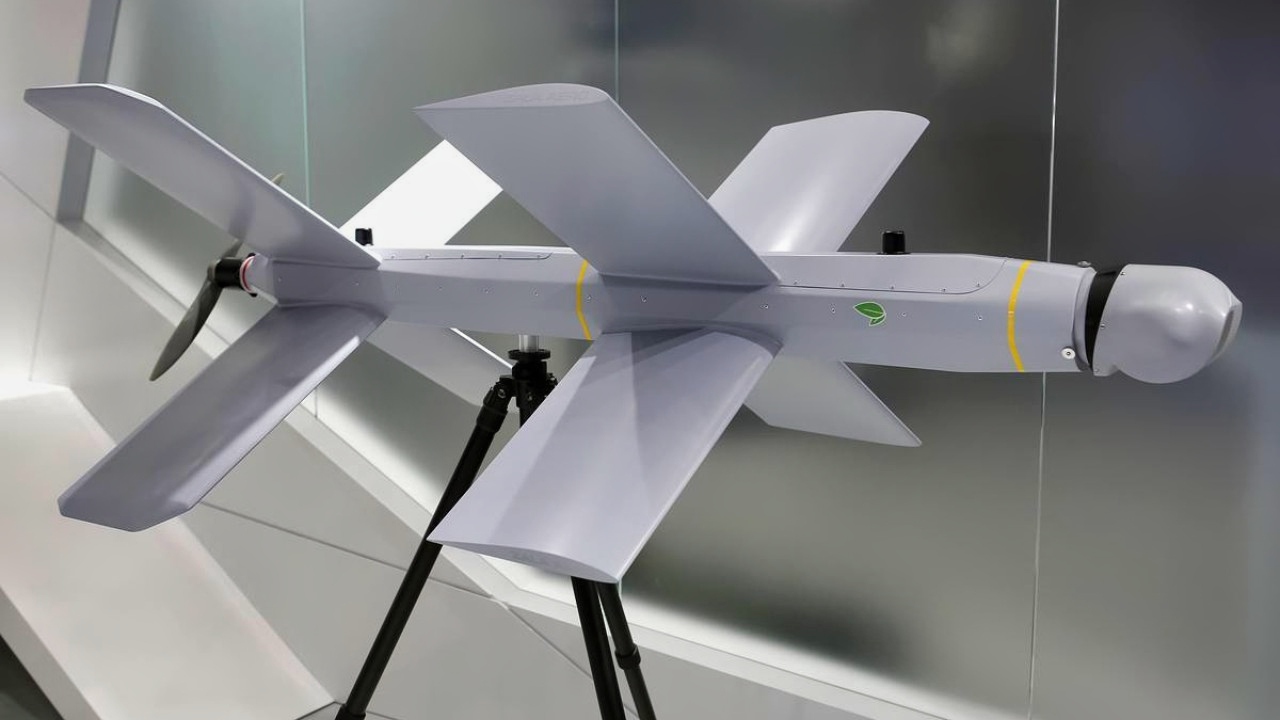
Lancet Drone. Image Credit: Russian State Media.

Lancet Drone from Russia. Image Credit: Creative Commons.
Beskrestnov, an expert on military communications and former adviser to the ousted defense minister Mykhailo Albertovych Fedorov, was appointed a non-staff adviser to the Ukrainian government in July.
A Warhead Built to Cut Steel
“Bad news. Today, the enemy for the first time used a special shaped-charge cutting warhead on a jet-powered unmanned aerial vehicle,” Beskrestnov wrote on Telegram, according to the Kyiv Independent.
He said the payload was built to damage high-voltage pylons and steel bridge structures and comprised a 40-kilogram main charge plus four additional destructive modules. “I think the enemy plans to attack important high-voltage power transmission lines,” he added.
Russia’s Biggest Energy Strike in Months
Following the major Sept. 29-30 attack, Ukraine reported 188 drone incursions. By early evening, Reuters reported that the air force had counted another 285 Russian drones throughout the daytime onslaught. It said 174 were faster, jet-propelled versions and that 254 drones were downed overnight.
Zelenskyy called it “a difficult attack” and said, “the main target was energy infrastructure in the capital and the Kyiv region.” Seven people were killed across Ukraine, including a child, according to the later Reuters tally.
Prime Minister Sergii Koretskyi said, “Russia has escalated to massive strikes on energy infrastructure,” adding that “a combined strike of this scale hasn’t happened since the end of last heating season.”
Emergency power cuts were imposed in Kyiv and three surrounding regions. Foreign Minister Andrii Sybiha accused Moscow of “trying once again to turn cold, darkness, and disruption of normal life into weapons.”
Russia’s Defense Ministry said it hit power plants in the Kyiv region, an industrial complex in Odesa region and port infrastructure at Izmail. Ukrainian officials did not confirm all those specific claims.
The attack also spilled toward Ukraine’s neighbors. Moldova said drones crossed its airspace during the day, while Romania scrambled Spanish F-18s after detecting an aerial target east of Izmail. Bucharest nevertheless said, “No incursions into the national airspace were detected.”
Jet Drones Stretch Ukraine’s Defenses
The anti-pylon payload is only part of the problem. The Associated Press reported Oct. 1 that Ukraine is struggling to catch the new jet-powered drones, which fly higher and faster than older propeller-driven Shahed-type weapons.
“They’re moving so fast that we can’t get a proper lock on them,” air-defense commander Volodymyr Serdiuk told AP. He compared trying to hit them to “chasing a pig in the forest.”
Sean Almeida, a former U.S. Marine volunteering with Serdiuk’s unit, said: “The problem is they’re flying too high.” Ukraine’s fastest interceptor drones typically reach around 300 to 400 kilometers per hour, AP reported.
“Right now, we’re in a race for speed,” said Oleksii Babenko, CEO of Vyriy Drones, as manufacturers work on faster interceptors, new propulsion and autonomous guidance.
‘If People Are in a Bunker, Business Stops’
The barrage is also exacting an economic cost beyond the physical damage. Economy and Environment Minister Oleksandr Kravchenko told the Guardian that missile alerts cost Ukraine an estimated $45 million for every hour they force businesses to halt work.
“If people are in a bunker, business stops,” he said.
Kravchenko estimated Russian attacks have caused around $10 billion in damage to fixed assets this year, including industrial sites, warehouses, logistics infrastructure and data centers. He described Moscow’s campaign as an attempt to “destroy pretty much the entire economy.”
Last month, Ukraine rolled out a two-tier alert system to limit disruption. Under this system, businesses can operate if their area remains under a yellow drone alert. If red missile or combined-attack warnings are active, business operations must stop and people are instructed to seek shelter.
The trade-off is sharpening as drones get faster.
Zelenskyy has warned that “the closer we get to winter, the more of this protection we need.” After Sept. 30, Ukraine’s grid is not only facing more attacks, but, as Beskrestnov warns, potentially new weapons designed to sabotage the grid itself.
About the Author: Georgia Gilholy
Georgia Gilholy is a journalist based in the United Kingdom who has been published in Newsweek, The Times of Israel, and the Spectator. Gilholy writes about international politics, culture, and education.


