

Ukraine Hits Last Major Russian Black Sea Fleet Stronghold – Ukraine launched one of its most ambitious attacks on Russia’s Black Sea military infrastructure yet, striking the naval base at Novorossiysk overnight with a combination of aerial and naval drones and missiles.
Ukrainian President Volodymyr Zelenskyy announced the strikes in a statement, describing them as a “unique operation” against the “last major stronghold of the Russian fleet in the Black Sea.” The strikes complicate Russian planning after much of its Black Sea Fleet was moved to Novorossiysk to protect its high-value assets following repeated Ukrainian strikes at the historic Sevastopol base.

A M109A7 Paladin, assigned to 1st Battalion, 82nd Field Artillery Regiment, Division Artillery, 1st Cavalry Division, fires a round during Operator New Equipment Training on Fort Hood, Texas, Aug. 25, 2025. The First Team is fielding new equipment, as part of the Transforming in Contact initiative, and conducting training to increase familiarization and precision with the new vehicles. (U.S. Army Photo by Spc. David Dumas)
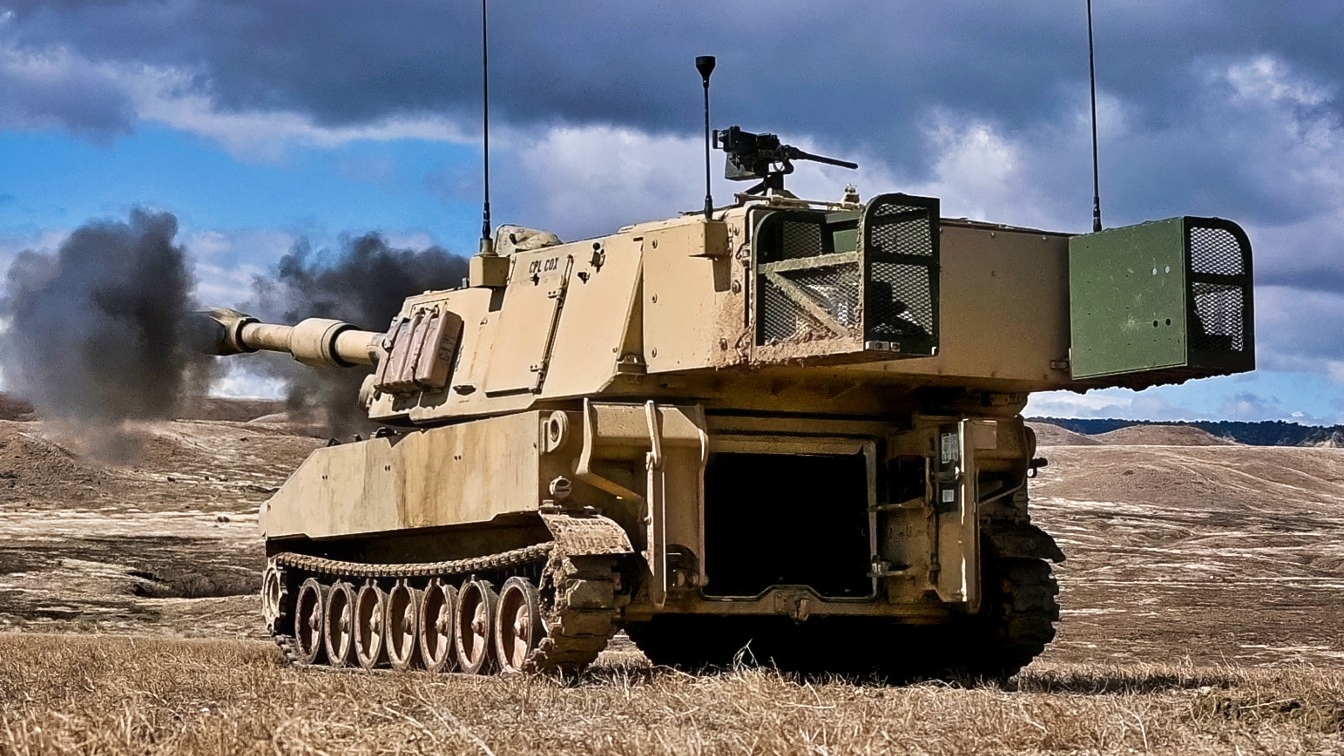
A U.S. Army M109A6 Paladin assigned to 3rd Battalion, 29th Field Artillery Regiment, 3rd Armored Brigade Combat Team, 4th Infantry Division fires during an artillery direct fire range at Fort Carson, Colorado, April 28, 2023. Direct fire ranges test gun crews’ abilities to engage threats at close range, one of the few times a gun crew can see their targets without a forward observer. (U.S. Army photo by Capt. Tobias Cukale)
The latest attack affected more than just another Russian port. Ukraine struck a location that Moscow now relies upon to protect its surviving naval assets – and it’s clear that refuge is no longer safe.
What Zelenskyy Said
In a statement issued on X, accompanied by dramatic video footage showing the aftermath of the strikes, Zelenskyy described how Ukrainian forces conducted a strike on the “last major stronghold of the Russian fleet in the Black Sea, more than 300 kilometers from the front line.”
Zelenskyy also described how the attack was conducted using a combination of Palianytsia jet-powered drones, missiles, and unmanned boats.
“Our Palianytsia jet-powered drones, Neptune missiles, and unmanned naval systems successfully struck the designated targets. Hits on air defense positions, piers, and seaport infrastructure have been confirmed,” Zelenskyy said.
“I thank the warriors of the Armed Forces of Ukraine, the Security Service of Ukraine, and our intelligence agencies for their accuracy and good results. The occupation fleet and all the infrastructure supporting it will not be safe as long as Russian aggression continues. The war must be stopped, and all reasonable proposals for diplomacy are on the table,” he continued.
Both of the main weapons identified by Zelenskyy are Ukrainian-made systems developed or substantially improved upon during the war. Those indigenous systems gave Kyiv a long-range strike capability that does not depend entirely on Western-supplied munitions.
Ukraine’s “Missile-Drone”
The Palianytsia is a jet-powered “missile-drone” that was first successfully used by Ukraine in 2024. Unlike the slower propeller-driven drones that Ukraine frequently sends deep into Russia, the Palianytsia uses a turbojet engine that combines characteristics of an unmanned aircraft and a cruise missile. It could even be compared to Russia’s own jet-powered Shahed-type drones, which are adapted Iranian designs.
Ukraine has disclosed relatively few specifications about the drone, including its range and payload, or indeed its current production numbers – but the latest strike proves that Kyiv’s domestic weapons industry is delivering for its armed forces.
Zelenskyy did, however, announce in December 2024 that the weapon had entered mass production, and Ukraine has since continued expanding its domestically produced long-range arsenal.
The Neptune
The Neptune has a longer history. Developed by Ukraine’s Luch Design Bureau from technology derived from the Soviet Kh-35, the original R-360 Neptune was designed as an anti-ship cruise missile with a range of around 300 kilometers and a 150-kilogram warhead. It became famous in April 2022 when Ukraine used Neptune missiles to strike the Moskva, the flagship of Russia’s Black Sea Fleet, which subsequently sank.
Since then, Ukraine has developed land-attack and extended-range versions of the Neptune missile. In March 2025, Zelenskyy announced the “Long Neptune,” a longer-range variant that was first successfully used in combat that same year and can strike targets up to 1,000 kilometers away.
The Attack Hit More Than Russia’s Navy
The strikes not only hit Russia’s Black Sea Fleet, but they also disrupted one of the country’s most important commercial export hubs, thereby increasing the economic pressure on Moscow to end the conflict.
Two major grain terminals at Novorossiysk suspended operations following the overnight strikes, according to Wednesday reports.
Russia is the world’s largest wheat exporter, and concerns about shipping disruptions have helped push global wheat prices up by around 3% following the announcement of the strikes. It means that Moscow has yet another reason to reconsider the conflict or speed up efforts to mitigate or prevent further Ukrainian strikes. Russian businesses and Moscow are now working to maintain commodity exports that continue generating revenue for its wartime economy.
The attack also comes as new reports reveal that U.S. Vice President JD Vance personally asked Zelenskyy to limit Ukrainian strikes around Novorossiysk to protect the Caspian Pipeline Consortium (CPC), which carries most of Kazakhstan’s crude exports and serves oil fields connected to U.S. companies Chevron and Exxon Mobil. The warning comes amid an ongoing global oil scare and the very real possibility that prices could climb well beyond $100 per barrel, with the Strait of Hormuz effectively closed.
Ukraine reportedly agreed not to target CPC infrastructure or non-Russian vessels using its facilities, and Wednesday’s operation shows that the agreement appears to be in place, with Ukraine targeting naval infrastructure that made the port Russia’s primary remaining Black Sea Fleet stronghold and grain export hub.
About the Author: Jack Buckby
Jack Buckby is a British researcher and analyst specializing in defense and national security, based in New York. His work focuses on military capability, procurement, and strategic competition, producing and editing analysis for policy and defense audiences. He brings extensive editorial experience, with a career output spanning over 1,000 articles at 19FortyFive and National Security Journal, and has previously authored books and papers on extremism and deradicalization.


