

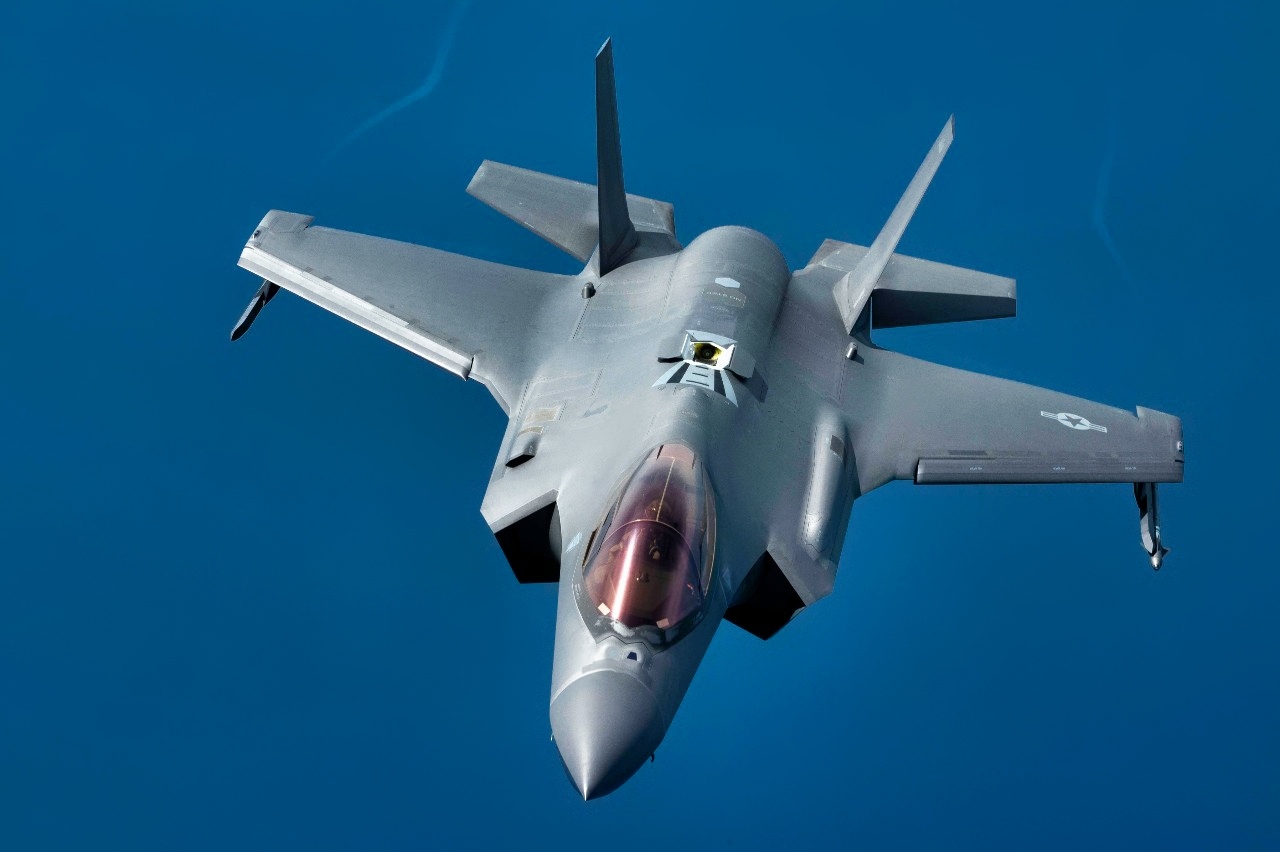
Key Points – The US Air Force has cut its F-35 procurement request for the fiscal year 2026 budget in half, asking for 24 jets instead of the 48 projected, according to a Bloomberg News report this week.
-The US Navy has also reportedly reduced its request from 17 to 12 F-35s. This move, characterized as “a blow to Lockheed Martin,” appears to align with Defense Secretary Pete Hegseth’s plan to reduce overall military spending by 8% over five years.
-Despite the cuts and criticism from figures like Elon Musk, powerful Congressional backers may seek to increase the final F-35 order.
The F-35 Has a New Problem
The Air Force has cut its request for F-35s in half, Bloomberg News reported this week. The outlet cited a procurement request document that requested 24 of the planes from Lockheed Martin, rather than the 48 that were projected.
Bloomberg characterized this as “a blow to Lockheed Martin,” as the Air Force is the world’s largest customer for F-35s. The 24 planes, however, are merely an ask, and could change as the bill moves through Congress.
“The scaling back of the F-35 request may reflect one way the service is revising its funding for fiscal 2026 to comply with Defense Secretary Pete Hegseth’s plan to reduce projected US military spending by 8% over the next five years,” Bloomberg said.
Reuters also reported that the Pentagon has asked for 12 of the Navy’s carrier versions of the F-35, rather than the 17 that were previously approved by Congress.
This follows the news, also this week, that Canada’s order for F-35s from Lockheed has gotten much more expensive than originally planned.
F-35: A Culture War Cudgel
As noted by Bloomberg, the continued spending on the F-35 emerged as something of a culture war talking point in the age of DOGE.
Elon Musk had stated in an X post last November that “some idiots are still building manned fighter jets like the F-35,” rather than emphasizing the use of drones.
Gadfly Laura Loomer, meanwhile, once stated that the continued funding of the F-35 was “a scandal that’s quietly draining our nation’s resources while compromising our military readiness every day.”
However, as noted in the story, Lockheed Martin has some powerful backers in Congress, who might insist on upping the order when it comes time to put together final legislation.
Hegseth’s Cuts
Hegseth, in his often embattled time at the Pentagon so far, has emphasized cost-cutting. In April, he announced $5.1 billion in what he called “wasteful” Pentagon contracts.
The cuts, the Pentagon said at the time, included $1.8 billion in consulting contracts, a $1.4 billion enterprise cloud IT services contract, and a $500 million “business process consulting” contract. This was in addition to 11 contracts related to diversity, equity and inclusion (DEI.)
“We need this money to spend on better health care for our warfighters and their families, instead of a $500 an hour business process consultant,” Hegseth said in the April announcement. “That’s a lot of consulting.”
These were added to previous cuts that were announced before.
“If you’re keeping score at home, today’s cuts bring our running total to nearly $6 billion in wasteful spending over the first six weeks of the Department of Government Efficiency effort here at the Defense Department,” the Defense Secretary said in April.
Surviving at the Pentagon
One thing worth noting is that after Pete Hegseth was confirmed by just a single vote, his job looked to be in danger earlier this spring, especially in the wake of the Signalgate scandal, which was followed by a series of high-profile staff departures at the Pentagon.
At one point, a former staffer and longtime friend of Hegseth’s even wrote an op-ed arguing that the secretary probably couldn’t survive at the Pentagon much longer.
But survive he has, and there’s no longer any daily drumbeat about Hegseth’s imminent departure. And while there was a report last week that the Pentagon’s watchdog was looking into whether staffers had been told to delete messages, Signalgate has mostly been out of the news, with the frequent other chaos of the second Trump era knocking it out of the headlines.
On Tuesday, Hegseth testified before a U.S. Senate committee about both the Pentagon budget and Signalgate.
“This budget provides a historic level of funding for military readiness, putting our warfighters and their needs first,” Hegseth said in comments released by the Department of Defense.
About the Author
Stephen Silver is an award-winning journalist, essayist and film critic, and contributor to the Philadelphia Inquirer, the Jewish Telegraphic Agency, Broad Street Review and Splice Today. The co-founder of the Philadelphia Film Critics Circle, Stephen lives in suburban Philadelphia with his wife and two sons. For over a decade, Stephen has authored thousands of articles that focus on politics, technology, and the economy. Follow him on X (formerly Twitter) at @StephenSilver, and subscribe to his Substack newsletter.
Russia’s Bomber Forces
Tu-22M3: The Bomber Ukraine Hit With Drones


Pingback: China's J-20 Stealth Fighter Simply Summed Up in 4 Words - National Security Journal
Pingback: F-35 Fighter For Ukraine? What That Would Mean in 4 Words - National Security Journal
Pingback: The F-35 Stealth Fighter Is Starting to 'Circle the Drain' - National Security Journal