


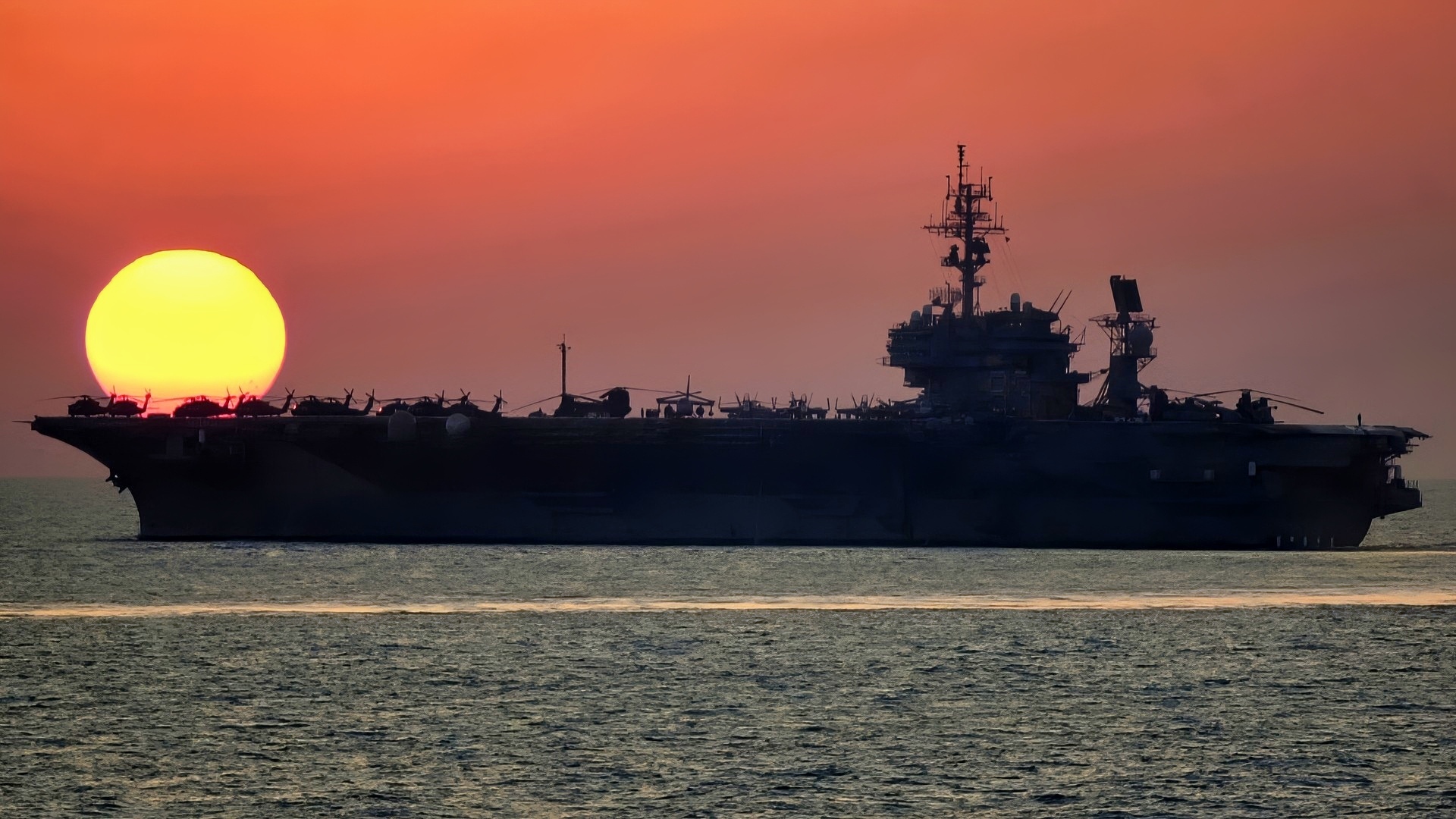
Key Points and Summary – USS Constellation (CV-64), the second Kitty Hawk–class carrier, was a conventionally powered Cold War workhorse that bridged the era between Forrestal-class flattops and today’s nuclear Nimitz fleet.
-Commissioned in 1961 after a deadly $75 million shipyard fire, “Connie” carried 70–90 aircraft and became synonymous with the Vietnam War, flying thousands of sorties during Rolling Thunder and the Linebacker campaigns while also becoming a magnet for antiwar activism.

USS Constellation Aircraft Carrier. Image Credit: Creative Commons.
-Modernized repeatedly, she later enforced no-fly zones over Iraq, launched strikes in Afghanistan after 9/11, and supported the 2003 Iraq invasion before decommissioning in 2003 and eventual scrapping.
The USS Constellation was the US Navy’s Cold War-era Workhorse
Part of the Kitty Hawk-class, the USS Constellation aircraft carrier served as a bridge to today’s nuclear-powered supercarriers.
The USS Constellation was the second of the Kitty Hawk-class carriers and was commissioned in 1961. The carrier’s construction was delayed by a fire that broke out in the yard where the carrier was being built the year before the USS Constellation’s commissioning.
Though the fire did not kill any sailors or firefighters, 50 dockworkers were killed during the blaze, accidentally caused when a forklift operator spilled diesel fuel that ignited. It took 17 hours to contain the blaze, which caused $75 million in damage.
In a comical twist, a clerical error by the US Navy led to the carrier bearing the same name as the 19th-century frigate USS Constellation, a historic ship still on the Navy’s books as a commissioned ship. The Navy, therefore, had two active vessels with the same name, contrary to naval policy.
To solve the problem, the Navy decommissioned the sail-driven frigate on the same day the aircraft carrier was commissioned in 1961.
The Kitty Hawk-class
The carriers were the last of the US Navy’s large, conventionally-powered aircraft carriers. Designed in the 1950s during the early stages of the Cold War, the carriers were the backbone of the Navy throughout the Conflict. They served as a bridge between the older Forrestal-class carriers and the Navy’s nuclear-powered Nimitz-class supercarriers.
The class was designed from the outset to be large carriers capable of supporting high-tempo operations. The class also had to adequately handle the era’s jet-powered aircraft, including early supersonic fighters, bulky early-warning aircraft, and other large aircraft.
Depending on air wing configuration, the class would embark with 70 to 90 aircraft at a time.
USS Kitty Hawk of Kitty-Hawk-Class. Image Credit: Creative Commons.
There were just four Kitty Hawk-class carriers, though the fourth, the USS John F. Kennedy, was a heavily modified variant, with a unique internal design and machinery specific to the carrier.
War in Vietnam
The USS Constellation’s operational life is associated with the Vietnam War. In 1964, the USS Constellation deployed to the Gulf of Tonkin. It launched thousands of sorties, including an essential role in Operation Rolling Thunder, and supporting air operations for Linebacker I and Linebacker II.
But the USS Constellation’s service has also been closely tied to the Vietnam War as a focal point of some of the era’s antiwar activism. When the USS Constellation deployed to Vietnam in 1971, nine of the ship’s crew refused to go to Vietnam and took sanctuary in a local Catholic church in San Diego.
Though the nine sailors were eventually arrested by US Marshals and sent back to the ship, most were discharged from the Navy. Ultimately, the Connie 9 were wrapped up in the broader Stop Our Ships antiwar movement of the era.
Post-war
Following the end of the Cold War, the USS Constellation moved from regularly supporting air sorties against the North Vietnamese to a routine of forward deployment as part of deterrence patrols.
A series of refits to the ship, which integrated more modern electronics and upgraded defensive systems, supported operations with newer aircraft such as the F-14 Tomcat, S-3 Viking, E-2C Hawkeye, and later the F/A-18 Hornet.

S-3 Viking. Image Credit: Creative Commons.
The carrier’s catapults and arresting gear were updated multiple times to keep pace with newer aircraft. While the refits and modernizations significantly improved the USS Constellation’s capabilities, the ship never received nuclear reactors, a staple of today’s nuclear-powered American carrier fleet.
Following the end of Cold War hostilities, the USS Constellation supported Operation Southern Watch during the 1990s and helped enforce a no-fly zone over Saddam Hussein’s Iraq.
Later, after the 9/11 attacks, the carrier returned to the Middle East for the opening phases of Operation Enduring Freedom, and in 2003, took part in strikes against Iraq, launching both Tomcats and Hornets from its flight deck for a variety of missions.

F-14D Tomcat NSJ Image. Image Credit: Taken by Jack Buckby on 9/18/2025.
Retirement
By the mid-2000s, however, the USS Constellation was an aged, 40-year-old aircraft carrier. The US Navy was upgrading and standardizing its carrier capabilities around the Nimitz-class nuclear supercarriers, and the USS Constellation’s conventional propulsion was at a distinct disadvantage.
Combined with increasing maintenance costs, as well as a constrained capacity for integrating future technologies—and in particular generating sufficient electrical generation to feed increasingly powerful computers and radars—the Navy decommissioned the USS Constellation in 2003.
A decade later, the USS Constellation was scrapped.
About the Author: Caleb Larson
Caleb Larson is an American multiformat journalist based in Berlin, Germany. His work covers the intersection of Conflict and society, focusing on American foreign policy and European security. He has reported from Germany, Russia, and the United States. Most recently, he covered the war in Ukraine, reporting extensively on the war’s shifting battle lines from Donbas and writing on the war’s civilian and humanitarian toll. Previously, he worked as a Defense Reporter for POLITICO Europe. You can follow his latest work on X.
More Military
The U.S. Navy’s Constellation-Class Frigate Crisis Keeps Getting Worse
China’s New H-20 Stealth Bomber Might Have a 10,000 km Range
Even Mach 3 Speeds Could Not Save the Titanium SR-71 Blackbird
The U.S. Navy’s New DDG(X) Destroyer Is Sailing Into Stormy Waters


