

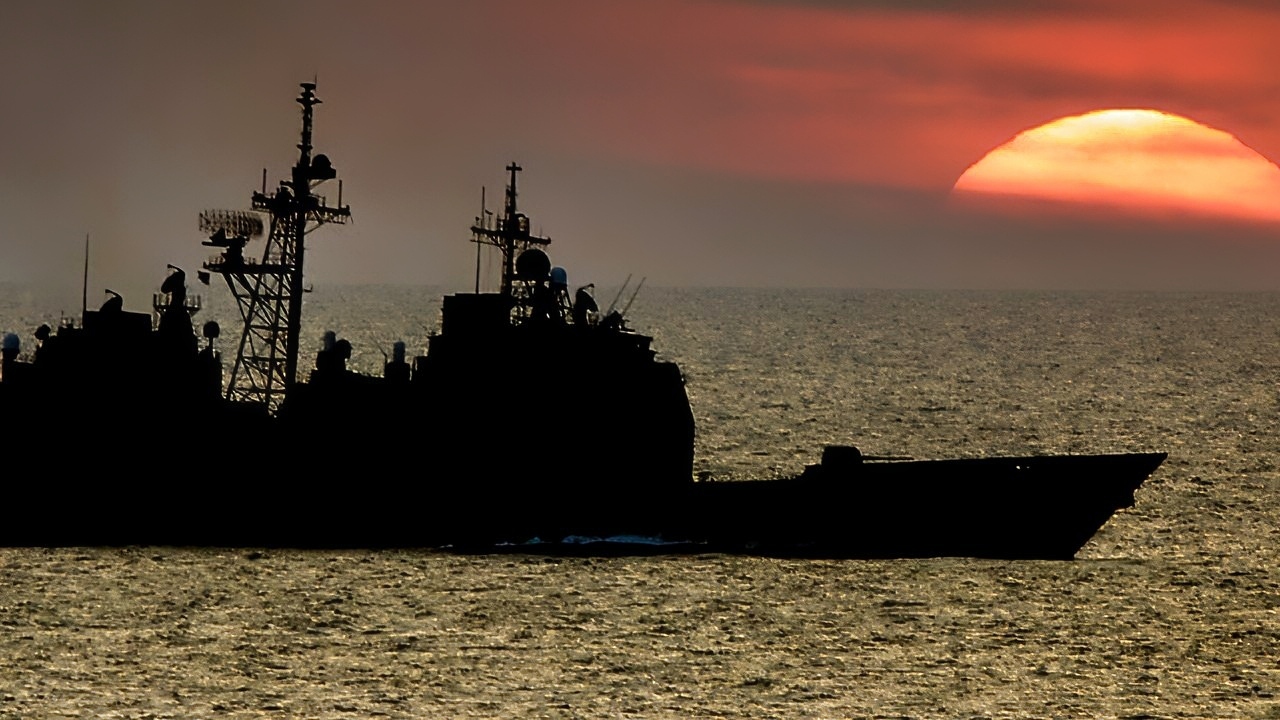
The U.S. Navy is retiring every single Ticonderoga-class guided-missile cruiser by 2029 — and with them, more than 1,200 missile launch cells the surface fleet cannot replace. Each Ticonderoga carries 122 VLS cells; the Flight III Arleigh Burke destroyer that replaces them carries just 96. With Operation Epic Fury burning through hundreds of Tomahawks against Iran, the timing of this loss could not be worse.
The U.S. Navy Is Losing Its Ticonderoga-Class Cruisers — And With Them, More Than 1,200 Missiles
The Ticonderoga-class guided-missile cruiser was the heaviest-armed surface warship the United States ever sent to sea.
Twenty-seven hulls were delivered between 1980 and 1994. Each one carried 122 Mk 41 Vertical Launch System cells — more than any other American surface combatant has ever fielded — loaded with a rotating mix of Tomahawk cruise missiles, Standard Missile-2 air defense weapons, SM-3 ballistic missile interceptors, SM-6 multi-role missiles, Evolved Sea Sparrow Missiles, ASROC anti-submarine rockets, and Harpoon anti-ship missiles.
By the close of 2029, every one of them will be gone.
The Navy is in the middle of decommissioning the entire class. Fourteen have already left service. The remaining hulls are scheduled to retire in stages through 2027, with three life-extended ships — USS Gettysburg, USS Chosin, and USS Cape St. George — granted reprieves through 2029. When the last Tico goes, the surface fleet loses more than 1,200 VLS cells.
The replacement is the Arleigh Burke Flight III destroyer at 96 cells per hull. Every one-for-one swap costs the Navy 26 launch tubes. Performed across the entire class, that arithmetic produces one of the largest unforced reductions in American shipboard missile capacity since the Cold War ended.
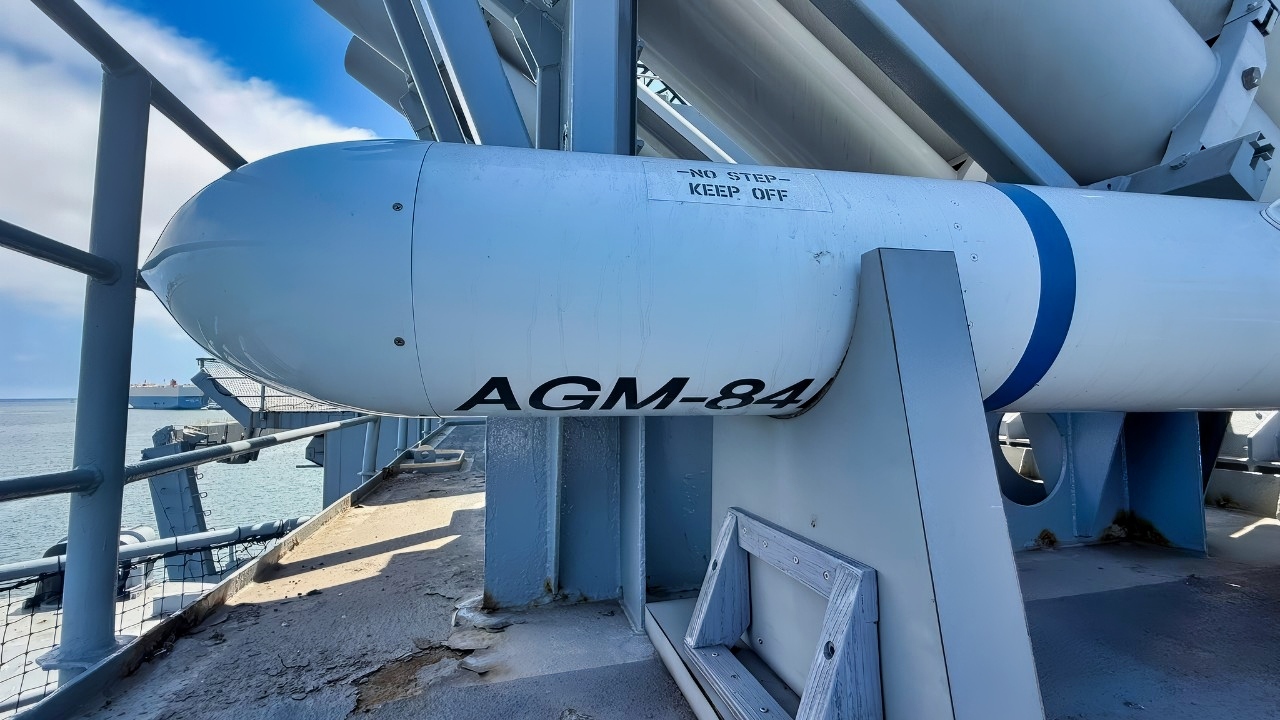
Harpoon Missile Onboard USS Iowa. Image Credit: National Security Journal.
Why The Navy Built Them
The Ticonderoga-class began as the surface platform for the Aegis Combat System — the most ambitious shipboard radar and weapons-integration effort the U.S. Navy had ever attempted.
The threat that drove Aegis was specific. By the late 1960s, Soviet naval aviation and surface forces had developed the capability to fire massed cruise missile salvos against American carrier battle groups. The forecast attack profile was a saturation raid — dozens of supersonic missiles inbound on multiple bearings at once, swamping the manual tracking and engagement systems that 1960s-era cruisers and destroyers depended on. Existing American warships could prosecute one threat at a time. The Soviets were planning to send fifty.
The Bureau of Ordnance opened work on a solution in 1959 under the codename TYPHON — an early effort at multi-target tracking. TYPHON was eventually rolled into the Advanced Surface Missile System program, which by the end of 1969 was renamed Aegis. Per the institutional history of the program’s development, the effort was driven by Rear Admiral Wayne E. Meyer, who pushed through a series of organizational changes at Naval Sea Systems Command to consolidate weapons development and ship-design authority into a single program office — the first time a hardware shop had been handed that level of integration control over an American shipbuilding effort.
The technical breakthrough was the AN/SPY-1 phased-array radar. Where conventional rotating radars scanned the sky mechanically, SPY-1 used electronically steered beams that could maintain track on more than 100 targets across the full 360-degree horizon simultaneously. Paired with the Aegis tactical weapon system — the digital command-and-decision computer that prioritized threats and assigned engagements automatically — the result was a warship that could fight a saturation attack in real time without overwhelming its crew.
Aegis needed a hull. The original plan was a nuclear-powered Strike Cruiser. Budget pressure killed that program. The fallback option was a modified Spruance-class destroyer hull carrying the Aegis suite and the existing Mark 26 twin-arm launchers. The lead ship was first designated DDG-47 — a guided-missile destroyer. The enhanced capability of Aegis, plus flagship command facilities, drove the reclassification to CG-47 — guided-missile cruiser — right before the keel went down.
USS Ticonderoga (CG-47) was commissioned at Ingalls Shipbuilding in Pascagoula, Mississippi on January 22, 1983, with Captain Roland Guilbault in command. First Lady Nancy Reagan had christened her on May 16, 1981. She was the fifth U.S. Navy vessel to carry the name, honoring the 1775 capture of the Lake Champlain fortress that opened the American Revolution.
How They Were Built And What They Carried
Twenty-seven Ticonderoga-class cruisers were delivered between 1980 and 1994 by Ingalls Shipbuilding in Mississippi and Bath Iron Works in Maine. The hull measured 567 feet long with a 55-foot beam. Full-load displacement reached 9,800 tons. Twin General Electric LM2500 gas turbines pushed her past 32 knots. The complement totaled approximately 330 sailors plus the embarked flag staff that the flagship facilities accommodated.
The first five ships in the class — Ticonderoga, USS Yorktown (CG-48), USS Vincennes (CG-49), USS Valley Forge (CG-50), and USS Thomas S. Gates (CG-51) — were built with legacy Mark 26 twin-arm launchers. Those rails were manpower-intensive and limited to one engagement per arm at a time. They were a carryover from the original DDG-47 configuration and became obsolete almost immediately.
Starting with USS Bunker Hill (CG-52) in 1986, the class transitioned to the Mark 41 Vertical Launch System. The Mk 41 was the breakthrough that turned the Ticonderoga into the most lethal surface combatant on the planet. Sixty-one cells forward, sixty-one cells aft. One hundred twenty-two total. Each cell could accept a Tomahawk, any variant of the Standard Missile family, an ESSM quad-pack, a vertical-launch ASROC, or — starting in the late 2000s — an SM-3 ballistic missile interceptor. The system was modular, scalable, and dramatically less manpower-intensive than the Mk 26 it replaced.
A representative 2018 Ticonderoga loadout: 12 SM-6s, 3 SM-2 Extended Range, 56 SM-2 Medium Range, 12 ESSMs, 10 SM-3 interceptors, 32 Tomahawks, 6 RUM-139 vertical-launch ASROCs. Plus eight Harpoon anti-ship missiles in canister launchers at the fantail. Two Mark 45 5-inch deck guns — one forward, one aft — giving the class its distinctive “double-ender” silhouette. Two Phalanx CIWS for close-in defense. Two triple-tube torpedo mounts. Two embarked SH-60 Seahawk helicopters for anti-submarine work.

Tomahawk Launch. Image Credit: Creative Commons.
The Aegis system itself was upgraded continuously across the class’s life. Baseline 1 through Baseline 9, eventually reaching the open-architecture Baseline 10 in the most recent Flight III Burkes. The Ticonderogas reached Baseline 7.1 with the AN/SPY-1D(V) variant — the same family radar that anchors the early Burkes, with improved electronic countermeasures and better performance in coastal waters. The SPQ-9B horizon search radar was added during modernization. The SQQ-89A(V)15 sonar suite handled subsurface surveillance.
The class became, in the Navy’s own framing, the air warfare commander’s flagship — the central node from which carrier strike group air defense was directed. No other warship in the fleet had the command spaces, the radar real estate, or the missile loadout to perform the role at the same level.
Operations And Combat History
The Ticonderoga combat record opens in October 1983, less than a year after the lead ship commissioned. USS Ticonderoga departed Norfolk with the USS Independence carrier battle group, diverted briefly to support Operation Urgent Fury off Grenada, and then continued to the Mediterranean for what became a 158-day deployment supporting the Multinational Peacekeeping Force off Beirut.
Per the USNI Proceedings retrospective on the first Aegis cruise, the lead ship spent 90 days on station off the Lebanese coast, controlled roughly 2,550 carrier air patrol intercepts using her Aegis coverage, and on December 13, 1983 fired her first shots in anger — naval gunfire against Syrian anti-aircraft positions that had been engaging F-14 Tomcats on reconnaissance flights over Lebanese airspace.
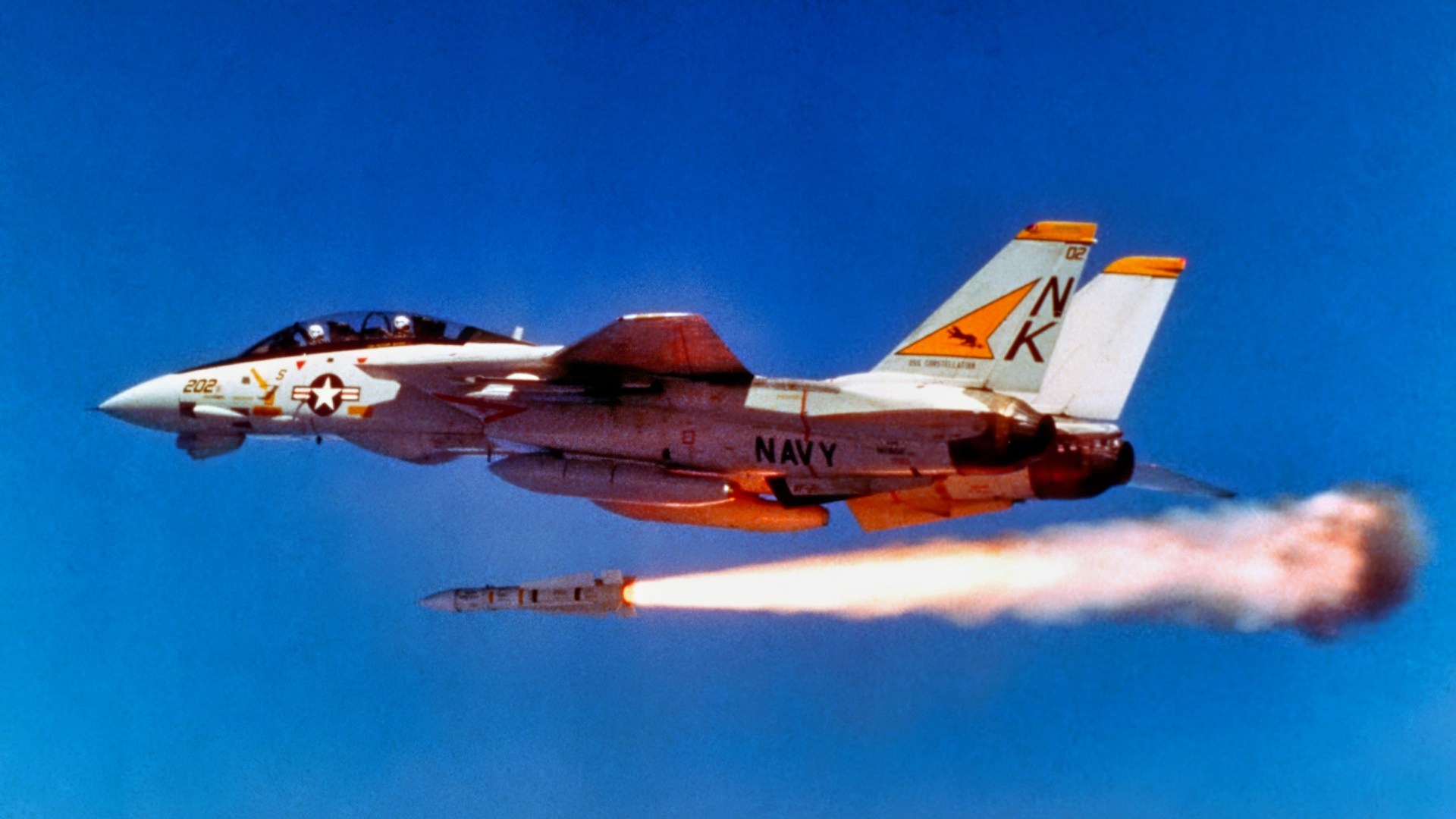
F-14 Tomcat Firing a Missile. Image Credit: Creative Commons.
The lead ship returned to combat in March 1986 during Freedom of Navigation operations in the Gulf of Sidra, where she destroyed Libyan patrol boats that had engaged the battle group after crossing Muammar Gaddafi’s self-declared “Line of Death.” Ticonderoga received her second Navy Unit Commendation and the Navy Expeditionary Medal for those operations. In April 1986, she supported the joint Navy-Air Force strikes on Libyan targets after the Berlin discotheque bombing. In the late 1980s, she served in the Persian Gulf during Operation Earnest Will, escorting reflagged Kuwaiti tankers through waters mined by Iran.
USS Vincennes (CG-49) became the most controversial hull in the class on July 3, 1988, when she shot down Iran Air Flight 655 over the Strait of Hormuz, killing 290 civilians. The incident raised enduring questions about integrating human decision-making with Aegis automation under tactical pressure.
During Operation Desert Storm in 1991, multiple Ticonderoga-class cruisers were deployed in the Gulf supporting the air campaign and providing track coordination for the combined naval task force. Tomahawk strikes launched from Ticonderogas became a regular element of post-Cold War American crisis response — Iraq in 1993, the Balkans through the late 1990s, multiple strike packages against Iraq in the run-up to and execution of Operation Iraqi Freedom in 2003. The first Tomahawk launches of Operation Iraqi Freedom came from Aegis warships, the Ticonderogas among them.
USS Lake Erie (CG-70) made history on February 20, 2008, by becoming the first U.S. Navy warship to shoot down a satellite in orbit — Operation Burnt Frost, an SM-3 intercept of a malfunctioning National Reconnaissance Office spacecraft carried out 247 kilometers over the Pacific. The shot demonstrated the Aegis Ballistic Missile Defense System’s anti-satellite reach and established the Ticonderoga-class as a strategic counter-space asset.
The class also handled carrier strike group air defense during the 2023-2024 Houthi engagements in the Red Sea, the 2025 Caribbean operations against Maduro, and the opening months of Operation Epic Fury in 2026. As of early 2026, the Navy expended 400 Tomahawks in roughly 72 hours during the first phase of the Iran campaign — a missile burn rate that put serious pressure on the VLS inventory the Ticonderogas were still helping to anchor.
How The Navy Tried To Save Them
The Navy did not always plan to retire the entire class.
The original 2010s plan called for a Cruiser Modernization Program — a phased upgrade of the existing 22-ship Ticonderoga fleet that would have extended each hull’s service life to roughly 40 years through hull, mechanical, and engineering work plus combat system modernization. The program ran into serious trouble. Structural cracking on multiple hulls drove repair costs upward. Shipyard schedules slipped. By the mid-2020s, the Government Accountability Office had documented substantial cost growth and capability shortfalls in the modernization effort, and the Navy began arguing the program had become an unrecoverable cost sink.
The original successor plan was even more ambitious. The CG(X) program was supposed to produce a clean-sheet next-generation cruiser to replace the Ticonderogas, possibly built around a Zumwalt-class hull form with substantially more VLS cells and a successor to Aegis. CG(X) was killed in 2010 under budget pressure. The Zumwalt-class itself was truncated to three hulls after its own cost overruns. With no replacement cruiser in development, the Navy’s only remaining option was to use the Flight III Arleigh Burke destroyer — a more modern combat system on a smaller hull with fewer VLS cells — as the de facto Ticonderoga replacement.
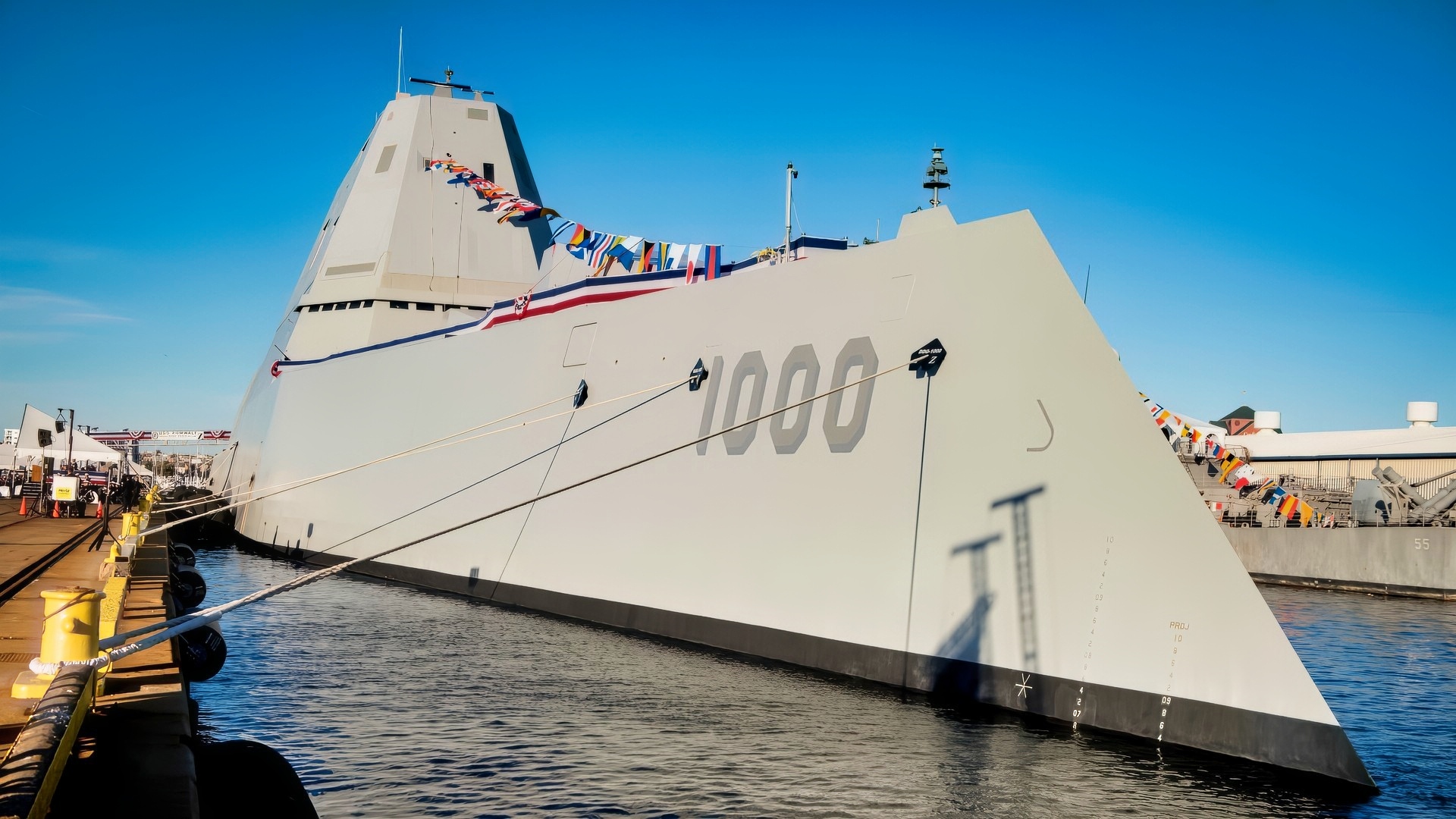
The Navy’s newest and most technologically advanced warship, USS Zumwalt (DDG 1000), is moored to the pier during a commissioning ceremony at North Locust Point in Baltimore. (U.S. Navy photo by Petty Officer 1st Class Nathan Laird/Released)
In 2022, the Navy announced plans to retire all 22 remaining Ticonderogas by 2027. Congress repeatedly blocked early retirements through NDAA language. By 2024, the Navy partially reversed course on three ships — USS Gettysburg (CG-64), USS Chosin (CG-65), and USS Cape St. George (CG-71) — extending their service lives through 2029 for the three hulls that had successfully completed modernization work. Then-Secretary of the Navy Carlos Del Toro stated at the time, “As a former cruiser Sailor, I know the incredible value these highly-capable warships bring to the fleet and I am proud of their many decades of service. After learning hard lessons from the cruiser modernization program, we are only extending ships that have completed modernization and have the material readiness needed to continue advancing our Navy’s mission.”
That extension was the final compromise. The other 19 ships remain on the retirement schedule. By 2029, the Ticonderoga era comes to an end.
The VLS Gap
The Navy has a math problem, and missiles are disappearing fast.
A Ticonderoga carries 122 Mk 41 VLS cells. A Flight III Arleigh Burke carries 96. A Constellation-class frigate — if any actually get completed after the program cancellation — would carry 32. The Navy’s total VLS inventory as of early 2025 sits at approximately 9,000 cells across the surface fleet and submarine force, concentrated primarily in Arleigh Burkes, Ticonderogas, Virginia-class attack submarines, and the four Ohio-class guided-missile boats.
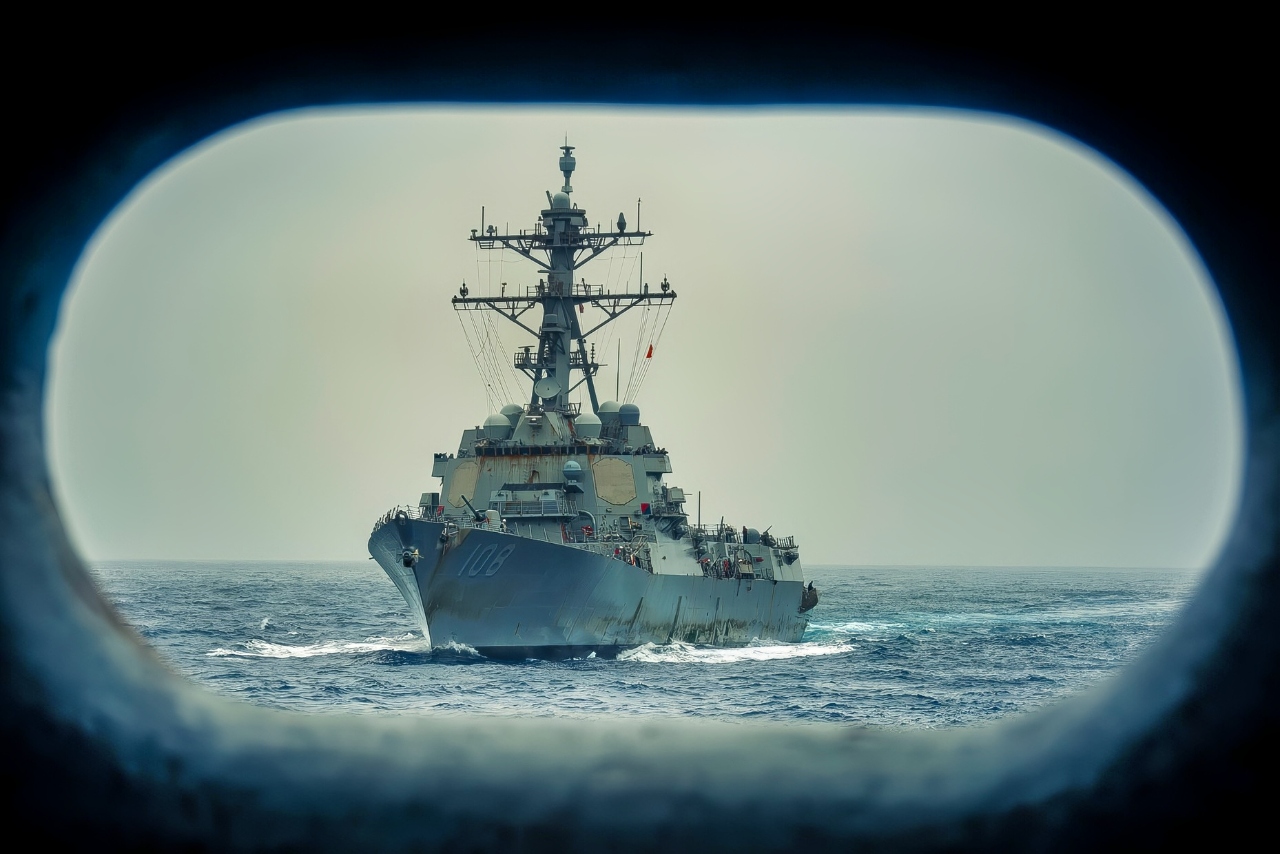
(August 1, 2025) The Arleigh Burke-class guided-missile destroyer USS Wayne E. Meyer (DDG 108) approaches the Nimitz-class aircraft carrier USS Nimitz (CVN 68) for a replenishment-at-sea in the U.S. Central Command area of responsibility. (Official U.S. Navy photo)
The Ticonderoga retirements take roughly 1,220 VLS cells off the books — 10 remaining hulls times 122 cells each, as a rough projection. The simultaneous retirement of the four Ohio SSGNs subtracts another 616 cells (154 Tomahawks per boat). Combined, the Navy is shedding nearly 1,900 launch tubes across the surface and submarine forces over a five-year window. New Flight III Burke deliveries, accelerated Virginia-class production, and ongoing VLS-restoration work on legacy Flight I Burkes will recover some of that capacity by decade’s end — but the trough is real, and it is happening during an active war.
The Navy did launch a prototype Transferable Reload At-sea Method system aboard USS Chosin in late 2024 — a capability that, if fully developed, would let surface combatants rearm VLS cells without returning to a friendly port. TRAM is a partial mitigation. It does not change the total cell count. It only changes how quickly an existing hull can be returned to combat readiness after firing.
The other partial mitigations are the installation of Naval Strike Missiles on Littoral Combat Ships, expanded SM-6 production, and the Maritime Strike Tomahawk program that converts the existing land-attack Tomahawk into an anti-ship round. None of those programs adds VLS cells. They just change what gets loaded into the cells that the Navy still has.
What The Navy Is Losing
The Ticonderoga class represents something the U.S. Navy may never build again at scale: a large, expensive, multi-mission surface combatant designed to absorb a massed cruise missile saturation attack and continue functioning as a battle group’s central command node. The institutional knowledge embedded in these ships — the Aegis training pipeline, the air warfare command staff billets, the surface combatant tactical doctrine the class taught the rest of the fleet — does not disappear overnight. But it does erode.
USS Ticonderoga herself was decommissioned on September 30, 2004, held in reserve, and eventually broken up for scrap. Most of the recently decommissioned hulls have followed similar paths. Some currently sit at the Naval Inactive Ship Maintenance Facility at Philadelphia. The remainder will eventually be scrapped at commercial recyclers or expended as targets in future sinking exercises.
What the Navy is losing is not just hulls. It is 122-cell magazines that no current platform replicates. It is the air warfare commander’s command space that the Flight III Burke can only partially absorb. It is the strategic margin that allowed a single Ticonderoga to carry enough Tomahawks for a full theater strike package while simultaneously holding the air defense umbrella over a carrier strike group. It is the redundancy that meant losing one cruiser did not collapse the air picture over an entire battle group.
The Real Problem
The replacement plan is a more capable destroyer carrying fewer missiles. The DDG(X) program — the eventual Burke successor — is projected at $4.4 billion per hull under CBO estimates, with first deliveries years away, and many say it will never sail. The Trump-class battleship is a rendering package and a presidential announcement, with many doubting it will sail as it will cost $17 billion per hull. The Constellation-class frigate is canceled. The Zumwalt is three hulls.

Trump-Class Battleship. Image Credit: White House.
For roughly four decades, the Ticonderoga-class cruiser was the heaviest-armed surface combatant the U.S. Navy operated. By 2029, it will no longer be in the fleet. The 1,200-plus VLS cells the class represents are not being directly replaced. The strategic margin those cells provided is not being directly replaced either.
The Navy is going to fight whatever comes next with substantially less surface fleet missile capacity than it had at the peak of the Cold War cruiser fleet. That’s a shame.
About the Author: Harry J. Kazianis
Harry J. Kazianis (@Grecianformula) was the former Senior Director of National Security Affairs at the Center for the National Interest (CFTNI), a foreign policy think tank founded by Richard Nixon based in Washington, DC. Harry has over a decade of experience in think tanks and national security publishing. His ideas have been published in the NY Times, The Washington Post, The Wall Street Journal, CNN, and many other outlets worldwide. He has held positions at CSIS, the Heritage Foundation, the University of Nottingham, and several other institutions related to national security research and studies. He is the former Executive Editor of the National Interest and the Diplomat. He holds a Master’s degree focusing on international affairs from Harvard University.


Michael
May 20, 2026 at 7:32 pm
They’re also losing the Ohio SSGNs as well.
The FREMM frigates were deemed unworthy (largely because of a lack of VLS capacity), and the current plan is to build Coast Guard cutters for the Navy.
They lack any VLS at all, and it looks like they won’t be much cheaper.
At this point, I’d be very happy building new OHPs for the Navy that incorporate the Australian upgrades.
That means an eight-bay VLS normally quad-packing 32 ESSMs, plus the Mk13 launcher capable of launching 40 missiles (SM2-MR (in the Aussie refit) or Harpoon (not recommended in the present day).