

The Iran War has been in limbo in recent weeks, amid stalled peace talks and the possibility that full-on war could resume, most likely after next week’s midterm elections in the United States.
But in the meantime, the American blockade of the Strait of Hormuz continues, and Iranians are still struggling.

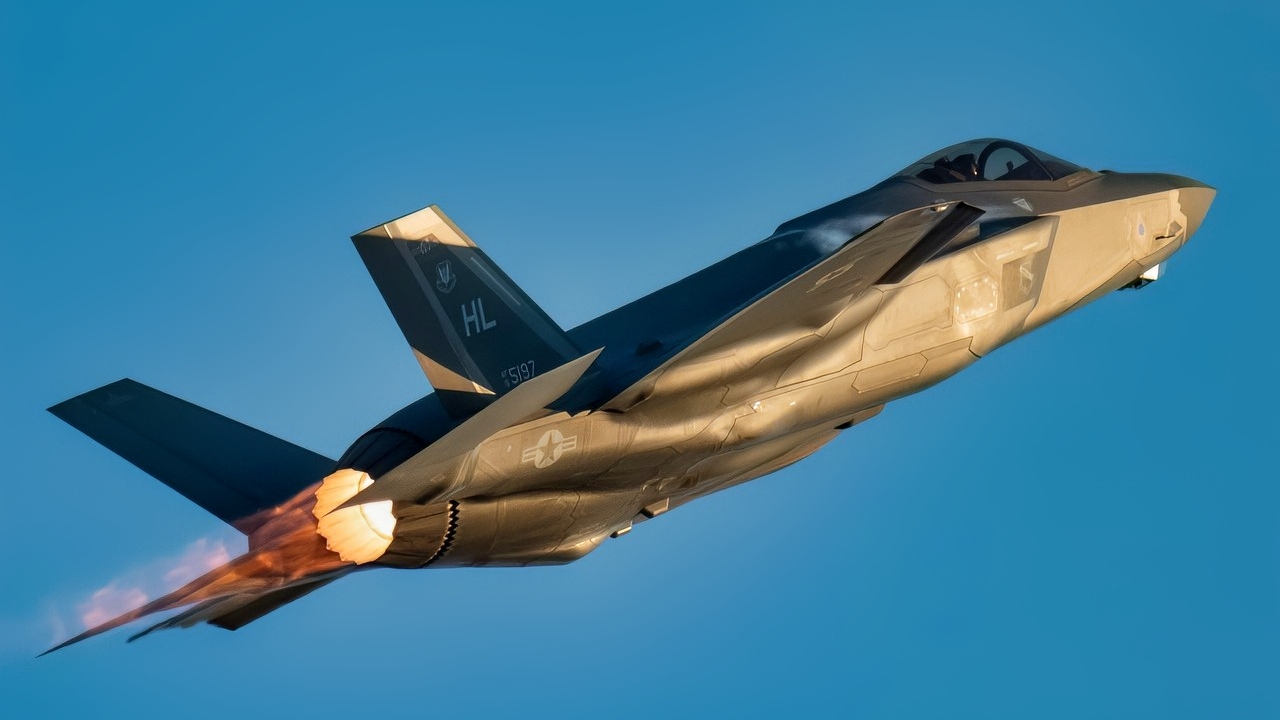
A crew chief from the 158th Fighter Wing taxis an F-35 II Lightning in for rapid refueling and rearming, July 24, 2025, at Westover Air Reserve Base, Chicopee, Mass.
During the D-ICT exercise, F-15’s from the 104th Fighter Wing and F35’s from the 158th Fighter Wing received simultaneous rapid rearming and refueling from the 103AW C-130H Hercules with all engines running. Performing these D-ICT exercises helps aircraft quickly return to their mission and highlights our ability to distribute and operate from anywhere. (U.S. Air National Guard Photo by Jay Hewitt)

F-35A Lightning II’s from the 34th Fighter Squadron at Hill Air Force Base, Utah, land at Royal Air Force Lakenheath, England, April 15, 2017. The aircraft arrival marks the first F-35A fighter training deployment to the U.S. European Command area of responsibility. (U.S. Air Force photo/Tech. Sgt. Matthew Plew)
According to Reuters, Iranians are “cutting back on food, housing and education,” amid the war and the massive inflation that has resulted from it.
This is happening in Iranian cities and the countryside.
The war itself, the blockade, and the years of sanctions against Iran have all been factors in what has brought Iran to this current moment.
Hurting Iranians further have been the “Operation Economic Outcast” sanctions announced by the Treasury Department earlier this fall, aimed at punishing countries that continue to trade with Iran.
Iran’s Economy Minister Ali Madanizadeh apologized this week for Iran’s cost-of-living struggles, as prices have risen 90 percent over the same period the year before.
Food, in particular, has jumped 121.8 percent over the last year.
Reuters also reported that the monthly cost of living for a three-person working-class family in Iran is around $336, while the average monthly wage for such a family is just $92.
Housing costs have also risen sharply, with rents up an average of 32.8 percent in September, compared with the same period the year before.
The war has also been a catastrophe for the labor market in Iran.
The “official” unemployment rate jumped to 9.1 percent in the spring, an increase of 1.8 percent from the same period the year before, while Iran’s economic participation rate fell to 40.7.
It’s hit young Iranians especially hard, with nearly a quarter of people aged 15 to 24 out of work.
“I have been looking for work since graduating in advertising, but after months of searching I’ve started to lose hope,” a 23-year-old woman named Firouzeh, who lives in the northwestern city of Urmia, told Reuters.
Reuters also reported that many Iranians can no longer afford to send their children abroad to study.
Iranians Speak
Reuters interviewed numerous everyday Iranians about how they’re handling the current moment.
“We have no money, no future, and no hope,” a shopkeeper named Mohammadali, who lives in the Northeastern city of Mashhad, told Reuters.
Another man, Mahmoud, a government employee in Isfahan, told the news agency that his $100 salary lasts only ten days.
He and his wife, he told Reuters, “lie to our daughters all the time when they ask for a toy or new clothes.”
One 39-year-old woman in the northern city of Rasht told Reuters that she had to move back into her parents’ house after her husband lost his job at a tile factory.
What Will the Regime Do?
The clear objective of the American pressure has been to get Iran’s regime to back down and accept an end to the war on something close to U.S. terms.
But Iran has shown little indication that the pressure is working to get it to agree to anything like that.
For the Atlantic Council’s Dispatches website, Andrew L. Peek and Jonathan Panikoff wrote in August about why Iran’s government hadn’t yet folded, and, two months later, why it still hasn’t.
Peek is director of the Adrienne Arsht National Security Resilience Initiative and the Geostrategy Initiative at the Scowcroft Center for Strategy and Security.
At the same time, Panikoff is senior director of the Atlantic Council’s Scowcroft Middle East Security Initiative.
Iran’s leaders, and those of its Islamic Revolutionary Guard Corps (IRGC), the authors write, are shaped by their experiences in the Iran-Iraq War of the 1980s.
Therefore, it “appears determined to resist US pressure rather than capitulate.” They describe the IRGC leaders, many of whom rose from the original Iranian revolution in 1979, as “hard men who will shoot back before they fold.”
The authors lay out a scenario for regime collapse: Iran losing the ability to export enough oil to sustain its reserves, a crack in the regime’s internal cohesion, and hyperinflation, which leads to “widespread, sustained popular unrest.”
“The signals of a weakening regime are clear,” Peek and Panikoff write. “ What will ultimately cause it to cave in is unknown and unknowable.”
About the Author: Stephen Silver
Stephen Silver is an award-winning journalist, essayist, and film critic, and contributor to the Philadelphia Inquirer, the Jewish Telegraphic Agency, Broad Street Review, and Splice Today. The co-founder of the Philadelphia Film Critics Circle, Stephen lives in suburban Philadelphia with his wife and two sons. For over a decade, Stephen has written thousands of articles on politics, national security, technology, and the economy. Follow him on X (formerly Twitter) at @StephenSilver, and subscribe to his Substack newsletter.


