


Summary and Key Points: Dr. Andrew Latham, a non-resident fellow at Defense Priorities, evaluates the push for impeachment by some following the February air strikes on Iran.
-Latham argues that Article II of the Constitution has historically allowed presidents to conduct limited military operations without prior Article I congressional authorization, citing precedents from Korea to Libya.
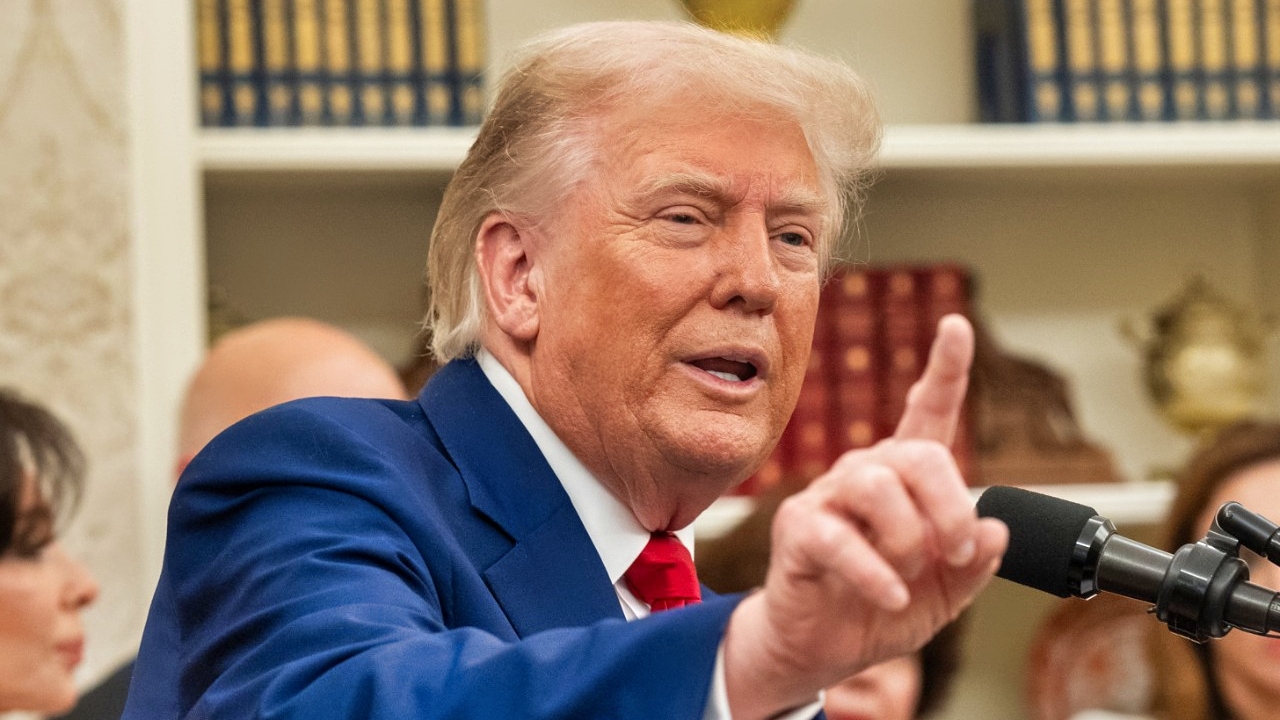
Donald Trump Pointing in Speech. Image Credit: White House.

President Donald Trump attends an event celebrating the 2025 NCAA Division 1 Men’s Basketball Champion Florida Gators, Wednesday, May 21, 2025, in the East Room of the White House. (Official White House Photo by Daniel Torok)
-This 19FortyFive report analyzes why the War Powers Resolution is a tool of “duration” rather than a barrier to initial action, concluding that while the strategic cost of Operation Epic Fury deserves scrutiny, using impeachment as a policy-corrective threatens to destabilize U.S. deterrence during an active conflict.
Impeachment or Overreach? Analyzing the Constitutional Battle Over the February Iran Strikes
Impeachment is reserved for clear abuses of office. It is not a device for criticizing military decisions. Yet after the February strikes on Iranian targets, some in Washington moved quickly to argue that President Trump had crossed a constitutional line by acting without prior congressional authorization.
The claim was not simply that the operation was unwise. It was what warranted removal.
We have been here before. In 2025, when U.S. and Israeli aircraft struck Iranian facilities, the same accusations surfaced. Article I was invoked. Executive overreach was alleged. Some lawmakers floated impeachment then as well. It went nowhere.
That earlier episode matters because the structural conditions have not changed. The personalities are the same. The constitutional terrain is the same. The congressional arithmetic is the same.
Articles I and II as They Actually Function
Article I gives Congress the power to declare war, yet Article II places the president at the head of the armed forces. The document offers no clear guidance on how to treat limited uses of force that stop short of declared war. That gap has done much of the work in shaping American war powers in practice.
Presidents have used force without formal declarations for decades. Korea proceeded under a U.N. banner rather than a congressional declaration. Kosovo and Libya followed without one, each justified under an expansive reading of executive authority. Syria saw limited strikes defended on similar grounds. Congress objected in each instance. It did not remove a president over them.
That history does not eliminate the debate over war powers. It does narrow the impeachment argument. When a pattern spans administrations of both parties, it becomes difficult to portray a new instance as a sudden constitutional rupture rather than a continuation of an established practice.
The executive branch has long maintained that operations of constrained scope and duration fall within Article II authority. Congress has challenged that view at times, yet it has rarely imposed a durable corrective. That uneasy equilibrium is the backdrop against which the February strikes must be evaluated.
What Impeachment Is Actually For
This is where the argument tends to slide off course. Impeachment is not a way to reverse a military decision you think was reckless. It is not a tool for registering anger at executive overreach. It is reserved for conduct that plainly crosses a constitutional line.
War powers fights are not new. Presidents have pressed their authority in this area for decades. Congress has pushed back, sometimes loudly, sometimes half-heartedly. The line between the branches has shifted through practice, through political pressure, and through selective resistance. It has rarely been reset through removal.
If every contested strike becomes an impeachment question, the standard for removal does not hold. It starts to blur with ordinary disagreement over policy. That shift would not restore congressional authority. It would simply raise the stakes of every future use-of-force dispute.
The February strikes may warrant sustained scrutiny. Congress has options if it believes the administration has overstepped. It can drag the issue into open hearings, force members to take recorded positions, or shape the scope of the operation through appropriations.
Those avenues exist for exactly this kind of interbranch conflict. Impeachment sits in a different category, and invoking it here would elevate a disputed use-of-force decision to a level the constitutional tradition generally reserves for unmistakable misconduct.
The War Powers Resolution and Its Real Limits
The War Powers Resolution was enacted in the shadow of Vietnam to prevent open-ended war without legislative consent. It requires notification within forty-eight hours of introducing forces into hostilities. It sets a sixty-day limit on continued operations absent authorization, followed by a withdrawal period. Those provisions were meant to restore congressional leverage.
The Resolution was written to stop another Vietnam, not to make every first strike unconstitutional.

An F-22 Raptor performs an aerial demonstration at Naval Air Station Oceana, Virginia, Sept. 19, 2025. Rapid changes in angle of attack create visible vapor around the aircraft, providing a clear view of its aerodynamic performance. This demonstration highlights the F-22’s advanced maneuvering capabilities, showcasing its speed, agility, and thrust-vectoring performance. (U.S. Air Force photo by Staff Sgt. Lauren Cobin)

The F-22 Raptor performs a demonstration at the Mather Airshow in Sacramento, California, Sept. 23, 2018. The P-38 is a World War I-era fighter aircraft that was developed for the Army Air Corps. (U.S. Air Force photo by Senior Airman Lauren Parsons/Released)

An Air Force F-22 Raptor executes a supersonic fly by over the flight deck of the aircraft carrier USS John C. Stennis. John C. Stennis is participating in Northern Edge 2009, a joint exercise focusing on detecting and tracking units at sea, in the air and on land.
It compels reporting and sets a deadline for continued operations. In doing so, it implicitly accepts that a president may introduce forces before Congress votes. Its leverage lies in duration, not in barring the opening move.
Critics contend that striking Iran without prior authorization encroaches on Congress’s Article I power. That objection is not frivolous. Presidential authority in matters of force has expanded over time, often with little resistance. Even so, limited air operations do not map neatly onto the constitutional category of declared war. In practice, that boundary has rarely been bright.
Impeachment is not designed to resolve that ambiguity. It addresses clear abuses of office or conduct that plainly violates constitutional duty. A contested interpretation of war powers, layered atop decades of precedent, does not easily meet that standard.
The Political Math No One Can Ignore
Impeachment lives or dies on votes. A majority in the House is required, along with two-thirds in the Senate. No cross-party bloc has emerged treating the February strikes as a removable offense. Many critics question the strategic calculus or fear escalation, yet that is a different threshold from launching a constitutional trial in the middle of an unfolding crisis.
Congress also has other instruments available. War powers resolutions can force debate. Hearings can probe the administration’s legal reasoning. Funding decisions can shape the scope and duration of operations. Those tools allow legislators to assert institutional authority without detonating the removal mechanism.
There is also a strategic layer that impeachment advocates tend to overlook. The United States is now engaged in overt hostilities with a regional power. Allies watch for steadiness. Adversaries watch for a fracture. An impeachment fight during active military operations would send a signal beyond Washington, and that signal would not remain confined to domestic audiences.
The Real Issue
The February strikes may prove strategically prudent or strategically costly. That debate should proceed on its merits. Escalation control, deterrence credibility, and regional stability are serious questions that deserve sustained analysis rather than procedural theater.
The tension between Article I and Article II predates this administration and will outlast it. If Congress believes the presidency has accumulated too much latitude in matters of force, it can confront that directly through legislation and the power of the purse.
The real question raised by the February strikes is not whether removal is warranted. It is whether Congress is prepared to reassert its war powers through legislation and funding rather than through rhetoric. If lawmakers believe the presidency has accumulated too much discretion, the Constitution gives them tools to respond.
Impeachment is not the right fit here.
About the Author: Dr. Andrew Latham
Andrew Latham is a non-resident fellow at Defense Priorities and a professor of international relations and political theory at Macalester College in Saint Paul, MN. You can follow him on X: @aakatham.


yeye
March 3, 2026 at 5:32 pm
If GOP congressmen get blown away (by US public) in the coming midterms, Donald trump will likely face impeachment hearings in 2027, or early next year.
Then, possibly, trump finds himself getting kicked out of the white house,and maybe, put into a court, defending himself from future Epstein allegations.
The bloody 2026 trump war against Iran is totally illegal, as negotiations were still ongoing, and the attack operated without congressional or UN approval.
Trump has a lot to answer for.
He hasn’t done anything for Gaza inhabitants, who continue to face Israeli gunfire, and clear Israeli policies of starvation, deprivation and denial of basic human needs.
Once trump gets impeached, democrats will take over the white house.
And then, and then, ww3 !
uncle-bubba
March 5, 2026 at 12:23 am
President trump has been giving conflicting and transactional reasons for waging war on Iran.
First, it was his gut feeling that Iran could strike first.
Then, it was the allegedly fail-to-pass smell test, when witkoff and kushner came back with their reports.
Then later, it was the belief that the sudden attack would end Iran’s hunt for the bomb.
But Marco Rubio, his right-hand man, said the decision for war was caused by netanyahu’s wish to go ahead with a preemptive strike.
So, the ground under Donald trump is constantly shifting, or moving, due to the need to satisfy the always-hungry-for-news media.
But now, the US public in 2026, beginning today, must press their reps in Congress for a clear answer, otherwise president must be impeached.
Impeached due to inability to speak the truth, inability to pay refunds, inability to provide affordability, inability to end perpetual wars and inability to rein in the desire to commit preemptive strikes.
And inability to preserve peace on Earth, or at least, peace in the middle east.
Thomas
March 5, 2026 at 1:37 pm
Presidents Bill Clinton, Barack Obama and Joe Biden each ordered military strikes or sustained air campaigns without a formal declaration of war, or specific congressional authorization for those actions, relying instead on existing authorizations, constitutional executive power, or international coalitions to justify their decisions. No calls for impeachment, no one accuses “illegal wars”.
Trump takes out a terrorist regime that has threatened the national security of America, close to having nuclear weapons, and now, what past presidents have done, it’s a problem?
It seems the Iranian people are thankful that President Trump had the courage to order a military operation, not a “war” as he has no power to declare war, to take out the regime. We should all be thankful too, it was Iran that killed 241 Marines which at that time was the largest attack on Americans, and we did nothing. But instead, democrats are calling for impeachment, unbelievable.