

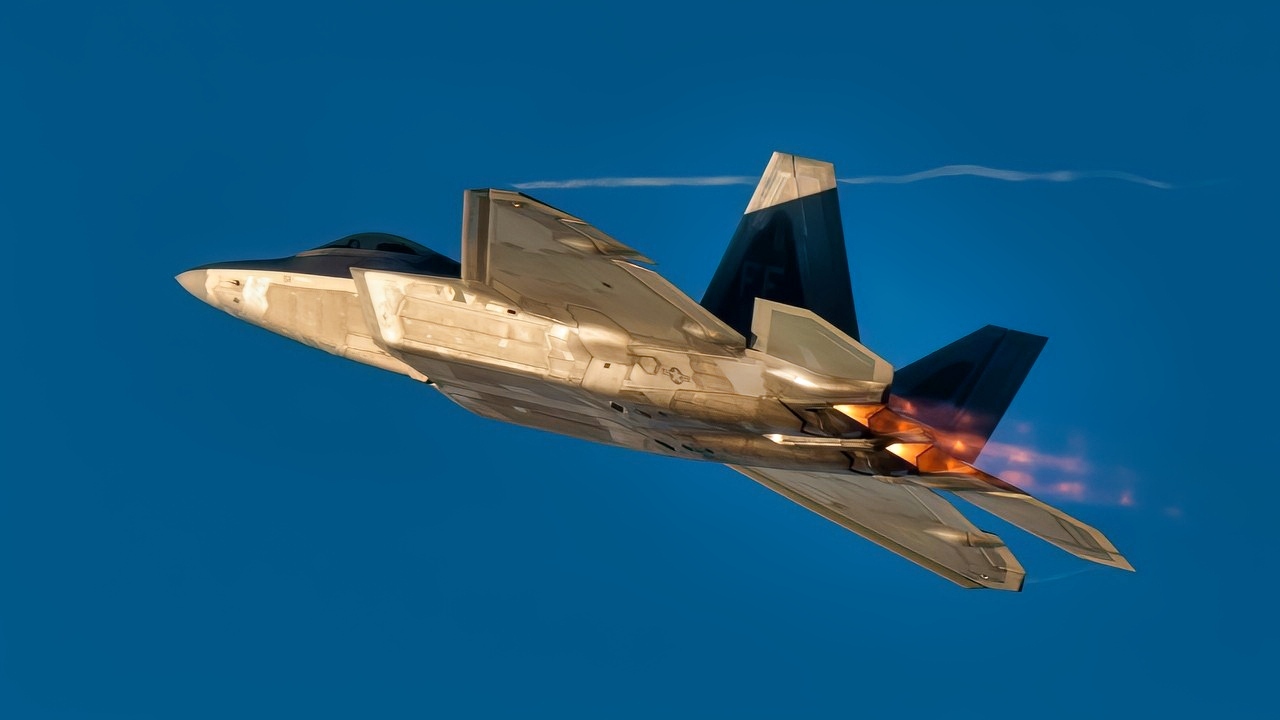
Key Points and Summary – In 2013, a stealthy U.S. Air Force F-22 Raptor quietly shadowed two Iranian F-4 Phantoms that were closing on an American MQ-1 Predator in international airspace.
-The Raptor pilot—Lt. Col. Kevin “Showtime” Sutterfield—slipped beneath a Phantom to check its loadout, then pulled up abeam and delivered a calm warning over the radio: “You really oughta go home.”
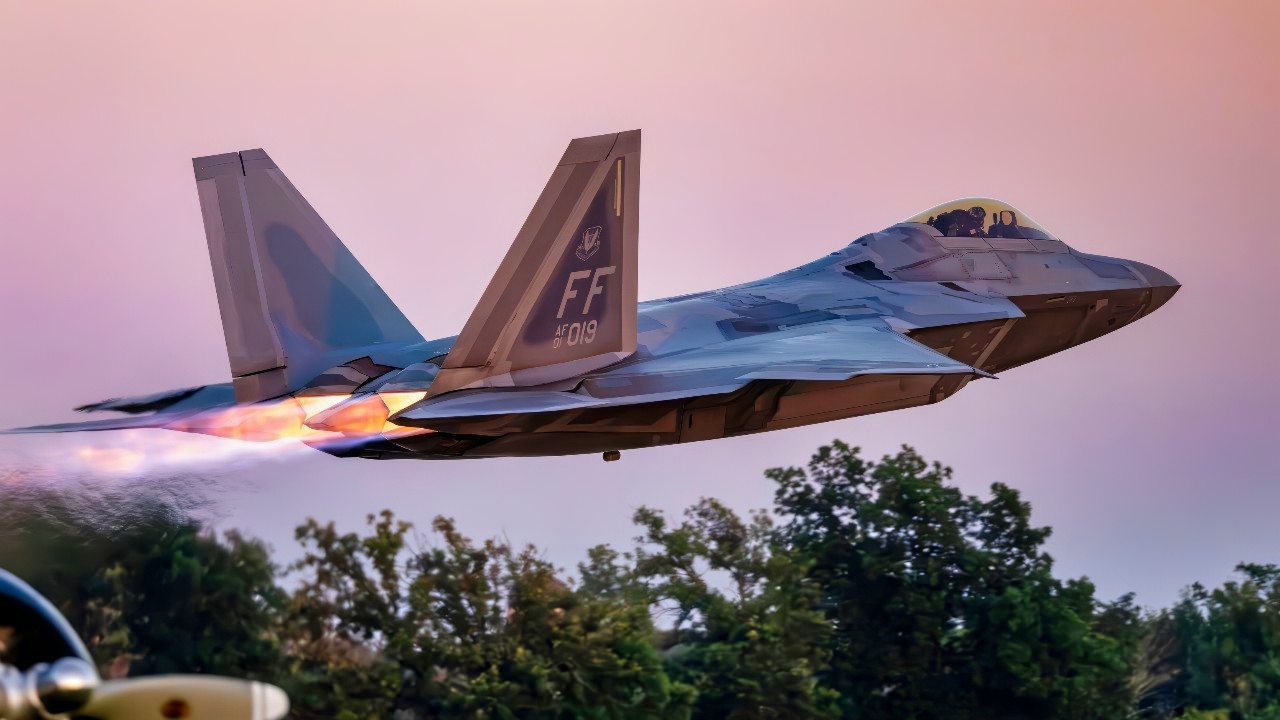
U.S. Air Force Capt. Nick “Laz” Le Tourneau, pilot and commander of the F-22 Raptor Aerial Demonstration Team, launches an F-22 Raptor during the night show at EAA AirVenture, Oshkosh, Wisconsin, July 26, 2025. The afterburners illuminate the night sky, creating a striking visual as the aircraft accelerates into flight. This takeoff gives spectators a front-row view of the F-22’s power, speed, and advanced capabilities, showcasing the skill of Airmen who operate and maintain the jet. (U.S. Air Force photo by Staff Sgt. Lauren Cobin)
-Both F-4s promptly broke off.
-The episode, later confirmed by then–Air Force Chief of Staff Gen. Mark Welsh, illustrates how the F-22’s low observability and sensor edge can defuse a dangerous intercept without a shot fired—and why the U.S. began escorting slow drones after a 2012 Iranian Su-25 attempted shoot-down.
The F-22 Is a Stealth Fighter Ghost
In 2013, an Iranian fighter pilot was closing with an American drone in international airspace when he was shocked to find a stealthy American F-22 Raptor flying right alongside him. According to reports, the F-22 pilot radioed to the encroaching Iranian jet and offered a bit of friendly advice before he and his wingman promptly bugged out. Even a two-to-one advantage over the Raptor simply wasn’t enough to make it a fight they wanted to have.
Six months after the incident, Air Force Chief of Staff (at the time) Gen. Mark Welsh finally revealed what went on to the public, along with what the Raptor pilot, callsign “Showtime,” said to immediately dissipate the threat the Iranians posed to the drone.
Drone hunting in Iranian Su-25s
On November 1, 2012, two Iranian Islamic Revolutionary Guard Corps Su-25 Frogfoot attack aircraft spotted a U.S. flagged MQ-1 Predator drone flying over international waters approximately 16 miles off the coast of Iran.
The MQ-1 is a subsonic remotely piloted aircraft that prioritizes longevity over performance, thanks to an onboard Rotax 914F air-cooled, turbocharged four-cylinder engine that produces just 115 horsepower. Its top speed may be a laughable 135 miles per hour, but its 48-foot wingspan and low fuel requirements allow the aircraft to loiter over target areas for as long as 14 straight hours without the need to refuel. To put a fine point on it, the Predator was designed for patient reconnaissance and air-strike operations and not only possesses no air-to-air capabilities, but would likely struggle to evade an attack if one were to happen
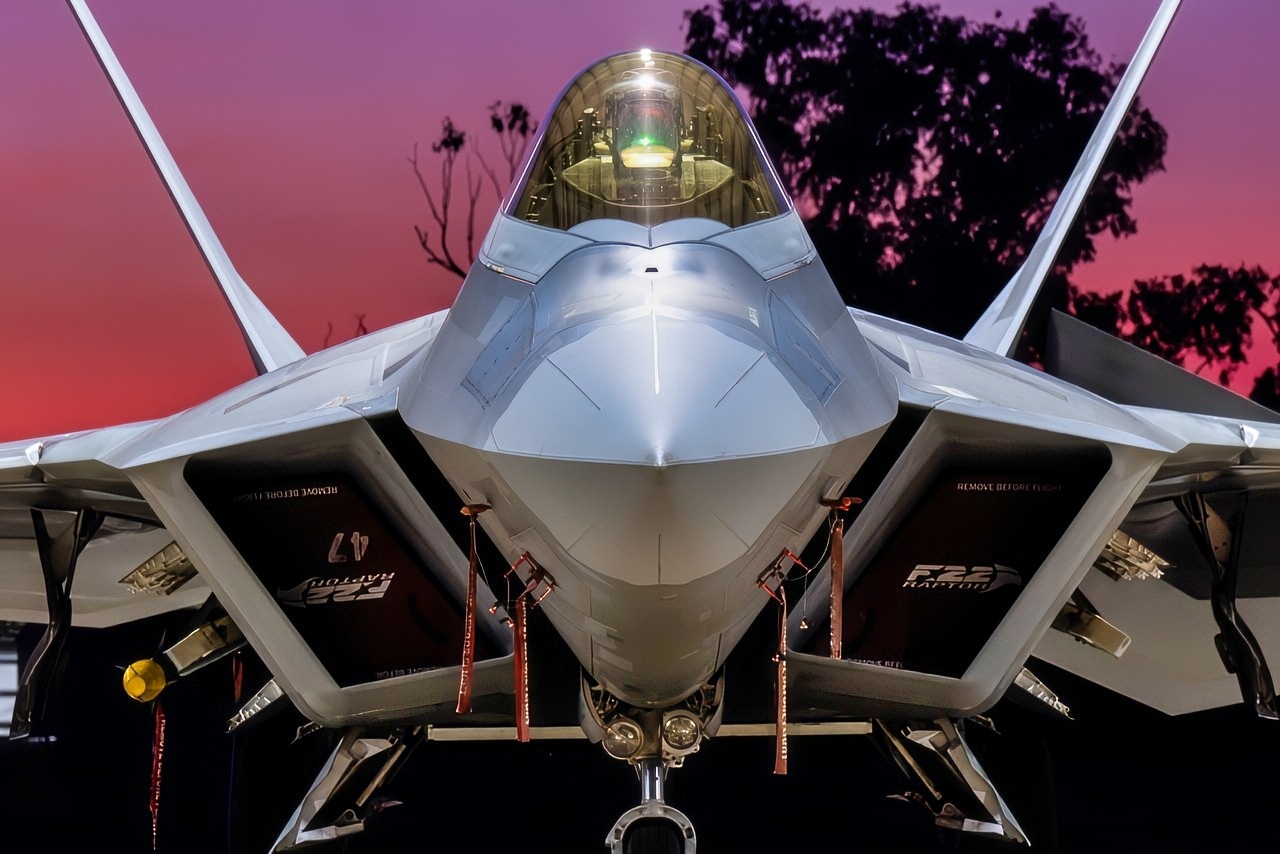
A U.S. Air Force F-22 Raptor assigned to the 199th Air Expeditionary Squadron sits beneath a hangar as the sun sets in Northern Territory, Australia, July 16, 2025, during Talisman Sabre 2025. Talisman Sabre is the largest bilateral military exercise between Australia and the United States advancing a free and open Indo-Pacific by strengthening relationships and interoperability among key allies and partners, while enhancing our collective capabilities to respond to a wide array of potential security concerns. (U.S. Air Force photo by Senior Airman Natalie Doan)
And that’s likely why the Iranian pilots, flying in Soviet-era attack planes, figured the Predator would make for an easy target. The Su-25 was designed to serve as a close air support platform in a similar fashion to America’s own A-10 Thunderbolt II, prompting some debate about its classification as an attack aircraft or light bomber. While not designed for air-to-air combat, a slow-moving and unarmed drone is about as easy an airborne target as you’re likely to come across.
According to reports released to the press after the fact, the Iranian Frogfoots closed with the slow-moving drone and opened fire using their 30mm cannons. After making multiple strafing runs, however, the MQ-1 remained entirely intact, and the two Su-25s broke off their pursuit–likely because both had expended all 250 rounds they carried onboard for the large gun.
It remains unclear whether the Iranian planes were really trying to shoot the drone down, or if they were simply trying to send a message, but in any event, the message was received. After that, the U.S. began flying these drone operations with fighter escorts–often with F/A-18 Super Hornets off of the nearby USS John C. Stennis, but occasionally with F-22 Raptors operating out of bases in the United Arab Emirates.
Of course, this policy must have been eliminated before Iran successfully downed a U.S. Navy RQ-4 Global Hawk in 2019.
America’s response: Send in the Raptor
The next time Iranian fighters would interact with an American drone came in March of the following year, though the details of the incident didn’t make it to the public until months later.
Once again, an American MQ-1 Predator was conducting surveillance and reconnaissance off the Iranian coast, approximately 16 miles from shore. Just as had happened in the previous encounter, a pair of Iranian fighters spotted the single, slow-moving aircraft and closed to intercept. This time, however, it was a pair of more-capable Iranian F-4 Phantoms, which despite being dated platforms, are more than capable of shooting down the slow-moving Predator.
The Phantom is no stranger to American aviators, having served in the U.S. Air Force, Navy, and Marine Corps starting in 1961 and remaining in service under American banners until as late as 1996. The heavy aircraft is often referred to as a fighter/bomber, but make no mistake, it was intended to serve as a high-speed interceptor in an era when brute force was often prized over technological finesse. With a top speed of Mach 2.23 and nine external hardpoints capable of carrying as much as 18,650 pounds of ordnance, the Phantom may have been old, but it poses a viable threat to other aircraft–especially slow-moving ones.

A U.S. Air Force F-22 Raptor assigned to the Air Force F-22 Demonstration Team, Air Combat Command, performs aerial maneuvers during the 2025 Marine Corps Base Hawaii Kaneohe Bay Air Show, Aug. 9, 2025. The Kaneohe Bay Air Show provides an opportunity to showcase the aircraft, equipment and capabilities of the armed forces in the Indo-Pacific region to the local community. The air show, which contained aerial performances, static displays, demonstrations and vendors, was designed to celebrate MCBH’s longstanding relationship with the local community. (U.S. Marine Corps photo by Lance Cpl. Blake Gonter)
With one F-4 hanging back, the other began closing with the MQ-1, maintaining its course some four miles outside Iran’s territorial waters. Unbeknownst to either F-4 pilot, however, was that they weren’t alone in tailing the Predator. A U.S. Air Force F-22 Raptor piloted by Lt. Col. Kevin “Showtime” Sutterfield was also flying undetected nearby, eyeing the oblivious Iranian fighter pilot as he began to make his move.
“When the combatant commander wants air power there is only one number to call,” explained Air Force Chief of Staff (at the time) Gen. Mark Welsh, months after the interaction.
“Showtime is an Air Force Reservist … he flies the F-22. He flies it really well,”
Showtime closed with the encroaching F-4 Phantom in Hollywood style worthy of his callsign, taking the sleek Raptor under the Iranian fighter to inspect the weapons it was carrying without being seen. While reports haven’t indicated what munitions the Phantom was equipped with, it seems clear that Showtime wasn’t impressed.
Technically speaking, the F-22 Raptor’s top speed of Mach 2.2 is slightly lower than the Phantom’s 2.23, but in practical application, those figures really don’t much matter. What did matter, however, was the F-22’s advanced stealth, allowing Showtime to operate in the same airspace as the Iranian fighters without them even noticing. If a fight were to break out, the F-22’s thrust-vectoring acrobatics and advanced avionics would have supplemented that stealthy design to make for what would have likely been a very one-sided fight.
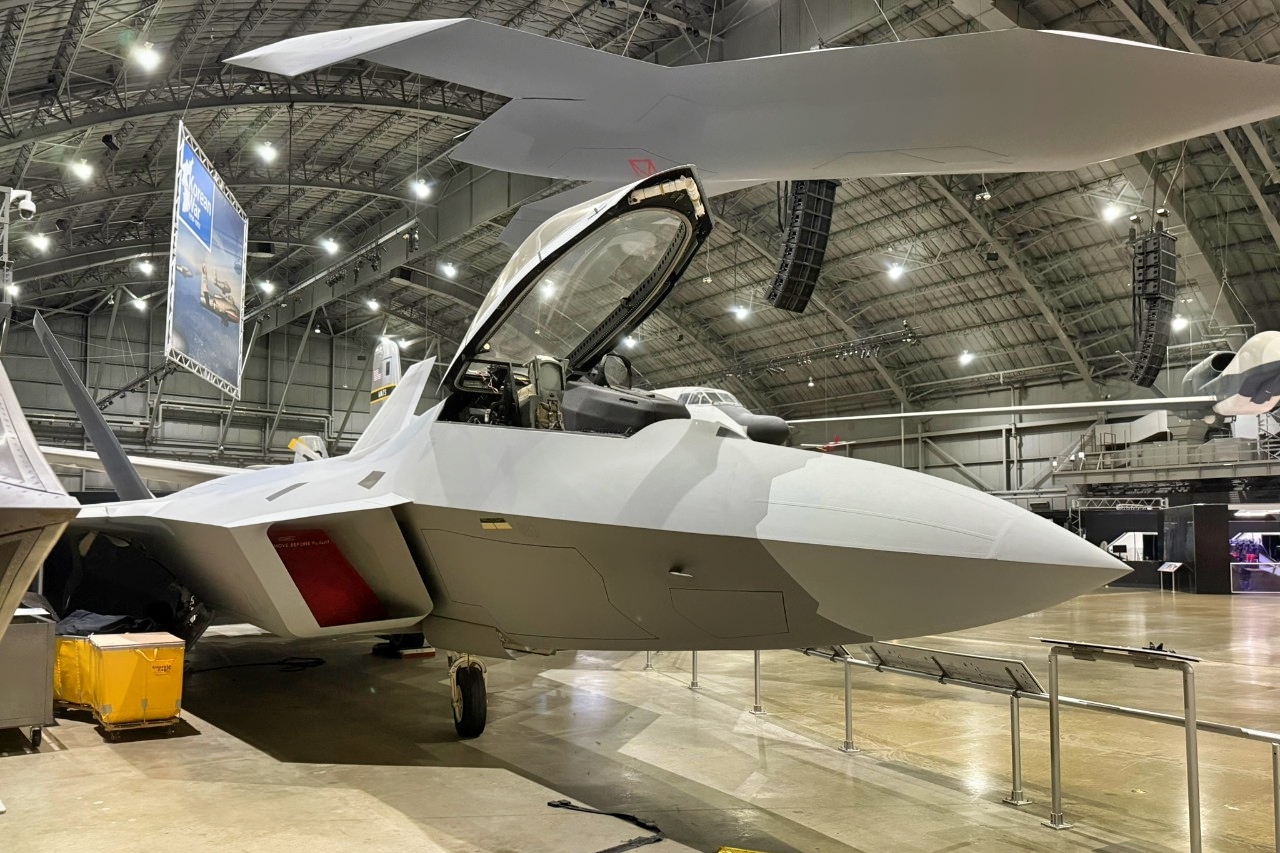
F-22A Raptor with YF-118G Overhead. Image Credit: National Security Journal.
Showtime knew that, and it was time that he let the Iranians in on it too.
From beneath the F-4 Phantom, now only miles from its MQ-1 Predator target, Showtime banked left and picked up some altitude. He brought his Raptor up and in line with the Phantom just in time to see what must have been one very shocked Iranian fighter pilot as he quite possibly made a mess in his pants. Just to make his point clear, Showtime hopped on the radio.
“You really oughta go home.”
And just like that, the Iranian F-4, and his wingman miles away, both promptly did.
About the Author: Alex Hollings
Alex Hollings is a writer, dad, and Marine veteran who specializes in foreign policy and defense technology analysis. He holds a master’s degree in Communications from Southern New Hampshire University, as well as a bachelor’s degree in Corporate and Organizational Communications from Framingham State University. This first appeared in Sandboxx.
More Military
USS Constellation Was the Workhorse Aircraft Carrier
Aircraft Carrier USS Independence: Summed Up in 4 Words
Russia’s Tu-95MS Bear: Moscow’s B-52 Bomber?


