


Key Points and Summary – USS Missouri (BB-63) embodied the last, best expression of American battleship power just as aircraft carriers took over the seas.
-Designed for speed, protection, and crushing firepower, she bombarded Iwo Jima and Okinawa, guarded fast carriers, and hosted Japan’s surrender on her teak deck in Tokyo Bay.
-Recommissioned for Korea, then again in the 1980s with Tomahawk, Harpoon, Phalanx, and drones, Missouri proved a big-gun ship could still matter—firing missiles in Desert Storm and shelling Iraqi targets.
-Retired after the Cold War, she now rests at Pearl Harbor as a museum, linking World War II’s opening tragedy to its closing signature.
USS Missouri (BB-63): America’s Last Word In Battleships
By the early 1940s, the aircraft carrier had already earned its place as the capital ship of the future. Coral Sea, Midway, and the long slog of the Solomons proved that air wings could reach far beyond the horizon and decide battles before gunfire was even heard.
Yet the U.S. Navy still pressed ahead with the Iowa-class. That wasn’t nostalgia; it was strategy. The fleet still needed ships that could keep up with fast carriers, survive hits, and deliver guaranteed effects—anti-aircraft fire by the ton and shore bombardment so punishing it changed ground campaigns.
Battleships also served as command platforms and political instruments. Their presence signaled resolve in a way few hulls could match. In that context, USS Missouri—the third Iowa to commission—wasn’t a dinosaur; she was the Navy’s way of hedging futurism with certainty. Jet aviation and radar were rewriting tactics, but heavy armor, high speed, and 16-inch rifles remained a kind of maritime truth the United States could put to work immediately.
Designing “Mighty Mo”: Speed, Survivability, And A Magazine Of Thunder
The Iowa concept started with a simple demand: outrun what you can’t outgun and outgun what you can’t outrun. That meant a long, fine hull that could sprint past 33 knots, enough to maneuver with the fast carrier task forces that needed steel in their air-defense rings. It also meant protection—an armor belt and deck scheme optimized against long-range shellfire and aerial bombs, plus internal subdivision and damage-control features honed by hard wartime experience.
At the heart of the ship were nine 16-inch/50 Mark 7 guns in three triple turrets. Each gun could loft a 2,700-pound armor-piercing shell or a high-capacity bombardment round tens of miles. The secondary battery—ten twin 5-inch/38 mounts—was the Navy’s most versatile gun, able to swat aircraft or rake shorelines with radar-directed precision. Surrounding these were the evolving forests of 40 mm Bofors and 20 mm Oerlikons that defined late-war anti-aircraft fits. Fire control stood on the shoulders of analog genius: rangekeepers, stable platforms, and radar directors that turned seas and skies into solvable equations.
The engineering plant—high-pressure boilers feeding geared steam turbines—was generously powerful, and the hull carried the fuel and stores to stay on station for the long Pacific pushes. Habitability, command spaces, and communications suites reflected another reality: these ships were designed to be fleet flagships as much as gun platforms.
What She Cost—And What That Bought
Wartime prices are hard to compare across decades, but building, equipping, and completing an Iowa-class ship like Missouri ran on the order of hundreds of millions of 1940s dollars (some sources have the figure at a solid $100,000,000 per Iowa-class warship), a figure that translates to many billions today when you account for labor, steel, electronics, and armament.
That money purchased not just a hull but an ecosystem: yards capable of heavy construction, magazines and depots that could feed a ravenous gun battery, and crews trained in a culture of damage control and precision gunnery.
In the context of total war, a ship that could anchor a task force, absorb punishment, and deliver repeatable, measurable effects was a rational—if enormous—investment.
Into War: Shakedown, Pacific Arrival, And The Road To Japan
Commissioned in 1944, USS Missouri worked up quickly and headed west to join the fast carrier task forces that were grinding down Japan’s perimeter. In that job she was both shield and sword: her 5-inch mounts and heavy AA webs thickened the sky around carriers, while her 16-inch guns smashed airfields, coastal batteries, and logistics hubs ahead of amphibious landings.

Aerial view of warships at the base piers of Norfolk Naval Base, Virginia (USA), circa August 1944. Among them are: the battleship USS Missouri (BB-63), the largest ship; the battlecruiser USS Alaska (CB-1), on the other side of the pier. Image Credit: Creative Commons.
At Iwo Jima and Okinawa, the ship’s bombardments were part of the pre-assault choreography—thousands of tons of steel meant to collapse caves, crack bunkers, and keep enemy gunners down while Marines clawed their way ashore. If the carrier air wing was the scalpel, Missouri’s broadside was the sledgehammer that broke doors.
The Surrender On The Teak Deck
On September 2, 1945, in Tokyo Bay, representatives of the Empire of Japan signed the instrument of surrender on Missouri’s quarterdeck. The site was chosen with care: a visible, indomitable American warship, its teak deck a stage for the end of the bloodiest war in history. The ship became a national symbol overnight, the place where one era of slaughter closed and another—uneasy but hopeful—began.
Symbolism didn’t erase the practical point. The Navy could have chosen any number of ships for the ceremony; selecting Missouri underscored the idea that sea power ends wars, not only by sinking fleets but by sustaining campaigns until signatures follow.
Cold Peace, Hot War: Missouri In Korea
In peacetime, USS Missouri paraded American might, visiting ports and exercising with allies. When Korea erupted in 1950, the battleship’s purpose snapped back into focus. Along the peninsula she became, again, the floating artillery brigade every ground commander wanted on call. Bridges, rail yards, tunnels, and gun positions fell under her fire; when shore batteries barked back, Missouri could take the punch, shift position, and reply with contempt.
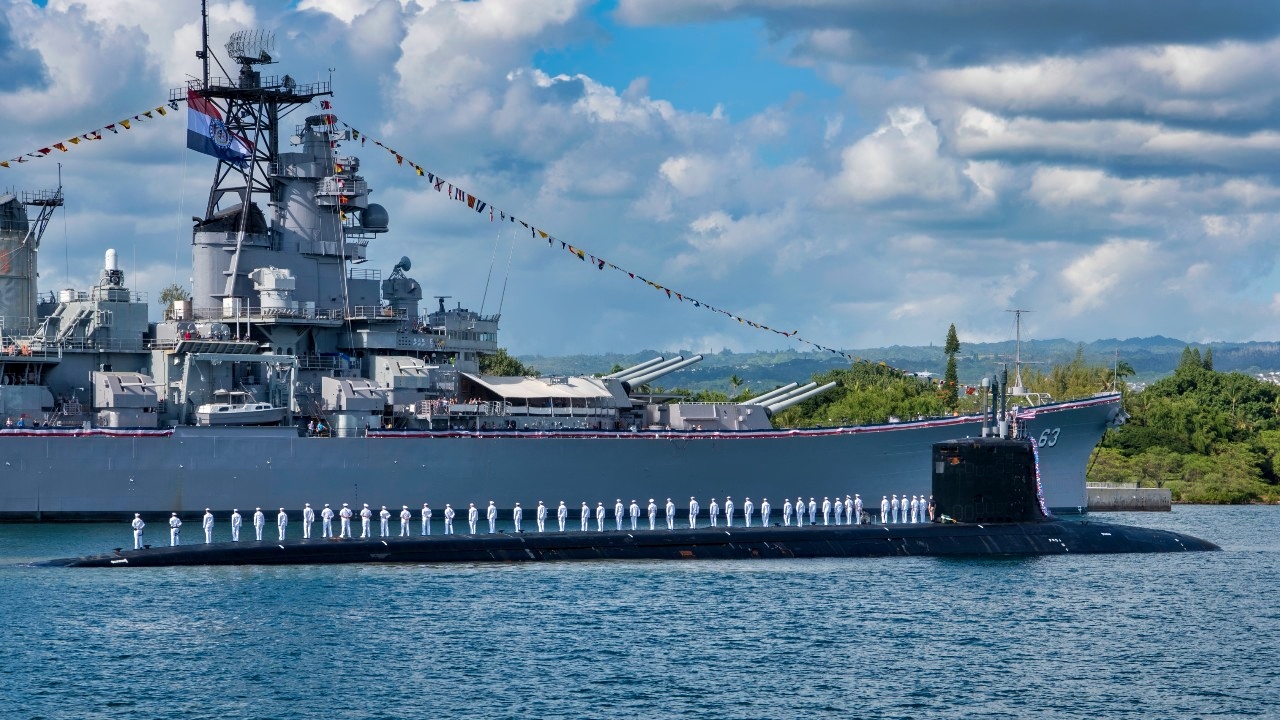
The crew of the Virginia-class fast-attack submarine USS Missouri (SSN 780) render honors to the Battleship Missouri Memorial following a homeport change from Groton, Connecticut. (U.S. Navy photo by Mass Communication Specialist 2nd Class Michael H. Lee/ Released)
Korea hammered home a lesson that persisted for decades: large-caliber naval gunfire support is an efficient equalizer against fixed defenses and massed troops near coastlines. Jets come and go with weather and tanker schedules; a battleship can kill targets in minutes so long as she is within range and a spotter can see.
Into Mothballs—But Not For Good
After Korea, carriers and missiles pulled attention and funds away from big-gun ships. Missouri decommissioned into the reserve fleet, maintained in caretaker status—too valuable to scrap, too expensive to keep at sea without a clear mission.
Yet her story wasn’t finished. The Navy never lost sight of what an Iowa-class hull could still do if integrated with modern sensors and weapons.
The 1980s Revival: Turning A 1940s Titan Into A Missile Ship
Cold War strategy shifted in the 1980s. The Navy aimed for a 600-ship fleet, pressing the Soviet periphery and preparing to strike deep ashore from the sea. Reactivating the Iowas—including Missouri—was both a deterrent theater and a capability surge.

USS Missouri Iowa-Class Battleship. Image Credit: Creative Commons.
The refit changed the ship’s silhouette and her syntax:
Tomahawk Land-Attack Missiles (TLAM) arrived in armored deck launchers, giving Missouri precision reach well inland, in any weather.
Harpoon anti-ship missiles offered sea-skimming punch against surface threats.
Phalanx CIWS and modern electronic warfare gear acknowledged the missile age, tightening the close-in defense and complicating enemy targeting.
Air search and navigation radars, communications suites, and command spaces were modernized so the ship could act as a strike warfare coordinator.
Most intriguingly, Missouri paired with RQ-2 Pioneer drones for over-the-horizon spotting—an old weapon guided by a very new eye.
The nine 16-inch rifles remained the soul of the ship. But now the captain could choose between precision standoff and area devastation, or use both in the same day.

16-Inch Iowa-Class Guns. Image Credit: National Security Journal.
Desert Storm: Missiles, Broadside, And A Strange Surrender
In 1991, Missouri deployed for Operation Desert Storm and did exactly what the refit promised. She launched Tomahawks during the opening strikes, contributing to the systematic paralysis of Iraqi command-and-control and air defenses. Then, closing the Kuwaiti coast, she fired 16-inch salvos—spotted by Pioneer UAVs—against artillery sites, bunkers, and troop concentrations.
One Pioneer mission produced an almost unbelievable moment: Iraqi soldiers, understanding what the drone meant—big guns inbound—attempted to surrender to the unmanned aircraft. It was a fitting symbol of a strange, transitional war: an ancient form of naval power, cued by a pilotless scout, breaking the will of troops onshore.
By war’s end, Missouri had proved a hybrid truth. Even as precision air and stealth captured headlines, a fast battleship could still change the tactical map: opening salvos with missiles, then punishing the littoral with steel that arrived faster than fixed-wing sorties could be re-tasked.
Was She A Symbol Or A Weapon? The Honest Answer Is “Both”
Critics have long framed the 1980s battleship revival as theatrics: a throwback for photo ops and port visits. The photographs weren’t accidents; presence matters in deterrence and diplomacy. A battleship sailing into a tense harbor compresses pages of talking points into a single, steel silhouette.
But Missouri’s value wasn’t only psychological. In Desert Storm she saved sorties for other aircraft, took no-fly weather out of the equation for near-shore fire missions, and delivered effects at timelines no other surface ship could match at the time. She was an expensive hammer, yes—but sometimes a hammer is exactly what a commander needs. The economics that ended her career were real (manpower, maintenance, and the logic of dispersing missiles across many VLS ships), yet they don’t erase the combat utility she provided when called.
How The Ship Evolved—And What Stayed The Same
Across half a century, USS Missouri changed in layers:
World War II: heavy AA suites, analog rangekeepers, early radars; a deck crew drilled to a metronome.
Korea: improved fire control, better communications, and the ethic of sustained shore fire as daily work.
1980s/1991: missiles, drones, digital comms, modern jammers—wrapped around the same fast, resilient hull and the same catastrophic artillery.
What never changed was the human system. The Iowas were designed to be maintained and fought by sailors with tools and training, not wishes. Damage-control spaces, magazines, ammunition trains, and redundant systems gave crews options when things went wrong. That, as much as armor thickness, is why these ships survived and aged well: they were built with margin—space, power, cooling, stability—so that future generations could keep adding capability.
After The Cold War: Why Retire For Good?
When the Soviet Union dissolved, the Navy’s calculus shifted. Dispersed Vertical Launching System (VLS) cells on cruisers and destroyers could carry more Tomahawks across more hulls with fewer sailors and lower operating costs. Precision airpower grew even more reliable. Meanwhile, Missouri’s crew size and yard bills were large, and her missile launchers—bolted to the weather deck—couldn’t match the adaptability of VLS belowdecks.
In a world focused on cost per effect, the big ship’s ledger no longer penciled out. She decommissioned in the early 1990s alongside her sisters, the last American battleships to serve. No navy has built their like since.
USS Missouri Legacy: Where Steel Meets Memory
Missouri’s legacy runs on three rails:
Operational Truth. She proved, more than once, that massed naval gunfire and a survivable platform still matter in modern war—especially when paired with spotters and missiles.
Design Lesson. Build generous margin—in power, cooling, and deck space—and a warship can absorb new technology across generations. That principle lives today in how the Navy thinks about growth in new combatants.
Civic Memory. The ship is a national landmark, welding together the opening wound of Pearl Harbor (just across the harbor) and the war’s closing ceremony on her deck. She teaches logistics, electronics, seamanship, and strategy by being there—steel and teak that people can touch.
The Museum At Pearl Harbor: A Bookend In The Pacific
Today, Battleship Missouri Memorial sits at Pearl Harbor, moored off Ford Island, her bow aligned toward the Arizona Memorial. The geography is deliberate: visitors can see, in a single sweep of water, the start and the finish of America’s war with Japan—the sunken battleship that symbolizes sacrifice and the intact battleship on which peace was signed.
On board, you can stand on the brass-inlaid spot where the surrender table sat, step into plotting rooms where analog computers once turned cogs into firing solutions, and look up at the turrets that hurled shells heavier than cars. You can also see the 1980s grafts—missile canisters, Phalanx housings, modern antennas—evidence that the ship lived a second, stranger youth.
Museum ships can drift into nostalgia. Missouri resists that. Her docents and displays speak the language of maintenance, logistics, and adaptation—the unglamorous disciplines that keep fleets alive. In that sense, she still serves: not as a gun platform, but as a schoolhouse for citizens who will decide what their navy needs next.
What “Mighty Mo” Means Now
The world will not see a new American battleship. That era passed with good reason. Yet the impulse that built Missouri—to field platforms that are fast, tough, and adaptable—isn’t obsolete. You can hear it in debates about electrical margin for next-gen radars, in arguments over how many VLS cells fit into a hull, in experiments that pair uncrewed scouts with traditional shooters. The shapes have changed; the underlying logic hasn’t.
If you want to understand the American way of naval war—industrial scale, technical ingenuity, human resilience—walk her decks. Read the surrender plaque. Look at the drone-era additions bolted beside 1940s hardware. Then look out across Pearl Harbor to the white span over USS Arizona. Between those two ships lies the story of a nation that learned to project power responsibly, end wars decisively, and remember the cost.
Final Appraisal: The Last Battleship Wasn’t A Relic—It Was A Bridge
USS Missouri entered a world already moving past her kind and left it having proved that some old tools, sharpened wisely, still have a place. She guarded carriers, battered beaches, witnessed surrender, held a line in Korea, reinvented herself with missiles and drones, fired in anger one last time, and finally came home to watch over the harbor where America’s Pacific war began.
In an age that prizes the invisible and the digital, Missouri endures because she is visibly, undeniably real—a reminder that strategy is ultimately executed by people in crafted things that must work when it counts. Her teak deck tells that story better than any book.
About the Author: Harry J. Kazianis
Harry J. Kazianis (@Grecianformula) is Editor-In-Chief and President of National Security Journal. He was the former Senior Director of National Security Affairs at the Center for the National Interest (CFTNI), a foreign policy think tank founded by Richard Nixon based in Washington, DC. Harry has over a decade of experience in think tanks and national security publishing. His ideas have been published in the NY Times, The Washington Post, The Wall Street Journal, CNN, and many other outlets worldwide. He has held positions at CSIS, the Heritage Foundation, the University of Nottingham, and several other institutions related to national security research and studies. He is the former Executive Editor of the National Interest and the Diplomat. He holds a Master’s degree focusing on international affairs from Harvard University.
More Military
Russia’s Su-75 Checkmate Stealth Fighter Proves 1 Thing
The F-14 Tomcat Fighter Was the U.S. Navy’s Wonder Weapon
The TOW Missile Has A Message for the U.S. Army
Russia’s ‘New’ PAK DA Stealth Bomber Will Never Be the B-21 or B-21 Raider
Russia Tried to Build Its Very Own ‘Nimitz-Class’ Nuclear Aircraft Carrier


