

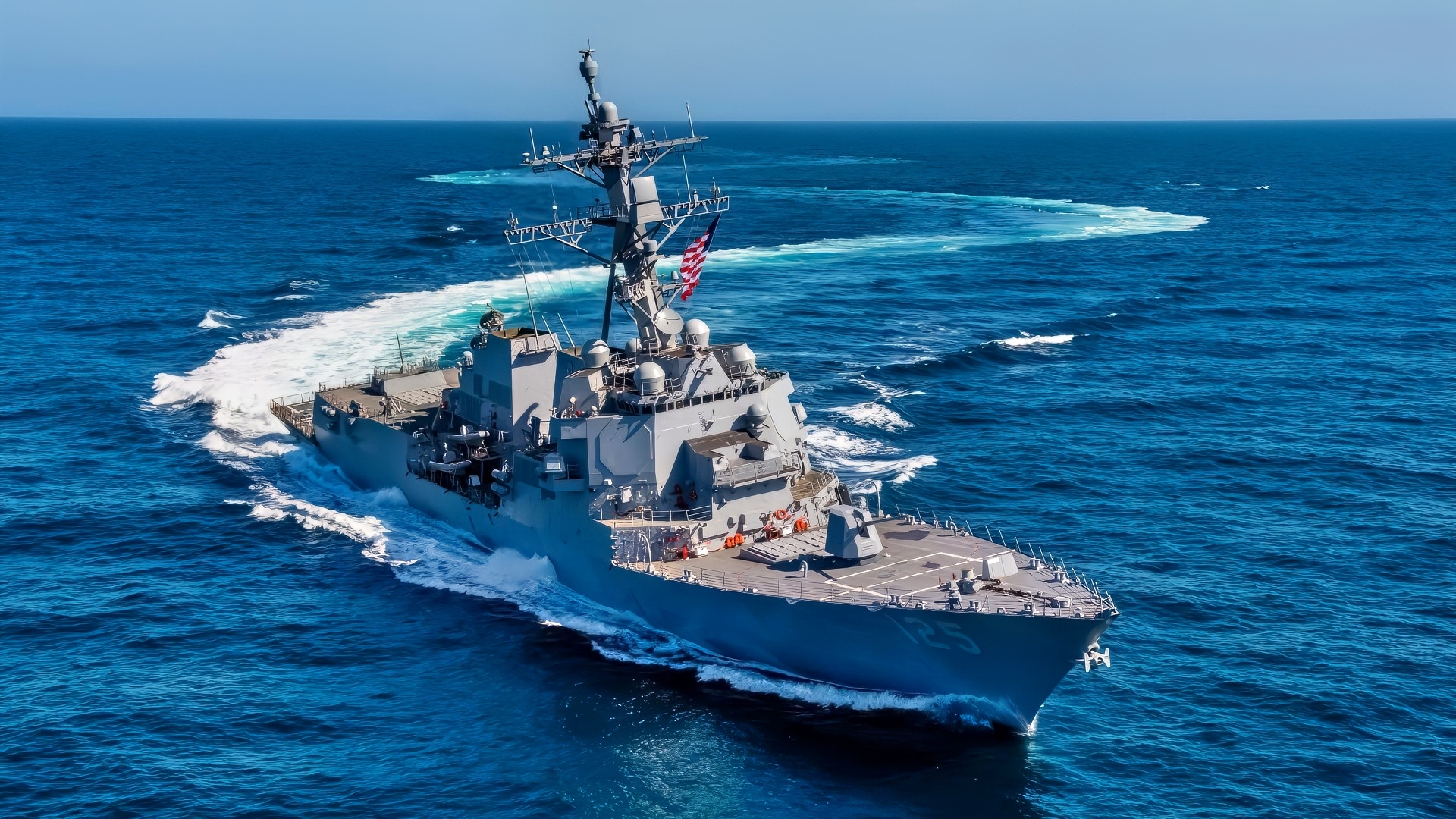
2017 was not a good year for the U.S. Navy’s surface fleet. Two deadly collisions haunted the maritime branch. The Arleigh Burke-class destroyers were involved in separate incidents that killed several sailors. The Navy questioned whether high operational tempo and sailor fatigue could have contributed to failures in seamanship and whether sailors had problems standing watch before the accidents.
Arleigh Burke U.S. Navy Tragedies: What Took Place?

Arleigh Burke-class guided-missile destroyer USS Michael Murphy (DDG 112) sails alongside Nimitz-class aircraft carrier USS Abraham Lincoln (CVN 72) on Dec. 8, 2025. USS Abraham Lincoln (CVN 72), flagship of the Abraham Lincoln Carrier Strike Group, is underway conducting routine operations in the U.S. 7th Fleet area of operations, demonstrating the U.S. Navy’s long-term commitment to a free and open Indo-Pacific. (U.S. Navy photo by Mass Communication Specialist 3rd Class Nathaly Cruz)

Arleigh Burke-Class. Image Credit: Creative Commons.
The USS Fitzgerald, an Arleigh Burke-class guided missile destroyer, collided with a civilian cargo ship near Japan in a tragic incident that killed seven sailors on June 17, 2017. The shipmates were found dead in flooded compartments. Three others were wounded. It happened off the coast of Honshu Island, near the port city of Yokosuka.
Unfortunately, many people were asleep when the collision happened as it made its way to the Philippines. The collision with ACX Crystal created a large gash underneath the waterline on the Fitzgerald. The damaged ship was quickly sent to Yokosuka. Navy divers located the victims.
It Could Have Been Worse
The BBC interviewed the commander of the 7th Fleet, Admiral Joseph P. Aucoin. He said that the crew acted heroically to save the ship. Aucoin explained that the vessel could have sunk if not for “heroic efforts” by the crew, which stopped the flooding from “catastrophically spreading” to other parts of the Fitzgerald.
“Marine traffic records suggest that the container ship, the Filipino-flagged ACX Crystal, made a sudden U-turn roughly 25 minutes before the crash. It is not known why it changed course,” BBC reported. Watch officers on both ships noticed the danger and tried to change speed and course.
The Investigation Report Was Scathing
The National Transportation Safety Board identified several safety problems after an investigation. “The Fitzgerald crew’s fatigue, the practice of U.S. naval vessels not to broadcast automatic identification system (AIS) information, failure of both vessels to follow required actions in accordance with the International Regulations for the Prevention of Collisions at Sea, the Fitzgerald commanding officer’s failure to adequately assess the hazard presented by the vessel’s intended transit, and insufficient oversight by the U.S. Navy.”

(Aug. 22, 2023) Gunner’s Mate 2nd Class Chase Allen maintains the barrel of a Mark 45 5-inch light-weight gun on the fo’c’sle of the Arleigh Burke-class guided-missile destroyer USS Paul Hamilton (DDG 60) in the Pacific Ocean, Aug. 22, 2023. Paul Hamilton is deployed to the U.S. 3rd Fleet area of operations. (U.S. Navy photo by Mass Communication Specialist 2nd Class Elliot Schaudt)
Could This Have Been Avoided?
This was a breakdown in the sailors’ training and situational awareness at sea, and could have been prevented. Was it a lack of sufficient levels of seamanship that the Navy could have improved upon prior to the wreck?
The crew should be given credit for rushing to make countermeasures, but the damage and loss of life were already etched in stone.
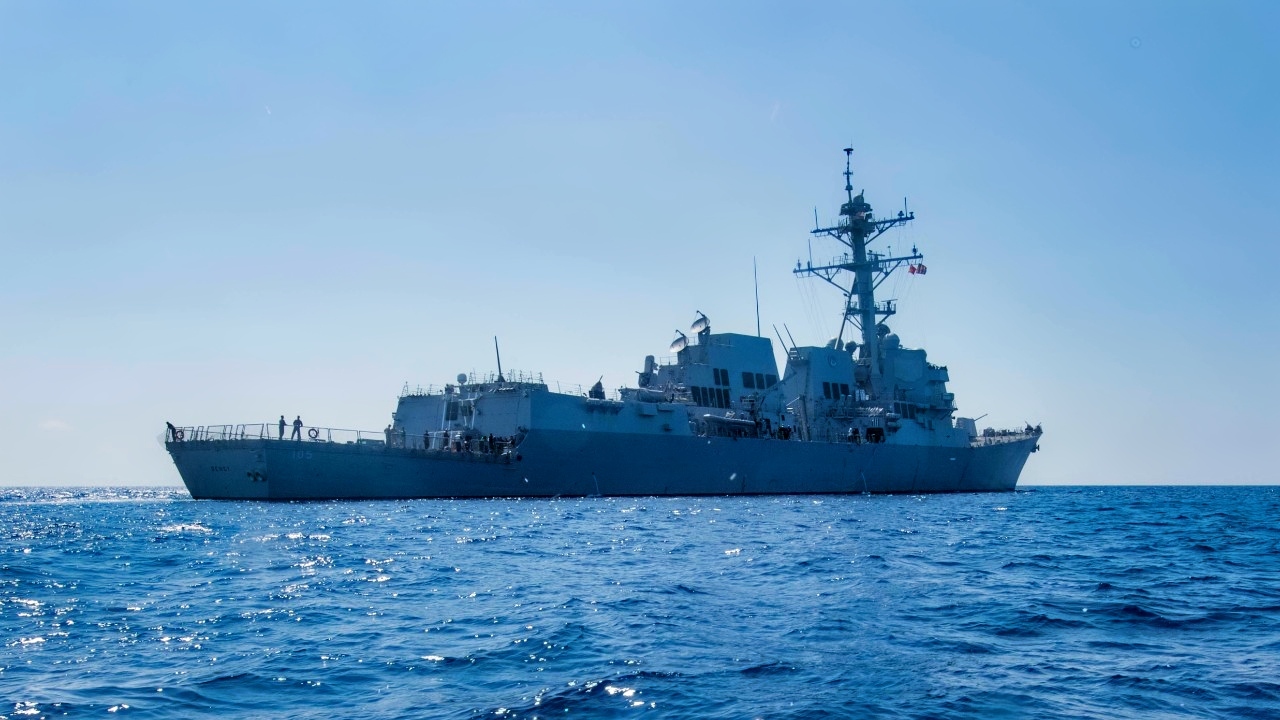
Arleigh Burke-class guided-missile destroyer USS Dewey (DDG 105) transits the South China Sea. Dewey is part of the Sterett-Dewey Surface Action Group and is the third deploying group operating under the command and control construct called 3rd Fleet Forward. The U.S. 3rd Fleet operating forward offers additional options to the Pacific Fleet commander by leveraging the capabilities of 3rd and 7th Fleets. (U.S. Navy Photo By Mass Communication Specialist 3rd Class Kryzentia Weiermann/ Released)
The crew must have been devastated, and the incident report was detrimental to many careers. The sailors were not following the correct techniques and procedures that led to the crash. The commanding officer did not react quickly enough to make decisions that could have prevented the wreck. The responsibility falls on the captain of the ship; he may have taken counteractions, but it was too little and too late.
USS John McCain Had a Similar Accident
On August 17 that year, the USS John S. McCain, another Arleigh Burke-class destroyer, had a massive accident. The ship collided with the merchant vessel Alnic MC while steaming east of the Straits of Malacca and Singapore. It happened five miles northeast of Horsburgh Lighthouse. Ten sailors died, 48 were hurt, and the wreck caused over $100 million in damage to the McCain.
Both ships were sailing in the westbound lane in the Middle Channel passage of the Singapore Strait. The destroyer crew had a “perceived loss of steering and, while the crew attempted to regain control of the vessel, the John S. McCain unintentionally turned to port into the path of the Alnic MC,” At 0524, the vessels collided,” the NTSB said in its investigation.
The NTSB Had a Laundry List of Problems
“The NTSB determined that the probable cause of the collision between the destroyer John S. McCain and the tanker Alnic MC was a lack of effective operational oversight of the destroyer by the US Navy, which resulted in insufficient training and inadequate bridge operating procedures.
Contributing to the accident were the John S. McCain bridge team’s loss of situation awareness and failure to follow loss-of-steering emergency procedures, which included the requirement to inform nearby traffic of their perceived loss of steering. Also contributing to the accident was the operation of the steering system in backup manual mode, which allowed for an unintentional, unilateral transfer of steering control,” the investigation reported.
This means the Navy was negligent in the wreck. How could the deck crew not be trained enough to execute their duties in a proper manner? Seamanship is drilled into sailors from the very beginning of their tutelage to become naval officers. This was highly disappointing.
When the ship lost steering control, the captain and his underlings should have taken proper countermeasures to prevent the wreck. The crew could also have radioed the other ship faster to help prevent the collision. They could have used the steering backup system better, but failed to do so.
Naval accidents often have fast, cascading events that create the most dangerous situations.
Shipmates must react quickly and fall back on their training. Most of this procedure involved engaging backup systems when the main apparatus fails. But in McCain’s case, the manual system was misused. The Navy should have required more drills simulating this action to prepare sailors for the worst.
Might These Incidents Happen More Frequently?
These accidents could happen again in East Asia today. There are so many ships from different countries and navies that miscalculations, mistakes, and ramming accidents could create the recipe for disaster. The Strait of Malacca is a narrow waterway, and when the Navy conducts freedom-of-navigation operations, its ships must often pass by merchant vessels.
These types of accidents must not happen again. The investigatory reports can serve as a guidebook for lessons learned from the tragedies. The Navy must ensure crews are sufficiently rested, well-trained, and able to respond quickly to accidents.
Most sailors are experts at their jobs, and bad luck happens, but it is clear in these incidents that the Naval ships could have handled themselves better.
About the Author: Brent M. Eastwood, PhD
Author of now over 3,500 articles on defense issues, Brent M. Eastwood, PhD, is the author of Don’t Turn Your Back On the World: A Conservative Foreign Policy and Humans, Machines, and Data: Future Trends in Warfare, plus two other books. Brent was the founder and CEO of a tech firm that predicted world events using artificial intelligence. He served as a legislative fellow for US Senator Tim Scott and advised the senator on defense and foreign policy issues. He has taught at American University, George Washington University, and George Mason University. Brent is a former US Army Infantry officer. He can be followed on X @BMEastwood.


