

Key Points and Summary – Aircraft carrier USS Ford proved first-in-class is hard: novel tech and evolving designs drove delays and costs.
-CVN-79 USS John F. Kennedy benefits from that pain. HII’s Newport News Shipbuilding locked in the design before cutting steel, utilized digital models to de-risk integration, and adopted a modular “superlift” construction approach, assembling and welding large sections ashore before installing them in dry dock.

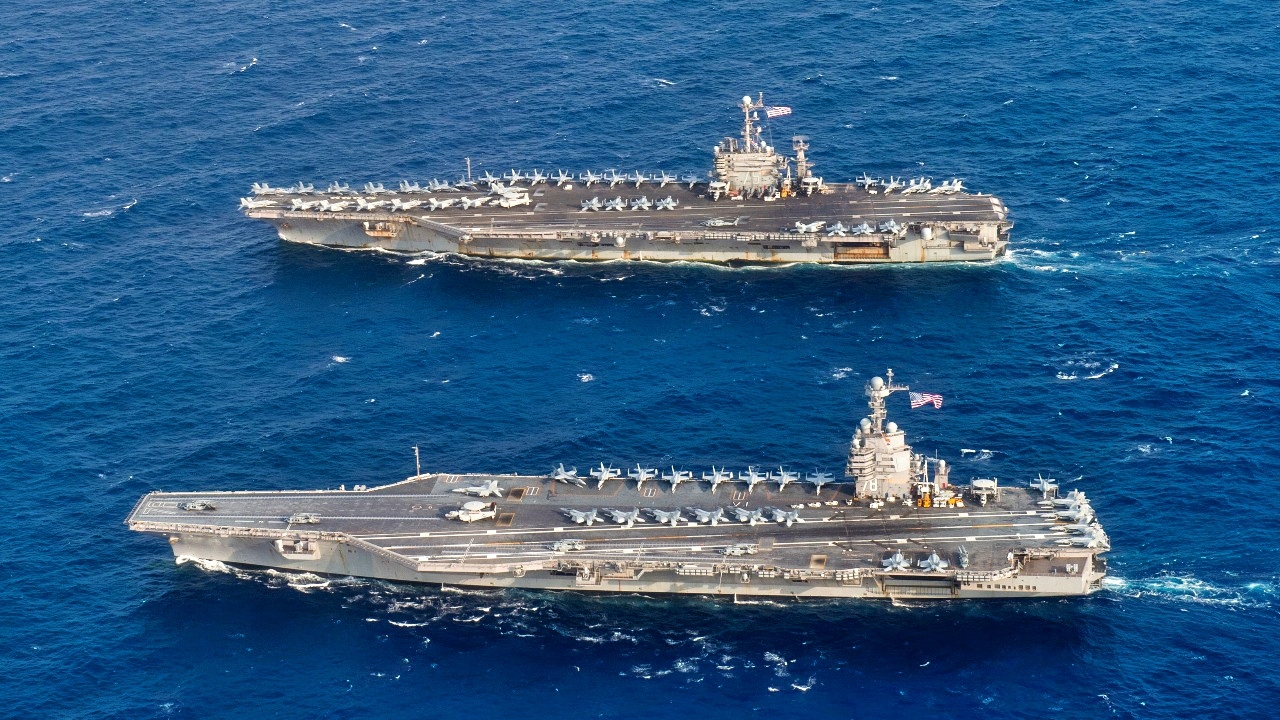
(Oct. 17, 2017) The aircraft carrier USS Nimitz (CVN 68) transits the Arabian Gulf, Oct 17, 2017. Nimitz is deployed in the U.S. 5th Fleet area of operations in support of Operation Inherent Resolve. While in this region, the ship and strike group are conducting maritime security operations to reassure allies and partners, preserve freedom of navigation, and maintain the free flow of commerce. (U.S. Navy photo by Mass Communication Specialist Seaman David Claypool/Released)
-Early bulk buys, more forging (less casting), a radar upgrade, and electric aircraft elevator drives further trim costs and complexity.
-Result: Kennedy is trending ~$1.5B cheaper and on a 2027 operational path.
-The takeaway: Disciplined design freezes and modular build methods are reshaping U.S. carrier construction.
-Pipe assemblies, cabling, shafts, rudders, and struts are just a few of the small parts of a massive aircraft carrier that need to be organized and built into a large, highly complex integrated design to bring an aircraft carrier to life.
12 Years for a New U.S. Navy Aircraft Carrier…But It Does Speed Up…
The famous and now operational USS Ford, the Navy’s first-in-class breakthrough carrier, took 12 years to assemble.
The first steel was cut in 2005, and the ship was commissioned for operational service in 2017, a challenging process marked by years of budgetary, technological, and scheduling difficulties.
Now the USS Kennedy is surging toward operational life in 2027. HII has leveraged new construction techniques to expedite the construction of the second Ford-class carrier.
Many of these new construction techniques emerged from lessons learned while building the USS Ford. Newport News Shipbuilders, a division of HII, has been moving forward for many years now with a process builders call modular construction, wherein ship compartments are assembled before being moved to the dock to expedite the building process.
Smaller segments of the ship are welded together into a structural “superlift,” a process designed to advance construction before the ship is lifted into dry dock.
Lessons Learned From USS Ford
In general, carrier construction begins with the bottom of the ship and works upward, with inner bottoms and side shells before moving to what’s called box units. The bottom third of the ship gets built first.
Additionally, some of the design methods now used for the Kennedy include efforts to fabricate or forge certain parts of the ship, rather than casting them, because HII builders have explained that this approach makes the process less expensive.
This construction technique for the Kennedy has included efforts to assemble compartments and parts of the ship before moving them to the dock—this expedites construction by allowing builders to integrate larger parts of the ship more quickly.
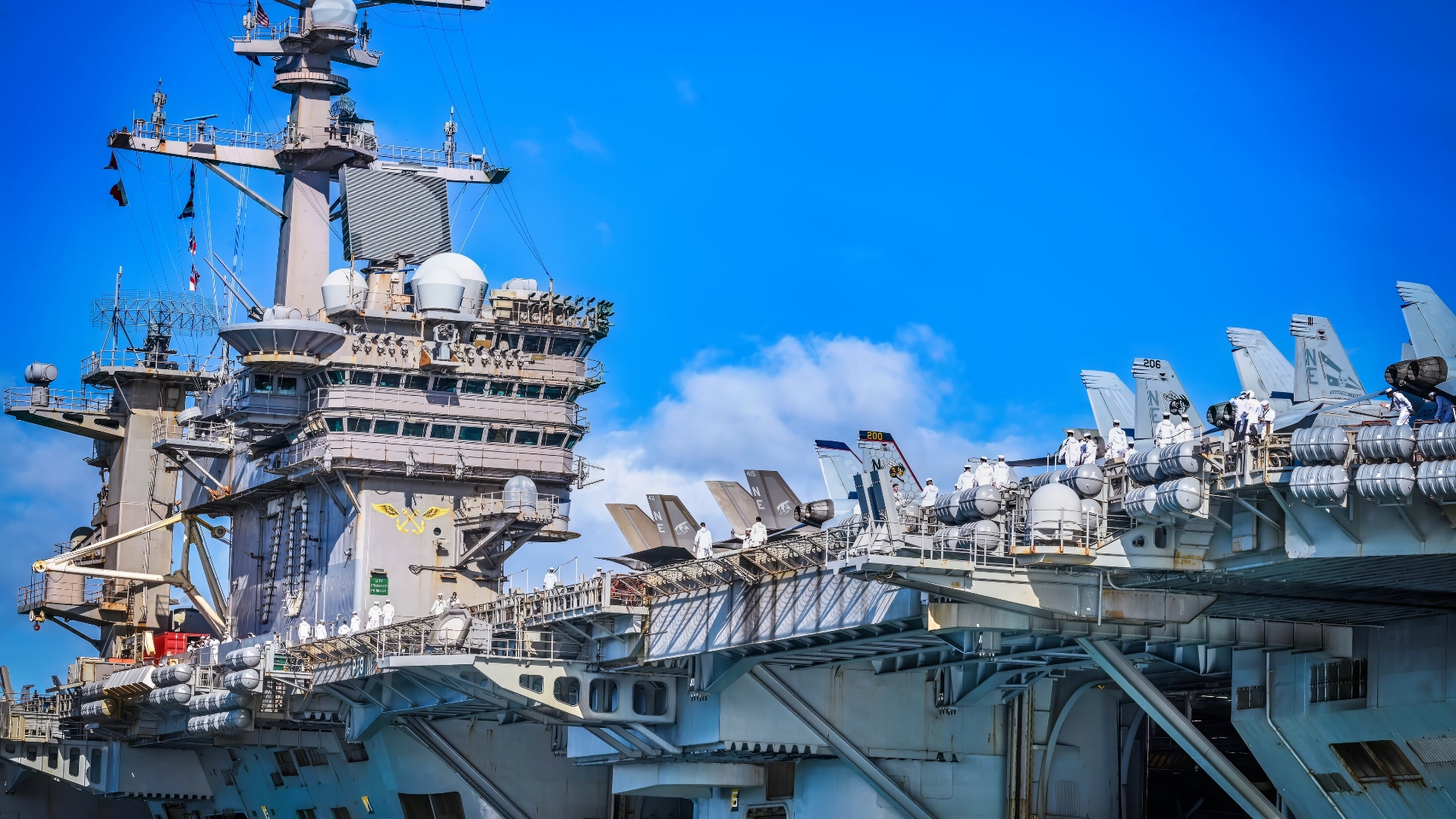
The Nimitz-class aircraft carrier USS Carl Vinson (CVN 70) arrives in Joint Base Pearl Harbor-Hickam, Hawaii, for a scheduled port visit, July 30, 2025. Vinson, the flagship of Carrier Strike Group ONE, is underway conducting routine operations in the U.S. 3rd Fleet area of operations. (U.S. Navy photo by Roann Gatdula)
This “modular construction” technique was also used when building the USS Ford, albeit to a lesser extent; the process involves welding smaller sections of the ship together into larger structural “superlift” units before they are lifted into the dry dock.
Aircraft Carrier Costs
HII ship developers have made progress in lowering the costs of the USS Kennedy, with some reports indicating that the cost of the USS Kennedy is at least $1.5 billion less than the cost to build the first Ford-Class aircraft carrier.
Many are likely to recall that the Navy received substantial criticism over several years from lawmakers and government watchdog groups during the construction of the USS Ford, primarily due to rising costs resulting from technological problems and scheduling delays.
The construction costs for the USS Ford ultimately exceeded early cost estimates by several billion dollars.
More than ten years ago, Navy officials responded that integrating new technologies would open the process up to challenges, adding that at least $3 billion of the Ford’s costs were due to what’s described as non-recurring engineering costs for a first-in-class ship such as this.
Also, Newport News Shipbuilding was able to buy larger quantities of parts earlier in the construction process with the Kennedy.
This is because, unlike the circumstances during the building of the USS Ford, the Kennedy’s ship design was complete before construction began.
This is quite significant, given that HII has for years used extensive digital modeling to solidify ship designs and support construction.
Progress with these efforts was significantly improved after the USS Ford was built, as computer models had already been designed and built.
As for the design, the Kennedy is largely similar to the design of the USS Ford, with a few minor alterations.
The Kennedy has a different radar, and its aircraft elevators will use electric motors instead of a hydraulic system to lower costs.
About the Author: Kris Osborn, Warrior Maven President
Kris Osborn is the President of Warrior Maven – Center for Military Modernization. Osborn previously served at the Pentagon as a highly qualified expert in the Office of the Assistant Secretary of the Army—Acquisition, Logistics & Technology. Osborn has also worked as an anchor and on-air military specialist at national TV networks. He has appeared as a guest military expert on Fox News, MSNBC, The Military Channel, and The History Channel. He also has a Masters Degree in Comparative Literature from Columbia University.
More Military
Canada Is ‘Full Steam Ahead’ on F-35 Stealth Fighter
Why Does Turkey Have So Many Main Battle Tanks?
‘Cracked Barrels’: The U.S. Navy’s Big Railgun Failure Explained in Just 2 Sad Words
‘Had No Chance’: The Montana-Class Was the 71,000-Ton Battleship Destined to Fail
‘Captain, We Smacked It Another Submarine’: British and French Nuclear Missile Subs Collided


