

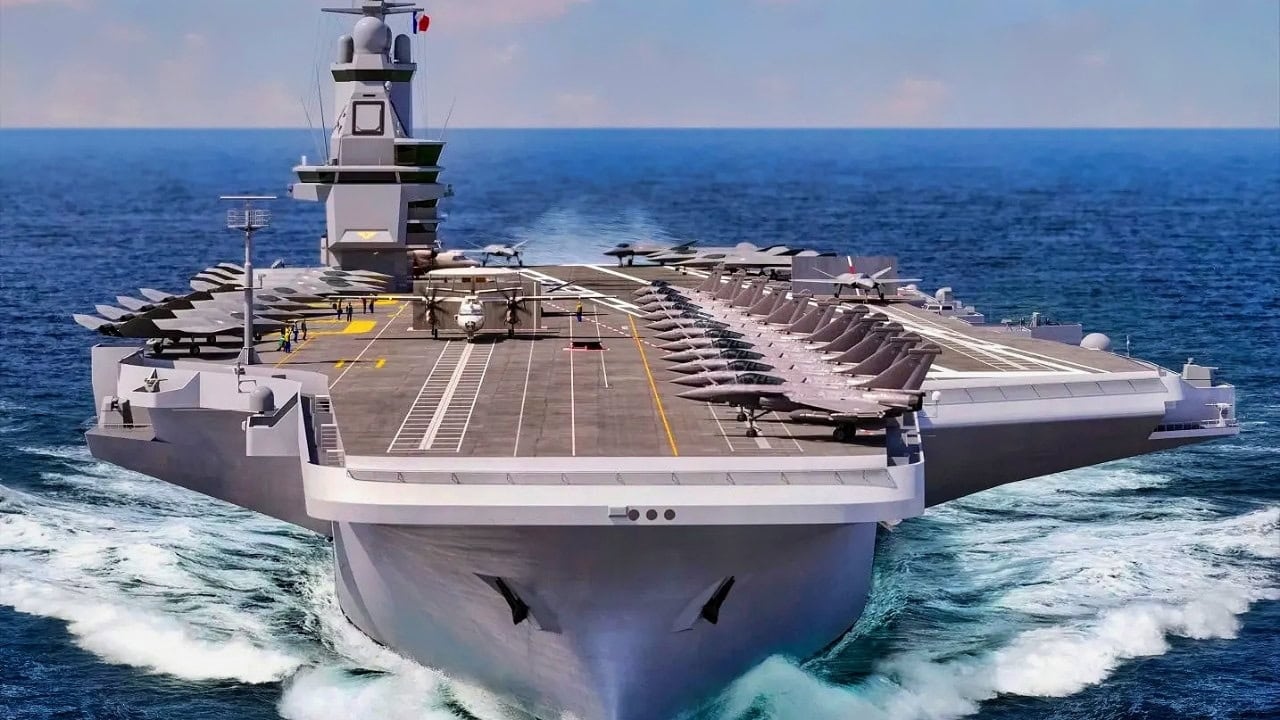
France has approved construction of the most ambitious warship in European history. Named France Libre after Charles de Gaulle’s wartime government-in-exile, the 78,000-ton nuclear-powered aircraft carrier will displace nearly twice the current Charles de Gaulle, cost €10.25 billion, and carry American electromagnetic catapults, French K22 reactors, and a sixth-generation air wing that does not yet exist. President Macron formally approved construction in December 2025 and named her in March 2026. She enters service in 2038 — the year the current Charles de Gaulle retires after 37 years. The question Paris is quietly asking: Does France actually need her?
France Is Building A 78,000-Ton Nuclear Aircraft Carrier — And The Charles De Gaulle Is Running Out Of Time To Wait For Her

PANG Aircraft Carrier from France. Image Credit: Creative Commons.
France has been operating a single nuclear-powered aircraft carrier since 2001. That carrier — the Charles de Gaulle — is currently 25 years old, deployed in the Eastern Mediterranean supporting the Iran war, and scheduled to retire in 2038. Her replacement was officially approved by President Emmanuel Macron on December 21, 2025. Macron named her on March 18, 2026: France Libre — after the Free France government-in-exile that de Gaulle himself led during World War II.
She will be 310 meters long. She will displace 78,000 tons — nearly double the Charles de Gaulle. She will be the largest warship Europe has ever built. She will cost €10.25 billion (approximately $12 billion). She will be nuclear-powered, equipped with American-designed electromagnetic catapults, and designed from the keel up to operate sixth-generation fighters and combat drones that do not yet exist.
She is also not coming until 2038.
This is what France is building, why it is building it, what the Charles de Gaulle did to earn her replacement, and the question that every French defense analyst is now privately asking: Does France actually need this carrier at all?
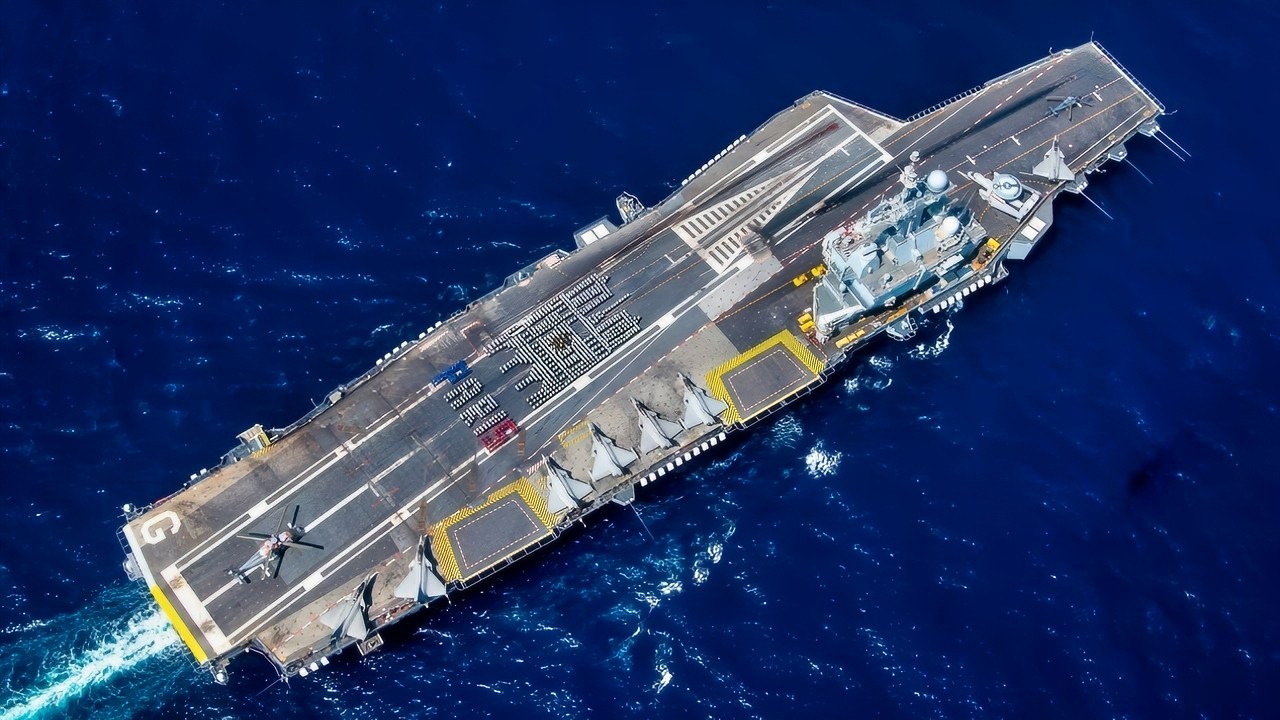
Charles de Gaulle Aircraft Carrier France. Image Credit: Creative Commons.
Why France Wants Nuclear Aircraft Carriers
The French argument for owning aircraft carriers comes down to a single phrase that recurs across every Macron speech, every Ministry of the Armed Forces planning document, and every Naval Group press release: strategic autonomy.
France is the only European Union member state with nuclear weapons. It is one of two NATO members outside the United States with the capability to operate a nuclear-powered fixed-wing aircraft carrier. There is also China; at least we think Beijing is building one. It maintains a permanent seat on the U.N. Security Council, overseas territories on five continents, and a defense doctrine that explicitly assumes France must be able to project force globally without permission from any other power, including the United States.
A carrier is the physical instrument of that doctrine. It allows France to move a sovereign airbase to any patch of international water within reach of any region that matters — the Indo-Pacific, the eastern Mediterranean, the Persian Gulf, the West African littoral. It does not require host-nation basing rights. It does not require American tankers. It does not require permission from anyone outside Paris.

Charles de Gaulle Aircraft Carrier. Image Credit: Creative Commons.
France has wanted that capability since 1945. Charles de Gaulle himself was a carrier advocate inside the wartime Free French leadership. The post-war French Navy operated the conventionally powered Clemenceau and Foch from the early 1960s through the late 1990s. By the mid-1970s, the Defense Ministry had identified the requirement for a nuclear-powered successor that could match the strategic autonomy of the United States Navy’s carrier fleet without depending on American fuel logistics.
That requirement became Charles de Gaulle.
The Carrier That Took Fourteen Years To Build
The Charles de Gaulle program was officially launched in 1980, when the French Defense Council specified two nuclear-powered carriers of 35,000 tons carrying catapults and arrestor gear capable of handling aircraft up to 22 tons. The first ship — originally to be named Bretagne, then renamed Richelieu in 1986 under President François Mitterrand — was ordered in 1986. Prime Minister Jacques Chirac renamed her Charles de Gaulle in 1987.
Construction began at the DCN Brest naval shipyard on November 24, 1987. She was launched on May 7, 1994. She was commissioned on May 18, 2001.
Fourteen years from ordering to commissioning. Construction was suspended on four separate occasions — 1990, 1991, 1993, and 1995 — due to post-Cold War budget cuts under successive French governments. The total cost reached approximately €3 billion, an 18 percent overrun against the original program estimate.
The technical problems were as severe as the budget problems. Sea trials, scheduled for July 1998, were delayed to January 1999 because of propulsion system issues. Trials had to be halted because of an electrical generation capacity problem. Higher-than-expected radioactivity in some compartments required additional shielding because safety standards had changed during the ship’s prolonged construction. The flight deck had to be extended by 4.4 meters during sea trials to give the E-2C Hawkeye early-warning aircraft enough runway to land safely.
The most embarrassing problem came during pre-commissioning trials. In November 2000, en route from Toulon to Norfolk, the port propeller broke off mid-Atlantic. The supplier, Atlantic Industrie, was blamed for poor-quality construction. The French Navy was forced to install the spare propellers from the decommissioned Clemenceau as a temporary fix — capping the carrier’s maximum speed at 25 knots rather than the contractual 27. Not long after the Defense Minister ordered an investigation, the supplier’s archives were destroyed in a fire.
The replacement propellers were installed during the first refueling in 2007. The carrier achieved her contractual speed in 2008.
In October 2010, a four-month deployment to fight piracy off the coast of Somalia was cut to a single day when an electrical fault in the propulsion system forced the carrier back to Toulon less than 24 hours after leaving port.
That was the Charles de Gaulle’s reputation through her first decade of service — a capable platform whose every public failure was magnified by the fact that France had only one carrier and could not afford for any single voyage to go wrong.

The French Marine Nationale aircraft carrier FS Charles De Gaulle (R91), and the aircraft carrier USS John C. Stennis (CVN 74) are underway in formation in the Red Sea, April 15, 2019. The John C. Stennis Carrier Strike Group is deployed to the U.S. 5th Fleet area of operations in support of naval operations to ensure maritime stability and security in the Central Region, connecting the Mediterranean and the Pacific through the western Indian Ocean and three strategic choke points. (U.S. Navy photo by Mass Communication Specialist Seaman Joshua L. Leonard)
The 18-month midlife refit, from February 2017 to September 2018, addressed most of the early-life problems. The K15 nuclear reactors were refueled. The combat system was modernized. The radars were replaced. The 1,950-person crew got a habitability upgrade. The carrier returned to service capable of operating Rafale M F3 fighters armed with ASMP-A air-launched nuclear missiles and SCALP-EG cruise missiles.
She has been operating that way ever since.
The Charles De Gaulle Is Currently Ready for Action
The current deployment itself is an argument for replacement.
On March 3, 2026, with Operation Epic Fury well into its first week, Macron announced that the Charles de Gaulle strike group would redeploy from the Baltic to the Eastern Mediterranean to defend allied bases during the Iran war. The strike group includes a nuclear attack submarine, a fleet oiler, the French frigates Chevalier Paul and Languedoc, the Spanish frigate Cristóbal Colón, and the Royal Netherlands Navy frigate Evertsen. The frigate Forbin was already deployed for Operation Aspides.
Charles de Gaulle arrived at Crete on March 9. Macron visited the carrier the same day and announced that France would lead an “unprecedented” naval mission of eight frigates and two helicopter carriers escorting merchant ships. The carrier transited the Suez Canal in early May 2026 with the frigate Alsace and the underway support ship Jacques Chevallier.
The air wing currently embarked includes three Rafale M squadrons (11F, 12F, and 17F) plus an E-2C Hawkeye detachment from squadron 4F. The carrier is doing exactly what France built her to do — projecting sovereign French airpower into a critical theater without requiring host-nation basing.
She is also 25 years old, on her second reactor refueling cycle, and operating beyond design margins. The K15 nuclear reactors aboard Charles de Gaulle require refueling every seven years, compared to once-per-lifetime refueling on modern American carriers. The CATOBAR steam catapults limit her air wing to 40 aircraft maximum and roughly 100 sorties per day at peak — well below comparable American carrier performance.
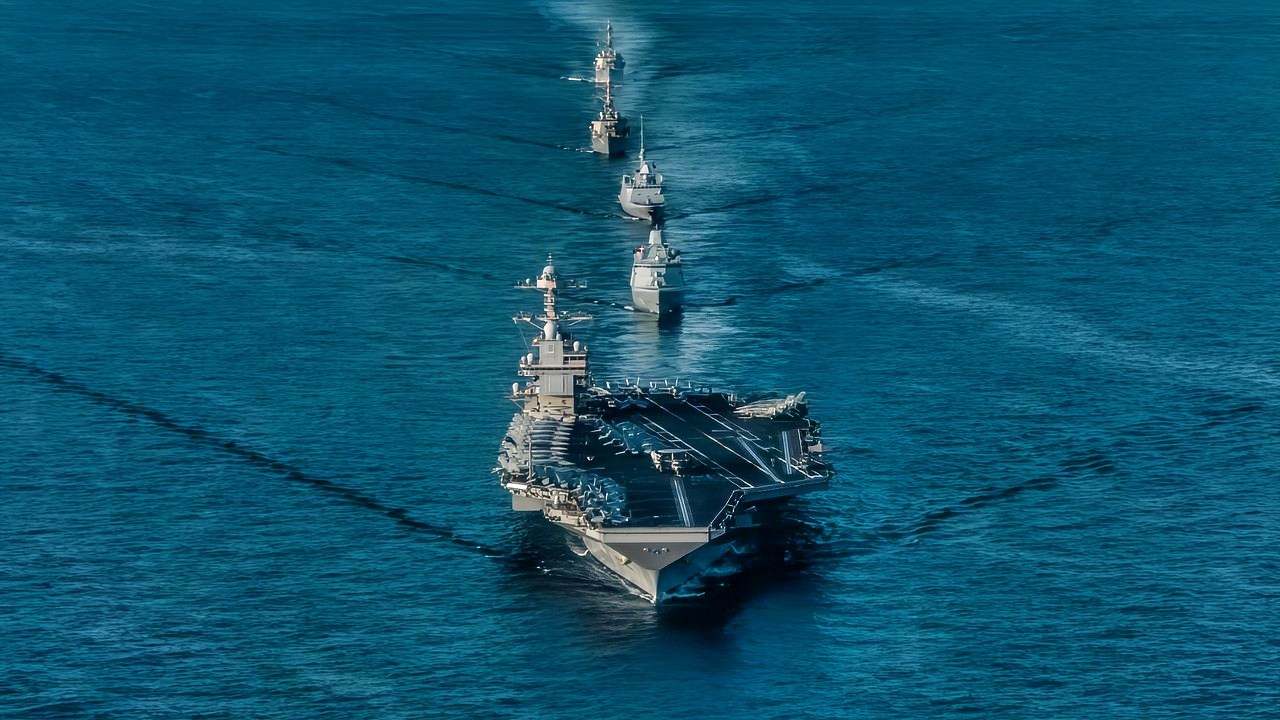
USS Gerald R. Ford Aircraft Carrier Training. Image Credit: U.S. Navy.
The replacement is overdue.
What France Libre Will Actually Be
The design that Macron approved in December 2025 represents a generational leap.
France Libre will be 310 meters long with a beam of approximately 90 meters and a displacement of 78,000 tons. The flight deck will measure 17,200 square meters — more than twice the deck area of the Charles de Gaulle.
The propulsion is two new TechnicAtome K22 pressurized water reactors producing 220 megawatts each — substantially more powerful than the K15 reactors aboard the current carrier, and engineered to reduce the refueling burden that has constrained Charles de Gaulle operations for two and a half decades. Preliminary design work on the K22 was completed in 2023. Manufacturing of the first reactor components began at Naval Group’s Cherbourg site on September 25, 2025.
The carrier will be a CATOBAR design, but the catapults will be American. France Libre will be equipped with three General Atomics Electromagnetic Aircraft Launch Systems and three Advanced Arresting Gear systems — the same EMALS and AAG that power the U.S. Navy’s Ford-class carriers.
The decision to procure American launch systems rather than develop a sovereign French alternative was driven by cost and schedule risk; the U.S. systems are operationally proven, the development cost has already been absorbed by the U.S. Navy, and the integration risk is lower than building a French equivalent from scratch.
The air wing is designed around 30 fighters, three E-2D Hawkeye airborne early-warning aircraft, and five to six helicopters — but the operational vision extends well beyond what the current Charles de Gaulle can fly. France Libre is expected to enter service with the Rafale M at F5 standard, and to integrate the Future Combat Air System sixth-generation fighter and carrier-compatible unmanned combat air vehicles from around 2040 onward.
Two hangars. Two deck-edge aircraft elevators with 40-ton lift capacity, offset to starboard. A single integrated island superstructure. Ship-wide electrification of power and equipment systems — anticipating future directed-energy weapons and high-bandwidth networking requirements that the Charles de Gaulle was not designed to support.
The construction schedule places hull assembly at Chantiers de l’Atlantique in Saint-Nazaire beginning in 2032, with transfer to Toulon Naval Base in mid-2035 for outfitting and nuclear fuelling. Sea trials begin in 2036. Commissioning in 2038.
That is a 13-year build from approved program to operational carrier. By 2038, the Charles de Gaulle will be 37 years old.
What France Libre Will Cost
The official program cost is €10.25 billion — approximately $12 billion in current exchange terms. Macron confirmed the figure during his December 2025 Abu Dhabi announcement, framing the procurement as a sovereign French commitment despite what he called “strained public finances.”
The cost is high but not unprecedented for a major capital warship program. The U.S. Navy’s lead Ford-class carrier, USS Gerald R. Ford, cost approximately $13.3 billion. The British Queen Elizabeth-class carriers cost approximately £3 billion each at their commissioning dates. The Chinese Type 003 Fujian carrier — comparable to Charles de Gaulle in size though conventionally powered — is estimated to have cost roughly $8 billion.

China’s New Carrier Type 003 CCTV Screencap Photo.
The €10.25 billion France Libre program covers ship construction at Chantiers de l’Atlantique and Naval Group, two K22 nuclear reactors at TechnicAtome, the EMALS and AAG procurement from General Atomics, integration of the embarked combat systems, and the long-lead component procurement that the DGA — France’s defense procurement agency — initiated in April 2024 with a €600 million order for critical-path equipment.
Approximately 800 suppliers will be involved in the program, 80 percent of which are small and medium-sized French enterprises. Macron has explicitly framed procurement as both a sovereign defense capability and an industrial base preservation program for French naval engineering, nuclear propulsion, and high-technology manufacturing.
Does France Actually Need It?
Here is the question that the French defense community is not publicly asking but is constantly debating in private.
A €10.25 billion carrier program competing for budget space with the FCAS sixth-generation fighter, the Suffren-class nuclear attack submarine procurement, the Aster missile family upgrade, and the broader French Navy modernization across surface combatants, amphibious ships, and patrol vessels is a substantial bet on continued French willingness to project force globally. The strategic environment of 2038 — when France Libre enters service — will look nothing like that of 2025, when Macron approved the program.
The argument for the carrier is the same argument France has used for fifty years. Sovereign power projection. Strategic autonomy. Refusal to depend on American basing or American tankers. The ability to put a French sovereign airbase anywhere in international waters within range of a regional crisis. The Indo-Pacific deployment requirement that Paris has explicitly committed to. The European leadership requires that France carry in the absence of any other EU member state with comparable capability.
The argument against the carrier is harder to articulate publicly but increasingly compelling on the merits. Long-range Chinese, Russian, and Iranian anti-ship weapons make carriers progressively more vulnerable in contested A2/AD environments. The cost of one carrier — €10.25 billion — could fund a much larger force of nuclear attack submarines, advanced frigates, long-range strike weapons, or sovereign French unmanned undersea and aerial capabilities that would arguably deliver more combat power per euro than a single high-value warship that requires its own escort fleet to operate safely.

DF-17 Missile from China. Image Credit: Creative Commons.
The Iran war is currently demonstrating both arguments simultaneously. The Charles de Gaulle is doing exactly what France built her for — leading a multinational naval mission, escorting commercial shipping, and providing sovereign French strike capability in a critical theater. She is also operating in waters where Iranian anti-ship missiles, Russian-supplied long-range systems, and Houthi drones have made carrier operations increasingly costly for the U.S. Navy. The combat record from 2026 will shape the French strategic conversation about France Libre’s role over the next decade.
The French government’s answer, for now, is that the carrier requirement is fundamental to French defense doctrine and is therefore non-negotiable. Macron’s December 2025 framing was unambiguous: “In an age of predators, we must be strong in order to be feared, and especially strong at sea.”
The Path Ahead
The program is now in the realization phase. The construction schedule is firm through 2038. The political support across the French establishment — including substantial support from opposition parties — is in place. The industrial base preparation is underway. The K22 reactor components are being manufactured at Cherbourg right now.
What remains uncertain is what the carrier will do with the 25 years of service life that begins in 2038. The Future Combat Air System sixth-generation fighter is supposed to fly from her deck. The carrier-compatible UCAV that will augment the air wing from 2040 has not been selected. The escort fleet that France will need to deploy alongside her does not yet exist in adequate numbers. The basing infrastructure at Toulon is undergoing parallel modernization.
Charles de Gaulle, meanwhile, has thirteen more years of operational service to bridge the gap. An assessment planned later this decade will determine whether the current carrier can be safely extended beyond her 2038 retirement horizon, depending on the condition of her nuclear reactors and hull structure.
That assessment is the genuine pinch point. If Charles de Gaulle cannot be extended, France faces a multi-year carrier gap between her retirement and the commissioning of France Libre. If she can be extended, the gap shrinks, but the political pressure to keep her sailing past her design life grows.
Either way, France is now committed. The carrier program that began as a Defense Council requirement in 1980 — through a 14-year build, four construction halts, an ocean-bottom propeller, two refits, and 25 years of operational service — will continue into the 2060s under the name of the French government-in-exile that won World War II.
France Libre is a 78,000-ton bet that sovereign French naval power projection will still matter four decades from now.
The Charles de Gaulle, deployed today off the Iranian coast, is the argument for why that bet is worth making.
The next thirteen years will determine whether the bet pays off — or whether France ends up with the most expensive symbol of strategic autonomy in European history.
MORE – The Ford-Class Aircraft Carrier: $13 Billion Wasted?
MORE – The B-21 Raider Has the Radar Signature of a Mosquito
About the Author: Harry J. Kazianis
Harry J. Kazianis (@Grecianformula) was the former Senior Director of National Security Affairs at the Center for the National Interest (CFTNI), a foreign policy think tank founded by Richard Nixon based in Washington, DC. Harry has over a decade of experience in think tanks and national security publishing. His ideas have been published in the NY Times, The Washington Post, The Wall Street Journal, CNN, and many other outlets worldwide. He has held positions at CSIS, the Heritage Foundation, the University of Nottingham, and several other institutions related to national security research and studies. He is the former Executive Editor of the National Interest and the Diplomat. He holds a Master’s degree focusing on international affairs from Harvard University.
CORRECTION: We have updated some of the language around China and nuclear aircraft carriers for clarity.


Derrick Landers
May 18, 2026 at 7:20 am
The article makes it sound like France and the others [in this so-called “Strike Group] were actively participating in the war – which they’re not. This article is just more doddering geopolitical pandering.
Rusty Shepard
May 18, 2026 at 11:20 am
France needs to build 10 more nuclear aircraft carriers before it talks shit to the usa…..
Gary
May 18, 2026 at 12:10 pm
I quit reading when it mentioned China as being a member of NATO.
Pedro
May 18, 2026 at 12:15 pm
Surrendering jokes aside, the USA would not have been possible without French aid during the Revolutionary War.k
Panama Mike
May 18, 2026 at 1:03 pm
French fleet showed up in 1782 the war was over by then, the friendship never kept their word in anything they are the least honorable of European nations
Dan
May 18, 2026 at 1:28 pm
Along with a new aircraft carrier for France, support ships will be needed to protect her from threats. Can France afford more warships?
CHARLES HODGES
May 18, 2026 at 3:04 pm
Old common folks ask themselves how the hell some of the politicians got elected to began with. Takes 30 USA Dollars to commute your vehicle with a half of tank to the doctor’s office. Fully tank costs is the same to tops its off Full. Vehicle with half a tank gets caught up in hour long traffic jam and your out of fuel. Vehicle with full tank drives on and barley makes it on time. If you’ve got a missile coming down on your ass you don’t have time to build something so you tell your family our ass is gone in 15 minutes . You’ve got something to defend yourself and family you can say I’ll see you at supper. If all goes well. As someone stated , where were they when we needed them. Why should we help them. Which. Makes more sense…
Myles
May 18, 2026 at 3:26 pm
Will it have reverse on it like their soldiers bunch of cowards
Chris Sansam
May 19, 2026 at 7:14 pm
This ship will be outdated by the time it’s launched and sixth gen fighter air wing is pure fantasy