

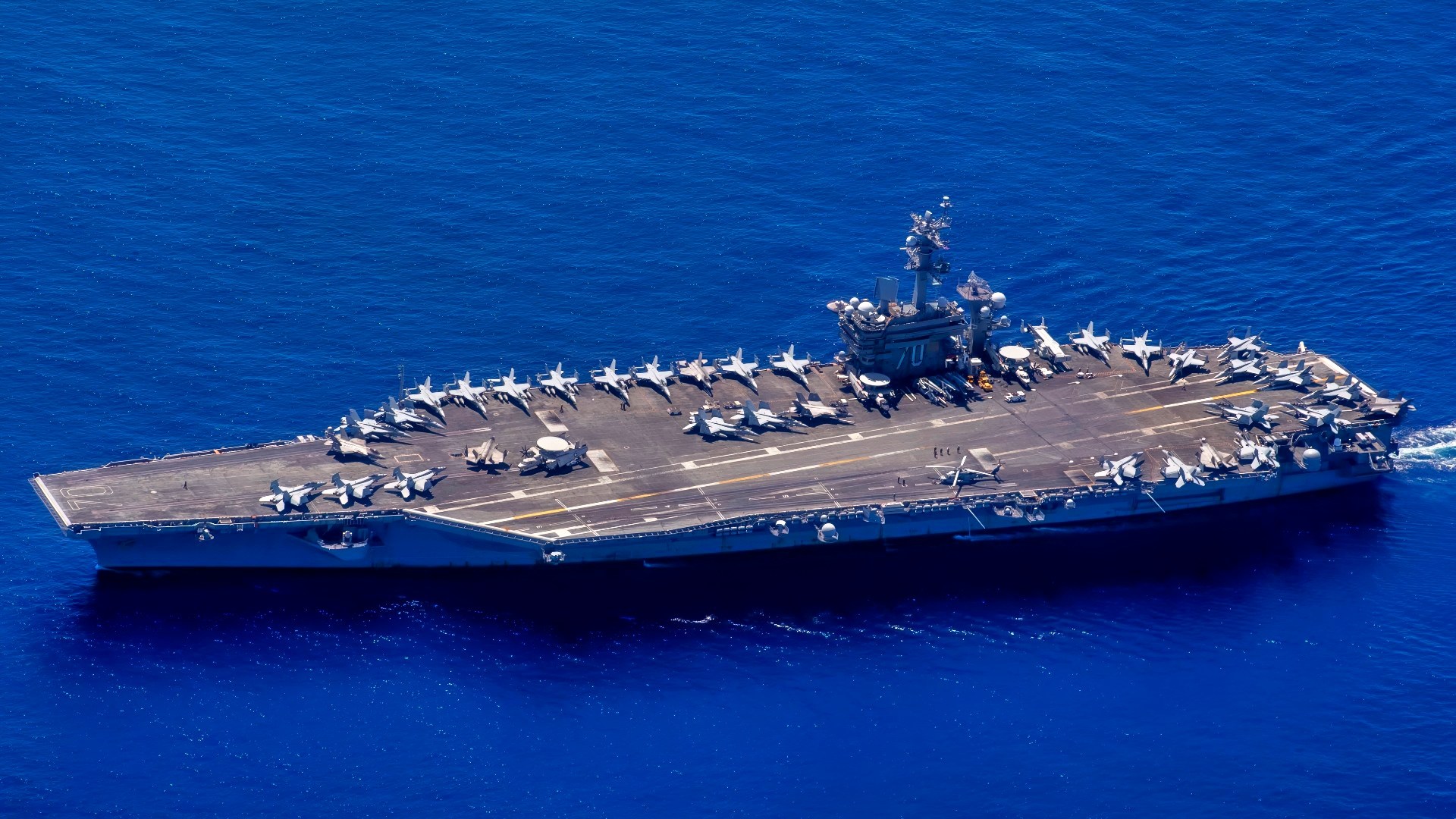
Iran absorbed the kinetic loss in the Gulf — China absorbed the engineering data. Every Chinese CM-302 cruise missile the U.S. Navy has shot down since Operation Epic Fury began on February 28 has been likely tracked from orbit by Beijing’s Jilin-1 constellation, 130 commercial imaging satellites mapping the U.S. intercept geometry in real time. The hypersonic DF-17 that China actually plans to use against American aircraft carriers was never tested in the Gulf.
China’s Missiles Powered Iran’s War with America
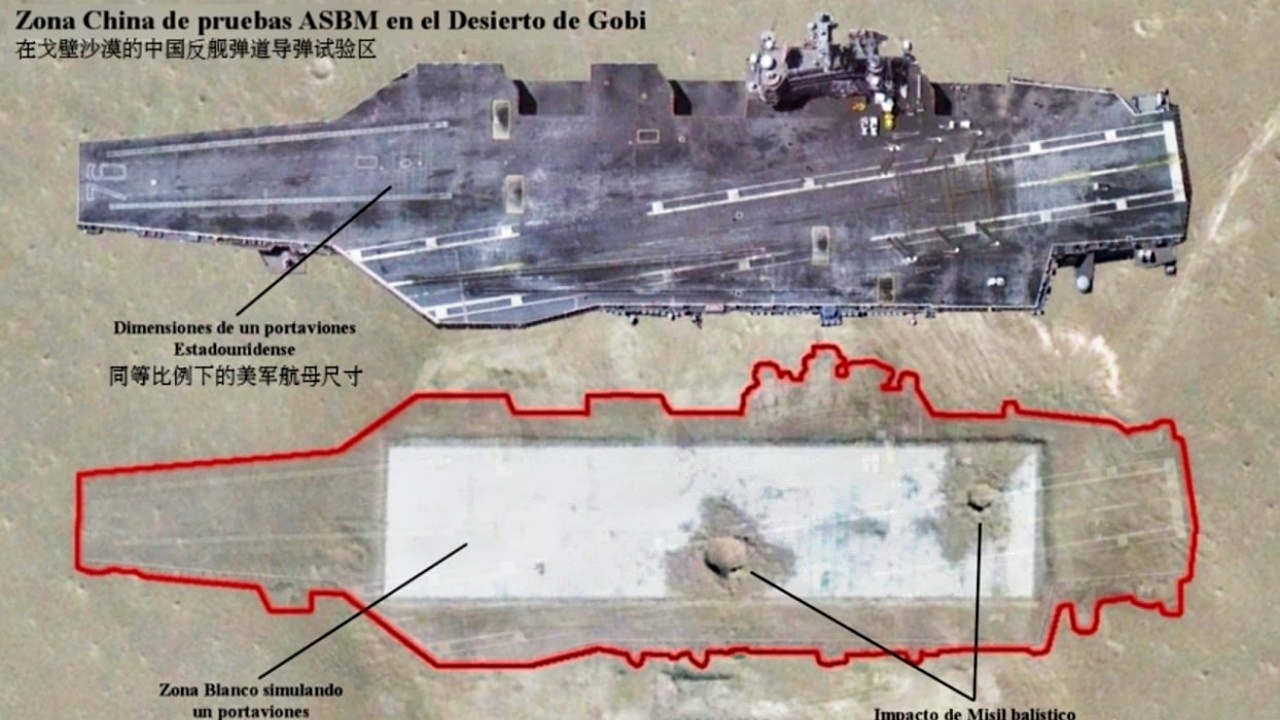
DF-26 China Missile Attack on Fake Aircraft Carrier Cut Out. Image Credit: Chinese Weibo Screenshot.
Washington is measuring success by the number of intercepts. That is the wrong metric.
Since Operation Epic Fury began on February 28, U.S. naval forces in the Gulf have intercepted missiles described in regional reporting as Chinese-made CM-302 anti-ship cruise missiles — the export variant of Beijing’s YJ-12, marketed for years as a carrier killer capable of threatening America’s most capital-intensive assets at sea. U.S. Central Command has described the intercept record as a vindication of layered naval air defense. The system held.
China is not mourning those intercepts. It is studying them.
The Wrong Side of the Lesson
Every weapons test produces its most useful data for the side whose weapon failed — not for the side that defeated it. The interceptor’s operator learns that the system worked. The weapon designer learns why it didn’t: under what engagement parameters, against what sensor architecture, at what altitude, and at what approach profile. One confirms a capability.
The other maps a problem that can be fixed.
Iran absorbed the kinetic loss. China absorbed the engineering data. That asymmetry has not received the attention it deserves.
The CM-302s that CENTCOM shot down were not flying blind. Beijing’s Jilin-1 commercial imaging constellation — now comprising over 130 satellites — was likely providing real-time surveillance coverage throughout the conflict. Chinese military planners watching those intercepts had eyes on the engagement geometry from above.

3rd Multi-Domain Task Force (3MDTF) conducts the first Mid-Range Capability live fire exercise outside of the continental United States successfully sinking a maritime target with a Standard Missile-6 Force during Exercise Talisman Sabre 25 on July 16, 2025. US Army photo
They could see which approach vectors got tracked, at what altitudes SM-6 engagements were initiated, and where the kill chain held. That is not passive observation. It is a controlled experiment, run with Iranian hardware and Iranian blood, on someone else’s defense architecture.
The result is a failure report that Beijing could not have purchased. It is now being processed.
The Weapon That Matters Is Not the One That Failed
Here is the problem with celebrating the CM-302 intercepts: the weapon China actually plans to lead with against U.S. carrier strike groups in a Taiwan contingency is not the CM-302.
It is the DF-17.
The DF-17 carries a hypersonic glide vehicle — the DF-ZF — capable of maneuvering at speeds that make Aegis and SM-6 intercepts considerably harder. Iran had no hypersonic missiles. That absence is not a minor detail. It is the central strategic fact that distinguishes the Gulf campaign from any future conflict in the Western Pacific.
What the CM-302’s combat performance tells Beijing is precisely where the ceiling of supersonic saturation warfare sits against current U.S. naval air defense. Washington has now demonstrated the engagement envelope — the altitudes, the intercept timelines, the sensor-to-shooter chains — that defeat a Chinese-export-grade supersonic anti-ship cruise missile under operational conditions. China has documented those parameters. The DF-17 is designed to operate outside them.
A carrier strike group that can down a CM-302 is not a carrier strike group that can survive a DF-ZF at hypersonic speeds the Gulf never tested.
The U.S. Navy’s layered defense architecture — however effective it proved against supersonic threats in the Gulf — has no demonstrated operational answer to a maneuvering hypersonic glide vehicle at terminal velocity. Beijing knows this. T
he Gulf confirmed the floor’s location.
China is now working out where the ceiling is.
The Next Version Won’t Miss
The harder question is what China’s weapons program looks like 18 months from now, recalibrated against a dataset it now holds.
Missile development is iterative. Known failure modes are solvable engineering problems. The CM-302 intercepts identified where Chinese anti-ship missile performance falls short against U.S. naval air defense in operational, not test-range, conditions.
The next variant gets designed around those gaps — tighter radar cross-section, sharper terminal maneuvering, approach vectors calibrated against the intercept geometry the Gulf just revealed.
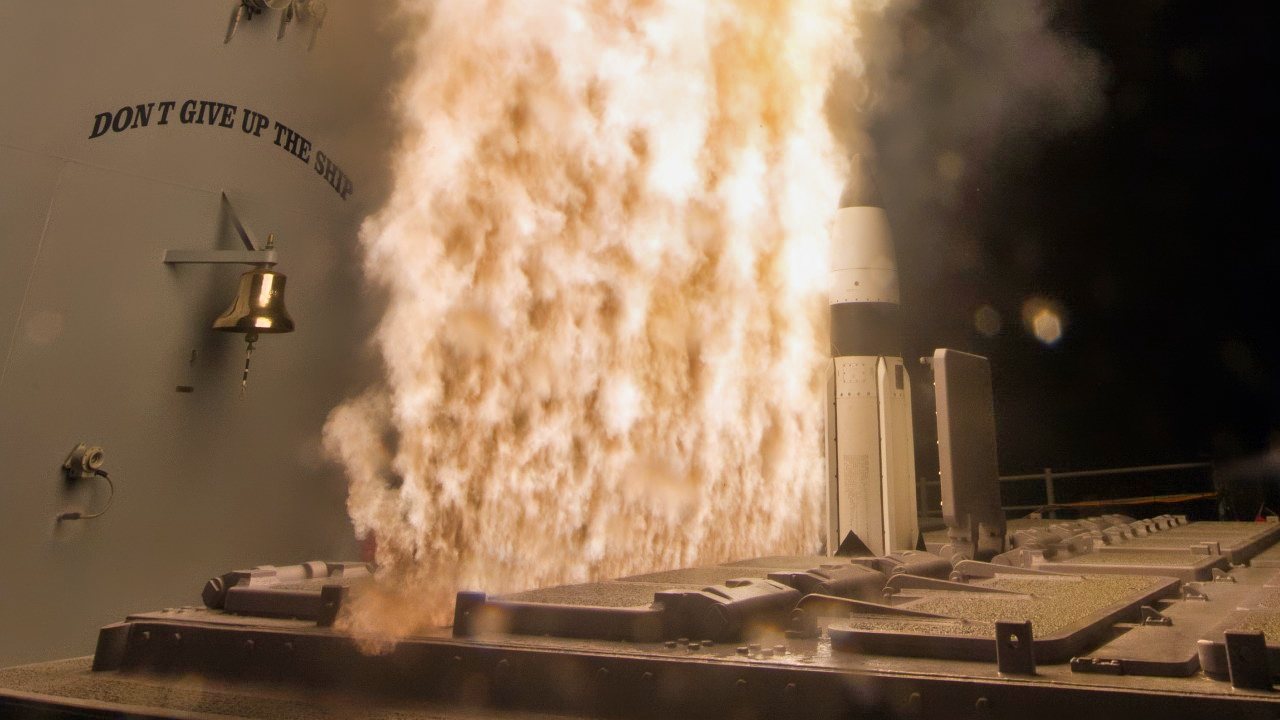
(Feb. 13, 2013) A Standard Missile-3 (SM-3) Block 1A interceptor is launched from the guided-missile cruiser USS Lake Erie (CG 70) during a Missile Defense Agency and U.S. Navy test in the Pacific Ocean. The SM-3 Block 1A successfully intercepted a target missile that had been launched from the Pacific Missile Range Facility, Barking Sands, Kauai, Hawaii. (U.S. Navy photo/Released)
Beijing is also watching how the U.S. defense industrial base is holding up. Stockpile concerns about SM-3 and SM-6 surfaced within weeks of Operation Epic Fury’s opening salvos. Production timelines for both interceptors run to years.
Not quarters. Years.
China has filed that alongside the intercept data. In a Taiwan contingency — fought at longer range, against a larger PLA force, with China’s full industrial weight behind it — the gap between expenditure and replenishment is not a background variable. It is the operational fulcrum that Beijing’s planners are already building around.
The Lesson China Actually Learned
The conventional framing of China’s takeaways from the Iran war runs something like this: Iran proved that drones and missiles can exhaust a superior adversary, and China will copy the model on an industrial scale.
That framing is too simple — and too comfortable.
China is not copying Iran’s arsenal. It is engineering around Iran’s failures. The Gulf told Beijing where supersonic and ballistic systems hit their ceiling against American air defense. It told them which approach vectors produce intercepts and where U.S. intercept capacity strains under sustained pressure. The next generation of Chinese anti-ship weapons will be designed around that knowledge — not to repeat the strikes that failed, but to exploit the margins those failures revealed.

(March 7, 2016) An F/A-18E Super Hornet assigned to the Warhawks of Strike Fighter Squadron (VFA) 97 performs a flyby during an aerial change of command ceremony above USS John C. Stennis (CVN 74). Providing a ready force supporting security and stability in the Indo-Asia-Pacific, Stennis is operating as part of the Great Green Fleet on a regularly scheduled 7th Fleet deployment. (U.S. Navy photo by Mass Communication Specialist Seaman Tomas Compian/Released)
Washington, meanwhile, is writing the after-action report about how well its interceptors performed.
Those are not the same lesson. One produces satisfaction. The other produces DF-17s with improved terminal guidance, aimed at carriers the U.S. cannot afford to lose and cannot quickly replace — optimized for the exact engagement geometry the Gulf just mapped.
The CM-302s failed. The experiment is not over.
About the Author: Dr. Andrew Latham
Andrew Latham is a professor of international relations and political theory at Macalester College in Saint Paul, MN. You can follow him on X: @aakatham.


xi-xi
May 7, 2026 at 11:08 pm
CM-302 is roughly within the brahmos-class missile, which south Asian pundits have proudly hailed as the ‘fastest supersonic missile in the world’.
CM-302 is likely same one as the cm-400akg missile, that follows a ballistic path toward its target, thus rendering it vulnerable to interception by fast long-range interceptors like the sm-6.
Anyway, for targeting USN carriers, the chines now have hypersonic warheads.
Whatever it is, supersonic and/or hypersonic, the emphasis is doing saturation attacks, since the missiles are way cheaper than their targets.
Centcom
May 11, 2026 at 4:48 am
this is misinformation , iran in the process of finalising acquirement of this missile on april.