


President Donald Trump’s job approval rating has fallen into the mid-30s in nearly every major poll released over the past six weeks. The collapse coincides almost exactly with the start of the Iran war on February 28, 2026. As of today, May 3 — six months out from the midterm elections — the Washington Post-ABC News-Ipsos poll reports that Trump’s disapproval rating has hit a new high in his second term, with Democrats significantly more motivated to vote than Republicans across every measured engagement metric.
I have watched GOP politics for a long time, not only advising presidential candidates in several cycles but also informally advising members of Congress for many years. Here is my read on what happened, what the polling actually shows, and what it likely means for the Republican Party in November and for the 2028 presidential race. And it’s all bad news.
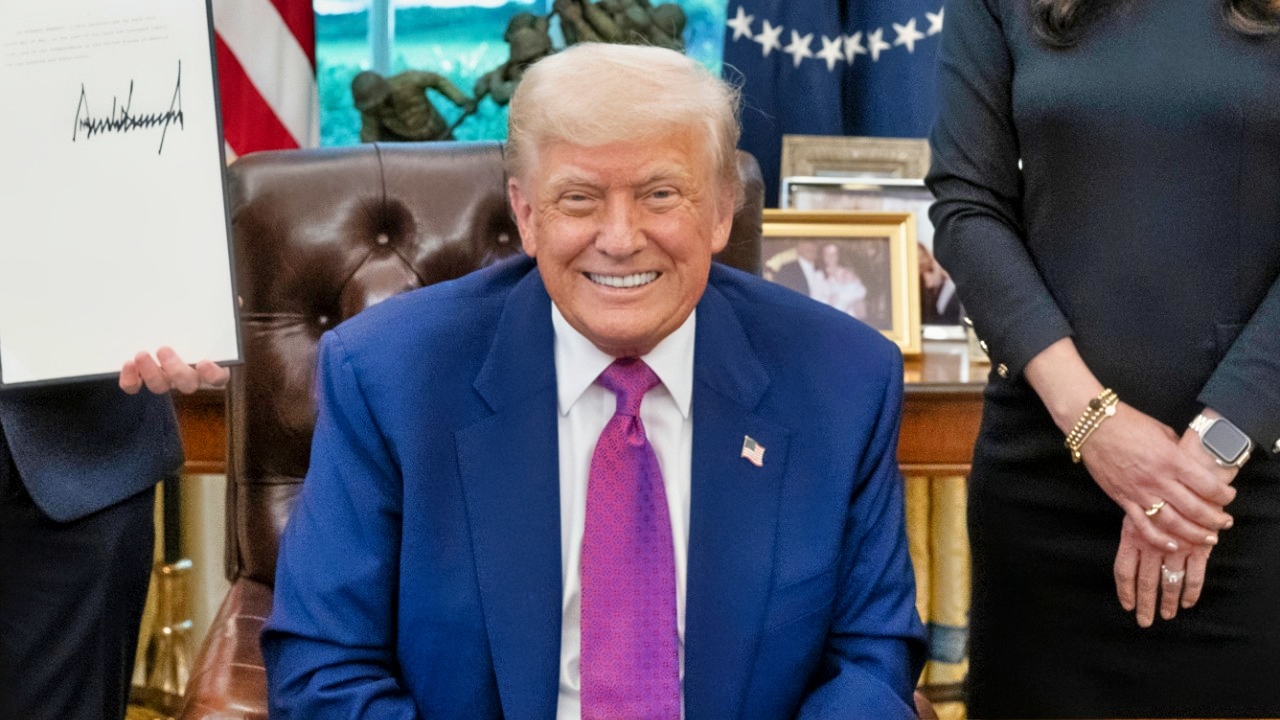
President Donald J. Trump holds a bill signing with members of Congress, Friday, May 9, 2025, in the Oval Office. (Official White House Photo by Molly Riley)
The Crash: Iran War Means Donald Trump’s Poll Numbers Tanked
Trump entered February 2026 with approval numbers in the low 40s in most major polls — historically weak for a first-year second-term president, but consistent with his floor-and-ceiling profile across both terms.
Then the war started.
By late April, the picture had changed substantially.
Three new surveys released the week of April 21 showed Trump’s approval rating in the mid-30s: 36 percent in Reuters/Ipsos, 35 percent in Strength in Numbers/Verasight, and 33 percent in AP-NORC.
An NBC News poll over the preceding weekend showed Trump at a new second-term low of 37 percent.
Eight of the nine quality polls CNN tracks over the past month have placed Trump in the 30s — the only exception being a Fox News survey at 41 percent that nonetheless represented Trump’s worst Fox News numbers since 2017.
The Washington Post-ABC News-Ipsos poll released this morning shows the trend continuing — with Trump’s disapproval reaching a new high for his second term as Americans register broad dissatisfaction with his handling of the Iran war alongside other key issues.
Why The Numbers Moved: Iran
The proximate cause is straightforward.

Donald Trump In a Meeting. Image Credit: Creative Commons.

Donald Trump at Ceremony. Image Credit: The White House.
The Iran war is unpopular, and the war has driven gas prices and inflation in directions that Trump’s economic approval numbers cannot survive.
Pew Research Center polling conducted March 16-22 — three weeks into the war — found that 59 percent of Americans believed the United States made the wrong decision in striking Iran, against 38 percent who said the decision was right.
By two-to-one, Americans said the military operation was not going well rather than going well.
Democrats opposed the war by 88 percent, independents leaned heavily against, and even within the Republican base, the support was uneven — Republicans 18-49 supporting the strikes at a notably lower rate than Republicans 50 and older.
The economic damage compounded the political damage. Gas prices crossed $4 per gallon in April for the first time since 2022. Trump’s economic approval dropped to a new all-time low of 31 percent in CNN polling. His disapproval on inflation reached 70 percent. The NBC poll found that 67 to 68 percent of Americans disapproved of his handling of both the war and inflation simultaneously — meaning the two issues had effectively merged in voter perception.
The Trump Base Is Starting to Get Upset
Most damaging for the White House, the slippage has reached into Trump’s base. According to YouGov/Economist tracking reported by The Hill, in the five weeks following the start of the war, Trump’s approval among his 2024 voters fell six points to 76 percent. Among self-described MAGA supporters, approval dropped five points to 92 percent. Among independents, approval fell from 31 percent in early March to 22 percent by mid-April.
When a Republican president loses points among MAGA supporters during an active military operation, the political ground has shifted in ways that an end to the war alone cannot easily reverse.
What This Means For The 2026 Midterms
The historical comparison the analysts are reaching for is George W. Bush in 2006.
Bush’s approval rating sank into the 30s during the worst of the Iraq war and stayed there. Republicans lost 30 House seats and six Senate seats in November 2006, surrendering both chambers to Democratic control. The mechanism was straightforward: an unpopular war, an unpopular president, and a midterm electorate that turns out heavily against the party in power when the country is dissatisfied.
The current environment has the same structural features. Today’s Washington Post-ABC-Ipsos poll explicitly frames Democrats as significantly more motivated to vote than Republicans heading into November. That enthusiasm gap is the single most important predictor of midterm results. Combined with mid-30s presidential approval, it points to losses for House Republicans in the double digits and a serious risk to the Senate map.
Republican strategists were already privately worried about midterm fundamentals before the Iran war began. The combination of the war and the gas-price-driven inflation spike has made what was a difficult cycle into a potentially catastrophic one.
What This Means For 2028
The 2028 implications are harder to read but probably worse for the GOP than the 2026 implications.
A presidential approval rating in the mid-30s through the second year of a second term is rare territory. As CNN’s analysis notes, it is mostly territory inhabited in recent decades by George W. Bush. Bush’s collapse in 2006 and 2007 set the conditions for Barack Obama’s 2008 victory — and for the Democratic Party to capture and hold the presidency through eight subsequent years.
If Trump’s numbers do not recover, the Republican presidential nominee in 2028 — whoever that turns out to be — will be running into the same political headwind that John McCain ran into in 2008. The party’s working assumption that a strong Trump second term would build durable Republican advantages into 2028 is now harder to defend.
The Iran war started on February 28. Months later, the political map looks worse for Republicans than at any point since 2006.
About the Author: Harry J. Kazianis
Harry J. Kazianis (@Grecianformula) was the former Senior Director of National Security Affairs at the Center for the National Interest (CFTNI), a foreign policy think tank founded by Richard Nixon based in Washington, DC. Harry has over a decade of experience in think tanks and national security publishing. His ideas have been published in the NY Times, The Washington Post, The Wall Street Journal, CNN, and many other outlets worldwide. He has held positions at CSIS, the Heritage Foundation, the University of Nottingham, and several other institutions related to national security research and studies. He is the former Executive Editor of the National Interest and the Diplomat. He holds a Master’s degree focusing on international affairs from Harvard University.


Hujjathullah M.H.Babu Sahib
May 3, 2026 at 2:01 pm
Kazianis is sharp in drawing the conclusion that the Republicans are stareing at a declining trajectory ahead on the basis of famous surveys and media polls. This is not also to admit that those polls are consistently accurate and have an unfailing predictive power, however. Both he and the polls are totally right to evidently cast a gloomy outcome for Trump in the upcoming 2026 midterm elections wherein as they have hinted gas prices, inflation and the increasingly unpopular Israeli-U.S. war on I.R. Iran are expected to be tangibly reflected. Having said this, it does not follow that the 2028 elections would necessarily follow the GWB lameduck scenario, however. The Republicans, Trump or whoever else who gets nominated eventually, do appear to have something up their sleeves and the oral play across Congress, as it may turn out, may eventually bear that out !