

There is a number that should worry the White House more than any roll call this month. That number is one. As in: one vote. That is the margin by which the United States House of Representatives, on April 16, 2026, rejected a war powers resolution that would have ordered President Trump to remove U.S. armed forces from hostilities with Iran absent explicit congressional authorization. The final tally was 213 to 214, almost entirely along party lines. One Republican — Thomas Massie of Kentucky — voted yes. One Democrat — Jared Golden of Maine — voted no. One Republican, Warren Davidson of Ohio, voted present. Three Republicans did not vote at all.
A single Democrat flipping their vote changes that resolution from defeated to passed.
And that vote came one day after the Senate rejected a similar resolution 52-47, with one Republican joining nearly every Democrat. House Democrats had previously forced three other war powers votes on the Iran conflict since the war’s start. All have failed. The most recent, before April 16 — on March 5 — saw two Republicans cross the aisle in support.
Two House Republicans in March. One in April. The trend line is moving in one direction.
Larson’s Articles of Impeachment over Iran War
The political rhetoric is moving even faster.
On April 7, Rep. John B. Larson of Connecticut filed 13 articles of impeachment against President Trump, accusing him of unconstitutionally initiating war “as a belligerent or co-belligerent against Iran, Yemen, Lebanon, Syria, Nigeria, and Gaza,” and of threatening military force against Panama, Colombia, Cuba, and Greenland — all without the congressional authorization the Constitution requires. The articles, drafted by consumer advocate Ralph Nader and constitutional lawyer Bruce Fein, accuse Trump of “serial usurpation of the congressional war power and commission of murder, war crimes, and piracy.”

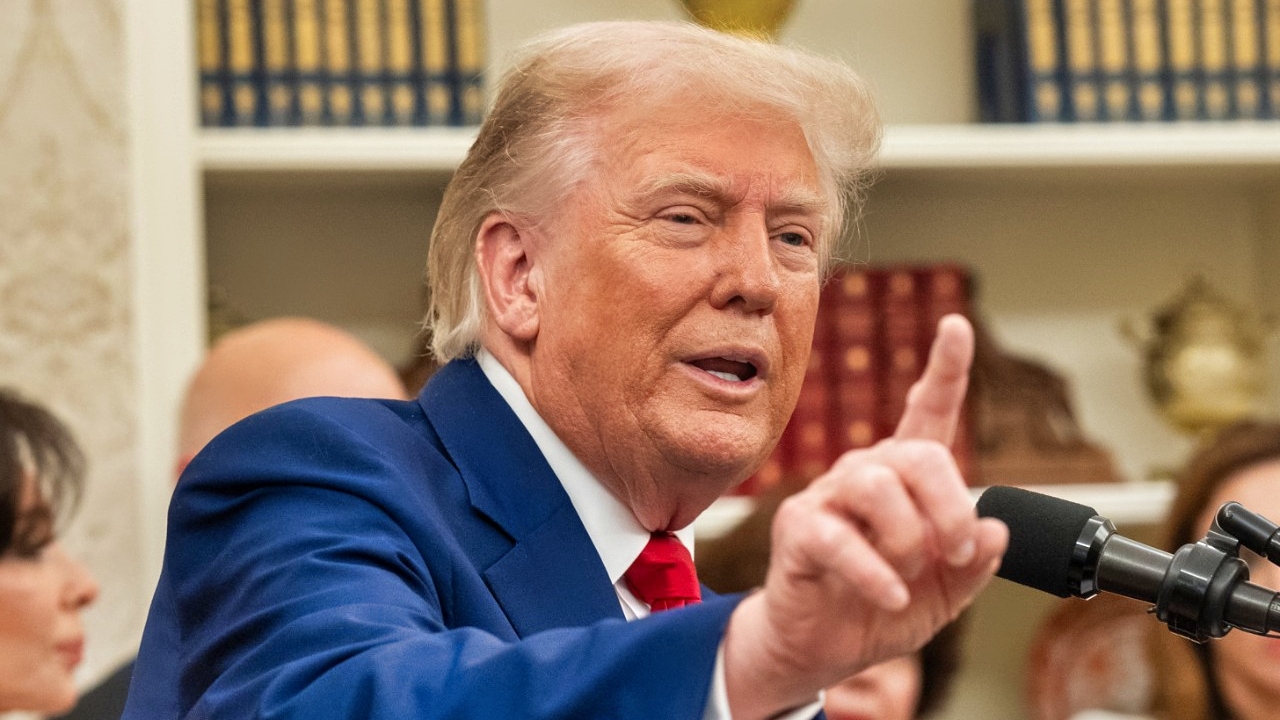
President Donald Trump delivers remarks before signing an executive order creating a task force for the 2028 Los Angeles Olympics, Tuesday, August 5, 2025, in the South Court Auditorium of the Eisenhower Executive Office Building at the White House. (Official White House Photo by Joyce N. Boghosian)

President Donald Trump signs an executive order creating a task force for the 2028 Los Angeles Olympics, Tuesday, August 5, 2025, in the South Court Auditorium of the Eisenhower Executive Office Building at the White House. Vice President JD Vance attends. (Official White House Photo by Emily J. Higgins.)
The trigger was Trump’s Easter Sunday social media post threatening to wipe out “a whole civilization” if Iran did not reopen the Strait of Hormuz, followed by the warning that Iranians would “be living in hell.” Trump backed off the deadline roughly 90 minutes before it expired, announcing a two-week ceasefire on Truth Social after Pakistani intervention.
Other Connecticut Democrats joined Larson in escalating. Rep. Rosa DeLauro called the rhetoric madness on X. Senator Chris Murphy was among the first to call for the 25th Amendment to be invoked. Larson’s own primary challenger, former Hartford mayor Luke Bronin, also called for either impeachment or invocation of the 25th Amendment — a sign that even within Larson’s own primary fight, the politics of the war are running hot.
Republicans control the House. The articles will not advance. House Speaker leadership has not allowed the resolution to move out of the Judiciary Committee, and there is no realistic path under current congressional math by which Trump faces a Senate trial in the 119th Congress.
That is not the political risk for the White House.
The Polling Is The Real Story on Iran and Trump
The polling is a political risk for the White House.
As of April 23, net support for the Iran war stands at -15.2 in the Silver Bulletin polling average. Some recent surveys are considerably worse. The Economist/YouGov has the war underwater by 27 points. Reuters/Ipsos has it at -24.
The April 3-6 Economist/YouGov poll found 53 percent of Americans oppose the war and only 34 percent support it. Among Democrats, opposition runs 84 percent. Among independents, 52 percent oppose. Even among Republicans, opposition has crept upward. On the question of sending ground troops, only 15 percent of Americans favor that step, against 62 percent opposed — and ground-troop opposition runs 39 percent even among Republicans.
The April 10-12 Ipsos survey showed 51 percent of Americans saying military action in Iran has not been worth it, against just 24 percent who say it has. Fifty-four percent say the war has had a mostly negative impact on their personal financial situation — including 40 percent of Republicans.
The Marquette Law School national survey, conducted April 8-16, found 76 percent of Americans had heard a lot about the Iran war — higher attention than the strikes generated last summer. Confidence that Trump’s policies will decrease inflation has fallen to 23 percent, down from 41 percent at the time of his reelection. Sixty-two percent now believe his policies will drive inflation higher.
CBS News-YouGov has only 25 percent of Americans calling the war a strategic success, against 42 percent who call it a strategic failure.
Pew finds just 27 percent believe the war makes Iranian nuclear development less likely — the same share that believes it makes development more likely.
Why This Matters Even Without The Votes
The arithmetic in Congress is one part of the picture. The arithmetic in the polling is the other part, and the polling is what actually moves Republican members of Congress as 2026 midterm campaigning intensifies.
Gas prices are up. Diesel and fertilizer costs are up. Republican strategists have been warning publicly about political fallout heading into the midterms. The April 16 House vote was 213-214. The next one — if Democrats force it, and they will force it — does not require a wave of GOP defections to flip. It requires three. Or two, plus a flipped Democrat back on the right side of the question.
Trump told Fox Business this week that the war is “very close to over” and that direct talks with Iran could resume in Pakistan as soon as this weekend. That is the fifth or sixth time the White House has projected the war’s imminent end since the strikes began. Iran’s foreign minister announced that the Strait of Hormuz is “completely open” for the remainder of the ceasefire. Markets rallied on the news. Oil dropped roughly 10 percent.
If the ceasefire holds, the political problem fades, maybe. If it does not — if the next round of escalation pushes oil back toward triple digits, if American casualties resume, if Trump’s Strait of Hormuz threats translate into another round of strikes — the next war powers vote will not be 213 to 214.
Larson’s articles will not remove Donald Trump from office. They are a record. The polling is what determines whether that record matters.
Right now, the polling says it might.
About the Author: Harry J. Kazianis
Harry J. Kazianis (@Grecianformula) was the former Senior Director of National Security Affairs at the Center for the National Interest (CFTNI), a foreign policy think tank founded by Richard Nixon based in Washington, DC. Harry has over a decade of experience in think tanks and national security publishing. His ideas have been published in the NY Times, The Washington Post, The Wall Street Journal, CNN, and many other outlets worldwide. He has held positions at CSIS, the Heritage Foundation, the University of Nottingham, and several other institutions related to national security research and studies. He is the former Executive Editor of the National Interest and the Diplomat. He holds a Master’s degree focusing on international affairs from Harvard University. Kazianis is Editor-In-Chief of 19FortyFive.


Walter
April 26, 2026 at 1:10 pm
What else is new? If they could, some Dems would impeach him for getting out of bed in the morning. Tired, juvenile, foolishness.