
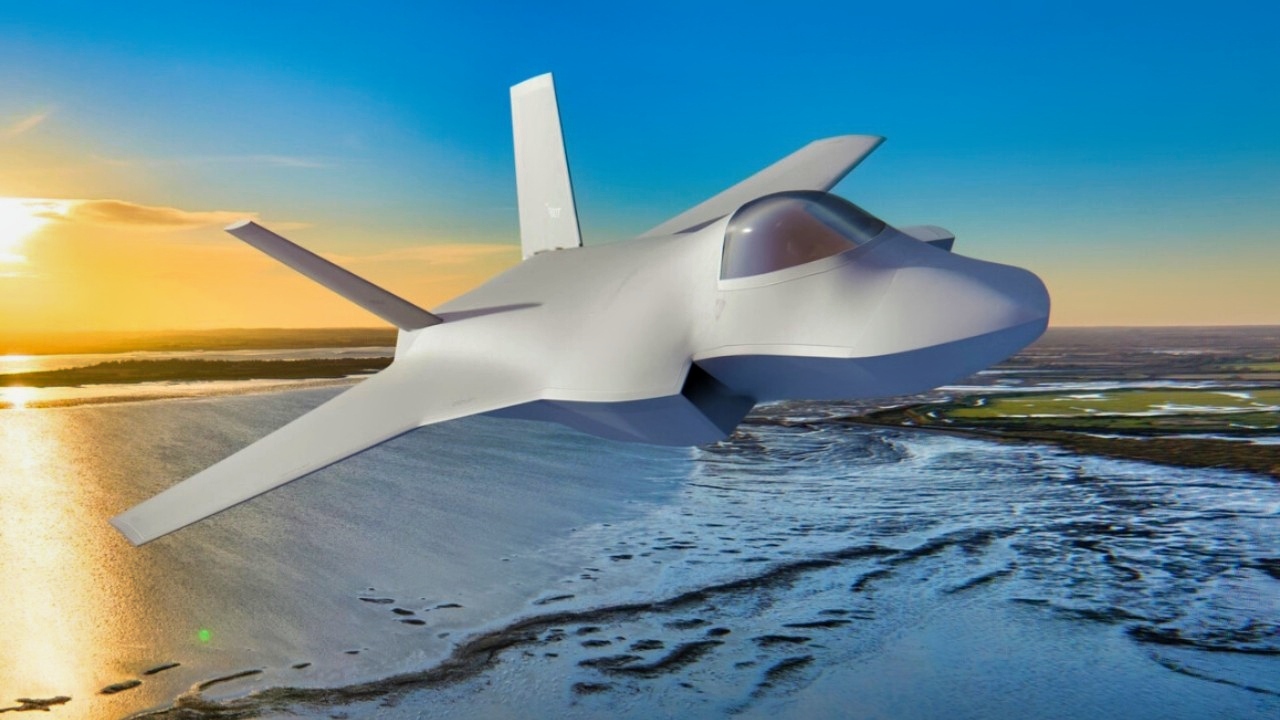
Key Points and Summary – The UK’s next-generation “Tempest” stealth fighter has undergone a radical redesign, revealed at the Farnborough International Airshow.
-The new model scraps the previous “lambda” wing for a more conventional cropped delta, and features a redesigned fuselage and engine intakes that are now more reminiscent of the American F-22 Raptor.
New design layout of Tempest sixth generation fighter showed at Farnborough Air Show. The differences on the previusly one looks are to be on air intakes, fuselage, engine nozzles and mostly the wing with new crawled arrow design tail connection on rudder.
Today is Tempest day.😁 pic.twitter.com/btG3qLsSpy— Ciro Nappi (@CiroNappi6) July 18, 2022
-Developed by BAE Systems, the sixth-generation fighter, which will fly with unmanned “loyal wingmen,” is being explicitly designed for deep-penetration missions. Analysts suggest its extended range and advanced stealth could allow it to strike strategic targets deep inside Russia from bases in the UK.
Britain’s Next-Generation “Tempest” Got a Radical Redesign
BAE Systems, the lead manufacturer of the United Kingdom’s sixth-generation fighter aircraft Tempest, has presented a new model of a possible configuration of the proposed aircraft.
The new model was revealed at the Farnborough International Airshow, taking place in southern England this week.
A new series of images provides a look at how the design has progressed since images, videos, and a full-size model were first revealed at the show in 2018.
Tempest is the Royal Air Force’s next-generation combat aircraft, expected to enter into service in 2035 to replace the Eurofighter Typhoon – a multirole fighter introduced in 2003 and currently used by the British, German, and Italian air forces.
Several major changes have been made to the proposed jet. While the aircraft maintains its upgraded stealth capabilities – crucial for next-generation jets – its wing platform looks dramatically different.
Gone is the ‘lambda’ wing design – named for its resemblance to the Greek letter “λ,” with its forward-swept leading edge and backward-swept trailing edge. That old design, originally intended to assist with the jet’s stealth abilities, has been replaced with what TWZ describes as a “cropped delta with an arrow-like trailing edge.”
Other notable changes include a redesigned forward fuselage and engine intake that now more closely resemble the American F-22 Raptor, replacing the ‘pelican’ nose profile seen in previous designs.
Engine nozzles are also more deeply shrouded within the rear fuselage, and the prominent central ‘sting’ between them appears to have been removed. Overall, the updated model is much more consistent with designs from other next-generation fighter programs – but this latest design is likely to see yet more changes before or even after first flight.
Developed by BAE Systems, the Tempest combines manned, unmanned, and optionally-manned platforms.
Through “scalable autonomy,” the new jet will be supported by offboard and onboard data processing and various “pilot decision aids” to support manned flight. According to the Royal Air Force website, scalable autonomy “will be key in the future as operating environments become more complex and threats become more sophisticated and dangerous.”
In 4 Words on Tempest: A Threat to Russia?
In recent days, media reports have focused heavily on the Tempest’s capabilities and the threat it might pose to Russia. Writing for The Telegraph, Matt Oliver suggested that Putin should “fear” Britain’s next fighter jet, citing early signs that the aircraft is being “designed for missions deep into enemy territory.”
Equipped with next-generation stealth and extended-range fuel tanks, the Tempest is being designed for deep-penetration missions far into hostile territory.
Analysts suggest the aircraft could take off from a base in the United Kingdom and strike strategic targets inside Russia – including air defense systems, missile installations, and airfields – with little-to-no refueling and without compromising on payload.
About the Author:
Jack Buckby is a British author, counter-extremism researcher, and journalist based in New York. Reporting on the U.K., Europe, and the U.S., he works to analyze and understand left-wing and right-wing radicalization, and reports on Western governments’ approaches to the pressing issues of today. His books and research papers explore these themes and propose pragmatic solutions to our increasingly polarized society. His latest book is The Truth Teller: RFK Jr. and the Case for a Post-Partisan Presidency.
The Best Tanks on Earth
AbramsX: The Tank the US Army Wants


