


Among all the tanks produced by the Soviet Union, the T-80 stands out as the black sheep of the family. Forever stuck in the shadows of its younger brother, the T-72, the T-80 never received glowing reviews in either Soviet or later Russian service. Today, in the West, the tank has a reputation for largely being a flop.
In the author’s humble opinion, this perception is mostly unwarranted.

T-80 Tank Russian Army. Image Credit: Creative Commons.
While the T-80 certainly left much to be desired compared to later tanks, it was subject to unfair criticism from the Russians during the Chechen Wars and was later judged harshly for being more expensive than the T-72 and T-90.
The tank itself is alright, especially after its thorough modernization efforts in the 2010s, but it still carries the reputation as the Soviet Union’s unwanted tank.
A Brief History of the T-80’s Development
In the 1970s, the Soviet tank industry began working on designs to replace the T-64 and T-72. While the T-64 had been an exemplary tank for its time, advancements in NATO armor spurred the development of a new generation of Soviet Main Battle Tanks (MBTs).
The Lenningrad Kirov-Plant (LKZ) submitted a new design that shared many similarities with the earlier T-64 but featured a gas turbine engine. The idea of incorporating a gas turbine engine into tanks had been floated around in the USSR since the 1950s, but was always considered too risky due to the turbine’s higher cost and lower fuel efficiency. LKZ’s design, Object 219, incorporated the GTD-1000T along with a new suspension system and running gear.
Object 219 would have been rejected, and the T-80 would have never existed were it not for the appointment of Dimitry Ustinov as the Soviet’s new Minister of Defense. Ustinov was a strong advocate for adopting gas turbine engines, and Object 219 was considered his personal pet project.
Undeterred by the cost considerations, he adopted the T-80 and ordered the tank plant in Omsk to produce the new tank in place of the T-64. The Kharkiv tank plant was additionally ordered to begin production of the tank.
Making a Poor First Impression
Initially, the T-80 was, to put it kindly, underwhelming.
The tank offered no improvement in firepower or armor over the T-64B, and its sights were originally inferior to those of its predecessors.
For extra protection, the tank was fitted with Kontakt-1 explosive reactive armor (ERA), which offered decent protection against shaped charges but did little against armor-piercing sabot rounds, which were increasingly used by NATO forces. The result was a tank that offered little advantage over the T-64B and was almost three times as expensive. The T-80’s only saving grace was the gas turbine, which made it slightly faster than its predecessors, but the engine also contributed to the tank’s high cost.
As time went on, however, the T-80 was quickly brought up to standard.
The T-80BV received better sights, but it was the T-80U that really brought life into the black sheep of the Soviet Union.
The tank was fitted with new and improved Kontakt-5 ERA, which offered significantly better protection against shaped charges and kinetic armor-piercing rounds.
Additionally, the tank received the new and vastly improved 1A45 fire control system, the 1G46 sight, and the 9M119 Refleks tube-launched missile, which replaced the older, less reliable Kobra missile. The turret of the T-80U also received improved composite armor, making it much more difficult for existing armor-piercing rounds at the time to penetrate it.
The Fall of the USSR and the Chechen Wars
Right before the fall of the USSR, the T-80 was the most capable tank in the Soviets’ inventory. The Soviet Army possessed more than 4,000 T-80s, most of which were forward-deployed near NATO and assigned to the USSR’s most combat-capable units.
When the Soviet Union finally collapsed, the Eastern Bloc’s tank industry was thrown into an existential crisis. Most tanks were in Russian control, with around 300 T-80UDs going to Ukraine. The premier tank manufacturers, Omsk and Kharkiv, were now in two different countries, and tank orders slowed to a crawl. Because of the political and economic turmoil in the post-Soviet republics, no new orders for T-80s were issued between 1991 and 2005.
The Chechen Wars, following the creation of the Russian Federation, were a dark blight on the T-80’s reputation that never went away. Following massive budget cuts in the army, units were given inefficient training with their T-80s and sent on hastily planned assaults on the city of Grozny.
The result was a complete slaughter for the Russians. The Chechen fighters were veterans of the Soviet Army and were well aware of the tank’s weaknesses. As a result, around 70% of the tanks involved in the first Chechen War were lost. The T-80’s design was blamed by many for Russia’s poor performance in Chechnya, while the real issues, poor tactics and training, were swept under the rug.
The T-80’s Surprising Comeback
Capitalizing on the mood, the Nizhny-Tagil tank plant, owned by Uralvagonzavod, ruthlessly criticized the T-80 while aggressively marketing its new tank, the newly designated T-90. The T-90 was marketed as an improved version of the T-72 while still being markedly cheaper than the T-80U.
In the end, the army chose the T-90 as its newest tank, which pretty much shattered the T-80’s future prospects. Ukraine, meanwhile, continued development on the T-80, leading to the T-84 and the BM Oplot.
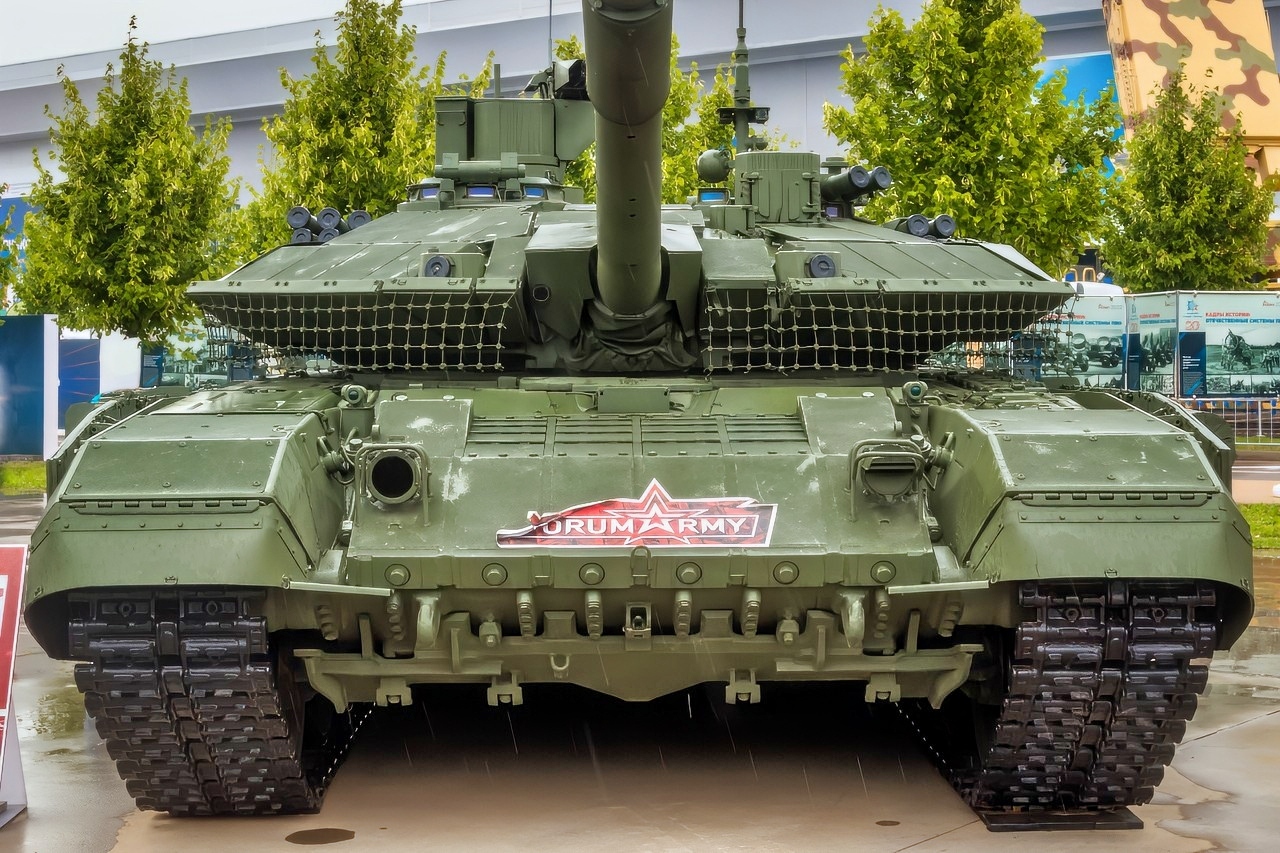
T-90M Russian Army. Image Credit: Creative Commons.

T-90 Tank from Ukraine War. Image Credit: Creative Commons.

T-90 Tank. Image Credit: Creative Commons.
When the war in Ukraine broke out, many analysts in the West criticized the T-80BVM, the newest iteration of the tank, for its seemingly poor battlefield performance. The Russians, interestingly enough, came to the opposite conclusion.
In 2023, Russia announced it intended to restart production of the T-80 from scratch, citing the tank’s performance in the war.
This announcement was a complete shock to many experts and analysts in the West who, somewhat understandably, could not understand why Russia would want more T-80s of all things. Currently, the new production lines are still being set up, while older T-80 models are being refurbished and delivered to the Russian Army. For the first time since 1991, the T-80 is now receiving a steady set of orders.
About the Author: Isaac Seitz
Isaac Seitz, a Defense Columnist, graduated from Patrick Henry College’s Strategic Intelligence and National Security program. He has also studied Russian at Middlebury Language Schools and has worked as an intelligence Analyst in the private sector.


