

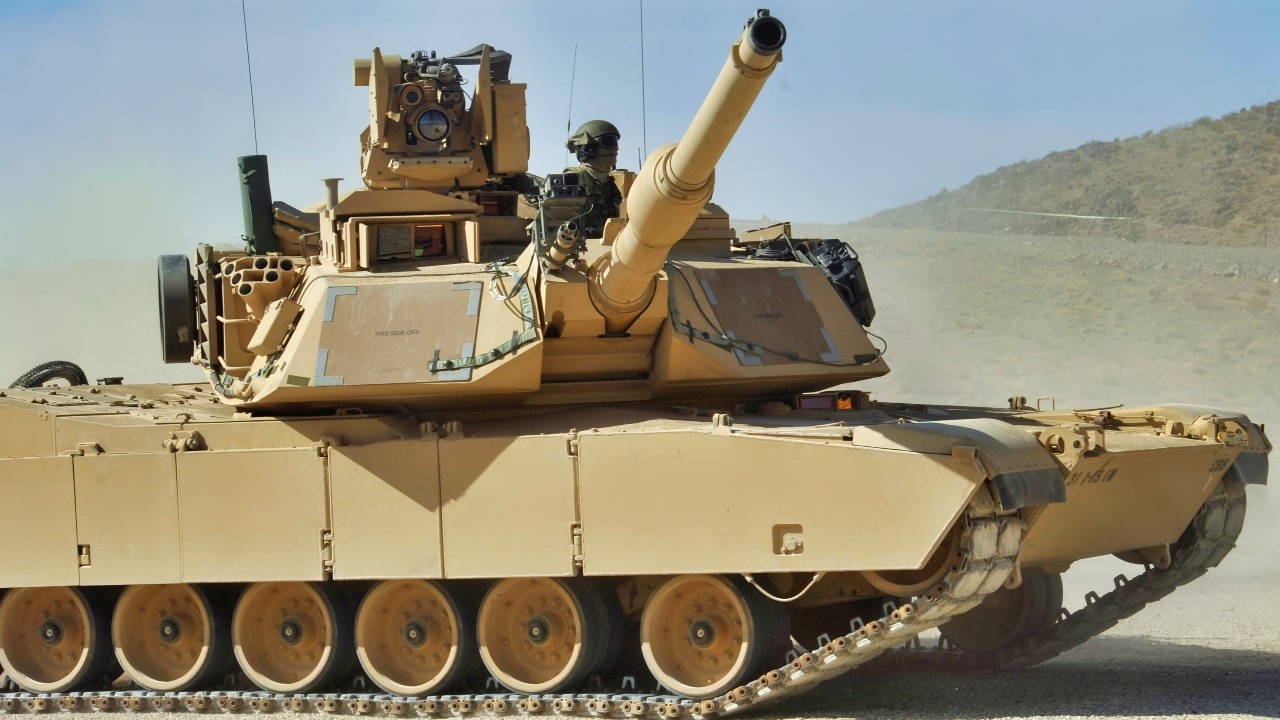
Key Points and Summary – The U.S. Army’s M1 Abrams tanks are “not fully ready” for modern drone warfare and have proven “vulnerable” to cheap, top-down attacks, as seen in Ukraine.
These tanks were built for one purpose: to beat the masses of Russian tanks that would come during the Cold War. They were not built with drone threats in mind and must adapt.
-Army Secretary Daniel Driscoll confirmed tanks can no longer lead frontal assaults.

U.S. Marine Corps M1A1 Abrams tank provides suppressive fire against simulated insurgents during day 18 of the Integrated Training Exercise 13-1 at Twentynine Palms Marine Corps Base, Calif., Jan 22, 2013. The ITX is the training exercise that Marines come to prior to deploying. (U.S. Air Force photo by Staff Sgt. Stephany Richards)

An M1A2 Abrams Tank fires a round at Fort Stewart, GA., June 23, 2025. (U.S. Army photo by Sgt. David Resnick)
-In response, the Army is spending $108M in FY2026 on survivability, including $92M for “Top Attack Protection” (TAP) systems, or “cope cages.”
-However, existing Active Protection Systems (APS) like Trophy are “not very effective” against these top-down strikes, and new laser defenses (DE-MSHORAD) are “proving challenging,” leaving the fleet “far from well-protected.”
The US M1 Abrams Aren’t Ready For Drone Warfare
The United States currently has thousands of US M1 Abrams tanks that are not fully ready for drone warfare and have demonstrated vulnerabilities, particularly to top-down attacks from inexpensive drones, leading the US Army to invest in upgrades and new tactics.
However, the Army is actively working on solutions, including enhanced armor, active protection systems like those being tested in upgrades to the M1A2 SEPv3 fleet, and the development of the future M1E3 variant, which is designed with drone threats in mind.
Current Vulnerabilities Of Abrams Tanks
Drones pose a significant threat to US M1 Abrams tanks, particularly through top-down attacks from loitering munitions and FPV drones, due to the tank’s vulnerable top armor.
This threat has led the US Army to re-evaluate tank strategy and invest in new technologies to improve survivability, such as enhancing armor, developing new counter-drone systems, and deploying passive protection measures like signature reduction.
Ukraine’s experience with Abrams tanks in its conflict with Russia has provided valuable insights into these vulnerabilities and the need for modifications.
The Army’s New Strategy
Back in May, Army Secretary Daniel Driscoll, speaking on the War on the Rocks podcast, stated that the surge of inexpensive drones capable of striking tanks’ most vulnerable points necessitates a significant shift in how armored units are deployed.

A U.S. Army tank crew assigned to 2nd Battalion, 5th Cavalry Regiment, 1st Armored Brigade Combat Team, 1st Cavalry Division, maneuvers an M1A2 Abrams tank at a railhead in preparation to transport it to Hohenfels, Germany during a railhead operation, Corbu, Romania, October 24, 2018. The Battalion has deployed to Europe in support of Atlantic Resolve, an enduring training exercise between NATO and U.S. Forces. (U.S. Army National Guard photo by Sgt. Jamar Marcel Pugh, 382nd Public Affairs Detachment/ 1st ABCT, 1st CD/Released)
Using the M1 Abrams as an example, Driscoll stated that armor can no longer rely on traditional frontal assault tactics and must instead operate from more protected, defended positions.
“The amount of sensors on the battlefield, the amount of ability from both sides to see what’s going on,” he stated, creates a situation where commanders cannot push tanks “as far forward in the formation as they used to be able to” because very cheap drones may be able to attack their vulnerabilities.
Driscoll added that armored units will be forced to become “a lot leaner,” thereby limiting their exposure to aerial threats and allowing them to stay in the fight longer.
The Army’s $108 Million Fix?
The U.S. Army’s 2026 Procurement of Weapons and Tracked Combat Vehicles (W&TCV) procurement report states that the Army is spending $108 million in the fiscal year 2026 budget for technology to enhance its survivability. Leaders are funding a modular suite of protection technologies that can be added to current and future armed vehicles to keep them relevant and survivable.
This allocation of funds is to improve the survivability of the existing M1A2 fleet, with upgrades focusing on armor and power systems. The Army is also looking into Top Attack Protection (TAP) add-on armor systems for its tracked armored vehicles. TAP “is a passive add-on armor to the base vehicle configuration,” the Army’s Fiscal Year 2026 Justification Book says.
“It is strategically placed over crew compartments and hatches, working in tandem with the base vehicle armor to mitigate damage from overhead threats. It is most effective against Explosively Formed Projectiles [EFPs] and Shaped Charge Jets.”
Of the cash, $92 million will be spent on top attack defenses, commonly called “cope cages,” as well as TAP systems. The design hasn’t been finalized, so it’s yet unknown how effective they will be against drone-dropped munitions.

A M1A2 SEPV3 Abrams Tank fires at multiple range targets during a range warfighter exercise, April 11, 2021, Fort Hood, Texas. The visit with foreign allies allows the U.S. Army to boost interoperability of staff members and warfighting capabilities with the M1A2 SEPv3 Abrams Tank. (U.S. Army photo by Sgt. Melissa N. Lessard)
The Army is incorporating active protection systems, such as the Trophy anti-missile system or Iron Fist, into the upgraded tanks to counter threats. However, those are not very effective due to the angle of the top-down drone attacks.
New Armor Doctrine and Tactics
The Army is developing new tactics, such as using M1028 canister rounds at close range to counter isolated drone threats.
The future M1E3 Abrams variant is being designed from the ground up with drone warfare in mind, incorporating features like advanced electronic warfare capabilities and AI-based threat assessment. The Army is testing new defensive features, such as lasers, to increase the tank’s ability to counter drones.
One particular weapon they are considering is the 50-kilowatt units mounted on the Directed Energy Maneuver Short Range Air Defense (DE-MSHORAD) Stryker variants.
These systems have undergone multiple rounds of testing and have been deployed to Europe and the Middle East. In these tests, the lasers proved capable of downing small drones; however, multiple issues have cropped up.
Soldiers identified that the weapon’s significant power draw was complicated by the need to remain mobile and move often. Things like dust, rain, fog, and other common environmental elements on a battlefield also proved to be an issue.
“What we’re finding is where the challenges are with directed energy at different power levels,” Army acquisition chief Doug Bush told members of the Senate Armed Services airland subcommittee in May of 2024.
“That [50-kilowatt] power level is proving challenging to incorporate into a vehicle that has to move around constantly — the heat dissipation, the amount of electronics, kind of the wear and tear of a vehicle in a tactical environment versus a fixed site.”
With a multitude of decisions looming and no single answer available, the Army’s M1 Abrams tanks are still not protected for facing an enemy with massive drone capabilities. They are improving their defenses, and they are better off than before, but they are far from well-protected.
About the Author: Steve Balestrieri
Steve Balestrieri is a National Security Columnist. He served as a US Army Special Forces NCO and Warrant Officer. In addition to writing on defense, he covers the NFL for PatsFans.com and is a member of the Pro Football Writers of America (PFWA). His work was regularly featured in many military publications.
More Military
The M113: America’s “Forgotten” APC That Just Won’t Quit
How British Aircraft Carriers Keep Sinking in War Games
Boeing F-47 NGAD Fighter: One Missing Fact Could Decide Its Fate
Canada Knows How to Sink U.S. Navy Nuclear Aircraft Carriers


bert33
November 8, 2025 at 2:44 pm
Put a baby yark machine on top in place of the 50. YYYAAAAAAAAAAAARRRRRRRRRRKKKKKK LOL