


Key Points and Summary – The Bradley Fighting Vehicle was the Army’s answer to Vietnam-era shortcomings and Cold War armored warfare.
-Born from the MICV program and refined after strict tests, it paired mobility and survivability with a 25mm Bushmaster, TOW missiles, and a two-variant concept (M2 IFV, M3 cav).
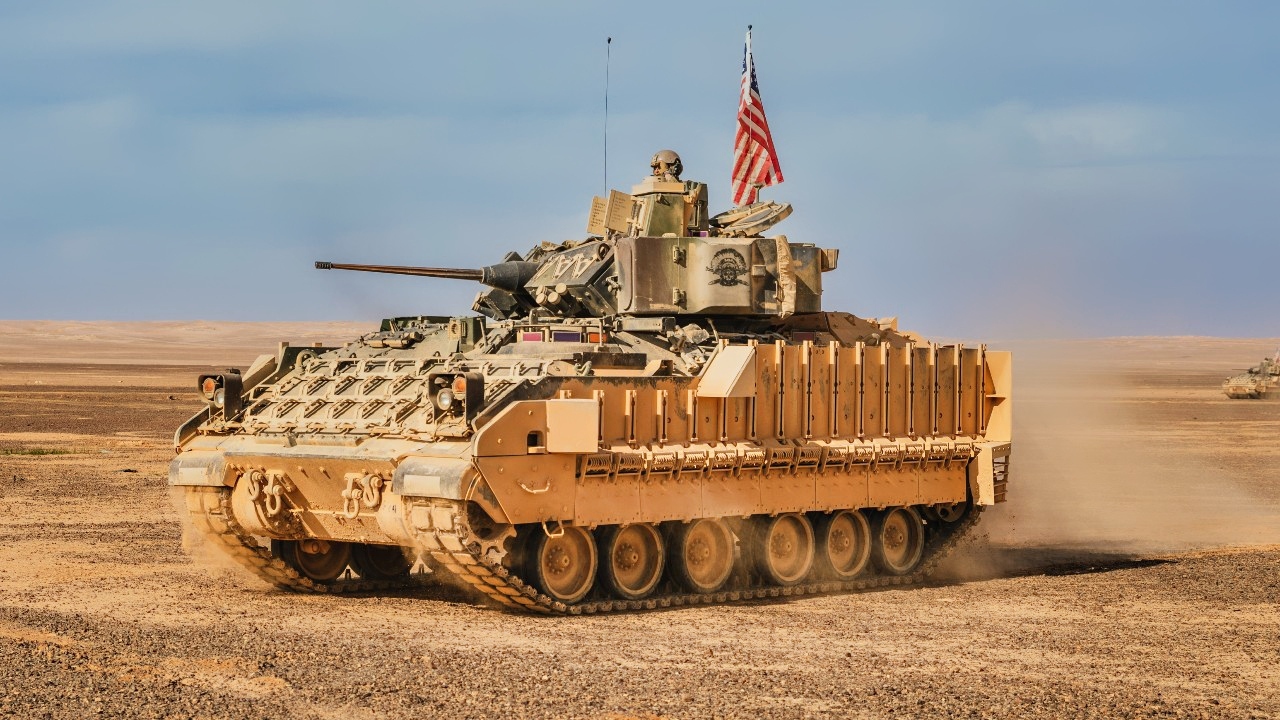
U.S. Army Soldiers assigned to 2nd Squadron, 278th Armored Cavalry Regiment, Task Force Reaper, conduct movement procedures with M2 Bradley Fighting Vehicles during the Jade Cobra VI exercise in the U.S. Central Command’s area of responsibility, Feb. 19, 2025. Jade Cobra VI strengthens military-to-military partnerships, increases readiness, and facilitates security cooperation between the United States and Jordan. (U.S. Army photo by Staff Sgt. Hector Tinoco)
-In Desert Storm, it shredded Iraqi armor; in Iraq, it adapted to urban battles; in Ukraine, it’s proving deadly and resilient against Russian forces.
-Early design flaws spurred smarter armor, ammo stowage, and suspension fixes, helping the Bradley become a Big Five success story.
-As it nears retirement, the XM30 aims to carry that legacy into the unmanned, AI-enabled era.
The Back Story Behind the Amazing Bradley Fighting Vehicle
I was a light infantry officer in the U.S. Army and not qualified for mechanized warfare, but I was always enthralled with the Bradley Fighting Vehicle.
This thing was faster than it looked. It can maneuver quickly around obstacles, and the armor is surprisingly resilient.
Plus, that powerful chain gun onboard was second to none.
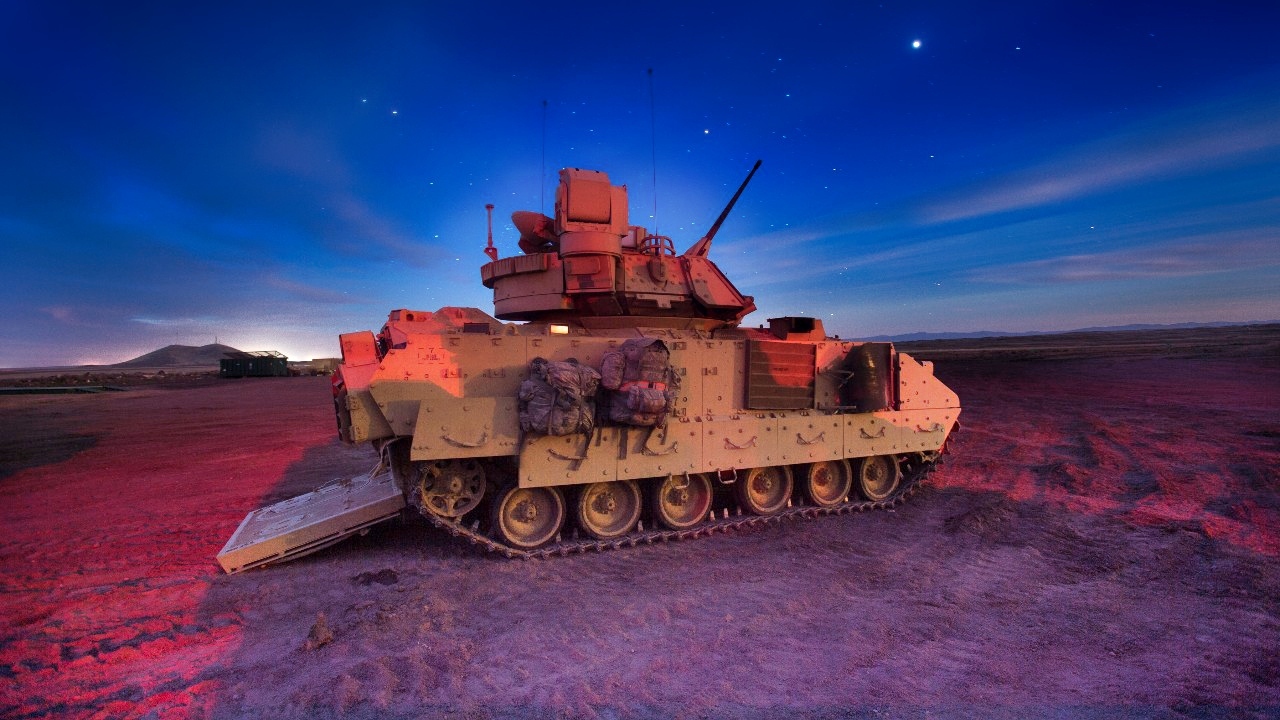
Engineers with the 116th Brigade Engineer Battalion conduct M2A3 Bradley fighting vehicle gunnery qualification on March 27, 2018, Orchard Combat Training Center, south of Boise, Idaho. Combat engineers with the 116th BEB trained through gunnery table XII, evaluating their ability to execute collective platoon-level tasks in a tactical live-fire environment; including integrating dismounted soldiers with their assigned BFV. (U.S. Army National Guard photo by 1LT Robert Barney)
Lately, the Bradley has worked out well against the Russians in Ukraine. While Abrams tanks have struggled, the “Brad” has been a bright spot.
The speed and the anti-tank TOW missiles that the little guy has launched have been deadly against Russian tanks.
What Is the Story Behind the Bradley?
We thought you would be interested in the history of the Bradley. The backstory is extremely compelling and shows how the U.S. Army transformed its tactics for better ground warfare after the Vietnam War.
The Bradley excelled during Operation Desert Storm, taking out many enemy armored vehicles.
The Bushmaster chain gun sent deadly rounds down range and made Saddam Hussein’s forces pay the price.
The Brad is around 40 years old. Two versions emerged early on. The M2 is an infantry fighting vehicle and the M3 cavalry fighting vehicle is meant for service in armored cavalry regiments and brigade combat teams for reconnaissance and anti-tank duties.
One of the ‘Big Five’ Weapons Systems That Transformed the Army
The Bradley is part of the “Big Five” weapons systems that the Army brought in to turn the tide after lessons learned from Vietnam.
This group consisted of the Abrams tank, the Apache attack helicopter, the Blackhawk utility helicopter, and the Patriot missile defense system.
Replacing the M113 Armored Personnel Carrier
The Brad was introduced in 1981. This was part of Ronald Reagan’s defense buildup to intimidate the Soviet Union.
The Bradley was meant to replace the M113 armored personnel carrier that soldiers utilized in Southeast Asia against the Viet Cong and North Vietnamese Army. The M113 had difficulty with protection from mines and RPGs, so the soldiers often rode on top and used heavy firepower to overawe the enemy in Vietnam.
But the Bradley would allow personnel to ride inside, protected from numerous threats. It would be fast enough to keep up with tanks and had the firepower to punch above its weight.
Big Shoes to Fill
The Bradley program began in the 1970s as the Mechanized Infantry Vehicle Combat Vehicle (MICV). Acquisition honchos had learned much from the Arab-Israel wars that saw massive tank-on-tank battles.
Infantry still had a role to play on this battlefield, and the MICV program aimed to address transportation issues while improving survivability to deploy dismounted fighters who could use anti-tank missiles to win mechanized battles.
The idea was to improve maneuver warfare and flank large tank columns with fast-moving armored personnel carriers. The MICV would also incorporate the new TOW anti-tank missile.
The Army wanted an infantry-and-cavalry version. If a single vehicle could meet both needs, it would be a force multiplier.
The service branch renamed the MICV program “Fighting Vehicle Systems,” in the late 1970s. The Fighting Vehicle Systems offering became too heavy for amphibious obstacles while crossing water hazards.
Congress investigated and also found that the Fighting Vehicle Systems prototype was not fast enough to keep up with tanks.
But the Army persisted, and the Fighting Vehicle System still had potential on the battlefield that would require every ounce of determination against the Soviet Union and the Warsaw Pact.
In 1978, Congress agreed on the requirements and increased funding for the program.
The Bradley Fighting Vehicle was born.
It Didn’t Look Good at the Beginning
Testing began, and the early results were disappointing, though.
“Secondary fires from damaged ammunition supplies, interior shock and pressure from explosive impacts, and potentially lethal chemical interactions with heat and the vehicle’s exterior armor were some of the possible situations that could negatively affect the Bradley’s crew and troops,” according to a comprehensive report from the University of Maryland.
Due to shortcomings, the Bradley was redesigned for better survivability, with improvements to its armor.
Suspension problems and concerns about ammunition storage were also mitigated. The Army discovered the Bradley could serve beyond its infantry and cavalry roles.
It could serve as a command-and-control and anti-aircraft vehicle with Stinger missiles. The Bradley could also haul combat engineers into battle.
The Army got the price down to $3 million a unit.
This was well worth the cost, and it displayed brilliance in combat.
In Operation Desert Storm, only 20 Bradleys were lost, and these were primarily because of friendly fire accidents.
During the Second Gulf War, about 50 Bradleys were knocked out, and this was due to various types of improvised explosive devices.
Here Comes the XM-30
The Bradley will soon reach the end of its service life.
It will be replaced by the XM-30 Mechanized Infantry Combat Vehicle.

XM-30. Image Credit: U.S. Army.
There could be optionally-manned robotic XM-30s. The turret will be unmanned and remote-controlled. New cannons will be installed, and artificial intelligence will help mitigate the use of enemy anti-tank missiles and drones.
The Bradley has enjoyed an excellent run of service.
It is combat-tested and passed with flying colors. It is still used by U.S. allies such as Ukraine, with glowing reports of its survivability and maneuverability in action against Russia.
The Bradley will go down as one of the most successful armored vehicles in Army history. Many soldiers will look back fondly on their service in the Bradley.
I wouldn’t have minded riding on the M2 or M3 myself and firing that Bushmaster chain gun or the effective TOW.
It has become more than a machine and almost a legend. So, hail the Bradley Fighting Vehicle. We hope that the XM-30 will be even more effective as it enters full-time service.
About the Author: Brent M. Eastwood
Brent M. Eastwood, PhD is the author of Don’t Turn Your Back On the World: a Conservative Foreign Policy and Humans, Machines, and Data: Future Trends in Warfare plus two other books. Brent was the founder and CEO of a tech firm that predicted world events using artificial intelligence. He served as a legislative fellow for US Senator Tim Scott and advised the senator on defense and foreign policy issues. He has taught at American University, George Washington University, and George Mason University. Brent is a former US Army Infantry officer. He can be followed on X @BMEastwood.
More Military
Forget the F-35 of F-47: A 7th Generation Fighter Is Possible
$500 Drones are Destroying $10,000,000 NATO Tanks in Ukraine War
The Mach 2.2 F-4 Phantom II Fighter Has a Message for Every Air Force on Earth
China’s White Emperor ‘NGAD’ Stealth Fighter Summed Up in 2 Words


