


Summary and Key Points: RIMPAC 2024 delivered a powerful demonstration of U.S. and allied maritime strike capability when the retired USS Dubuque and USS Tarawa were sunk in separate SINKEX events near Hawaii.
-The exercises showcased realistic live-fire training, interoperability, and the use of modern anti-ship weapons, including LRASM and the QUICKSINK munition.
-A B-2 Spirit and an AC-130 also contributed to the broader testing effort, highlighting joint-force maritime strike options.
-Beyond training value, the sinkings underscored a strategic message aimed at China: U.S. and partner forces are refining long-range, precision anti-ship capabilities for a future Indo-Pacific fight, especially in a Taiwan contingency.
USS Tarawa and USS Dubuque Sunk at RIMPAC 2024 in a Clear Message to China
The former amphibious transport dock Dubuque and amphibious assault ship Tarawa were sunk in 15,000 feet of water on July 11 and 19, 2024, respectively, as part of the 2024 Rim of the Pacific exercise, or RIMPAC.
The decommissioned amphibious assault ship USS Tarawa (LHA-1) was sunk during a SINKEX (sinking exercise) on July 19, 2024, as part of the RIMPAC 2024 exercises more than 50 miles off the northern coast of Kauai, Hawaii.
U.S. and partner nation forces targeted the 820-foot, 39,000-ton vessel to test weapons in a 15,000-foot deep area.
SINKEX Tests Weapons And Shipboard Built-in Defenses

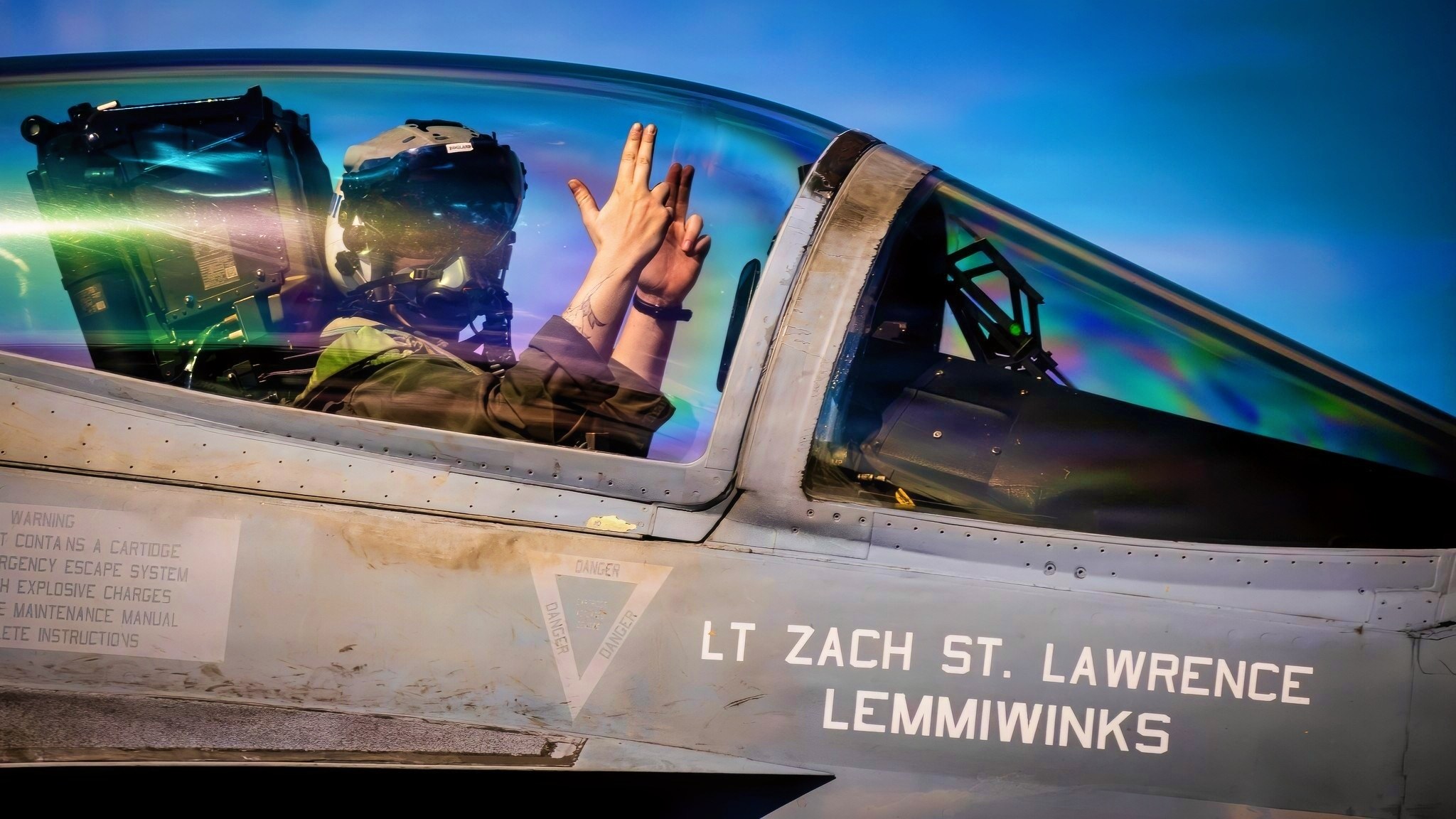
A U.S. Navy F/A-18E Super Hornet aircraft assigned to Strike Fighter Squadron (VFA) 14 participates in an air power demonstration near the aircraft carrier USS John C. Stennis (CVN 74) April 24, 2013, in the Pacific Ocean. The John C. Stennis Carrier Strike Group was returning from an eight-month deployment to the U.S. 5th Fleet and U.S. 7th Fleet areas of responsibility. (U.S. Navy photo by Mass Communication Specialist Seaman Apprentice Ignacio D. Perez/Released)
A U.S. Sailor assigned to Strike Fighter Squadron 37 signals to arm ordnance in an F/A-18E Super Hornet aircraft on the flight deck of the world’s largest aircraft carrier, Ford-class aircraft carrier USS Gerald R. Ford (CVN 78), while underway in the Caribbean Sea, Nov. 30, 2025. U.S. military forces are deployed to the U.S. Southern Command area of responsibility in support of Operation SOUTHERN SPEAR, Department of War-directed operations, and the president’s priorities to disrupt illicit drug trafficking and protect the homeland. (U.S. Navy photo)
The exercise culminated in a “SINKEX,” in which the Navy sank one of its retired warships, sending a subtle but powerful message to China that the US Navy remains a force to be reckoned with.
A SINKEX, or Sink Exercise, is a live-fire training exercise where the U.S. Navy and its allies use decommissioned ships as targets for live-fire exercises with missiles and torpedoes.
These exercises provide realistic training opportunities for participating military forces to test weapon systems, practice tactics, and build interoperability in a maritime environment.
However, before a ship is sunk, it undergoes a rigorous environmental cleanup to remove harmful materials, including PCBs and petroleum.
Sending The Chinese A Clear Message

A U.S. Navy F/A-18F Super Hornet, attached to Air Test and Evaluation Squadron (VX) 9, takes off from Naval Air Station Point Mugu during Gray Flag, Sept. 12, 2025. Gray Flag 2025 is the naval aviation test community’s premier large force test event, providing unique venues for large-scale integration of new capabilities across services and platforms. Working with the Joint Force, industry, and our nation’s allies to ensure seamless integration and interoperability is key to ensuring warfighters have a decisive advantage in the field. (U.S. Navy photo by Mass Communication Specialist 2nd Class August Clawson)

EAST CHINA SEA (Dec. 06, 2010) Sailors assigned to the Eagles of Strike Fighter Squadron (VFA) 115 move an F/A-18E Super Hornet on the flight deck aboard the aircraft carrier USS George Washington (CVN 73). George Washington is participating in Keen Sword 2010 with the Japanese Maritime Self-Defense Force through Dec. 10. (U.S. Navy photo by Mass Communication Specialist 3rd Class David A. Cox/Released)
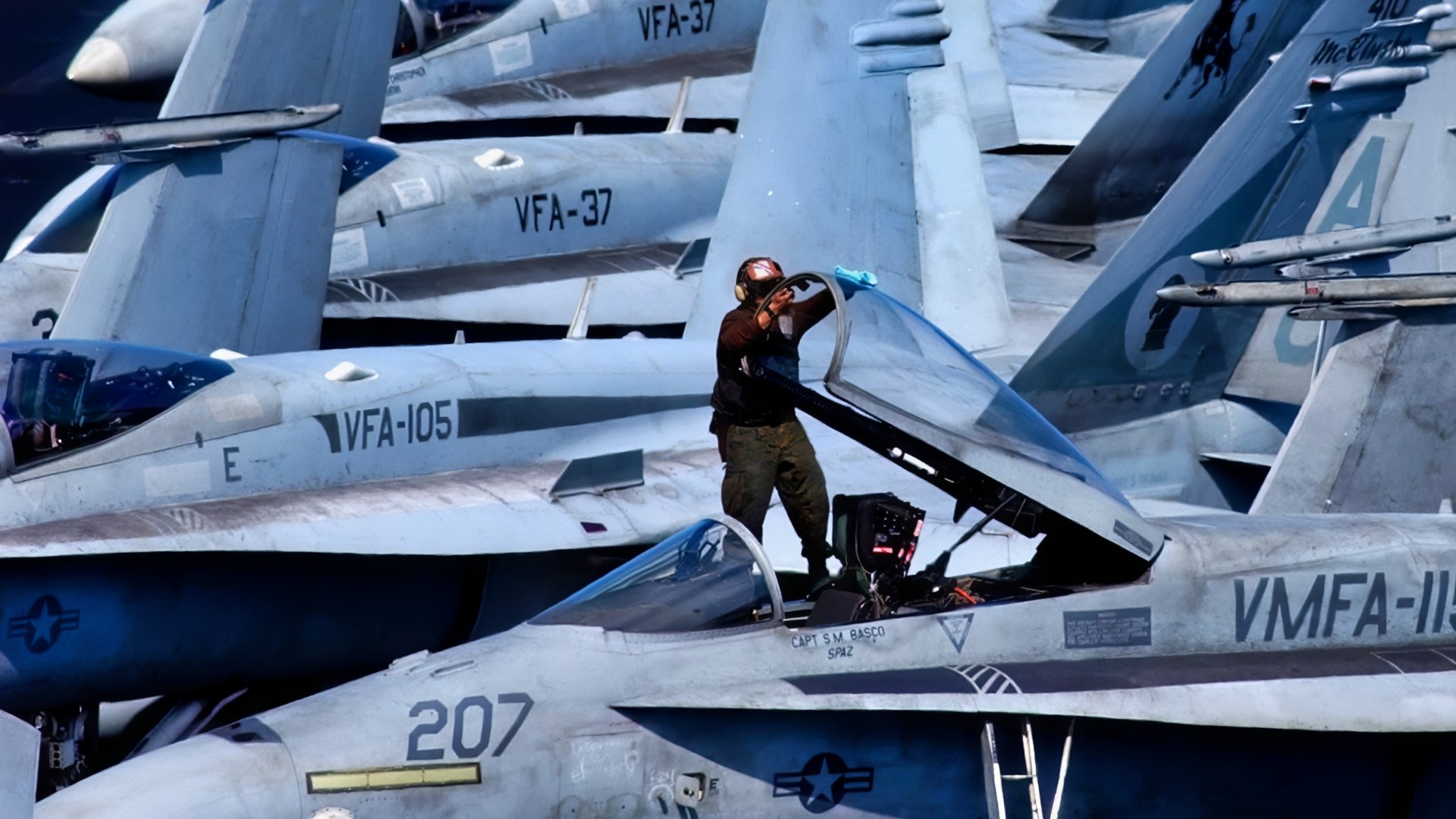
Marine Cpl. Rodger Lagrange cleans the canopy of a Marine F/A-18A+ Hornet onboard the USS Harry S. Truman (CVN 75) while the aircraft carrier operates at sea on Feb. 14, 2005. The Truman Strike Group and Carrier Air Wing 3 are conducting close air support, intelligence, surveillance, and reconnaissance missions over Iraq. Lagrange is attached to Marine Fighter Attack Squadron 115 deployed from Marine Corps Air Station Beaufort, S.C.
(DoD photo by Airman Philip V. Morrill, U.S. Navy. (Released))
During the SINKEX in the Pacific during Operation Rimpac 2024, the US Navy sank the decommissioned USS Dubuque (LPD 8) on July 11, 2024, and the decommissioned USS Tarawa (LHA 1) on July 19, 2024.
The Air Force also used an AC-130 gunship to fire on the Dubuque.
The sinking of the ex-Tarawa included the employment of a Long-Range Anti-Ship Missile (LRASM) from a U.S. Navy F/A-18F Super Hornet. As a precise, stealthy, and survivable cruise missile, LRASM provides multi-service, multi-platform, and multi-mission capabilities for offensive anti-surface warfare. Currently, LRASMs are deployed from U.S. Navy F/A-18 and U.S. Air Force B-1B aircraft.
Why is it important?
The reason for conducting these SINKEX operations and their importance are two-fold. One is that China now has the largest Navy by number of ships (the US Navy is still the largest by tonnage). And China likes to rattle its saber with the ship-killing abilities, in an obvious finger pointed at the US.
Well, the LRASM and the new Maritime Strike Tomahawk cruise missile, along with the precision QUICKSINK bombs, have extended the US Navy’s reach in the Pacific Ocean to show China that its Navy, while still operating close to its shores and under the protection of its A2/AD systems, is still a viable target in the case of war over Taiwan.
Conducting realistic training events, such as live-fire SINKEXs, enables participating nations to test and train on weapons and systems in a realistic environment that cannot be replicated in simulators. Additionally, these training events refine partner nations’ abilities to plan, communicate, and conduct complex maritime operations, including precision and long-range strike capabilities.
“Sinking exercises give us a chance to sharpen our skills, learn from one another, and get real-world experience,” said U.S. Navy Vice Adm. John Wade, RIMPAC 2024 Combined Task Force Commander.
“Using advanced weapons and seeing the professionalism of our teams during these drills shows our commitment to keeping the Indo-Pacific region safe and open.”
Navy F/A-18s And B-2 Spirit Bombers Were Used

AGM-158 Extreme Range LRASM. Image Credit: Industry Handout.
The sinking of the Tarawa was conducted by the use of a Long-Range Anti-Ship Missile (LRASM) from a U.S. Navy F/A-18F Super Hornet. The LRASM provides multi-service, multi-platform, and multi-mission capabilities for offensive anti-surface warfare. Currently, LRASMs are deployed from U.S. Navy F/A-18 and U.S. Air Force B-1B and B-2 Spirit aircraft.
Additionally, a U.S. Air Force B-2 Spirit stealth bomber conducted an air-delivered method for defeating surface vessels through a QUICKSINK munitions demonstration as part of the second SINKEX.
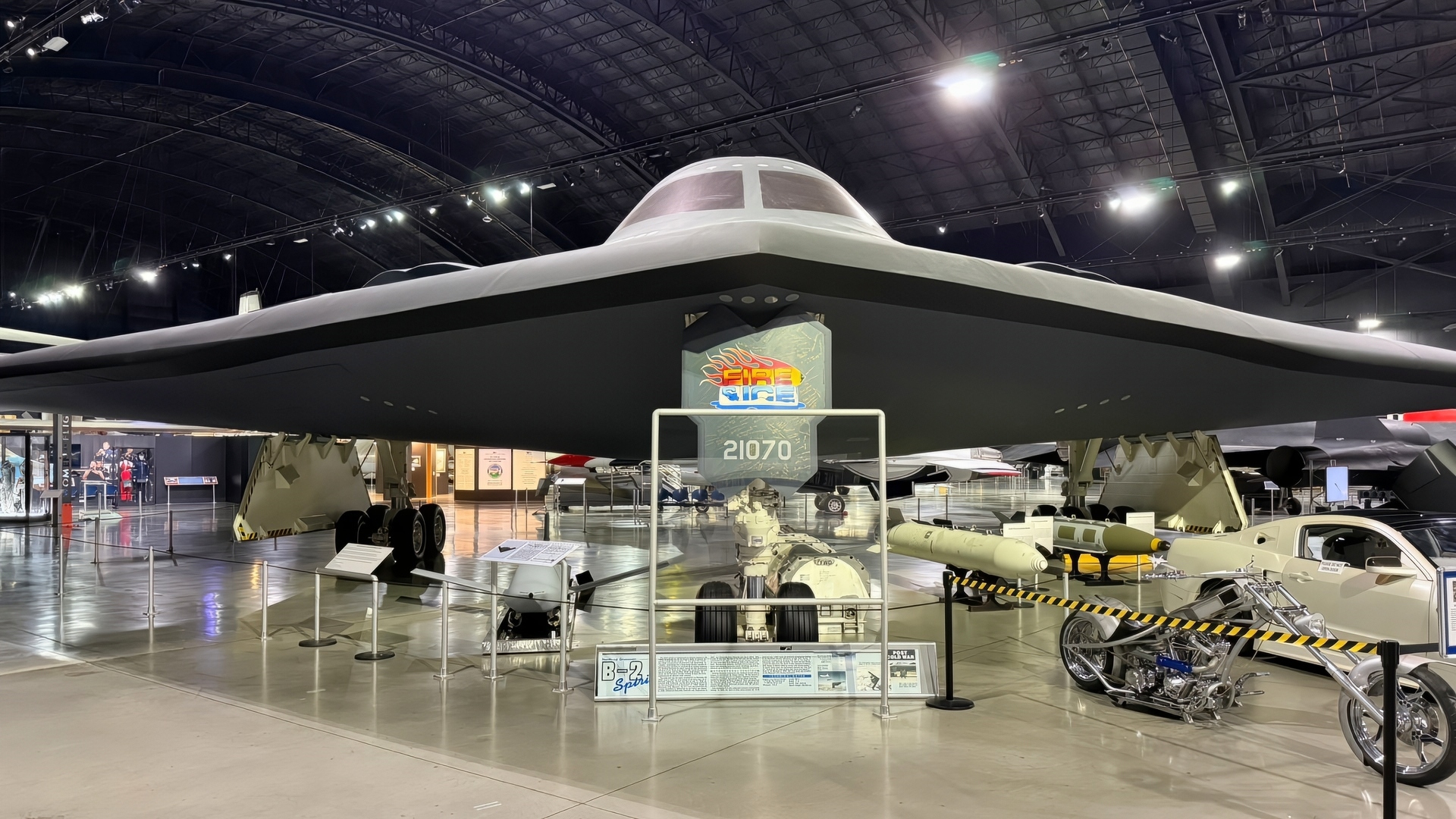
B-2A Spirit On Display. Image by Editor Harry J. Kazianis/National Security Journal.
The QUICKSINK exercise was funded by the Office of the Under Secretary of Defense for Research and Engineering and aims to provide options to neutralize surface maritime threats while demonstrating the inherent flexibility of the joint force.
This capability addresses an urgent need to quickly neutralize maritime threats across vast ocean expanses worldwide at minimal cost.
QUICKSINK Munitions
QUICKSINK is a Joint Capability Technology Demonstration (JCTD) program that rapidly integrates and demonstrates USAF technology that creates an air-delivered, low-cost, surface vessel defeat weapon.
This is installed on the nose of a GBU-31/B Joint Direct Attack Munition (JDAM) and combined with an imaging infra-red camera mounted in a fairing on the side of the munition, as well as the JDAM’s existing tail-mounted GPS-assisted inertial navigation system (INS) guidance.
When the Quicksink munition is released, it uses the standard JDAM kit to glide to the target area and then the seeker/camera combination to lock onto the ship, after which the guidance system directs the bomb to detonate near the hull just below the waterline.
QUICKSINK and LRASM demonstrate just how much the Air Force’s focus has shifted from the Global War on Terror (GWOT) to the new threats from China, especially in the maritime arena.
“This is a sign of the Air Force’s renewed focus on maritime strike, which it had walked away from after the Cold War ended,” Stacie Pettyjohn, director of the defense program at the Center for a New American Security, told Air & Space Forces Magazine.
RIMPAC Exercises Build Relationships With Allies and Partners
“The power of RIMPAC is in how it strengthens relationships between participating nations by challenging us to conduct realistic and relevant training together,” said Royal Australian Air Force Air Commodore Louise desJardins, Combined Force Air Component Commander.
“It is a real demonstration of how we plan, communicate, and conduct complex operations like a SINKEX together and reflects the value of robust relationships between regional partners.”
The 2024 sinking of a Tarawa-class ship is the second time a ship of this class has been used for a SINKEX. Previously, the retired USS Belleau Wood (LHA 3) was sunk during the SINKEX as part of RIMPAC 2006.
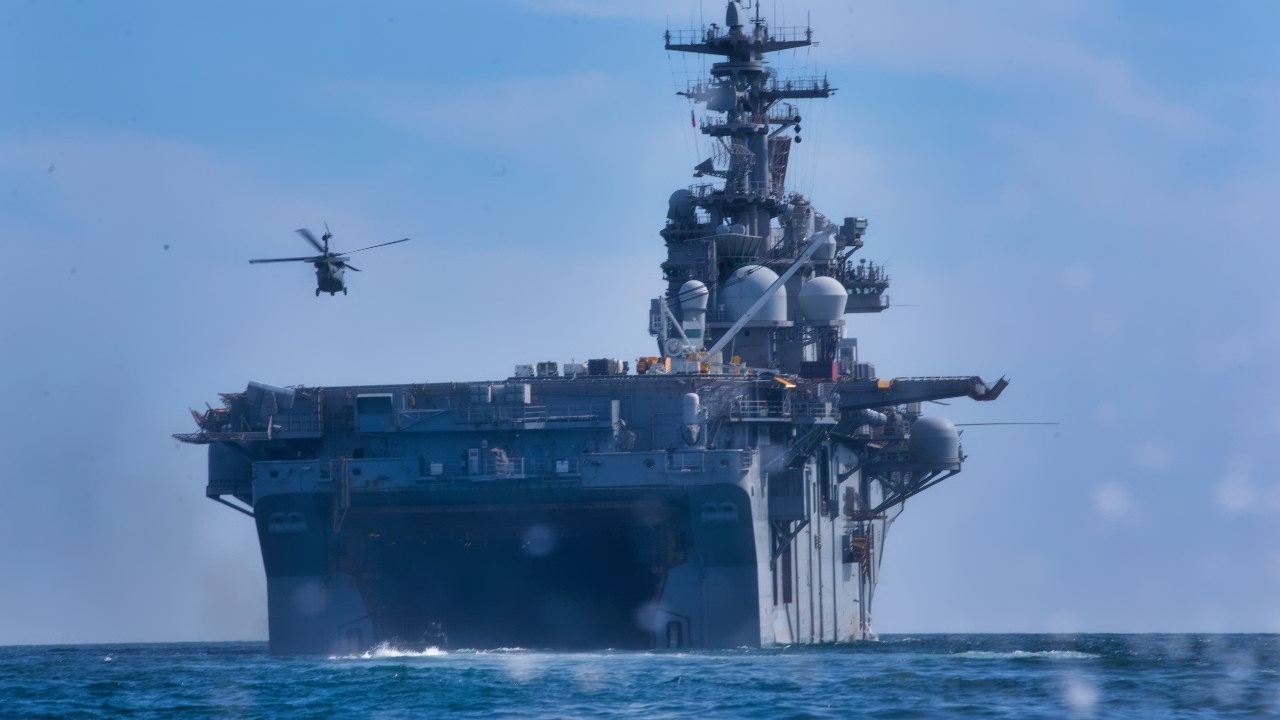
U.S. Marines with Bravo Company, 2d Assault Amphibious Battalion, 2d Marine Division approach the USS Wasp (LHD 1) in assault amphibious vehicles off of Onslow Beach during a three-day ship-to-shore exercise on Camp Lejeune, N.C., June 27, 2020. During the exercise, the Marines conducted amphibious maneuvers and dynamic ship-to-shore operations with the USS Wasp (LHD 1). (U.S. Marine Corps photo by Lance Cpl. Jacqueline Parsons)
Interestingly enough, the SINKEXs of the USS Dubuque and USS Tarawa were just shy of the anniversary of the Army Air Service Brig. Gen. Billy Mitchell’s sinking of another decommissioned vessel, the captured German battleship Ostfriesland, on July 21, 1921, was one of the most significant events in the evolution of airpower and the first sign that the age of the battleship was over.
Twenty-nine nations, 40 surface ships, three submarines, 14 nations’ land forces, more than 150 aircraft, and 25,000 personnel participated in RIMPAC 2024 in and around the Hawaiian Islands, between June 27 and August 1.
The world’s largest international maritime exercise, RIMPAC, exercises are critical to ensuring the safety of sea lanes and security on the world’s oceans. RIMPAC 2024 is the 29th exercise in the series that began in 1971.
About the Author: Steve Balestrieri
Steve Balestrieri is a National Security Columnist. He served as a US Army Special Forces NCO and Warrant Officer. In addition to writing on defense, he covers the NFL for PatsFans.com and is a member of the Pro Football Writers of America (PFWA). His work was regularly featured in many military publications.


