


Key Points and Summary – Boeing just marked 30 years since the F/A-18E/F Super Hornet’s first flight on November 29, 1995, in St. Louis, where it began as a McDonnell Douglas program.
-Born in an era of post–Cold War cuts and after the A-12’s cancellation, the “Hornet 2000” concept offered the Navy an affordable, enlarged evolution of the legacy Hornet that could fill both fighter and attack roles.
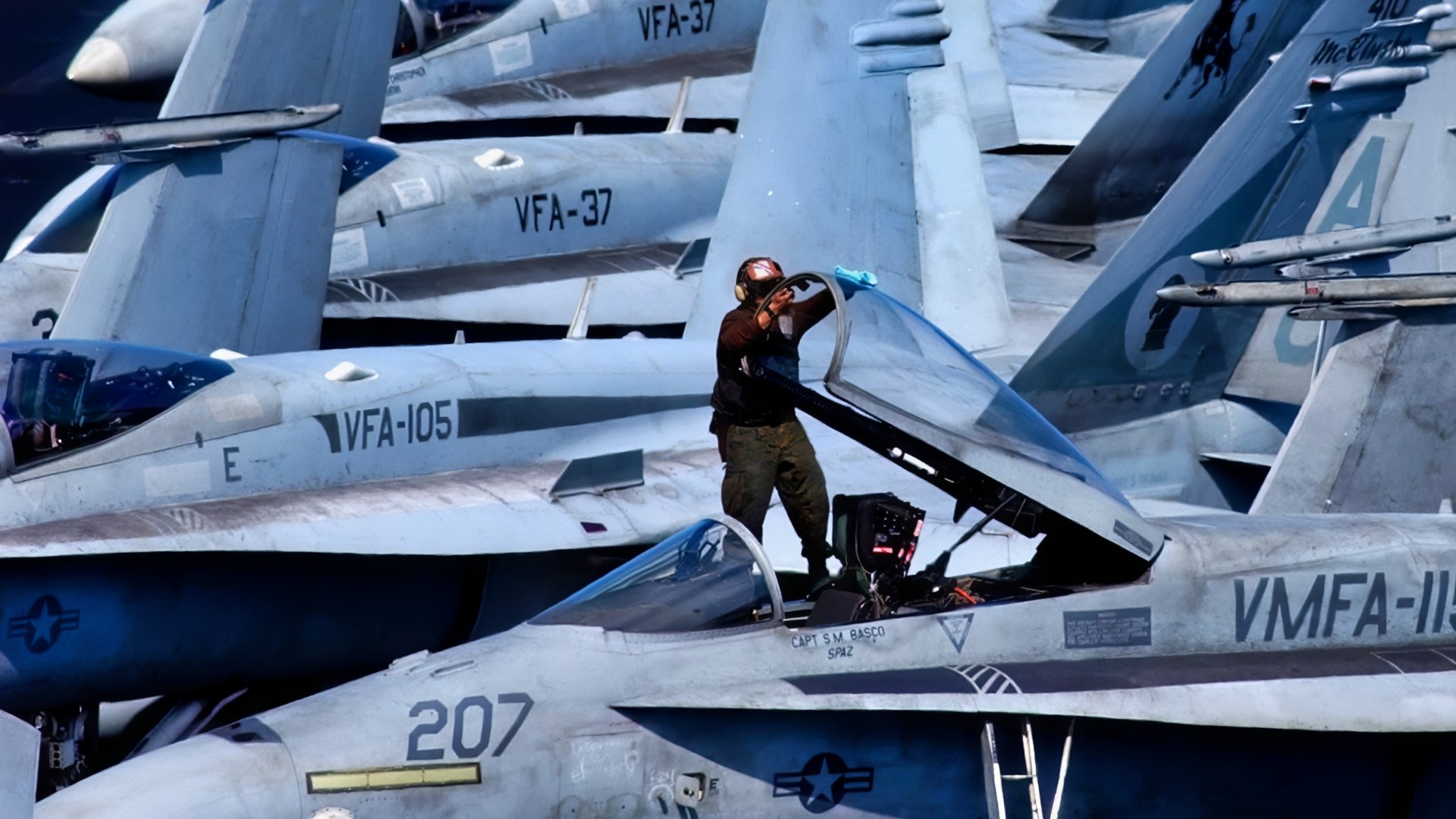
Marine Cpl. Rodger Lagrange cleans the canopy of a Marine F/A-18A+ Hornet onboard the USS Harry S. Truman (CVN 75) while the aircraft carrier operates at sea on Feb. 14, 2005. The Truman Strike Group and Carrier Air Wing 3 are conducting close air support, intelligence, surveillance, and reconnaissance missions over Iraq. Lagrange is attached to Marine Fighter Attack Squadron 115 deployed from Marine Corps Air Station Beaufort, S.C.
(DoD photo by Airman Philip V. Morrill, U.S. Navy. (Released))
-Since entering carrier service in the late 1990s, the Super Hornet has flown in nearly every major U.S. naval air campaign, from Iraq and Afghanistan to Libya and Somalia, and even starred in Top Gun: Maverick, as production winds down toward 2027.
In 1 Word: 30 (As In 30 years old!)
The F/A-18 Super Hornet Turns 30 – And It’s Still Carrying the Fleet
Boeing last week celebrated the 30th anniversary of the first flight of the F/A-18E/F Super Hornet. The aircraft first flew on Nov. 29, 1995, from the St. Louis facility of what was then McDonnell Douglas—now Boeing.
“30 Super years in flight!,” Boeing Defense posted to its social media accounts on Dec. 1, with a picture of staffers arrayed in the number “30,” along with the jet itself.
“Thirty years ago, the first F/A-18 Super Hornet took to the skies for the first time. We’re thankful for the thousands of #TeamBoeing employees, partners, and suppliers who keep the Super Hornet modernized and evolving, delivering unmatched capabilities to naval aviation for decades to come.”
The St. Louis Business Journal wrote about what the anniversary and the jet have meant for the St. Louis area.
“People have worked on this program for their entire career. For a number of decades, it was the premier-performing program at the company.
People came to St. Louis to study how the program was run. The Super Hornet, since its earliest days, was the example of how government and industry can bring capability to the field on time and under cost,” Mark Sears, vice president/program manager for Boeing Fighters, told the publication.
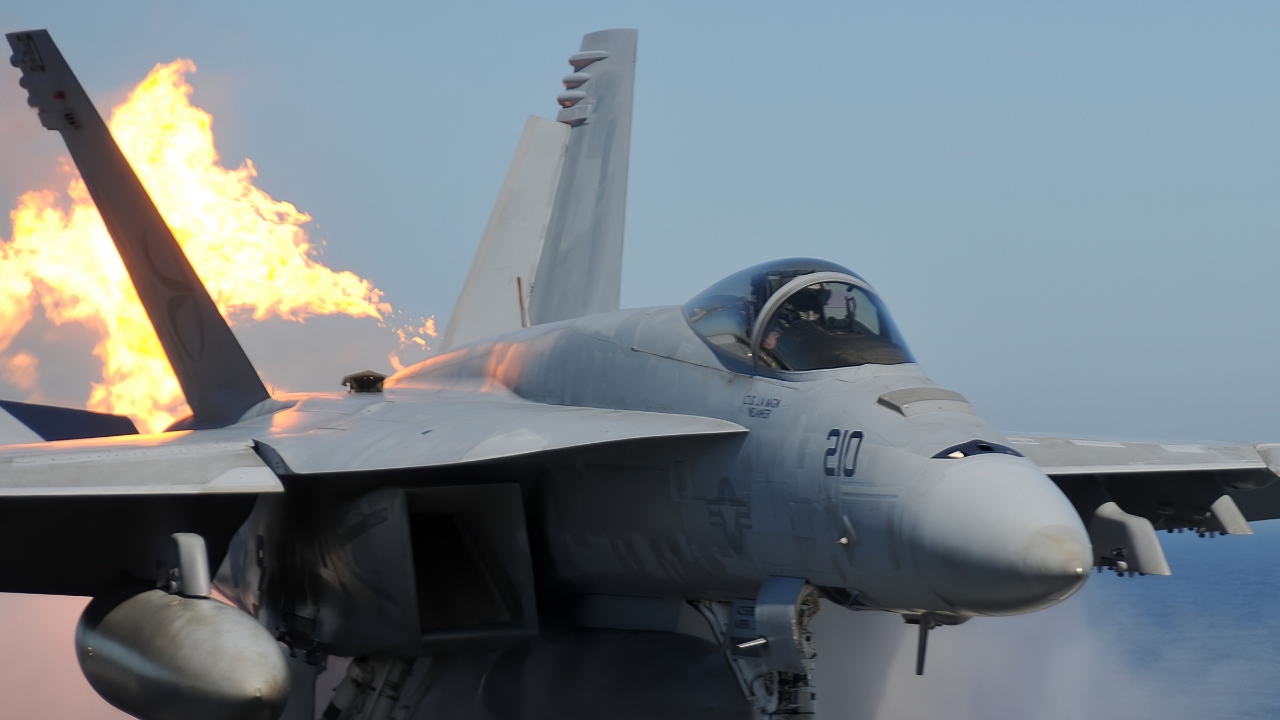
A U.S. Navy F/A-18E Super Hornet aircraft assigned to Strike Fighter Squadron 137 is launched from the flight deck of the aircraft carrier USS Abraham Lincoln (CVN 72) while underway in the Pacific Ocean on Feb.2, 2009.
(DoD photo by Petty Officer 2nd Class James R. Evans, U.S. Navy. (Released))
The Hornet’s Beginnings
According to The Aviationist, the Super Hornet “was born in a period of budget cuts and restructuring, which led the Navy to cancel a number of programs. However, the new aircraft was able to succeed and ultimately became the most widely used strike fighter aboard U.S. Navy aircraft carriers and still continues to evolve today.”
The Super Hornet followed the cancellation of the A-12 Avenger II Advanced Tactical Aircraft upon the end of the Cold War in 1991.
“McDonnell Douglas proposed an enlarged, substantially redesigned evolution of the F/A-18C/D Hornet, large enough to fill the capability gap left by the Intruder, yet similar enough to leverage existing infrastructure, training pipelines, and maintenance regimes,” The Aviationist writes. “This proposal, initially dubbed ‘Hornet II’ and later ‘Hornet 2000,’ offered the Navy reduced development risk and predictable cost, while still enabling meaningful capability growth.”
The aircraft was first ordered in 1992, with the first flight coming three years later.
“The aircraft represented a shift in U.S. Navy procurement strategy, with a cautious evolutionary approach instead of revolutionary as initially intended with the A-12, A-X and NATF. The service was confident in the jet’s capabilities, and the Super Hornet first landed on a carrier in 1997, quickly moving into production,” The Aviationist writes.
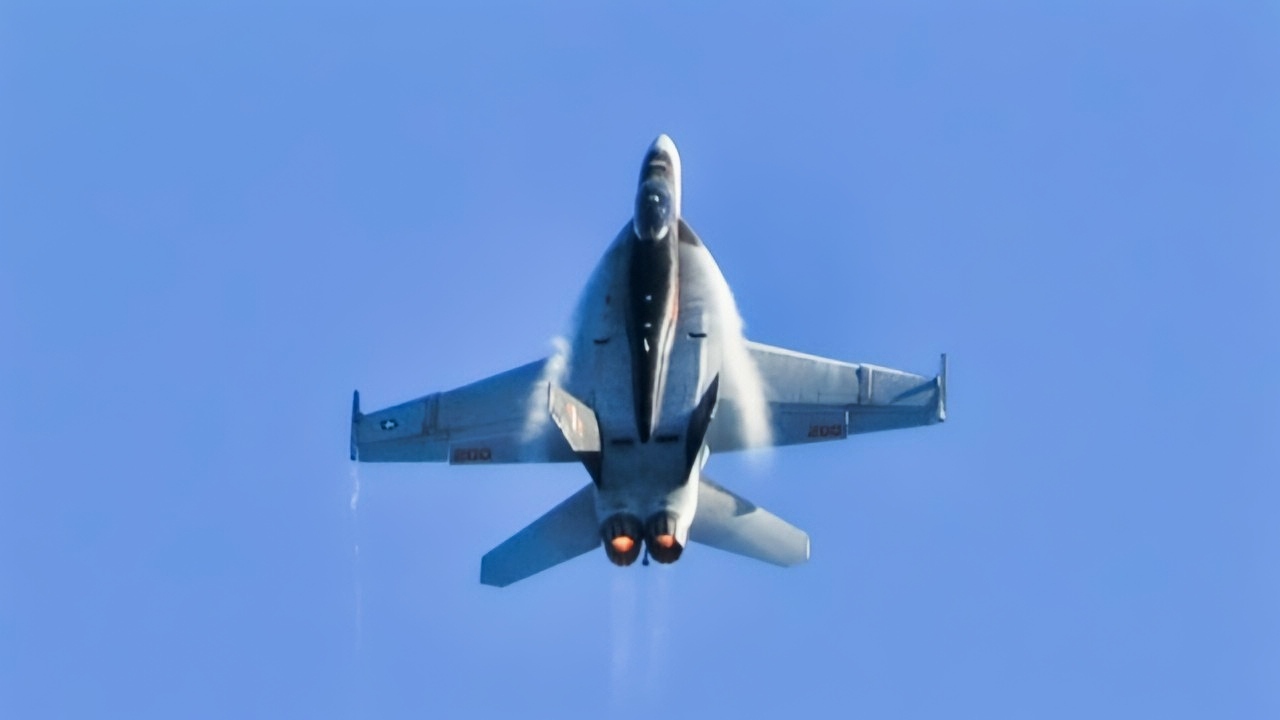
A U.S. Navy F/A-18E Super Hornet aircraft assigned to Strike Fighter Squadron (VFA) 147 performs maneuvers above the aircraft carrier USS Nimitz (CVN 68) during the departure of Carrier Air Wing (CVW) 11 Dec. 10, 2013, in the Pacific Ocean. CVW-11 fixed wing aircraft flew off the Nimitz to return home after being deployed to the U.S. 5th, 6th and 7th Fleet areas of responsibility. (U.S. Navy photo by Mass Communication Specialist Seaman Apprentice Kelly M. Agee/Released)
McDonnell Douglas and Boeing merged that same year, and the program moved under the auspices of Boeing.
The Super Hornet made its combat debut in Iraq, The Aviationist explains, “with a strike against hostile targets in Iraq’s no-fly zone as part of Operation Southern Watch. The deployment also validated the aircraft’s expanded payload flexibility and greater endurance, bringing a significantly more capable strike fighter into the fleet during the opening phase of the Global War on Terror.”
In 2001, Super Hornet’s Block II was introduced, which “transformed the jet into a technologically modern multirole fighter,” according to The Aviationist. “The Super Hornet has now participated in nearly every major U.S. carrier deployment since 2002. Its missions have included operations in Afghanistan and Iraq during Operations Enduring Freedom and Iraqi Freedom, in Libya during Operation Odyssey Dawn and Unified Protector, in the Middle East during Operation Inherent Resolve, as well as routine missions in the Indo-Pacific.”
The Navy has about 550 F/A-18E/F Super Hornets currently, according to the report.
A Recent Use
Per the Navy Times, the U.S. Navy’s Carrier Air Wing 1 in February took part in “the largest maritime strike in Navy aviation history in terms of bomb tonnage.”
“On Feb. 1, the aircraft carrier Harry S. Truman launched 27 F/A-18 Super Hornets as part of a coordinated airstrike against Islamic State operatives in Somalia in collaboration with the federal government of Somalia, a defense official with knowledge of the strike said.”

Members of the US Navy F/A-18F Super Hornet Demo Team performs a maneuver at the Wings Over South Texas Air Show. This year’s air show marks the first return of Wings Over South Texas to Naval Air Station Corpus Christi since 2019.
The Super Hornet also had a starring role in a fictional mission in the 2022 Hollywood movie Top Gun: Maverick. According to The Wall Street Journal, producers rented the jets from the Navy.
Back in November, meanwhile, it was reported that the Navy was trying to salvage the remains of a Super Hornet that crashed in the South China Sea.
“A MH-60R Sea Hawk helicopter and F/A-18F Super Hornet fighter jet assigned to the aircraft carrier USS Nimitz went down less than an hour apart on Oct. 26,” the Navy Times reported. “All personnel involved in the crash were recovered safely and in stable condition.”
It was one of several Super Hornets lost of late.
“The USS Gettysburg accidentally shot down an F/A-18 in December 2024, an F/A-18 attempting to land on the USS Harry S. Truman in May fell overboard, another F/A-18 fighter jet slipped off the hangar deck of the Truman in April and an F/A-18E crashed during a training flight off the coast of Virginia in August,” Navy Times reported.
The Future of the Hornet
While it’s expected to fly into the 2040s, production of new Super Hornets is nearing an end.

(Jan 31, 2009) An F/A-18 Super Hornet assigned to the “Tomcatters” of Strike Fighter Squadron (VFA) 31 launches from the flight deck of USS Theodore Roosevelt (CVN 71). The Nimitz-class aircraft carrier and embarked Carrier Air Wing (CVW) 8 are operating in the 5th Fleet area of responsibility and are focused on reassuring regional partners of the United States’ commitment to security, which promotes stability and global prosperity (U.S. Navy photo by Mass Communication Specialist 3rd Class Jonathan Snyder/Released)
Per Aerospace Global News, Boeing said that production would end in 2025. After the Navy ordered 17 more Super Hornet jets, production will continue through 2027.
Upgrade work will continue, although Boeing has said that it will move upgrade work out of the St. Louis area, with sites in Texas and Florida under consideration.
“Our expansion plans across the St. Louis site triggered the execution of a multi-year strategic plan, requiring the relocation of some work,” Dan Gillian, Boeing’s vice president and general manager of Air Dominance and senior St. Louis site executive, said in a September statement. “Given we are already successfully conducting SLM at other locations, this move is logical so we can continue to meet our customers’ commitments while ensuring we are well poised for future work.”
About the Author: Stephen Silver
Stephen Silver is an award-winning journalist, essayist, and film critic, and contributor to the Philadelphia Inquirer, the Jewish Telegraphic Agency, Broad Street Review, and Splice Today. The co-founder of the Philadelphia Film Critics Circle, Stephen lives in suburban Philadelphia with his wife and two sons. For over a decade, Stephen has authored thousands of articles that focus on politics, national security, technology, and the economy. Follow him on X (formerly Twitter) at @StephenSilver, and subscribe to his Substack newsletter.


