


The Boeing EA-18G Growler is the U.S. military’s only dedicated tactical airborne electronic attack capability. The EA-18G Growler derives from the Boeing F/A-18F Super Hornet. The EA-18G Growler’s purpose is to dominate the electromagnetic (EM) spectrum — attacking enemy radar networks and disrupting communications links. The EA-18G Growler can target the targeting systems of enemy air defense (AD) batteries.
The EA-18G Growler Is Vital for the U.S. Navy
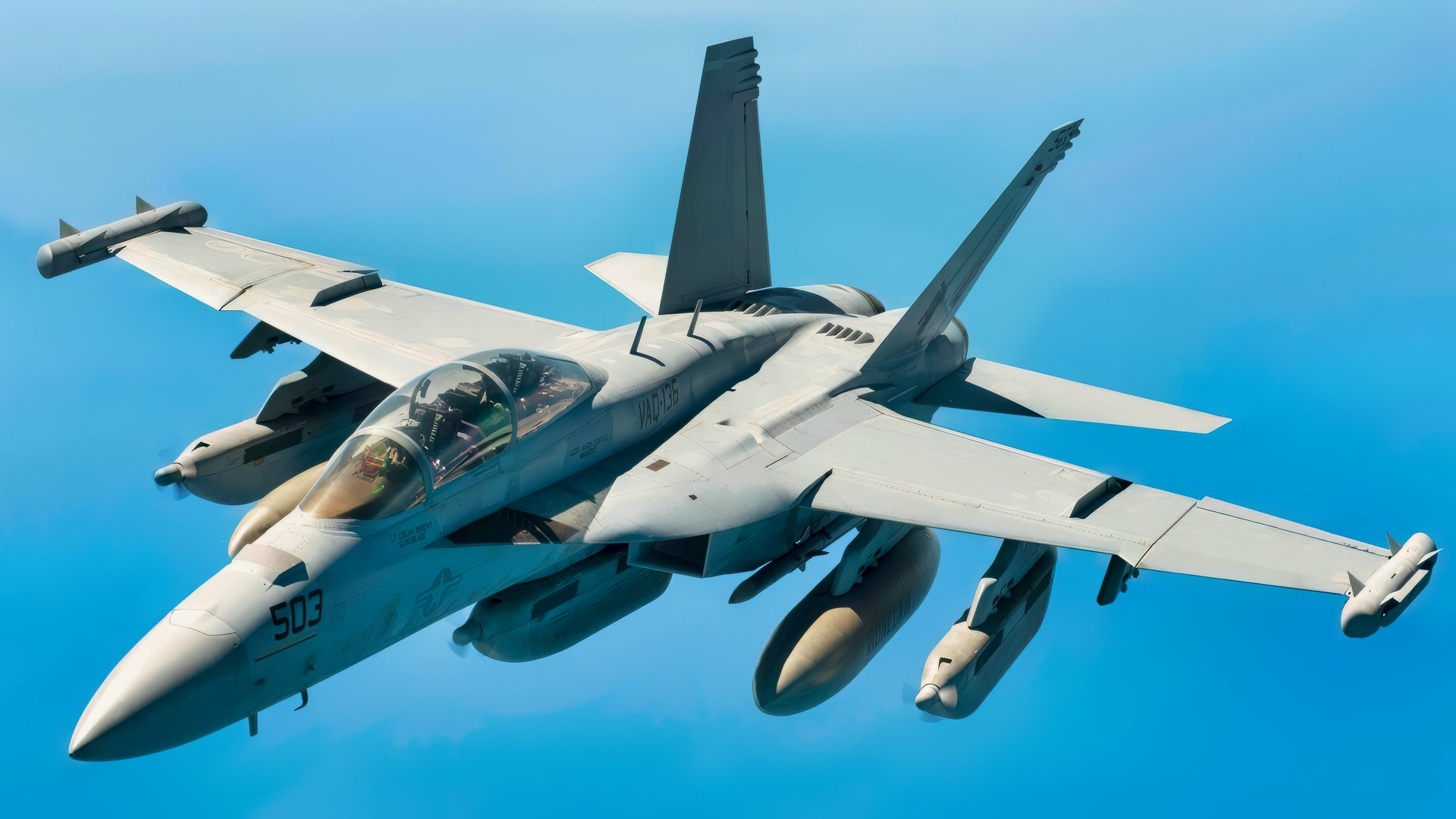
A U.S. Navy EA-18G Growler assigned to the USS Carl Vinson breaks away from a U.S. Air Force KC-135 Stratotanker from the 909th Air Refueling Squadron after conducting in-air refueling May 3, 2017, over the Western Pacific Ocean. The 909th ARS is an essential component to the mid-air refueling of a multitude of aircraft ranging from fighter jets to cargo planes from different services and nations in the region. (U.S. Air Force photo by Senior Airman John Linzmeier)

A joint test team including the Flight Test Division of the French Directorate General of Armaments (DGA/EV), the French Naval Aeronautics Experimentation Center (CEPA/10S), and the U.S. Navy’s Air Test and Evaluation Squadron (VX) 23 are leading flight tests that will enable the French fighter jet Dassault Rafale to aerial refuel with naval aviation’s F/A-18 Hornet and Super Hornet and EA-18G Growler. The tanker qualification partnership paves the way for an extended reach and enhanced interoperability for allied airpower. (U.S. Navy photo by Erik Hildebrandt) Erik_Hildebrandt
The United States military spends enormous sums on developing stealth fighters, aircraft carriers, and next-generation bombs. The public conversation surrounding American airpower almost always revolves around glamorous platforms, like the Lockheed Martin F-35 Lightning II, the Northrop Grumman B-21 Raider, or now the F-47 sixth-generation warplane.
Yet, one of the most important warplanes in the US military’s arsenal is not particularly stealthy, does not carry the heaviest bomb load, and rarely receives the public attention showered upon America’s flashier warplanes.
That aircraft is the Boeing EA-18G Growler.
And without it, much of America’s airpower would struggle to survive in a modern war.
The Growler Does Not Fight Like a Traditional Fighter
The EA-18G Growler derives from the Boeing F/A-18F Super Hornet. At first glance, the Growler looks like the Super Hornet. Internally, however, the aircraft serves a mission of radical importance. The Growler exists primarily to dominate the electromagnetic (EM) spectrum.

At sea (Mar. 1, 2007) – Capt. Craig “Animal” Williams (front) in a F/A 18C Hornet (front) and Capt. Richard “Rhett” Butler (back) in an F/A 18C Hornet look up for a photo as they fly over USS Ronald Reagan (CVN 76). Capt. Williams, a 22-year Naval Aviator who graduated from the United States Naval Academy, was relieved as Commander, Carrier Air Wing Fourteen (CVW-14) by 21-year Naval Aviator, Capt. Butler, a graduate of the University of Kentucky during an aerial change of command ceremony. The Ronald Reagan Carrier Strike Group is currently underway in the Pacific Ocean on a surge deployment in support of U.S. military operations in the Western Pacific. Official U.S. Navy photo by Lt. Cmdr. Tam Pham
(RELEASED)
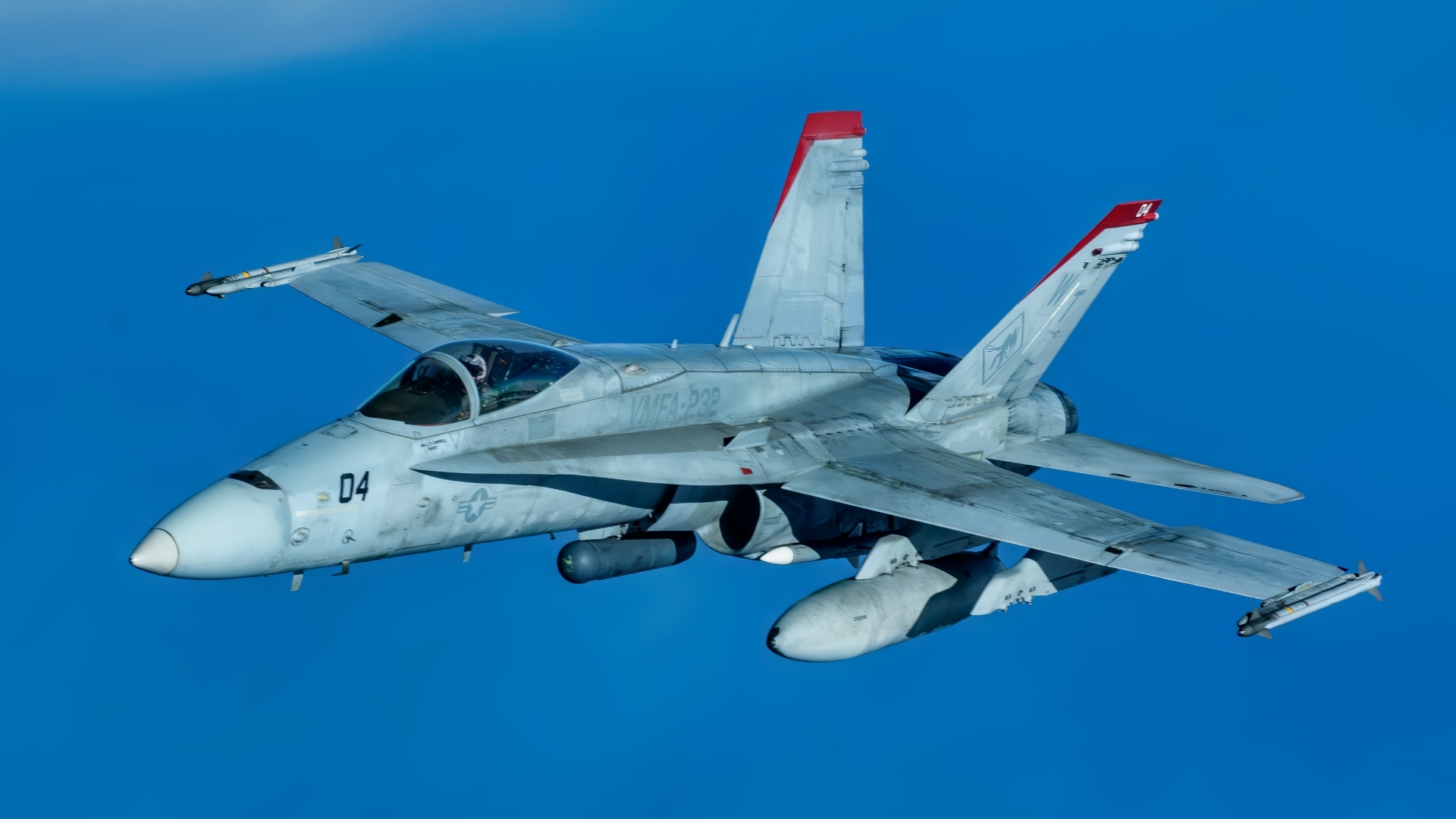
A U.S. Marine Corps F/A-18 Hornet pulls away from a U.S. Air Force KC-135 Stratotanker from Kadena Air Base after refueling over the Pacific Jan. 3, 2024. Conducting joint operations enhances the lethality and readiness of U.S. forces and its ability to project superior airpower to the Indo-Pacific region. (U.S. Air Force photo by Senior Airman Cedriue Oldaker)
Its purpose is not simply to shoot down enemy aircraft or drop bombs on ground targets. Instead, the Growler blinds, jams, deceives, suppresses, and confuses enemy air defense systems. This bird attacks enemy radar networks and disrupts communications links.
Even more interestingly, the Growler can target the targeting systems of enemy air defense (AD) batteries. If the enemy had a central nervous system, it’d be their electronic capabilities. And the Growler is meant to disrupt, defeat, and destroy that enemy’s electronic central nervous system.
Increasingly, modern warfare occurs under conditions of overwhelming air superiority. Desert Storm possessed formidable Soviet-designed air defenses. American electronic warfare (EW), coupled with its stealth capabilities, dismantled those otherwise state-of-the-art Soviet AD systems in Iraq.
But the era of uncontested air superiority of the kind US forces enjoyed in Iraq and Afghanistan is ending.
China, Russia, and even regional powers, such as Iran, have all invested heavily in layered AD systems designed specifically to negate US military power projection. Anti-access/area denial (A2/AD) has become the basis of enemy doctrine in fighting the US military’s expeditionary forces.
Thus, the Growler’s importance becomes all the more important.
Stealth aircraft, of course, remain critical, but stealth technology no longer guarantees survivability. Stealth reduces detection ranges. EW actively degrades enemy capability. These are complementary concepts, not interchangeable ones.
A stealth aircraft operating without EW support eventually risks detection. A strike package supported by Growlers becomes more difficult to track, target, and engage. The Growler increasingly appears less like a supporting aircraft and more like the foundation upon which modern American airpower rests.
The Last Dedicated Tactical Jammer
One of the least appreciated realities in the United States military today is that the Navy’s EA-18G Growler force effectively serves as America’s only dedicated tactical airborne electronic attack capability.
The Air Force retired their EF-111A Raven decades ago and never fielded a true replacement. The Marine Corps retired its EA-6B Prowler in 2019. As a result, the Navy’s Growlers now support not only naval aviation operations but also increasingly joint-force missions across the entire military.
There is immense operational pressure on the Growler today.
In a conflict with China, for example, Growlers would likely become some of the highest-demand assets in the American inventory. Carrier air wings would require them for survivability. Long-range Air Force strike packages would need electronic support to penetrate contested airspace. Bomber operations involving the B-2 Spirit or future B-21 Raider would likely depend on electromagnetic suppression. Marine Corps operations throughout the First Island Chain would similarly require Growler support against Chinese radar and missile networks.
The problem is simple: there are not enough Growlers to meet all these demands simultaneously.
Electronic Warfare is Continuous
One of the biggest misconceptions surrounding EW is the belief that it matters only during the opening phases of a campaign.
In reality, EW remains essential throughout sustained combat operations.
We’ve seen this play out both during last year’s 12-Day War and this current Iran War, in which Growlers remained heavily engaged throughout the air campaign rather than simply supporting the initial wave of attacks.
That sustained operational tempo reinforces broader concerns about stockpile depletion and force exhaustion in modern warfare. High-end conflicts consume precision munitions, interceptors, maintenance cycles, and specialized aircraft at astonishing rates. EW aircraft become particularly valuable because they help preserve survivability across the broader force.
The Side That Controls the EM Spectrum Controls the War
The deeper lesson of the Growler is not merely about one aircraft. It reflects the changing nature of warfare itself. Modern militaries increasingly depend on information systems for integrated battlefield awareness. If those systems become compromised, military effectiveness deteriorates rapidly.
If the military cannot see clearly or communicate reliably, even advanced weapons that the US military routinely employs lose their effectiveness.
That’s why the EA-18G Growler is so important. The plane doesn’t just destroy targets. These birds break the enemy’s situational awareness electronically, giving the other warplanes and bombers in America’s arsenal time to attack their intended targets and get away safely.
About the Author: Brandon J. Weichert
Brandon J. Weichert is a Senior National Security Editor. Recently, Weichert became the editor of the “NatSec Guy” section at Emerald. TV. He was previously the senior national security editor at The National Interest. Weichert hosts The National Security Hour on iHeartRadio, where he discusses national security policy every Wednesday at 8 p.m. Eastern. He hosts a companion show on Rumble entitled “National Security Talk.” Weichert consults regularly with various government institutions and private organizations on geopolitical issues. His writings have appeared in numerous publications, among them Popular Mechanics, National Review, MSN, and The American Spectator. And his books include Winning Space: How America Remains a Superpower, Biohacked: China’s Race to Control Life, and The Shadow War: Iran’s Quest for Supremacy. Weichert’s newest book, A Disaster of Our Own Making: How the West Lost Ukraine, is available for purchase at any bookstore. Follow him via Twitter/X @WeTheBrandon.


